Why Strong LinkedIn Profiles for IP Experts Start with Positioning


Many IP experts know the feeling very well. Their LinkedIn profile is complete, professional, and factually correct, yet it still does not really work. The photo looks appropriate, the experience section is filled, the professional titles are accurate, and the services are listed in a way that nobody could seriously call wrong.
And still, something important is missing. The profile explains who the expert is, but it does not explain clearly enough why the right person should care. It shows expertise, but it does not create immediate relevance in the mind of a founder, investor, general counsel, CFO, innovation manager, or business leader who is facing a concrete problem.
That is the real issue behind many weak LinkedIn profiles in the IP field. The problem is rarely only the wording, the structure, or the profile picture. Most IP experts do not first need a better LinkedIn profile, but clearer positioning behind the profile.
A LinkedIn Profile Is Not a Digital CV
A LinkedIn profile can look like a CV, but it should not behave like one. A CV documents the past, lists roles, shows qualifications, and helps someone understand what a person has done. That is useful in an employment context, but it is not enough for an IP expert who wants to become visible, trusted, and remembered by a specific market.
For an IP expert, the LinkedIn profile is often the first strategic interface between expertise and demand. It is the place where a potential client or referral partner tries to understand whether this person could be relevant for a specific situation. That situation may be a funding round, a licensing conflict, a copycat problem, a due diligence process, a market entry, or a board discussion about intangible assets.
A functioning profile therefore needs to answer a different question than a CV. It should not merely say what the expert has done. It should help the visitor understand why this expert matters now, for this type of client, in this type of business problem.
Relevance Comes Before Credentials
IP experts are usually proud of their credentials, and rightly so. Legal qualifications, technical expertise, years of practice, awards, litigation experience, prosecution work, licensing projects, due diligence matters, and advisory roles all create credibility. Without credibility, expert positioning becomes empty communication.
But credentials alone do not automatically create market relevance. A founder preparing for a funding round does not primarily search for a complete list of IP services. The founder worries whether investors will believe that the company has a defensible technological edge, whether data and algorithms are properly protected, and whether the IP story supports valuation.
A CFO in a licensing business has a different concern. The CFO may wonder whether royalty streams are being missed, whether licensees are reporting correctly, and whether existing agreements contain hidden financial potential. A company facing product piracy has yet another problem, because it needs confidence that its products, brands, markets, and internal protection structures can be defended against copycats.
These are not abstract legal categories. They are business situations in which IP suddenly becomes relevant, urgent, and valuable. A strong LinkedIn profile speaks into such situations before it starts describing the expert’s qualifications.
What Positioning Means for IP Experts
Positioning is the strategic decision about the place an expert should occupy in the mind of the market. It answers a simple but demanding question: when should the market think of this expert? That question forces clarity, because no expert can be remembered for everything at the same time.
This is especially difficult for IP experts because their competence is often broad. They may be able to advise on patents, trademarks, designs, trade secrets, contracts, enforcement, licensing, portfolio management, due diligence, and IP governance. From the expert’s internal perspective, that breadth feels like strength, because it reflects real experience and professional maturity.
From the market’s perspective, however, too much breadth can easily become blur. If the profile says everything, the reader may remember nothing. Positioning does not make the expert smaller, but it makes the expert easier to understand.
The expert can still provide a broader range of services once the conversation begins. But the profile needs one strong entry point into that broader expertise. It needs a clear market signal that helps the right people stop, understand, and remember.
Why IP Expertise Needs Translation
The value of IP work is often not visible at first glance. Intellectual property sits between law, technology, strategy, finance, competition, governance, and market access. That makes the work highly valuable, but also difficult to explain to people who do not think in IP categories every day.
A weak LinkedIn profile assumes that the market already understands why IP matters. It lists services such as patent strategy, trade mark protection, licensing, enforcement, or portfolio management and expects the reader to make the connection to business value. Many readers will not make that connection on their own, even if the services are objectively relevant.
A strong profile performs the translation. It connects IP to business moments that people already understand, such as growth, funding, valuation, market entry, imitation, investor confidence, licensing income, strategic partnerships, and exit readiness. In that sense, positioning is the bridge between expert language and client reality.
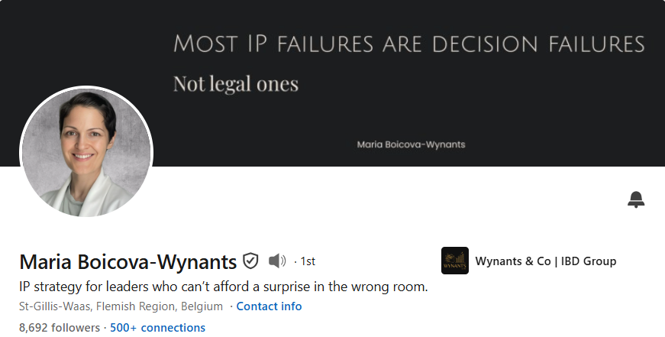
Maria Boicova-Wynants: IP as High Stakes Decision Making
Maria Boicova-Wynants provides a strong example of positioning because her profile does not present IP as a formal legal service category. It frames IP as a high stakes decision issue that becomes visible when timing, risk, and business pressure collide. The central message is that IP problems often appear when it is almost too late, for example during exit, due diligence, market entry, or strategic decision making.
This creates immediate relevance for leaders, founders, investors, and legal teams. They do not only see an IP lawyer with experience in trademarks, designs, mediation, and strategy. They see someone who understands the dangerous gap between business decisions and delayed IP consequences.
That is strong positioning because it creates a clear mental category. Maria becomes associated with IP strategy before the wrong decision becomes expensive. The profile turns IP from a technical legal topic into a management and judgment issue.
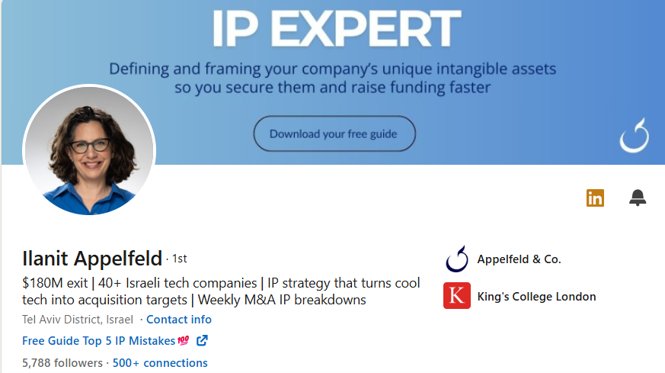
Ilanit Appelfeld: IP as Investor and Exit Readiness
Ilanit Appelfeld shows a different but equally clear form of positioning. Her profile speaks to technology founders, legal teams, investors, and advisors around funding, valuation, M&A readiness, and acquisition value. The focus is not simply on filing patents, but on helping companies identify, protect, and communicate the IP that supports growth.
This is powerful because many founders do not experience IP as a separate legal topic. They experience it through investor questions, due diligence requests, valuation discussions, and concerns about defensibility. They need to explain why their technology, data, algorithms, trade secrets, and intangible assets create a credible advantage.
Ilanit’s positioning connects IP to exactly that business reality. The profile makes IP understandable as part of the funding and exit story. It helps the reader see why IP communication can be as important as IP protection itself.
Tomas Geerkens: IP as Revenue Recovery
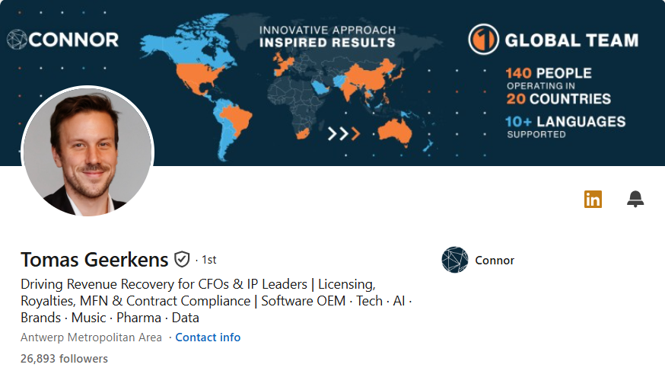
Tomas Geerkens represents another positioning logic. His profile focuses on revenue recovery, licensing, royalties, MFN clauses, and contract compliance for CFOs and IP leaders. This is a very specific position, and that specificity is precisely what makes it strong.
The profile does not ask the market to appreciate licensing expertise in the abstract. It makes the economic relevance visible by connecting contract compliance with overlooked revenue, risk mitigation, transparency, and trust with licensees. For a CFO, this is immediately understandable because the value is linked to financial outcomes.
For an IP leader, this positioning is also useful because it connects IP management with measurable business performance. Licensing and royalty audits are no longer perceived as narrow compliance exercises. They become part of value capture and commercial discipline.
Andreas Jacob: IP as Product and Market Protection
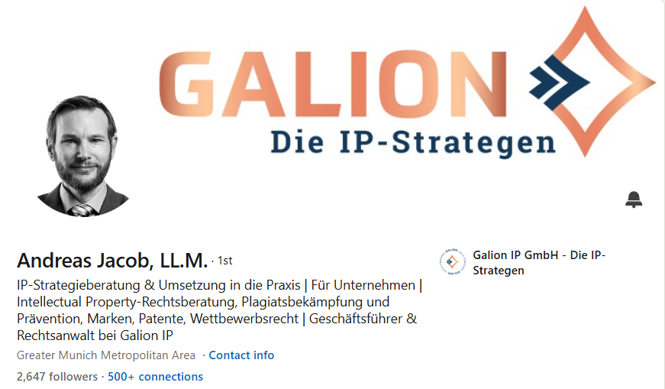
Andreas Jacob offers a fourth pattern of positioning. His profile speaks to companies that want to protect products, markets, brands, and patent positions against plagiarism, copycats, product piracy, and unfair competition. The positioning is practical, management oriented, and closely connected to implementation.
This matters because many companies do not simply need isolated legal advice. They need structure, external leadership, enforcement capability, and a coherent IP infrastructure that supports management goals. They want to protect value without overloading internal resources or losing focus on their core business.
In this positioning, IP becomes a matter of product protection, market defense, and organized responsibility. The profile does not treat IP rights as documents alone. It presents them as part of a broader system for securing business value.
The Common Pattern Behind Strong Profiles
These four examples are very different, and that is exactly the lesson. There is no universal perfect LinkedIn profile for IP experts. There is only a profile that fits a clear positioning and makes that positioning visible in a way the market can understand.
Maria’s profile works because it owns the space of high stakes IP decision making. Ilanit’s profile works because it connects IP with startup funding, investor confidence, and acquisition readiness. Tomas’ profile works because it turns licensing compliance into financial relevance, while Andreas’ profile works because it connects IP strategy with product protection and market defense.
The common pattern is not the same wording, layout, or tone. The common pattern is clarity. Each profile gives the reader a reason to understand the expert in relation to a specific business situation.
How Positioning Shapes the Profile
Once positioning is clear, the LinkedIn profile becomes much easier to write. The headline can become more than a title, because it can signal the audience, problem, or outcome. The About section can become more than a biography, because it can begin with the client’s situation and explain why the expert’s work matters there.
The Experience section also changes its function. It does not have to be only a chronological archive of past roles. It can become proof that the expert has worked in the relevant context, solved similar problems, and developed the judgment required for the chosen position.
The Featured section becomes more strategic as well. Instead of showing random links, it can present articles, interviews, case studies, podcast episodes, reports, or posts that reinforce the expert’s market association. Even the activity feed becomes more coherent, because every post and comment can deepen the same positioning over time.
Recognition Comes Before Conversion
A functioning LinkedIn profile does not need to sell aggressively. Expert services, especially in IP, are rarely bought like simple online products. Trust usually develops over time, and the first realistic goal is recognition rather than immediate conversion.
A potential client may visit the profile today and take no action. But if the positioning is strong, something stays in memory. Later, when the relevant trigger appears, the expert is easier to remember and easier to recommend.
Those triggers are often very concrete. A funding round begins, a competitor copies a product, a license dispute becomes uncomfortable, a due diligence process starts, a strategic partnership is negotiated, or a board asks whether the company is properly protected. When that moment comes, the market remembers the expert with the clearest association.
Visibility Without Positioning Remains Weak
Many professionals invest heavily in visibility. They post regularly, comment often, connect with new people, and appear in the feed. This can be useful, but visibility alone does not create strong business development if people do not understand what the expert should be remembered for.
Positioning gives visibility a direction. It helps every profile visit, every post, every comment, and every publication reinforce the same market meaning. Over time, this consistency creates trust because the expert appears focused, relevant, and recognizable.
For IP experts, this is particularly important because many potential clients do not yet know what kind of IP support they need. They may not use the right legal terminology. They may only feel the business pressure, and a positioned profile helps them give that pressure a name.
From Expert Identity to Market Role
The deeper shift is from expert identity to market role. Expert identity says that a person is qualified. Market role explains where that qualification creates value.
Both are necessary, but they should not be confused. Qualifications create trust, experience creates credibility, and professional background creates confidence. Yet all of these elements should support the positioning instead of replacing it.
For IP experts, the key movement is from “I know IP” to “I help this audience solve this kind of strategic problem through IP.” That movement changes the profile from a static record into an active business development asset. It helps the right people understand the expert faster and remember the expert more clearly.
Why This Matters Now
The market for IP expertise is changing. Companies increasingly understand that intangible assets influence growth, valuation, competition, funding, and resilience. At the same time, technologies such as artificial intelligence, data based business models, platform ecosystems, and global digital markets make IP questions more complex.
This should create new opportunities for IP experts. But those opportunities will not automatically go to the most technically competent experts. They will go to those who can make their relevance visible and understandable at the right moment.
A strong LinkedIn profile is one important place where this translation happens. But the profile cannot do the strategic work alone. It needs positioning behind it, because positioning decides what the profile should make visible in the first place.
The Profile Is the Expression, Not the Strategy
 Before improving a LinkedIn profile, an IP expert should not begin with wording. The first question is not how the profile can sound better. The first question is what this expert should become known for.
Once that question is answered, everything becomes easier. The headline becomes sharper, the About section becomes more relevant, the Experience section becomes proof, the Featured section becomes evidence, and the content strategy becomes more consistent. A LinkedIn profile without positioning is like an IP portfolio without strategy, because it may contain valuable assets while the value remains hard to see.
A LinkedIn profile with positioning is different. It tells the market who the expert is for, what problem the expert helps solve, and why the conversation matters. For IP experts, that is not cosmetic communication, but the foundation of meaningful digital business development.