Human First AI: Using Tools Without Losing Your Voice

Artificial intelligence has arrived in the everyday working reality of IP professionals. Patent attorneys, trademark experts, in house IP leaders, licensing specialists, and law firm partners are already using AI to summarize materials, prepare first drafts, structure ideas, propose headlines, and create text variants for different channels. What once took hours can now be done in minutes.
That is the opportunity. But it is not yet the answer.
Because in IP, visibility is not only about producing more content. It is about making expertise recognisable, credible, and trustworthy in a field where much of the real work remains invisible to outsiders. Clients do not choose an IP expert only because that person publishes often. They choose because they recognise a way of thinking. They notice judgment. They sense clarity. They remember a voice.
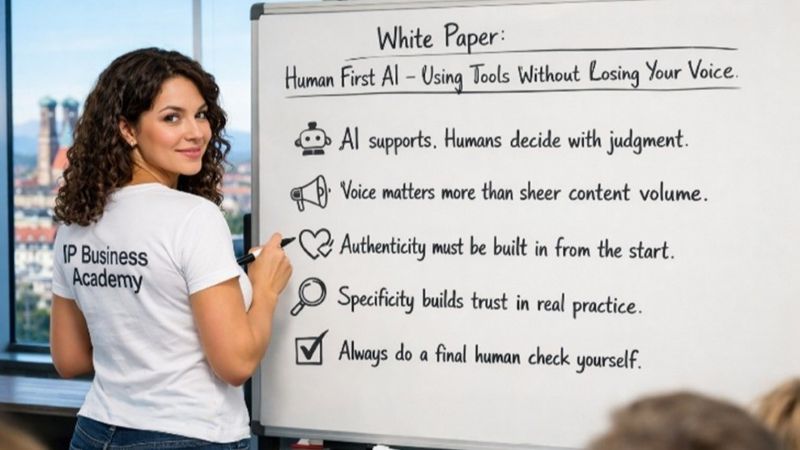
That is exactly where the new white paper, “Human First AI: Using Tools Without Losing Your Voice,” starts. It takes a practical question seriously: how can IP experts use AI in a way that saves time and increases consistency, without ending up with content that feels smooth, generic, and strangely detached from the person behind it?
Send download link to:White Paper Human First AI
This publication is also a preparation for the upcoming ETL IP Expert Exchange on March 24 in Berlin on authenticity in digital IP business development and on the very real tension between being visible online and staying credible as a professional. That makes this topic timely in the best possible sense. It is not about novelty. It is about getting an important professional habit right.
The real problem is not AI. It is recognisability
Many IP experts do not have a competence problem. They have a translation problem.
They work on highly relevant questions, but those questions often sit inside confidential projects, technical discussions, portfolio decisions, or internal business processes that are hard to show from the outside. As a result, strong work often produces weak public signals. Expertise exists, but it does not always become legible to the market.
AI seems to offer a solution because it reduces the friction of content creation. A blank page becomes less intimidating. A rough thought can quickly become a structured outline. A webinar transcript can be turned into a post. A set of notes can become a first article draft.
But that convenience comes with a hidden cost. As more professionals use similar tools in similar ways, language becomes flatter. Posts begin to sound alike. Articles become polished but forgettable. The words are correct, yet the person disappears.
This matters in IP more than many assume. The field is interpretive. It is not only about information. Two experts can know the same law and still frame a problem differently because they see different commercial risks, different timing issues, or different strategic implications. That interpretive layer is often what clients are actually buying. They are not just buying access to legal rules. They are buying judgment under uncertainty.
When AI removes that interpretive signature, it does not simply make communication cleaner. It makes the expert less distinct.
What Human First AI actually means
“Human First AI” means using tools where they are strong, while protecting the human elements that create trust. AI can support research, structure, variation, repurposing, and editorial preparation. It can help experts move faster and work more consistently across formats. But the final shape of the message still needs to reflect a real person with a real point of view.
One of the most useful ideas in the paper is that authenticity should not be treated as a vague personality trait or as a marketing slogan. It should be treated as a production criterion. In other words, the question is not simply whether a text is fluent. The question is whether it still sounds like the same person who would speak in a client meeting, teach in a workshop, or comment thoughtfully in a professional discussion.
Instead of asking AI for a final answer, the expert can use it for divergence first. Generate possible angles. Test structures. Compare hooks. Explore variants. Then comes convergence, the human stage where the expert narrows, selects, sharpens, qualifies, and removes what does not feel owned.
A patent attorney who regularly explains software related inventions through the lens of technical architecture and business model logic should not publish generic AI text about innovation. A trademark practitioner who has seen how naming enthusiasm inside companies creates early conflict should let that lived observation shape the article. A licensing expert who knows that negotiation problems often come from misaligned internal assumptions should make that operational reality visible.
The point is simple: tools can help produce language, but only the expert can decide what is worth saying and how it should be framed.
Why this matters for digital business development
The white paper is explicitly written for the IP context, and that is one of its strengths. It does not treat AI as a generic productivity topic. It treats it as part of a larger capability: digital visibility that supports credibility and business development.
That is also why it connects so well to the upcoming Berlin exchange with ETL IP.
The event announcement makes clear that the conversation is not about “more posting” for its own sake. It is about connecting physical trust and digital continuity. That is the real challenge for many IP experts. They may already be highly credible in conferences, meetings, workshops, and referrals, but digitally they often disappear before and after those moments. The market then sees isolated signals instead of a coherent professional identity.
Used well, it can help an expert turn one source of real thinking into several connected touchpoints. A talk can become a short article. An interview can become a glossary entry. A workshop can become a newsletter reflection. A discussion point can become a LinkedIn post. The system becomes more efficient, but also more coherent.
Yet coherence only helps if the communication still feels authored. That is why the white paper insists on something many professionals skip: the explicit final human check.
This is not proofreading. It is a serious review step. Does the text sound like you? Does it overstate certainty? Does it stay within professional boundaries? Does it reflect your real priorities? Would you actually say it this way to a serious client or peer? That single question is more powerful than many prompt libraries.
A practical quality standard for IP experts
Another reason this white paper matters is that it gives IP experts permission to resist a false choice.
The false choice says: either use AI heavily and accept generic output, or reject AI and keep struggling with slow, inconsistent communication. The paper rejects both extremes. It proposes a middle path that is far more useful for professional practice.
This path begins with real source material. Notes, transcripts, speaking points, article drafts, recurring client questions, and workshop ideas all give AI something better to work with than an empty prompt. From there, the method remains disciplined: define audience, clarify purpose, generate options, refine selectively, add operational realism, reduce abstraction, and finish with a clear human review.
That sequence matters because IP communication is unusually vulnerable to over smoothing. A text can sound impressive while saying almost nothing memorable. It can use elegant vocabulary while hiding the absence of a concrete point. It can become “professional” in tone while losing the marks of lived expertise.
The paper is strongest when it argues that specificity creates trust. Not client secrets. Not exaggerated detail. Specificity in the sense of realistic situations, actual friction points, and concrete mechanisms that practitioners recognise. That is what makes content feel real. That is what signals authority without self-display.
Why the free email course belongs in this conversation
For readers who want to connect this topic with a broader business development routine, the free email course “Business Development for IP Experts” in the 🌱 Resource Hub is a useful companion resource.
It addresses a related challenge: how IP experts can move from reactive outreach to a more structured form of business development, with clearer positioning, stronger habits, and a more sustainable growth logic. In that sense, it complements the white paper well. The white paper explains how to use AI without losing your voice. The email course helps build the wider business development foundation in which that voice can matter.
That combination is important. Tools alone do not create visibility. Visibility alone does not create trust. Trust alone does not create a system. IP experts need all three layers to work together.
And that is perhaps the most valuable message of this new white paper.
Human First AI is not a warning against technology. It is a reminder that professional communication only becomes strategically useful when efficiency and identity support each other. In the years ahead, more people will be able to produce acceptable content. That will not make human judgment less important. It will make it easier to see who still has one.
The entire series at a glance (with direct links)
Building Visible Expertise: Personal & expert branding translates that positioning into consistent signals — tone, focus, proof, and recognition — so people can remember you.
LinkedIn for IP Experts becomes the operating layer where those signals are distributed: profile clarity, repeatable content, and visible engagement create discoverability.
Thought Leadership for IP Experts. Turn deep IP expertise into public authority by packaging it as repeatable insight.
International Business Development for IP Experts. Build international IP business development as a system, not a travel schedule.
Positioning: From Expertise to Recognized Authority defines the exact problem you solve, for whom, and why you’re different; it gives your communication a sharp centre of gravity.
Referral marketing (“Trusted, Not Touted”) turns trust into transfer: it makes your work easy and safe for others to recommend through shareable stories and proof assets.
Business development archetypes ensure sustainability by aligning formats and outreach with your natural style — so consistency is realistic.
Networking: From Visibility to Qualified Conversations connects everything to real opportunities: it converts visibility and trust into specific relationships, introductions, and follow-ups that reliably lead to mandates.
Digitally Real – Authentic Visibility Without Performing translates authenticity into a practical operating model for professional visibility that does not require building a persona, turning into a full-time creator, or forcing a style that feels unnatural.
The Human Side of Authority in IP frames authority as a practical capability that can be trained and communicated clearly.
The Conversation Engine reframes business development as relationship work that happens in small digital moments.
Trusted by Method addresses how to communicate substance without exposing mandates, data, or client strategy.
Teaching as Business Development in IP provides a practical framework for building credibility and demand through teaching content that feels useful, human, and non-promotional.
Personal Brand Consistency in IP argues, consistency is not a cosmetic question. It is a professional capability that helps expertise become visible, understandable, and memorable over time.