
Learning to Manage IP as a Business Function: Enrolment Opened for the MIPLM 2026/27

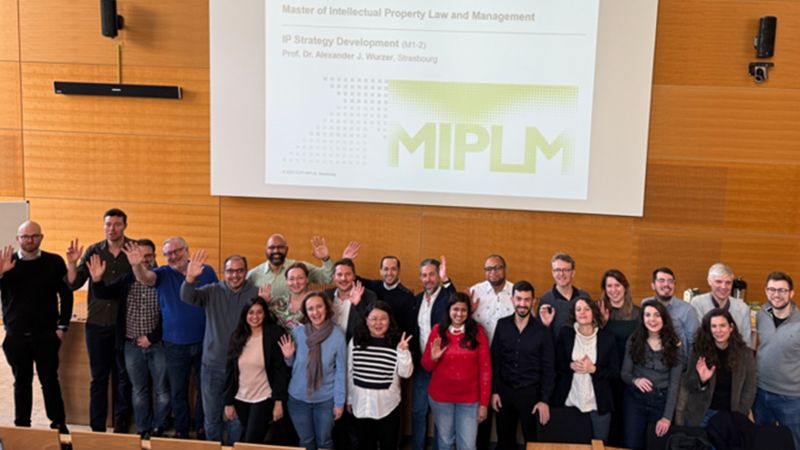
The enrolment for the 2026/27 edition of the Master of Intellectual Property Law and Management (MIPLM) at CEIPI, University of Strasbourg, is now open. The program will run from autumn 2026 into 2027 and is delivered in a modular format, combining on-site sessions in Strasbourg with online modules. Designed as a part-time executive program, it allows participants to remain in their professional roles while engaging with the course over several intensive weeks.
At first glance, this may appear as a standard academic offering. In reality, the MIPLM reflects a much broader development in the role of intellectual property within companies. IP is no longer confined to legal protection. It has become a core element of how businesses structure innovation, define competitive positioning, and build sustainable value.
What Is Taught: IP as a Management Discipline
This shift is directly embedded in what is taught in the program. The MIPLM does not focus on legal doctrine alone. Instead, it addresses intellectual property as a management function. Participants work on how IP interacts with innovation processes, how it supports business models, how it can be aligned with corporate strategy, and how it contributes to value creation and decision-making at management level.
The program therefore connects legal knowledge with technological understanding and business thinking. It reflects the environments in which IP decisions are made today, where legal considerations, technical realities, and commercial objectives must be integrated rather than treated separately.
How It Is Taught: A Method Developed Over 15 Years
What distinguishes the MIPLM from other programs is the method behind it. Over more than 15 years, the program has developed a learning approach that consistently links theory to application. Rather than treating IP as an isolated discipline, participants engage with real-world scenarios in which intellectual property becomes part of broader business challenges.
This method has proven to be a continuous success, as it mirrors the reality of modern IP practice. Learning is not limited to absorbing knowledge, but focused on applying it in contexts that resemble actual decision-making situations within companies.
Where and With Whom: An International, Modular Format
The structure of the program reinforces this perspective. The modular design, the international cohorts, and the combination of academic and practical input create an environment where different professional viewpoints meet. Sessions in Strasbourg are complemented by online modules, allowing participants from different regions to take part without stepping away from their professional responsibilities.
Patent attorneys, in-house counsels, and innovation managers bring their respective experiences into the learning process. This diversity reflects the interdisciplinary nature of IP management today, where collaboration across functions is essential.
A Track Record of Shaping IP Management Thinking
Looking at the history of the MIPLM, it becomes clear that the program has not only adapted to changes in the IP landscape, but has actively contributed to shaping a more business-oriented understanding of intellectual property. Alumni frequently move into roles where IP is integrated into strategic decision-making rather than applied as a downstream function.
This development reflects a broader expectation within companies. IP expertise is increasingly required at the level where business decisions are made, not only where legal risks are managed.
Why It Matters Now
For IP professionals, this raises a fundamental question. It is no longer sufficient to understand how to protect an invention. The key challenge is to understand how intellectual property can be used to create, support, and sustain business value in complex and fast-changing environments.
The opening of enrolment for the MIPLM 2026/27 therefore marks more than the start of a new academic cycle. It highlights the continued need for professionals who can operate at the intersection of law, technology, and business, and who are able to translate intellectual property into a strategic asset.
Further details on the program structure, modules, and application process can be found on the official course page, while the blogpost about the development of the MIPLM over the past 15 years provides additional context on how this approach to IP education has evolved into a continuous success story.