LinkedIn Campaigns for IP Subject Matter Experts – Turning Expertise into Market Conversations

In many IP markets, expertise is not the limiting factor. Visibility is. IP Subject Matter Experts often have deep knowledge, strong practical experience, and highly relevant perspectives for companies. They work on complex cases, shape strategies, and solve high-impact problems. Yet this expertise rarely reaches the people who would benefit from it most. It remains within professional circles, conference audiences, client meetings, or specialist publications where the audience already understands IP.
Outside this circle, the situation looks different. Decision-makers in business, technology, and innovation are not actively searching for IP expertise as such. They are dealing with concrete challenges—market entry, product development, partnerships, funding, or risk management—and only encounter IP when it directly affects these decisions. If the expert perspective is not present in these contexts, it remains invisible, regardless of its quality.
The challenge is therefore not only to publish more. The challenge is to create structured conversations in the right audience environments, where IP becomes part of ongoing business discussions rather than a separate, technical layer.
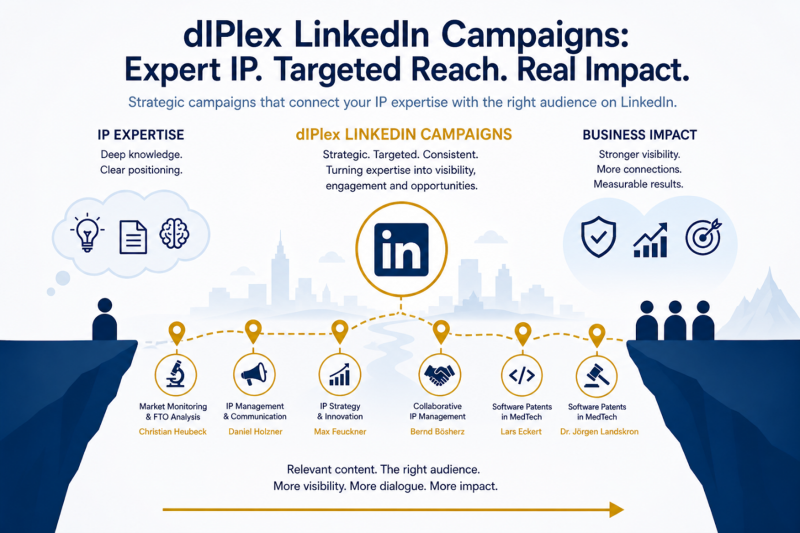
This is where LinkedIn campaigns become essential. LinkedIn campaigns transform IP expertise into visible, repeated, and market-relevant conversations. They help IP Subject Matter Experts move beyond isolated posts and build a recognizable position around specific problem spaces. For companies, they provide accessible entry points into complex IP topics before urgent decisions arise.
And for IP Subject Matter Experts, they create what is often missing in traditional professional communication: a structured bridge between expertise, visibility, trust, and qualified business conversations.
Here is an explainer video about dIPlex LinkedIn Campaign
The Visibility Problem in IP
Many IP Subject Matter Experts communicate mainly within the IP community. They post about legal developments, court decisions, patent strategy, licensing, enforcement, or technology-related IP questions. These topics are highly relevant, but they often circulate in a relatively narrow professional network.
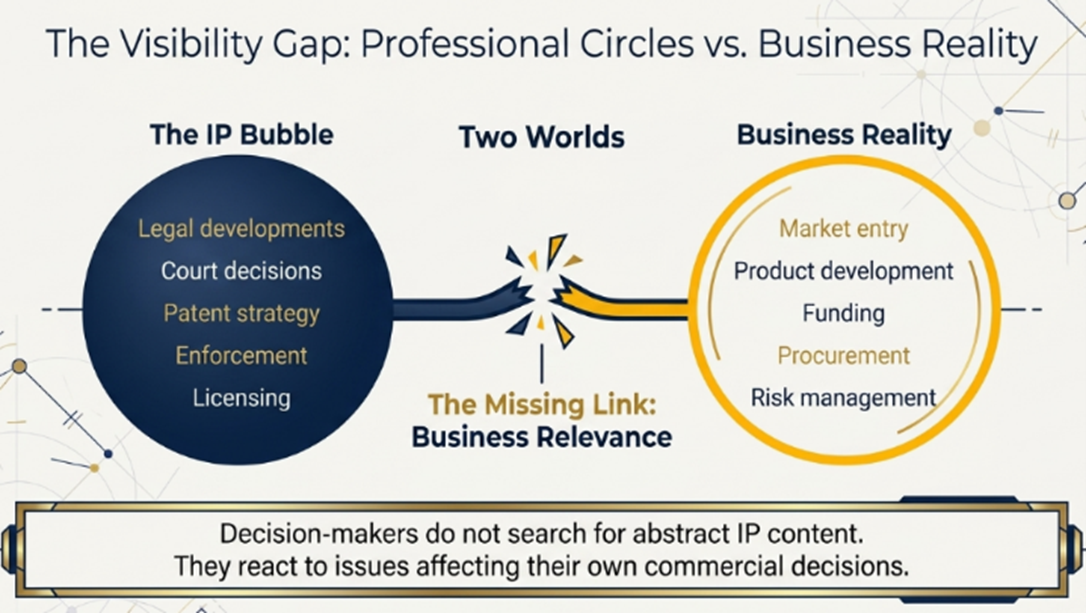
For business decision-makers, founders, engineers, product managers, innovation leaders, and investors, IP usually becomes relevant only when it connects to a concrete business problem. They do not search for abstract IP content. They react to issues that affect their own decisions: freedom to operate, market entry, procurement risks, licensing options, software protection, collaboration contracts, or product differentiation.
A LinkedIn campaign helps to bridge this gap.
It does not simply increase visibility. It creates repeated, structured touchpoints around a clearly defined problem space.
LinkedIn Campaigns as Structured Market Access
A LinkedIn campaign is not a collection of random posts.
It is a structured communication format that translates expert knowledge into a sequence of market-relevant messages. Each post serves a specific function: creating awareness, framing a problem, demonstrating expertise, encouraging discussion, or guiding attention toward a deeper resource.
A well-designed LinkedIn campaign:
- defines a clear target audience
- translates IP expertise into business-relevant language
- builds trust through repeated, useful contributions
- connects short-form visibility with deeper assets such as dIPlex pages, checklists, whitepapers, playbooks, or reviews
In this sense, a LinkedIn campaign is not social media activity. It is a business development instrument.
It turns expertise into conversations.
From Posting to Positioning
What distinguishes a professional LinkedIn campaign from ordinary posting is strategic consistency. Many experts publish when they have time, when a legal update appears, or when an event needs to be promoted. This can create visibility, but it rarely creates positioning. Positioning requires repetition, focus, and recognizable relevance.
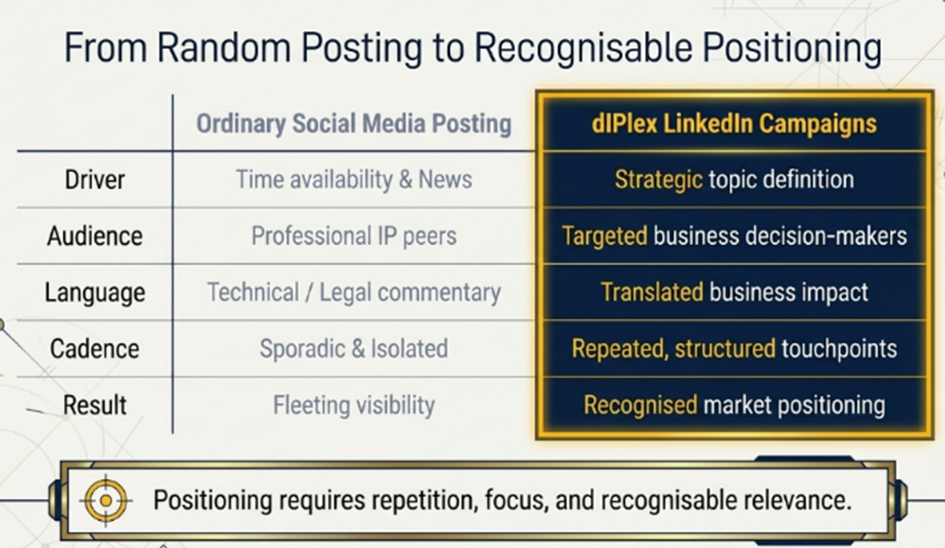
A campaign defines the topic space in which the IP Subject Matter Expert wants to be remembered. It connects the expert’s knowledge with the needs of a specific audience. Over time, this creates a clear association: this person understands this problem and can help companies think through it. This changes the role of LinkedIn. It is no longer just a broadcasting channel. It becomes a structured market interface.
Real Examples from IP Subject Matter Experts
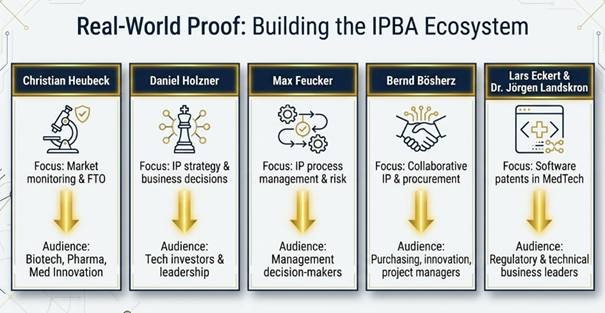
The IPBA ecosystem already shows how LinkedIn campaigns can support expert positioning across different IP topics and industries.
Christian Heubeck provides a strong example in the field of life sciences IP. His expertise around market monitoring, freedom-to-operate analysis, and IP protection in regulated innovation environments can be translated into campaign topics that speak directly to biotech, pharma, diagnostics, and medical innovation audiences.
Daniel Holzner represents another type of expert positioning. His perspective can be used to connect IP strategy with technology-driven business decisions, helping audiences understand how IP affects investment, product development, and competitive advantage.
Max Feucker demonstrates how IP process management can be made visible through campaign communication. His work on reducing IP risks and improving IP usage lends itself to practical posts that translate internal IP processes into management-relevant decision points.
Bernd Bösherz brings a particularly strong angle for collaborative IP management. Topics such as procurement, collaboration contracts, and IP in supplier relationships are highly relevant beyond the legal department. A campaign around these issues can reach business, purchasing, innovation, and project management audiences.
Lars Eckert and Dr. Jörgen Landskron provide a highly specialized example in software patents in MedTech. Their topic connects regulatory, technical, patent, and business considerations. A LinkedIn campaign can make this complexity visible in small, understandable steps and guide relevant audiences toward deeper resources.
Across all these examples, the pattern is clear. The campaign does not merely promote the expert. It creates a structured conversation around a problem the market already has.
Why LinkedIn Campaigns Work for IP Management
LinkedIn campaigns are particularly effective for IP management because IP relevance often needs to be made visible before demand becomes explicit. Many companies only recognize IP issues when a conflict, transaction, product launch, collaboration, or competitive threat occurs. By then, the decision space may already be constrained. A structured campaign can surface IP relevance earlier.
It can show how IP affects:
- market entry
- technology choices
- collaborations
- licensing models
- procurement decisions
- product differentiation
- risk management
This makes LinkedIn campaigns valuable not only for visibility, but for market education.
They help audiences understand why IP matters before they urgently need advice.
Beyond the IP Bubble
The central challenge for IP Subject Matter Experts is not to speak louder within the IP bubble. It is to become relevant in the conversations where future clients already spend their attention. LinkedIn is particularly suitable for this because it connects professional identity, content distribution, and network interaction.
However, this only works if the campaign is not written as internal IP commentary. Posts must translate IP into the language of the target audience. They need to show why a legal, technical, or strategic IP issue matters for business outcomes. The goal is not to demonstrate complexity. The goal is to make complexity usable. A strong LinkedIn campaign therefore acts as a translation layer. It brings IP expertise into the market conversation.
The Role of the Platform
Within the broader IPBA and dIPlex ecosystem, LinkedIn campaigns are connected to deeper assets.
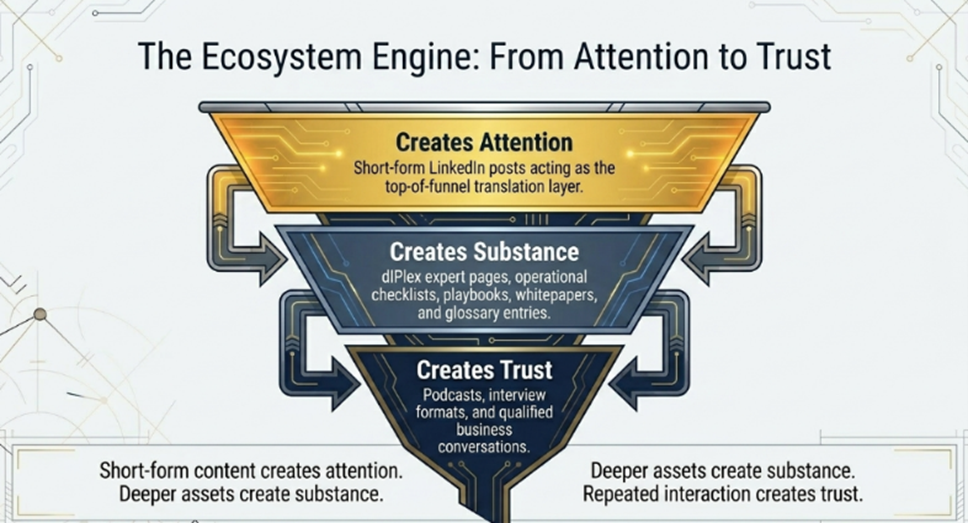
A post can create attention, but it should not stand alone. It can point to:
- dIPlex expert pages for credibility
- checklists for operational use
- whitepapers, playbooks, and reviews for strategic orientation
- glossary entries for conceptual clarity
- podcast or interview formats for personal trust building
This layered structure is important.
Short-form content creates attention. Deeper assets create substance. Repeated interaction creates trust. Together, they form a structured client journey. For the IP Subject Matter Expert, this means that LinkedIn is not treated as an isolated channel. It becomes part of a broader positioning and business development system.