
Agile IP Management in Practice: Module 4 of the MIPLM 2025–26 About Organizing Innovation


Agile IP Management is no longer a niche topic for legal specialists. It has become a practical management question for organizations that must innovate under conditions of uncertainty, speed, and constant change. In Module 4 of the Master Programme for IP Law and Management 2025–26, the lecture on Agile IP Management makes exactly this point. It shows that intellectual property cannot be treated as a slow, isolated support function if the business itself is learning, iterating, and adapting in real time.
Why Agile Thinking Matters for IP Management
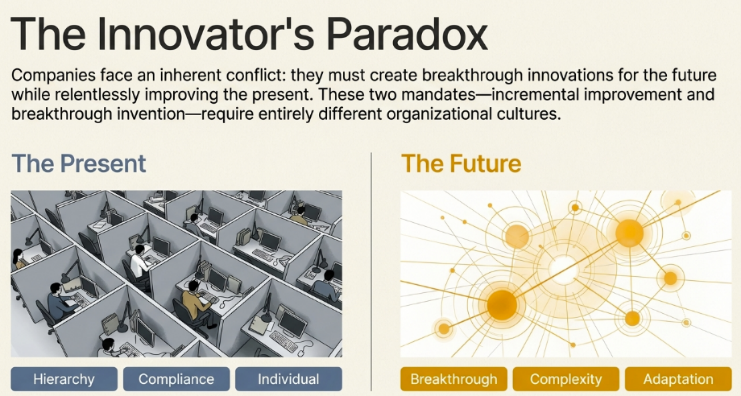 Companies need to improve the present while also building the future. Incremental innovation helps optimize existing products, services, and processes. Radical innovation opens the path to new markets, new business models, and new sources of competitive advantage. The challenge is that these two forms of innovation usually thrive under different conditions. Incremental innovation often benefits from efficiency, routines, control, and risk reduction. Radical innovation, by contrast, depends on experimentation, flexibility, speed, and the willingness to accept uncertainty.
This is why the lecture introduces the concept of the ambidextrous organization. An ambidextrous organization is designed to manage both worlds at the same time. It keeps established business structures running efficiently while creating separate but connected spaces for emerging business opportunities. These units may have different processes, different structures, and even different cultures, but they remain integrated through leadership, shared values, and strategic alignment. For IP management, this is highly relevant. It means that the protection, capture, and strategic use of intellectual assets cannot be uniform across the whole company. The way IP is managed in a stable business area may need to differ significantly from the way it is handled in an exploratory one.
This insight creates the bridge to Agile IP Management. If innovation is increasingly shaped by complexity, then IP practices must also become more adaptive. Traditional IP work often assumes long planning cycles, sequential decision making, and clearly defined handovers between inventors, business teams, and legal experts. Agile environments challenge this logic. Teams work iteratively. Priorities shift quickly. Product features evolve through rapid feedback. Market learning happens continuously. In such a setting, IP management has to move closer to the rhythm of innovation itself.
Core Principles of Agile IP Management
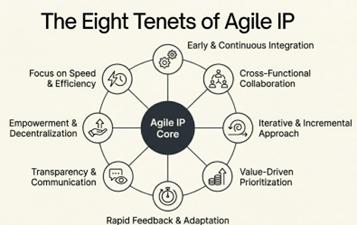 The lecture identifies several core principles of Agile IP Management. The first is early and continuous integration. IP should not enter the process only at the end, when an invention is already mature or when a launch is around the corner. Instead, IP thinking should be present from the beginning and remain part of the discussion throughout development. This does not mean over formalizing early ideas. It means recognizing that valuable knowledge, strategic options, and possible risks emerge long before a final product is defined.
A second principle is cross functional collaboration. Agile IP Management depends on interaction between technical teams, product management, strategy, and IP professionals. This changes the role of the IP function. Instead of acting only as an expert reviewer, the IP team becomes a collaborative participant in innovation work. It helps identify inventions earlier, frames strategic choices, supports prioritization, and translates legal possibilities into business relevant guidance.
A third principle is the iterative and incremental approach. In a conventional model, IP decisions may be taken at a few large milestones. In an agile model, they are revisited repeatedly. New information can change what is worth protecting, what should remain secret, or where freedom to operate concerns might arise. This requires lighter processes, better internal visibility, and a willingness to make provisional decisions that can later be refined.
The lecture also emphasizes value driven prioritization. Not every invention deserves the same attention. Not every filing supports the strategy. Agile IP Management therefore asks a simple but powerful question: where does IP create the highest value in relation to business goals? This can mean protecting the most differentiating technical elements, focusing on assets that support growth, or securing the features that matter most for customer adoption and market position.
Other important principles include rapid feedback and adaptation, transparency and communication, empowerment and decentralization, and a strong focus on speed and efficiency. Together, these principles suggest that Agile IP Management is not merely a faster patent process. It is a broader organizational approach that aligns IP work with agile innovation logic.
What Agile IP Management Looks Like in Practice
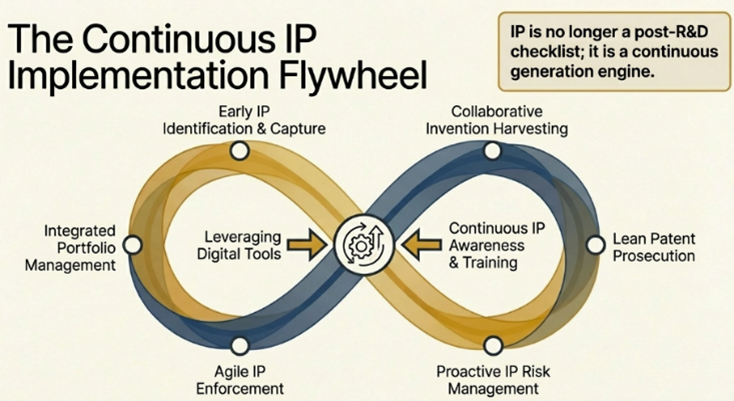
The lecture then makes this practical by highlighting key aspects of Agile IP Management in day to day work. These include early IP identification and capture, collaborative invention harvesting, lean patent prosecution, agile IP strategy development, integrated IP portfolio management, proactive IP risk management, the agile handling of enforcement questions, the use of digital tools, and continuous IP awareness and training. What matters here is the combination. Agile IP Management is not a single technique. It is a system of practices that together make IP more responsive, more connected, and more strategically useful.
 At the same time, the lecture does not romanticize the shift. It openly addresses the challenges. A move toward agile IP practices requires cultural change. It often demands a mindset shift from IP professionals who were trained to value certainty, completeness, and procedural rigor. Existing processes may resist adaptation. Organizations may struggle to define value metrics for IP in dynamic settings. There is also a constant tension between speed and thoroughness. If teams move too fast, important legal details may be missed. If IP work remains too slow, strategic windows can close before action is taken. Leadership support is therefore essential. Without buy in from management, Agile IP Management remains a concept rather than an operating model.
This practical perspective is one of the strengths of the lecture. It avoids presenting agility as a buzzword. Instead, it frames Agile IP Management as a response to real organizational pressure. Businesses do not innovate in a neat sequence anymore. They test, learn, pivot, and scale in parallel. IP management therefore has to become more embedded in business processes, more visible to decision makers, and more capable of working with partial information.
What the Spotify Case Study Teaches About Strategic IP
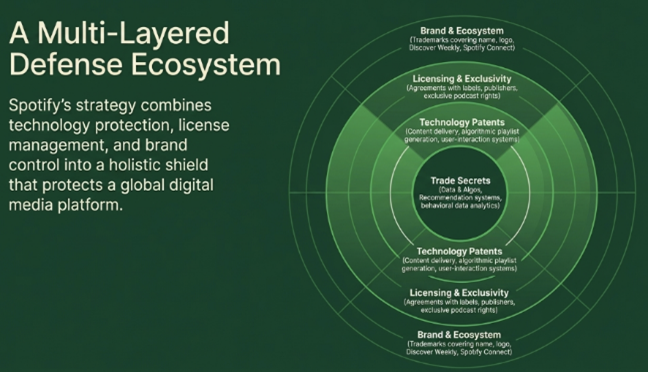
A particularly strong part of the lecture is the Spotify case study. Spotify is presented not only as a successful digital platform, but as an illustration of how agile organization and agile IP strategy can reinforce each other. The company grew from a legal alternative to music piracy into a global platform by combining technology development, licensing, data driven personalization, and brand building. Its IP strategy is not limited to patents. It includes large scale licensing agreements, trademark protection, trade secrets, content rights, and the strategic design of the user experience.
The Spotify Model
This case is especially useful because it shows that value creation in digital business often sits at the intersection of technology, content, data, design, and customer interaction. Spotify protects streaming technologies, recommendation systems, and interaction mechanisms. At the same time, much of its competitive strength also lies in assets that are not fully captured by patents alone. Data analytics, algorithmic personalization, brand recognition, exclusive content, and a distinctive interface all contribute to differentiation.
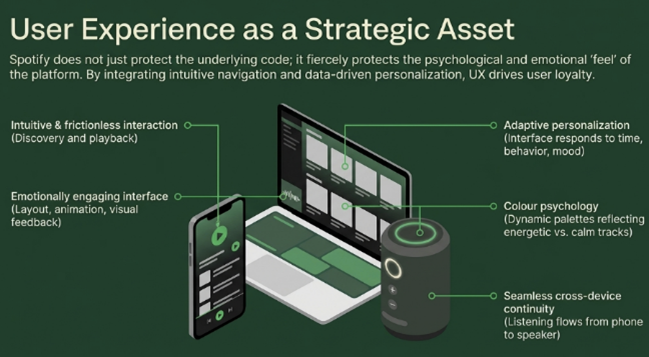
 The lecture goes one step further by treating user experience as a strategic asset in its own right. This is a crucial point for modern IP management. In many businesses, the protected value is no longer just a technical invention in isolation. It is the total experience created through design, interface logic, emotional engagement, and seamless continuity across devices. For this reason, Agile IP Management must become capable of seeing more than patents. It has to recognize how different forms of intellectual assets work together to support business success.
 Agile IP Management is about organizing IP for environments shaped by complexity. It requires ambidextrous structures, collaborative practices, leadership alignment, and a more dynamic understanding of value. For students in the MIPLM programme, this matters because it reflects the reality they will face in innovative organizations. IP management today is not just about securing rights. It is about enabling innovation, guiding strategic choices, and helping organizations protect what actually creates competitive advantage.
That is what makes this lecture so important in Module 4. It does not present Agile IP Management as a fashionable label. It presents it as a necessary response to the way innovation is increasingly organized.