
Checklist Thinking in IP Management – Turning Expertise into Actionable Decision Support


In many IP discussions, the problem is not a lack of knowledge. The problem is translation. Checklists represent a powerful way to bridge the gap between IP expertise and real-world decision-making.
They transform knowledge into action, reduce complexity, and make IP more accessible to relevant audiences. For IP Subject Matter Experts, they offer a way to position themselves not only as providers of knowledge, but as enablers of decisions.
And for companies, they provide something that is often missing in IP management: practical orientation in situations where decisions cannot be postponed.
Companies are surrounded by insights, legal analyses, and strategic recommendations. Yet when it comes to actual decisions, uncertainty remains high. What exactly should be done? In what order? And based on which criteria? This is where a specific type of IP asset becomes highly valuable: the checklist.
Here is an explainer video about dIPlex checklists
The Hidden Gap Between Insight and Action
Most IP Subject Matter Experts are excellent at explaining complex topics. They publish articles, give talks, and contribute to strategic discussions. However, for many companies, especially outside the IP core community, this is only the first step.
Understanding is not the same as execution.
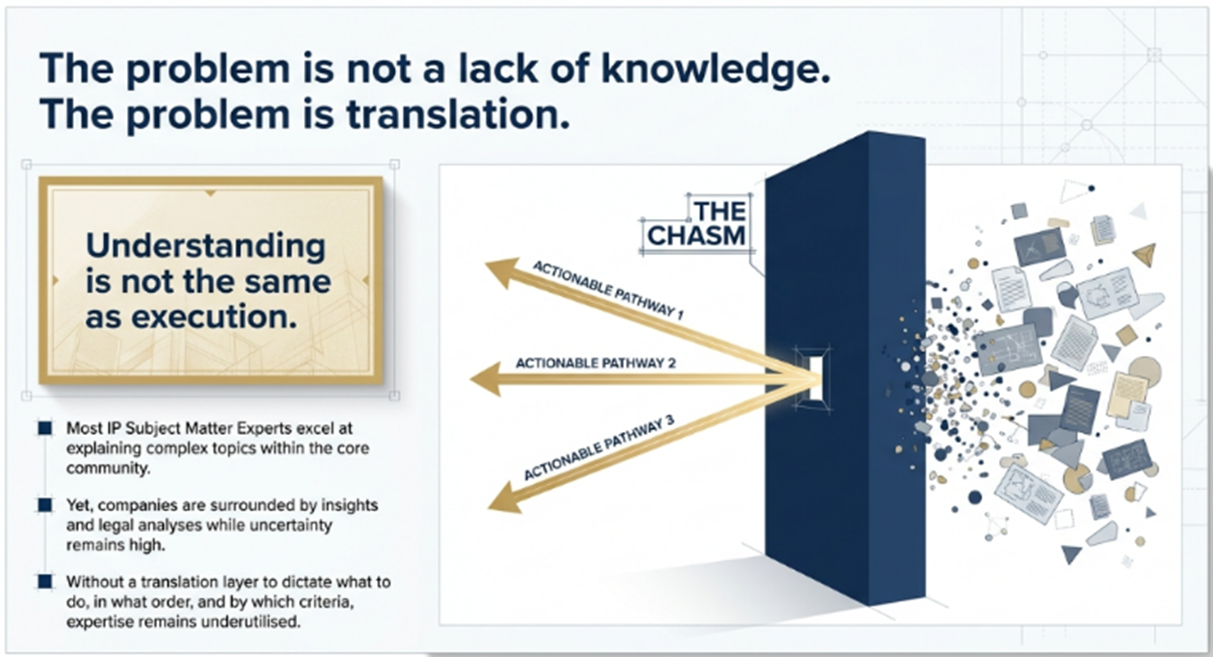
Decision-makers in business, technology, or management roles rarely need a full legal analysis. What they need is orientation under time pressure. They need to know what to look for, what to prioritize, and what to avoid.
Without this translation layer, even the best expertise remains underutilized.
Checklists as a Format for Decision Support
A checklist is not a simplification of expertise. It is a structured extraction of what really matters in practice.
Well-designed IP checklists:
- translate complex IP logic into actionable steps
- highlight critical decision points
- reduce uncertainty in operational contexts
- make expertise usable beyond the IP department
In this sense, a checklist is not just a document. It is a decision tool.
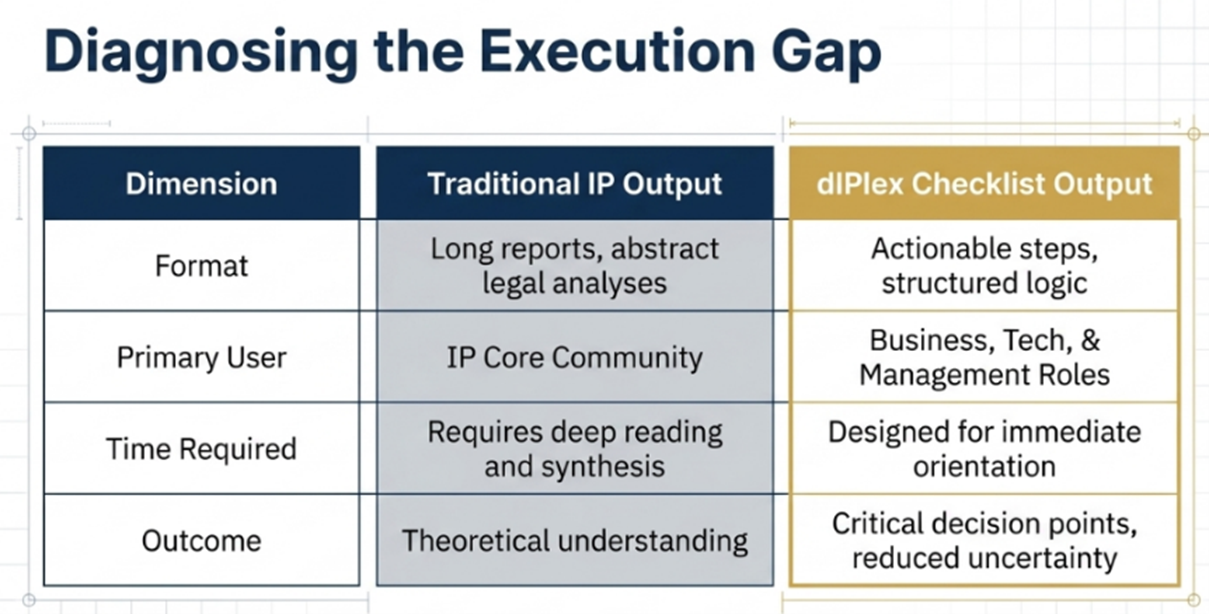
It allows companies to engage with IP questions in a way that is aligned with how real decisions are made: step by step, under constraints, and often without complete information.
From Content to Product
What makes checklists particularly interesting is that they transform IP expertise into a reusable product format. Unlike articles or presentations, a checklist can be directly applied. It accompanies a process, guides a decision, and structures internal discussions.
This changes the role of the IP Subject Matter Expert. Instead of only providing explanations, the expert becomes a provider of decision infrastructure. This is a fundamental shift because it moves IP expertise closer to where value is actually created: in operational and strategic decisions.
Real Examples from the dIPlex
The digital IP Lexicon 🧭dIPlex already includes several examples of how checklists can be used to make IP expertise actionable.
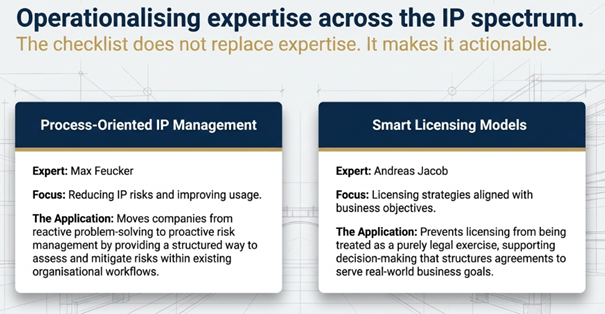
One example is the checklist by Max Feucker on reducing IP risks and improving IP usage.
👉 https://profwurzer.com/diplex/docs/ip-process-management/reduced-ip-risks-and-improved-ip-usage/
This checklist focuses on process-oriented IP management. Instead of discussing risks in abstract terms, it provides a structured way to identify, assess, and mitigate IP-related risks within organizational workflows.
It enables companies to move from reactive problem-solving to proactive risk management.
Another example is the checklist by Andreas Jacob on smart licensing models.
👉 https://profwurzer.com/diplex/docs/smart-licensing-models/smart-licensing-check/
Here, the checklist supports decision-making in licensing strategies. It helps companies understand how to structure licensing agreements in a way that aligns with business objectives, rather than treating licensing as a purely legal exercise.
Both examples show a common pattern. The checklist does not replace expertise. It operationalizes it.
Why Checklists Work in IP Management
Checklists are particularly effective in IP management because they address a core structural challenge. IP decisions are rarely made in isolation. They are embedded in broader business contexts, involve multiple stakeholders, and are often characterized by uncertainty.
In such environments, long reports are difficult to use.
Checklists, by contrast:
- provide clarity under uncertainty
- enable alignment across teams
- support consistent decision-making
- reduce dependency on individual experts in every single step
They create a shared reference point.
This is especially important when IP considerations need to be integrated into non-IP functions such as R&D, product management, or business development.
Beyond the IP Bubble
One of the most powerful aspects of checklists is their ability to travel. While traditional IP content often remains within the IP community, checklists can be used directly by non-IP professionals. They are easier to share, easier to understand, and easier to apply.
This makes them an ideal format for reaching relevant audiences beyond the IP bubble. Instead of asking decision-makers to enter the world of IP, the checklist brings IP into their existing workflows. This is a fundamentally different approach to IP communication.
A Structured Approach to Checklist Creation
Creating an effective IP checklist is not trivial.
It requires more than listing a few questions or steps. A strong checklist must be based on real decision situations and reflect the logic of how companies operate.
This typically involves:
- identifying recurring decision scenarios
- structuring them into clear steps
- defining criteria for evaluation
- ensuring usability for non-IP stakeholders
In other words, it is a process of translating expertise into a usable format.
The Role of the Platform
On platforms like the digital IP Lexicon 🧭dIPlex, checklists become part of a larger system.

They are not isolated documents, but integrated elements within a broader knowledge and communication infrastructure.
They can be linked to:
- glossary entries for conceptual understanding
- case studies for practical context
- expert profiles for credibility and follow-up
This creates a layered experience.
Users can start with a checklist and, if needed, explore deeper levels of information.
For the IP Subject Matter Expert, this means that a checklist is not just a standalone asset, but part of a broader positioning and business development strategy.