
UPC Decision Case: The Strategic IP Choice in Life Sciences Portfolios with Dr. Natalie Kirchhofer

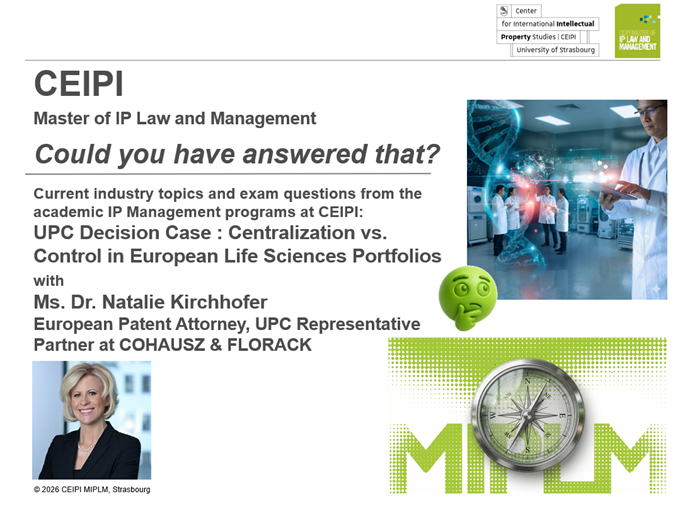
The introduction of the Unitary Patent and the Unified Patent Court (UPC) has fundamentally changed how companies structure and manage their European patent portfolios. For many industries, this is already a strategic question. In life sciences, however, it becomes a critical business decision with direct impact on market exclusivity, pricing power, and long-term competitive positioning.
To better understand these developments, the CEIPI IP Business Academy continuously exchanges with practitioners from industry, advisory services and private practice, including through its Open Foresight Board activities. These discussions confirm that there is a growing need for decision-oriented guidance at the interface of IP management, business strategy, and regulatory dynamics – particularly in complex, high-investment sectors such as life sciences.
Against this background, the CEIPI IP Business Academy systematically integrates real-world decision situations into its teaching and examination formats. The goal is not only to explain legal frameworks, but to develop the capability to navigate strategic trade-offs under uncertainty.
The following IP Decision Case was reviewed by Dr. Natalie Kirchhofer and addresses a central strategic challenge in life sciences IP: how to structure European patent protection in the era of the UPC. Dr. Natalie Kirchhofer is a leading expert in the field of Life Sciences, Pharma and Chemistry and provides a practitioner perspective on how companies balance efficiency, risk concentration, and flexibility when designing their patent portfolios.
The case shows that the choice between Unitary Patent and classical European validation is not a technical filing decision. It is a structural decision that shapes how an entire portfolio behaves over time – from enforcement to risk exposure and strategic optionality. This reflects exactly the concern described in the UPC Strategy Gap study: companies face centralized injunction risks, revocation exposure, forum choices and portfolio vulnerabilities, while the market still often frames UPC advice too narrowly as procedural litigation expertise.
The CEIPI IP Business Academy recently addressed the UPC Strategy Gap in Europe, showing that companies increasingly recognize the strategic relevance of the Unified Patent Court, while much of the market still frames UPC support mainly as procedural or litigation expertise.
Here you find the Findings of the study: “The UPC Strategy Gap in Europe”
Here is her assessment of this IP Decision Case on UPC:
This case captures a genuinely practice-relevant strategic question. In life sciences, and particularly in pharma and biotech, portfolio value is typically concentrated in a small number of key patents protecting core innovations—very different from technology fields where products may be covered by large patent thickets and the loss of any single right is less material.
Against this backdrop, the choice between Unitary Patent protection and classical European validations or national phase entries is not merely administrative, it is a high-impact portfolio design decision. The trade-off between centralized enforcement and centralized revocation risk is real, and for commercially critical assets it must be actively managed rather than resolved in a one-size-fits-all manner.
In practice, we increasingly recommend a differentiated “UP+” strategy for important assets. Many jurisdictions incl. Germany have in view of the UPC system relaxed their double patenting bars ad now allow parallel protection structures. In particular, pursuing a German national patent (e.g. via national phase entry from the PCT) alongside a European patent or Unitary Patent can provide an additional layer of resilience and flexibility as to use of the German national court system for litigation. After expiry of the transitional period, not only UP-patents, but also classically validated EP patents will fall under the exclusive jurisdiction of the UPC. Thus the decision should not only be UP vs. EP validation, but also include parallel national phase entries in the bouquet of options.
This exam case therefore reflects well the level of decision-making expected in modern IP practice: it is not about choosing one system over the other in the abstract, but about designing robust, asset-specific protection strategies that balance enforcement efficiency with risk diversification in an uncertain and highly competitive environment.
Centralization vs. Control in European Life Sciences Portfolios
Decision Context
A mid- to large-sized pharmaceutical company is preparing the next generation of patent filings for a pipeline of biologics and follow-on innovations across Europe. The company operates in a highly competitive therapeutic area with increasing biosimilar pressure and significant regulatory disclosure requirements.
With the introduction of the Unitary Patent and the Unified Patent Court (UPC), the company must define how future European protection is structured. The decision is not isolated to individual assets. It affects how the entire portfolio behaves over time, including enforcement capabilities, exposure to invalidation, and flexibility in responding to evolving market dynamics.
At the same time, the competitive landscape is uncertain. Clinical outcomes, regulatory pathways, and competitor strategies remain only partially visible at the time of filing.
The Decision
Should the company prioritize the Unitary Patent to achieve centralized protection and enforcement efficiency across Europe, or should it maintain a classical European patent strategy with national validations to preserve flexibility and distribute legal risk?
Why This Decision Is Difficult
This decision cannot be reduced to cost or coverage considerations. It introduces structural trade-offs that unfold over time:
- Efficiency vs. Risk Concentration
Centralized protection simplifies administration and enables cross-border enforcement, but it also creates the possibility of a single invalidation affecting all participating jurisdictions simultaneously. - Flexibility vs. Irreversibility
Classical validations allow country-specific adjustments and strategic differentiation. The Unitary Patent, once chosen, fixes the structure of protection and limits future adaptability. - Portfolio Effects vs. Asset-Level Decisions
Individual filing choices accumulate into portfolio-wide exposure patterns. A consistent preference for one system may unintentionally concentrate risk or reduce strategic optionality. - Timing under Partial Visibility
Decisions must be taken before key uncertainties are resolved, including clinical success, regulatory developments, and competitor behavior in biosimilar entry. - Integration of Legal and Commercial Strategy
Patent protection choices directly influence pricing power, licensing strategies, and negotiation leverage in a market where exclusivity periods are economically critical.
Practitioner Perspective
From a Life Sciences perspective, the relevance of this decision is highly context-dependent.
It becomes particularly critical for companies with broad European market exposure, biologics portfolios with high development costs, and a need for coordinated enforcement against biosimilar entrants. In such settings, centralized enforcement can significantly strengthen competitive positioning.
At the same time, the risk of central invalidation carries substantial economic consequences, especially for key assets that underpin market exclusivity. For these assets, maintaining structural flexibility and distributing risk across jurisdictions may remain a deliberate strategic choice.
The decision therefore does not lend itself to a uniform approach. It requires alignment between portfolio architecture, product lifecycle expectations, and competitive strategy, as well as the internal capability to reassess and adjust positioning over time.
Implication for IP Management Education
This case highlights a shift from legal knowledge to decision capability. Future IP professionals must be able to evaluate interdependent choices across portfolio design, enforcement strategy, and business objectives under conditions of uncertainty. This includes understanding how individual filing decisions accumulate into strategic patterns and how these patterns influence long-term competitive positioning.
Dr. Natalie Kirchhofer
 Double-qualified German/European patent attorney and UPC representative with strong background in Life Sciences, Pharma and Chemistry and appreciation of U.S. law; understands client needs and exceeds expectations; daily practice includes advising biotech startups as well as U.S., international, and German pharma and general chemistry companies in all aspects of intellectual property law. Particular track record of success in defending and attacking patents in high stakes EPO oppositions and German or UPC patent litigation proceedings. Core expertise also includes providing patent infringement, patent invalidity and freedom-to-operate opinions. Hands-on inhouse experience through 1-year-secondment in chemical industry patent department. U.S. work experience includes six months secondment in the IP patent litigation practice group of Ropes & Gray LLP; well familiar with U.S. patent law and prosecution before the USPTO; passed the USPTO Patent Bar Exam in 2014; active as author and speaker on European pharma and biotech patent law.