
What Makes Digital Marketing for IP Law Firms Work: Powell Gilbert and Carpmaels & Ransford

Digital marketing for IP law firms works best when it does not look like marketing. It works when the visible communication of a firm reflects a strategic market position that already exists in the work, the people, the cases and the architecture of the firm.
In many IP markets, clients already assume a high technical baseline. The decisive question is not whether a firm is competent, but whether the firm has created a visible reason to be chosen. Expertise that remains invisible rarely becomes a differentiating factor in the client’s decision process.
Two European examples show particularly well how this can work in practice: Powell Gilbert in the field of UPC litigation and Carpmaels & Ransford in the life sciences. Both firms have received major external recognition. But the interesting point is not the awards itself. The interesting point is that the awards confirm a position that was already digitally visible for a long time.
Powell Gilbert: Turning the UPC into a focused litigation identity
Powell Gilbert is a strong example of focused digital positioning. The firm was recognised by JUVE Patent as the first ever “UPC Firm of the Year” in the JUVE Patent UPC Rankings 2025 and also received a four-star recommendation for UPC litigation. On its own award page, Powell Gilbert connects this recognition directly to its UPC practice and describes the result as recognition for the team’s work in the new European patent litigation system.
The firm’s dedicated Patent Litigation UPC page makes the positioning even clearer. Powell Gilbert states that it has represented clients before the UPC since the court opened in June 2023 and refers to experience across Local Divisions, the Nordic-Baltic Regional Division, Central Divisions and the Court of Appeal. This matters from a marketing perspective because the message is not generic. Powell Gilbert does not simply say: we are excellent patent litigators. The digital story is narrower, more specific and therefore more memorable: we are a patent litigation firm built for complex European disputes, and the UPC is now a natural arena for that capability.
This is the first best-practice lesson. Many law firms communicate at a high level of abstraction. They describe themselves as experienced, strategic, international or client-focused. These descriptions may be true, but they rarely create a distinctive market position. Powell Gilbert’s UPC communication works differently. It connects the firm’s litigation identity with a concrete market development. The UPC is not treated as one additional service line among many. It becomes a defining arena in which existing litigation expertise is made visible.
The firm’s broader digital award architecture supports this signal. Powell Gilbert maintains an awards hub where the JUVE Patent UPC recognition appears alongside other patent litigation and life sciences litigation distinctions. JUVE Patent’s own firm profile also describes Powell Gilbert as one of the most highly regarded European IP litigation firms, with teams in London, Düsseldorf and Dublin. Together, these assets create a coherent picture. The firm is not merely reporting an award. It is reinforcing a recognisable litigation identity.
From a business development perspective, this is important. The UPC has created new strategic choices for patent owners, challengers and defendants. Clients need to decide where to litigate, whether to use central revocation actions, how to coordinate national and UPC proceedings and how to assess the risk of pan-European injunctions. A firm that wants to be chosen for this work must therefore do more than explain the UPC. It must show why it belongs in the client’s consideration set for UPC disputes.
Powell Gilbert’s digital marketing does this by reducing complexity. It does not try to present every possible competence equally. It concentrates attention on a decisive field of client choice. The award then becomes useful because it validates an already visible position.
Carpmaels & Ransford: Building a knowledge architecture around life sciences
Carpmaels & Ransford shows a different but equally instructive model. The firm took home four awards at the 2026 Managing IP EMEA Awards: UK Patent Disputes Firm of the Year, EPO Proceedings Firm of the Year, UK Patent Practitioner of the Year for John Brunner and Europe Cross-Border Patent Litigation Team of the Year.
For digital marketing, however, the stronger lesson lies in how these awards fit into Carpmaels’ wider public knowledge system. Life sciences clients rarely buy isolated legal services. They face connected questions: invention capture, patent drafting, prosecution, oppositions, SPCs, regulatory timing, market entry, enforcement, defence, transactions, data-driven innovation and cross-border litigation. A firm that wants to be visible in this sector therefore needs more than occasional articles. It needs a digital structure that reflects the complexity of the client’s decision environment.
Carpmaels does this through a sector-based content architecture. Its life sciences positioning is supported by dedicated pages and subtopics, including biotechnology, pharmaceuticals, medical devices, SPCs and regulatory work, and digital life sciences and bioinformatics. The firm’s website describes these areas as part of a broader life sciences offering across the IP lifecycle.
The digital strength is especially visible in the firm’s treatment of emerging life sciences innovation. Its Digital Life Sciences & Bioinformatics page links the sector to related insights on software inventions, diabetes technology and the changing IP landscape for computational life sciences. The article “Digital Life Sciences: Mapping a Shifting IP Landscape” explains how AI, data platforms, techbio firms and technology companies are reshaping the life sciences IP environment. Carpmaels also uses LinkedIn to distribute this thought leadership, presenting the same article as an explanation of how AI, data platforms and new players are changing IP in life sciences.
This is the second best-practice lesson. Carpmaels does not only publish content. It builds a navigable knowledge environment. A client can move from the firm’s award recognition to sector pages, from sector pages to specific technology areas, and from there to articles and related insights. The result is a cumulative credibility effect. The client does not only see that Carpmaels claims life sciences expertise. The client can explore how the firm thinks about the sector’s legal, technological and commercial changes.
This approach is particularly effective in life sciences because the buying decision is rarely based on one isolated question. A pharmaceutical, medtech or techbio company needs advisors who can connect legal analysis with scientific and commercial context. The firm must show that it understands both established patent practice and the new forms of innovation created by AI, software, data and platform-based R&D. Carpmaels’ digital architecture makes this connection visible.
Two different models of digital marketing success
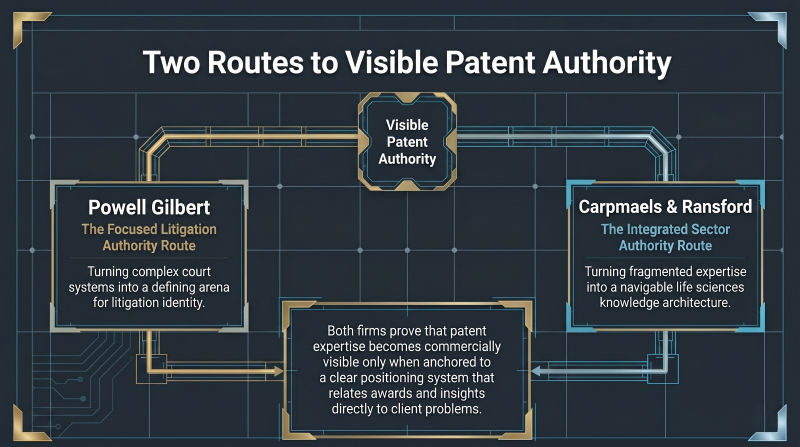
Powell Gilbert and Carpmaels & Ransford therefore represent two different models of successful digital marketing for IP law firms.
Powell Gilbert represents the focused litigation model. The firm creates a strong association with a specific strategic arena: UPC litigation. The marketing logic is concentration. A new court system creates uncertainty. The firm positions itself as one of the names the market should remember when that uncertainty becomes a mandate.
Carpmaels represents the integrated sector model. The firm creates a broader knowledge architecture around life sciences IP. The marketing logic is systematisation. A complex sector creates many connected legal and strategic questions. The firm positions itself as a place where those questions can be understood together.
Both models are effective because they avoid a common weakness of law firm marketing: fragmented competence signals. Many IP firms have strong people, relevant cases, technical expertise, rankings and client relationships. But their digital presence often presents these strengths as disconnected pieces. There may be a service page, a few award announcements and occasional articles, but no clear market-facing logic that turns these assets into a reason to choose the firm.
Powell Gilbert reduces complexity by focusing attention on one decisive arena. Carpmaels manages complexity by organising it into a sector-specific knowledge architecture. Both approaches help the client answer the same implicit question: why this firm?
The award is not the campaign
For IP law firms, awards are often used as standalone announcements. A firm posts that it has been ranked, shortlisted or recognised. That may create a short reputation signal, but it rarely changes market perception by itself. Awards are strongest when they are connected to a visible positioning system.
In the Powell Gilbert case, the UPC award reinforces a clear strategic identity. In the Carpmaels case, the Managing IP awards reinforce a sector and cross-border litigation narrative that is already supported by substantial digital content. The award is therefore not the beginning of the story. It is a competence proof inside an existing story.
This is the practical lesson for IP law firms. Before communicating an award, the firm should ask: what position does this award confirm? Which client problems does it relate to? Which existing pages, articles, cases, people and insights support the recognition? How can the award become part of a repeatable communication structure instead of disappearing after one news post?
Digital marketing for IP law firms is not about making expertise look bigger than it is. It is about making real expertise visible in a form that the market can recognise, trust and act upon. Powell Gilbert and Carpmaels & Ransford show two credible ways of doing this. One model is focused. The other is systemic. Both turn external recognition into something more valuable than a badge: a visible reason to be chosen.