IP Risk Management as a Business Discipline: CEIPI Master in Applied IP Law

In many organizations, intellectual property is still treated as a specialist function that becomes relevant only at particular moments: when a patent is filed, when a contract is signed, or when a conflict appears on the horizon. That view is too narrow for the realities of modern innovation. IP risk management is not just about preventing legal trouble. It is about making better business decisions under uncertainty.
That is the deeper message of the lecture on IP Risk Management in the CEIPI Master Applied IP Law. The central idea is simple but powerful: IP creates value only when it is managed in direct relation to business goals, technological choices, cooperation structures, market timing, and long-term strategic positioning. Risk, in this context, is not merely the possibility of litigation. It includes wasted filing budgets, blocked market access, hidden ownership conflicts, weak software protection strategies, late-stage redesign costs, and missed innovation opportunities.
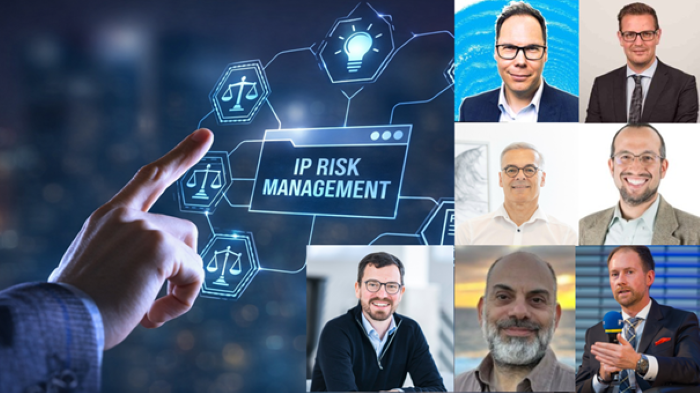
Seen this way, IP risk management becomes an operating discipline. It helps companies decide what to protect, where to invest, when to cooperate, how to design around barriers, and how to build portfolios that remain useful even when markets, technologies, and legal interpretations change. The lecture becomes especially strong where it connects this broader management logic to the perspectives of several IP Subject Matter Experts, each of whom highlights a specific risk field that companies too often underestimate.
Max Feucker: IP Process Management as Risk Prevention
 Max Feucker’s contribution makes a crucial point at the beginning of the discussion: risk management starts long before any dispute arises. It starts with process design. If IP activities are handled ad hoc, companies tend to file too much, too little, or simply the wrong things. They miss freedom-to-operate signals, overlook competitors, and accumulate assets that look impressive on paper but add little commercial value.
His perspective reframes IP process management as a preventive discipline. Filing strategies should not be driven by habit or by technical enthusiasm alone. They should be linked to business priorities, product plans, relevant markets, and the actual logic of competitive advantage. This matters because every misaligned filing decision creates downstream risk. Money is tied up in rights that may never support the business, while genuine vulnerabilities remain unaddressed.
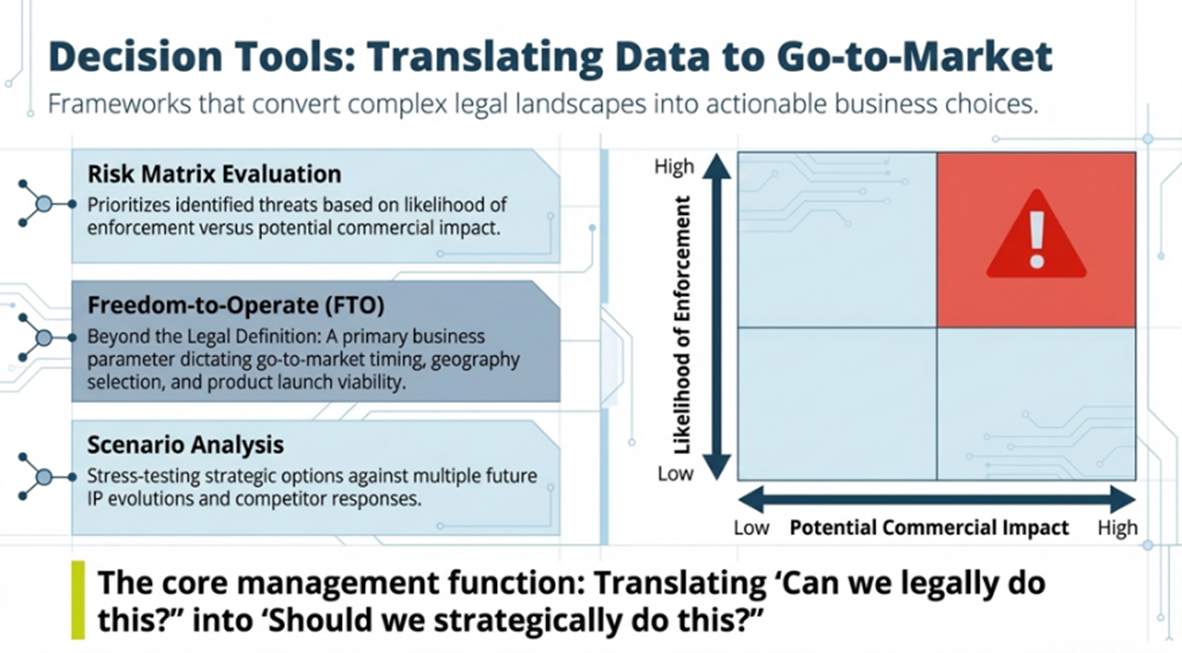
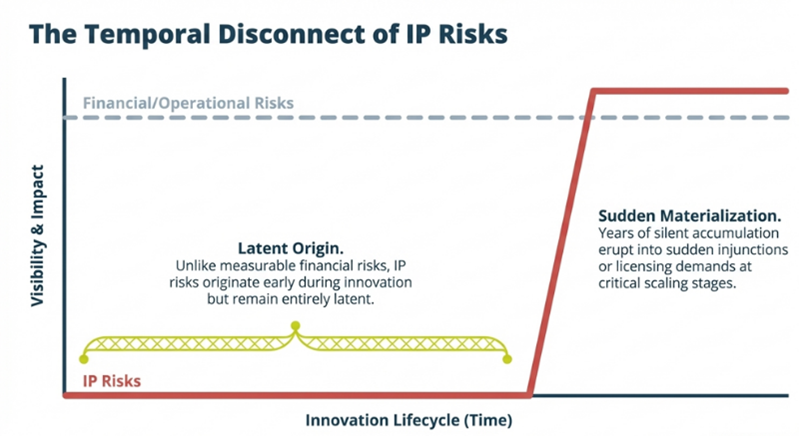 Feucker’s emphasis on early Freedom-to-Operate analysis is particularly important. When FTO is integrated early into development, it supports informed decisions while alternatives are still available. When it happens too late, it becomes a crisis tool rather than a strategic instrument. The same applies to competitor monitoring. Used systematically, it reveals threats, white spaces, and licensing opportunities. Used sporadically, it merely confirms what a company already fears.
His contribution therefore shows that process is not bureaucracy. In IP risk management, process is what turns scattered legal reactions into a repeatable business capability. Here you can find Max Feucker’s 🧭digital IP lexicon page on: IP Process Management.
Volker Tillmann: Why Scale-ups Need Business-Aligned IP
 Volker Tillmann focuses on a setting where IP risk often becomes acute very quickly: the scale-up phase. Startups and scale-ups operate under speed, capital constraints, and pressure to prove traction. In that environment, IP can easily become disconnected from the actual growth logic of the company. Teams file broadly because protection feels important, or postpone difficult IP decisions because other priorities seem more urgent.
Tillmann’s core argument is that IP only becomes risk-reducing when it is aligned with business objectives. That means filings, renewals, enforcement choices, and even internal prioritization must be tied to concrete goals such as market entry, differentiation, financing readiness, product defensibility, or partnership strategy. Without that alignment, IP becomes expensive noise.
 This is highly relevant for scale-ups because they cannot afford diffuse portfolios. Their budgets are limited, their market assumptions may still change, and every major IP decision competes with product development, hiring, and commercialization. In that context, risk management means focus. It means identifying the innovations that truly matter, recognizing freedom-to-operate issues early, and treating IP as part of investment logic rather than as a detached legal ritual.
Tillmann’s contribution is valuable because it highlights a recurring managerial mistake: companies often ask whether they have IP, but not whether their IP supports the business they are actually trying to build. That gap is itself a major risk. Here you can find Volker Tillmann’s 🧭digital IP lexicon page on: IP Management for Scale-ups.
Nicos Raftis: Inventing Around as a Practical Freedom-to-Operate Strategy
 Nicos Raftis addresses one of the most immediate and commercially dangerous IP risks: patent infringement in product development. Many companies discover blocking rights too late, when engineering paths are already fixed, launch plans are in motion, and alternative design routes have become expensive or unattractive. At that point, the menu of responses narrows to unpleasant choices: licensing under pressure, costly invalidation efforts, or redesign under time constraints.
Raftis brings a practical and realistic lens to this problem. He highlights inventing around as an early-stage risk mitigation strategy. This is important because it moves the conversation away from a purely defensive posture. Instead of waiting for conflict and then reacting, companies can study the claims, identify the protected elements that truly matter, and develop technically viable alternatives that preserve performance while improving freedom to operate.
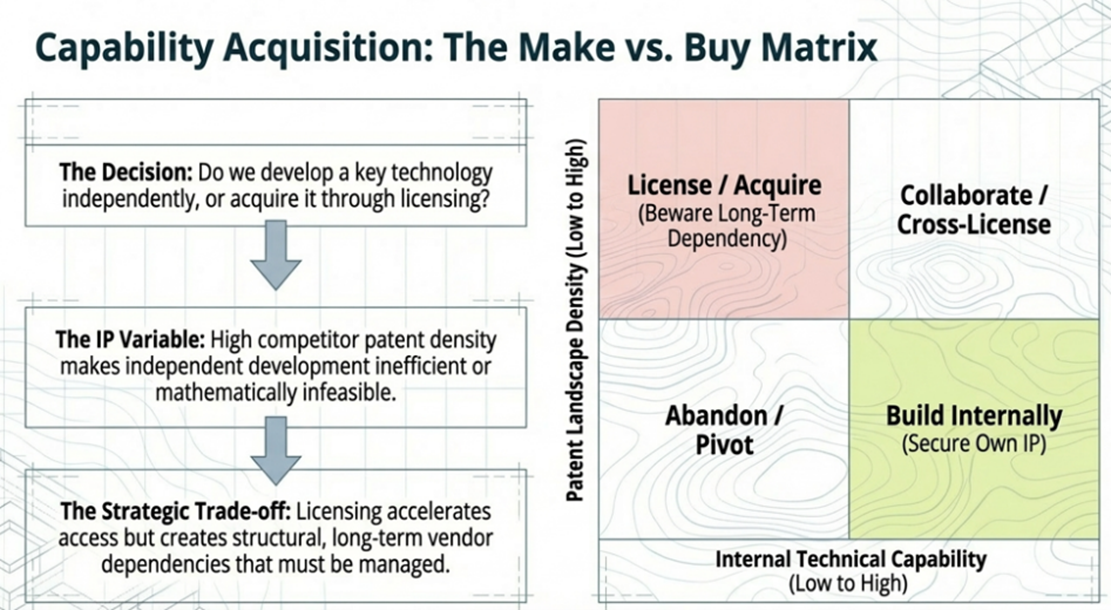 The strength of this approach lies in timing. Design-around strategies are most valuable when integrated into product development early enough for engineering choices to remain flexible. That is why claim analysis should not be a last-minute legal review. It should be part of development governance.
Raftis therefore contributes a highly actionable lesson to IP risk management: legal awareness creates room for technical creativity. When companies understand the patent landscape early, they do not just avoid infringement. They often become better at disciplined innovation. Here you can find Nicos Raftis’ 🧭digital IP lexicon page on: Inventing around with clarity of function and structure.
Robert Plotkin: Structural Risk in European Software Filings
 Robert Plotkin’s contribution adds an especially important dimension because it deals with structural risk rather than immediate operational risk. In software and AI-related inventions, many European applicants assume that a technically well-drafted patent application can be translated across jurisdictions with manageable adjustments. Plotkin shows why that assumption is dangerous.
The problem is not simply different legal wording between Europe and the United States. The deeper issue is a mismatch in patent logic, especially regarding eligibility. A portfolio that appears technically robust and prosecution-friendly in Europe may prove fragile when assessed later under US standards. This creates a time-lag risk. The application may look successful in the short term, while its long-term enforceability remains uncertain.
 That insight is highly relevant for risk management because it challenges the comfort of formal success. A granted right is not automatically a durable business asset. In cross-border portfolio building, companies must ask whether the legal foundation of a filing strategy remains stable when the invention is reinterpreted in another system, under another doctrine, or later in litigation.
Plotkin’s contribution is therefore a reminder that IP risk is not always visible at the moment of filing. Some risks are embedded in the architecture of the portfolio itself. They emerge slowly, often only when the company tries to enforce, finance, license, or defend its position internationally. Here you can find Robert Plotkin’s 🧭digital IP lexicon page on: Where European Software Patents Meet US Eligibility.
Bernd Boesherz: Managing Risk in External Cooperation
 Bernd Boesherz brings the cooperation perspective into the center of IP risk management. This is essential because many valuable innovations no longer emerge within a single organizational boundary. Companies work with suppliers, universities, development partners, customers, and sometimes even competitors. Cooperation accelerates innovation, but it also multiplies risk.
The key challenge is that collaboration depends on openness, while IP protection depends on selective control. If that tension is not managed consciously, companies face information leakage, unclear ownership, conflicting expectations, and later disputes over use rights, improvements, and commercialization.
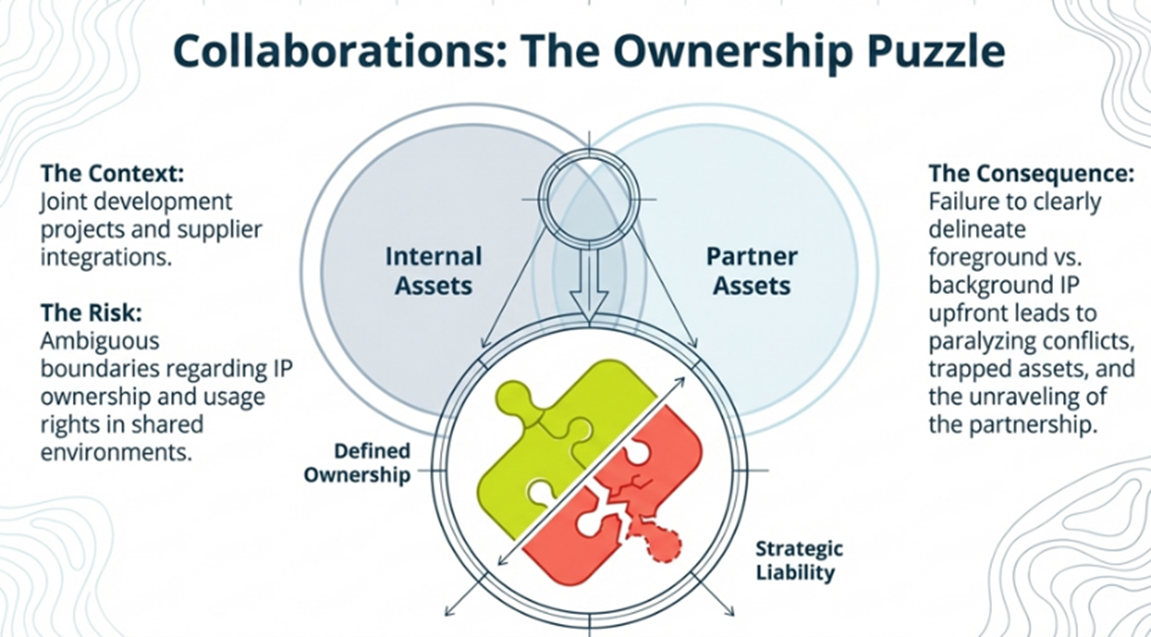 Boesherz’s contribution emphasizes that collaboration needs structure. NDAs are important, but they are only the beginning. Effective risk management in cooperative settings also requires clear governance, defined responsibilities, explicit ownership rules, and a shared understanding of how results may be used. These points are often treated as formalities at the start of a cooperation, yet they determine whether joint innovation later becomes a source of value or a source of conflict.
His perspective matters because it treats cooperation not as an exception to risk management, but as one of its most demanding tests. The more innovation depends on networks, the more companies need frameworks that allow knowledge exchange without losing strategic control. Here you can find Bernd Boesherez’ 🧭digital IP lexicon page on: Collaborative IP Management.
Daniel Holzner: White Spot Analyses as Early Risk Guidance
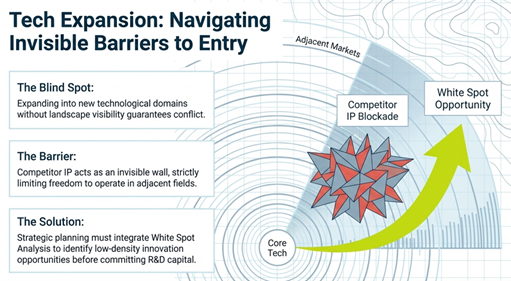
 Daniel Holzner’s contribution on patent white spot analyses expands the idea of IP risk management beyond defense and into opportunity selection. That makes it particularly relevant for innovation-led organizations. Risk is not only about avoiding prohibited territory. It is also about choosing where to invest inventive effort in the first place.
White spot analysis helps identify areas with lower patent density, reduced infringement pressure, and potentially stronger prospects for patentability. When combined with AI-assisted patent analytics, this becomes a much more dynamic capability. Companies can map landscapes faster, compare feature constellations more intelligently, and detect spaces where technical development is both strategically interesting and legally less crowded.
 The managerial value is considerable. Instead of inventing first and checking later whether the path is blocked, organizations can guide R&D toward areas where the likelihood of conflict is lower and the potential value of protection is higher. This creates a more informed relationship between technical exploration and legal foresight.
Holzner’s contribution is important because it shifts IP risk management upstream. It shows that the most elegant way to reduce risk is often not to resolve conflict later, but to steer innovation earlier. Here you can find Daniel Holzner’s 🧭digital IP lexicon page on: AI-assisted invention processes.
Jörn Plettig: Systematic IP Management as the Integrating Framework
 Jörn Plettig closes the picture by returning to the broader organizational question. Companies do not manage IP risks well when IP is handled as a collection of isolated expert tasks. They manage it well when IP is integrated into the wider business system.
His contribution on systematic IP management is therefore foundational. Ad hoc IP handling leads to missed filing opportunities, unmanaged know-how loss, unclear ownership, inconsistent decisions, and poor allocation of resources. A systematic approach, by contrast, embeds IP into business processes from research and development through commercialization. It creates visibility, continuity, and accountability.
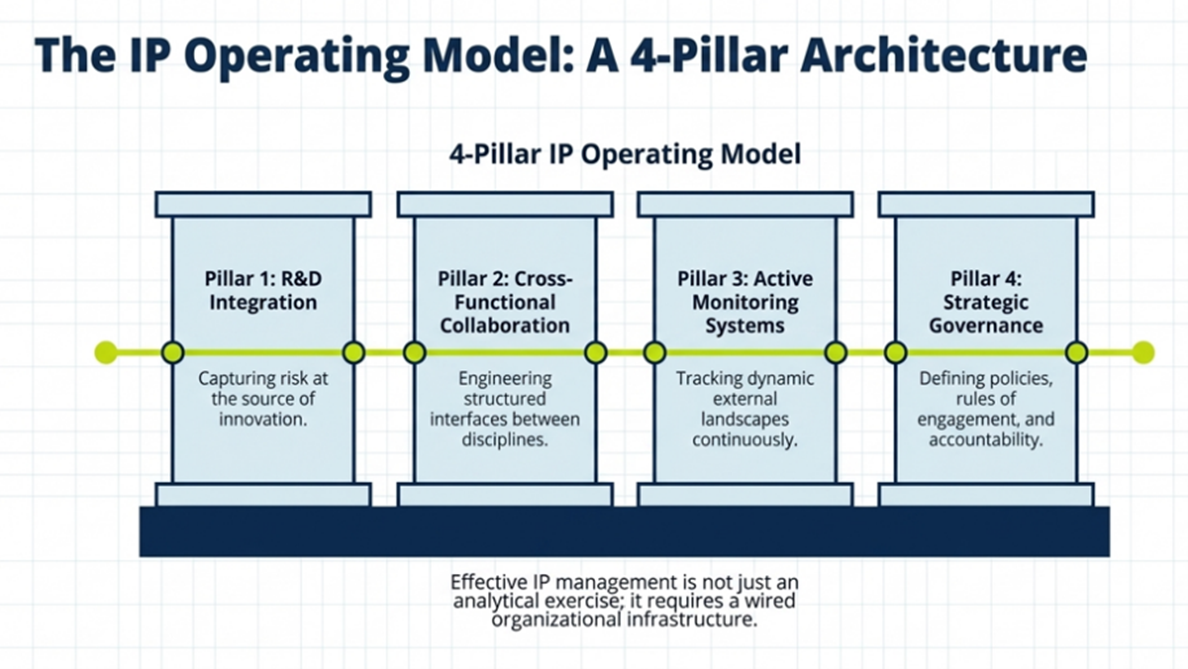 This is more than an administrative recommendation. It is a strategic one. Systematic IP management enables earlier threat detection, more coherent prioritization, and more resilient decision-making. It allows the organization to connect invention, protection, cooperation, market use, and learning over time.
Plettig’s perspective is especially valuable because it clarifies that good IP risk management is not a stand-alone project. It is an organizational capability. Without that capability, even strong individual decisions remain isolated. With it, companies can build a repeatable logic for handling uncertainty. Here you can find Jörn Plettig’s 🧭digital IP lexicon page on: Integrated IP Management Systems.
From Legal Risk to Business Capability
Taken together, the contributions in the lecture point to a broader conclusion: IP risk management should not be understood as a narrow compliance exercise. It is a way of making strategic choices more robust.
Max Feucker shows that structured processes prevent risk before it accumulates. Volker Tillmann shows that business alignment is essential, especially in growth phases where resources are scarce. Nicos Raftis demonstrates that early patent awareness expands technical room to maneuver. Robert Plotkin reveals that portfolio vulnerability can be built into cross-jurisdictional assumptions from the start. Bernd Boesherz reminds us that cooperation without governance produces avoidable exposure. Daniel Holzner shows how analytics can guide invention toward safer and more valuable territory. Jörn Plettig then ties these strands together by showing that systematic IP management is the framework that makes all of this operational.
The common thread is that uncertainty cannot be eliminated. Markets change. Competitors move. doctrines evolve. Partnerships shift. Technologies converge. But companies can still become better at managing this uncertainty. They can design processes, portfolios, and decision structures that remain useful under pressure.
That is what makes IP risk management strategically relevant. It does not promise certainty. It creates preparedness. And in innovation-driven business, preparedness is often what separates fragile IP activity from durable competitive advantage.