
Practical Question GreenTech Marko Brumnik: When Digital Twins Become Climate Decision Infrastructure

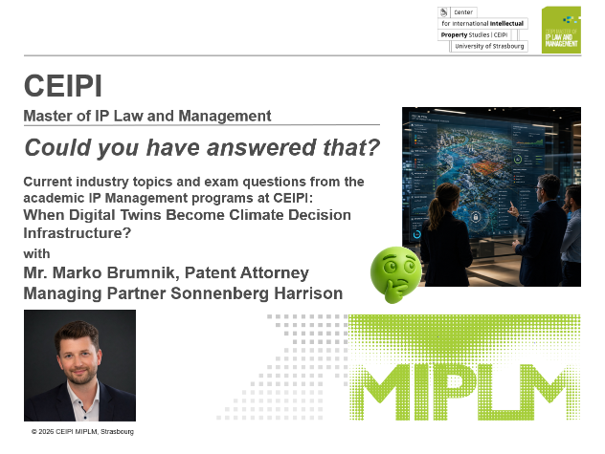
GreenTech is increasingly becoming a question of decision infrastructure. In many sustainable innovation systems, value is no longer created only by a physical technology or one protected invention. It is created by the way data, models, interfaces, assumptions, workflows and technical expertise are combined into systems that help customers make better long term decisions.
This creates a new strategic challenge for GreenTech companies. A digital twin for climate and infrastructure planning may be highly valuable because it makes complex risks visible and supports decisions on flood protection, heat resilience, water use, energy demand or maintenance. Yet the same transparency that customers, public authorities and partners need in order to trust the system can also expose the model logic, data structures, scenario assumptions and integration architecture that give the company its strategic position.
This is exactly the type of shift described in the CEIPI IP Business Academy analysis “The GreenTech Strategy Gap”. The study shows that GreenTech companies increasingly operate in layered transition systems where IP strategy must connect patents, trade secrets, data control, software architecture, contracts, interoperability, procurement requirements and market access into one coherent control architecture.
Here you find the findings of this study: “The GreenTech Strategy Gap: What Sustainable Innovation Companies Need, and What IP Advice Still Often Fails to Integrate”
Against this background, the CEIPI IP Business Academy integrates practice based questions from industry into its teaching. These questions help students understand IP not only as a legal protection tool, but as a management instrument for strategic decision making in complex innovation systems.
We are therefore pleased to include this industry case study with Marko Brumnik, Patent Attorney and Managing Partner at Sonneberg Harrison. His practical question focuses on a central issue for GreenTech software, IoT and infrastructure companies: how to protect the strategic control points of a climate and infrastructure digital twin when trust, interoperability and customer access require substantial technical transparency.
Here is the evaluation of this case by Marko Brumnik, Patent Attorney and Managing Partner, Sonneberg Harrison:
“I consider this issue highly relevant to actual practice. Just last week, I dealt with a case involving digital twin solutions in the IoT sector. From an IP perspective, such scenarios raise very specific questions regarding which parts of a solution can be disclosed and which components should, for reasons of know-how protection, IP strategy, or long-term commercial viability, be withheld. In these technological fields, the question of transparency is of particular strategic importance regarding IP.
I find this topic highly suitable for training in strategic IP management, as the practical need for advice in such cases rarely centers on a single intellectual property right; rather, the situation can only be meaningfully addressed through the interplay of various protection mechanisms and structuring tools.”
Mini Case Study
A GreenTech company develops digital twin software for climate and infrastructure planning. The system combines IoT sensor data, satellite information, weather models, engineering assumptions and simulation tools to help cities, utilities and industrial operators assess climate risks, plan adaptation measures and prioritize infrastructure investments.
The company is preparing a large pilot with a regional infrastructure operator. To win the project, it must explain how the digital twin produces reliable recommendations for flood protection, heat resilience, water use, energy demand and maintenance planning. However, the customer also wants access to the underlying model logic, data interfaces and scenario assumptions, because the results may influence long term investment decisions.
The management team faces a difficult trade-off. Transparency is needed to create trust, comply with procurement requirements and integrate the system into existing planning workflows. At the same time, too much disclosure could enable engineering partners, software vendors or public bodies to rebuild parts of the solution, standardize around competing interfaces or reduce the company to a replaceable analytics supplier.
Practical Question
How should a GreenTech company protect the strategic control points of a climate and infrastructure digital twin when trust, interoperability and customer access require substantial technical transparency?
Why This Question Matters in Practice
This question becomes relevant when a digital twin moves from an internal simulation tool to a decision infrastructure used by external customers, project partners or public authorities. At that stage, IP is not only about protecting software or data. It is about deciding which elements of the system create commercial leverage, customer dependency and long term differentiation.
The question matters for GreenTech software companies, engineering firms, infrastructure operators, municipal technology providers, investors and IP managers working with climate adaptation, smart cities, water systems, energy infrastructure or industrial resilience. These organizations often operate in collaborative environments where sensor networks, public data, proprietary models, customer datasets and third-party platforms must be combined.
The issue becomes critical when the economic value of the solution lies across several layers: data access, data cleaning, simulation models, scenario design, user workflows, integration interfaces, benchmarking logic and decision reports. Under these conditions, a narrow patent filing strategy may be insufficient, while excessive secrecy may block adoption. The practical IP challenge is to define what must be open enough to build trust and what must remain controlled enough to preserve pricing power, partner relevance and strategic position in the emerging climate infrastructure market.
Marko Brumnik
 Marko Brumnik is a Patent Attorney, European Trademark and Design Attorney, and Managing Partner at Sonnenberg Harrison in Munich. He advises deep-tech start-ups, small and medium-sized enterprises, and multinational companies on the development, protection, enforcement, and strategic use of intellectual property. His work focuses on aligning patents, utility models, trademarks, designs, trade secrets, and related IP assets with technical and commercial objectives. Before becoming Managing Partner, he worked as a Patent Attorney at Sonnenberg Harrison and gained further professional experience at Brumnik IP, the German Patent and Trade Mark Office, 24IP Law Group, and the European Patent Office, where his work at the European Patent Academy focused on IP strategy and IP management for companies.
Alongside his client work, Marko Brumnik is a Lecturer at CEIPI in the certified university course “IP in digital technologies”, with a focus on 3D printing and additive manufacturing. He is also active in the Licensing Executives Society, serving as Chair of the LES International Young Members Congress and previously as Chair of LES Austria YMC. His technical background is rooted in mechanical engineering and management, with a Master of Science with distinction from the Vienna University of Technology and additional studies in mechanical engineering and economics at Tomsk Polytechnic University. Earlier roles in engineering, quality management, asset management, Industry 4.0 pilot factory development, and entrepreneurship give him a practical understanding of technology, innovation processes, and the strategic role of IP in business.