
Smart Patents for Smart Manufacturing: How Venner Shipley and Reddie & Grose Frame Industry 4.0 IP Strategy

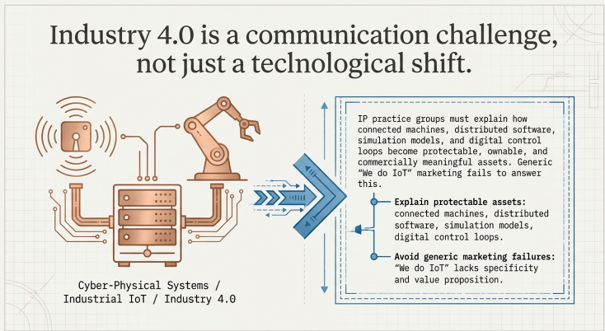
Industrial IoT, Smart Manufacturing, Cyber Physical Systems and Industry 4.0 are often described as technological shifts. That description is correct, but incomplete. For IP practice groups, these fields are also communication challenges. They require lawyers and patent attorneys to explain how connected machines, distributed software, sensor data, simulation models, automated production systems and digital control loops become protectable, ownable and commercially meaningful assets.
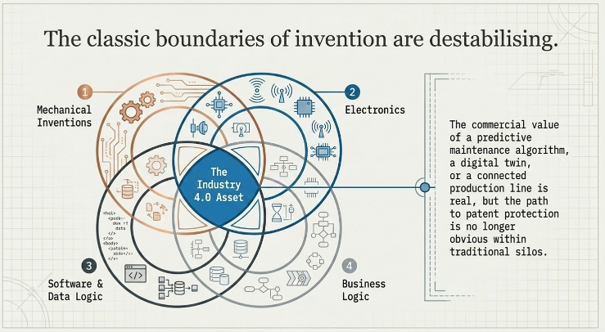
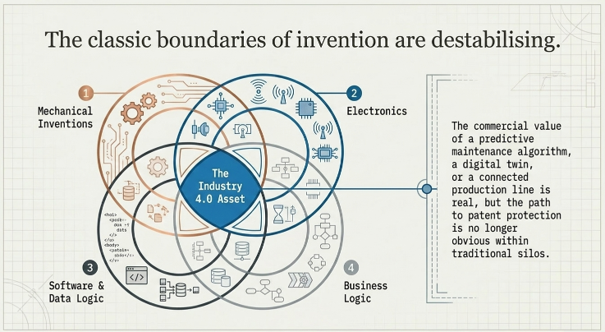
This is why the way IP firms frame Industry 4.0 matters. A practice group can present the topic as a matter of software patentability. It can frame it as an engineering challenge in which cyber physical systems require more precise claim drafting. It can treat it as a business architecture problem, where the value no longer sits in a single product but in the interaction between devices, platforms, data flows and services. Or it can use the topic to show clients that the classic boundary between mechanical inventions, electronics, software and business logic is becoming less stable.
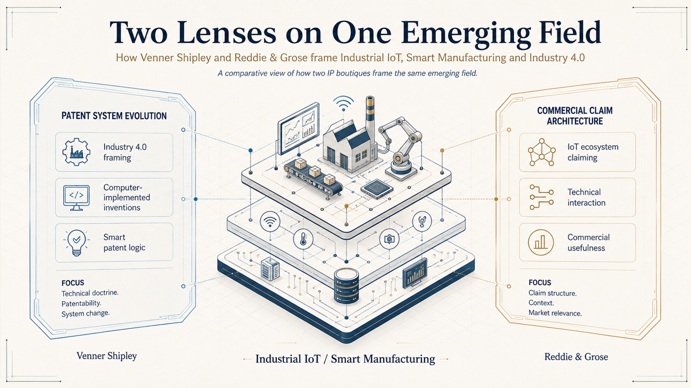
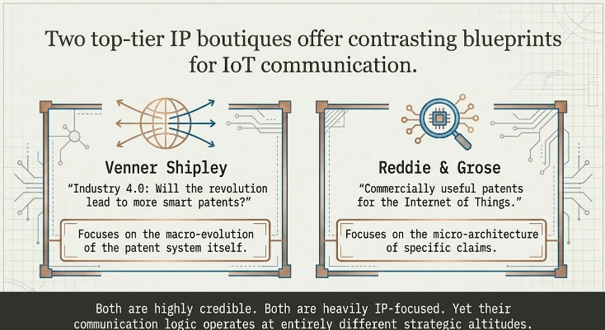
Venner Shipley and Reddie & Grose offer a useful comparison because both firms approach the same broad technological transformation from recognisably different angles. Both are IP focused firms with strong patent attorney traditions. Both discuss Industry 4.0, IoT and computer implemented inventions in a way that goes beyond a general practice page. Yet their communication logic is not identical.
Venner Shipley frames Industry 4.0 as part of a larger evolution of the patent system. Its article “Industry 4.0: Will the revolution lead to more smart patents?” places cyber physical systems, Industrial IoT, artificial intelligence, machine learning, blockchain, big data analytics and smart factories within a historical narrative of industrial revolutions and patent law adaptation. The emphasis is on whether patent systems can continue to protect inventions as innovation becomes increasingly digital, networked and computational.
Reddie & Grose, by contrast, is more immediately practical in the way it discusses IoT patenting. Its article “Commercially useful patents for the Internet of Things” focuses on how IoT inventions can be claimed in a way that better reflects their technical and commercial context. The central idea is that IoT patents are often stronger when the invention is not described as an isolated device, but as a device operating within an ecosystem of other devices, hubs, servers or control systems.
The comparison is not about which firm is better. It is about how two IP practice groups translate the same technological field into different advisory narratives.
Venner Shipley: Positioning Analysis
Venner Shipley’s positioning around Industry 4.0 is notable because it starts from the transformation of industry itself. The firm does not simply list technologies such as IoT, artificial intelligence or blockchain as service keywords. Instead, it places them within the broader movement from earlier industrial revolutions to a new generation of connected, data rich and software dependent industrial systems.
This framing has an important effect. It presents the patent attorney not only as a technical drafter, but as someone who understands how the patent system responds to structural technological change. The question is not merely whether a single invention can be patented. The larger question is whether the patent system can continue to provide meaningful protection when the inventive contribution may lie in software, simulation, interaction between machines or data enabled control.
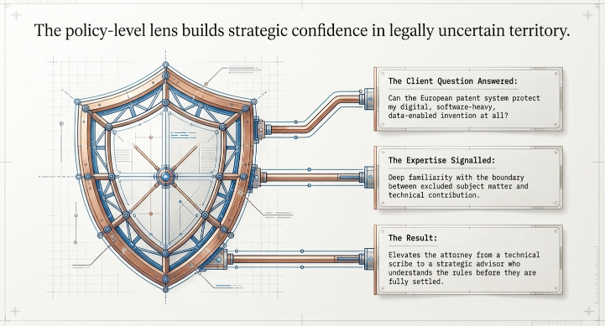
That is a strong communication position for an IP boutique. It suggests a practice group that is comfortable with doctrinal uncertainty and with the boundary between excluded subject matter and technical contribution. In the European patent context, that boundary is central to computer implemented inventions. For Industry 4.0 companies, this is not an academic issue. Their innovation may arise from predictive maintenance models, digital twins, production line simulations, machine learning based process control or communication between distributed industrial devices. The commercial value may be real, but the path to patent protection may not be obvious.
Venner Shipley’s Industry 4.0 content also benefits from its connection to patent system development. The firm refers to involvement with patentability guidelines for computer implemented inventions and to questions around simulations before the EPO. This matters because it gives the communication a policy and system level dimension. The firm is not only saying that it understands Industry 4.0 technologies. It is suggesting that it understands how the rules for protecting these technologies are evolving.
The positioning logic is therefore relatively high level and jurisprudential. Venner Shipley frames Industry 4.0 as a point where technology evolution and patent law evolution meet. That is valuable for clients whose innovations sit in legally uncertain territory, especially where the technical contribution is distributed across software, data, models and machines.
For IP business development, this is a sophisticated approach. It does not rely on sector marketing alone. It creates authority by explaining the structural problem behind the sector: Industry 4.0 produces inventions that challenge traditional categories, and clients need advisors who can translate those inventions into patentable technical contributions.
Reddie & Grose: Positioning Analysis
Reddie & Grose approaches the same broad field from a different communicative angle. Its IoT content is more immediately centred on the practical question of what makes an IoT patent commercially useful. This is a subtle but important difference. Rather than beginning with the evolution of industry and patent law, the firm begins with the practical architecture of the invention.
The core idea in Reddie & Grose’s IoT analysis is that patent applicants in Europe may have better success when the patent describes how the IoT device operates within its wider ecosystem. That could mean interactions with other connected devices, a server, a hub, a control unit or a wider system. This is a highly relevant insight for Industrial IoT and Smart Manufacturing because industrial value is rarely created by a standalone sensor or machine. It is created through coordinated operation.
In a smart factory, a sensor may detect a condition, a control system may interpret it, a machine may adjust its operation, a platform may store the data and a maintenance system may trigger an intervention. The invention may lie in how these elements interact. If the patent strategy focuses too narrowly on the device alone, it may fail to capture the economic logic of the system.
This is where Reddie & Grose’s communication becomes particularly useful. The firm’s message is not only about patentability in the formal sense. It is about claim architecture and commercial relevance. A patent for an IoT invention should not merely describe a technically clever object. It should capture the relationships that make the object valuable in practice.
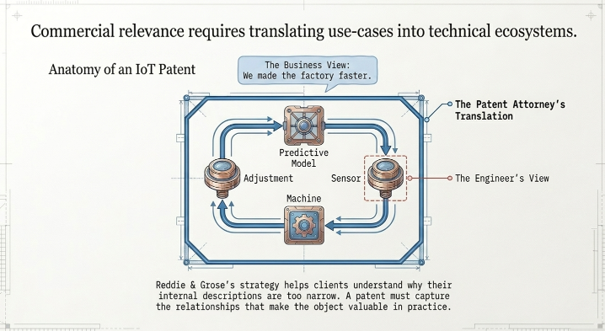
That framing is close to the practical work of patent drafting. It helps clients understand why their internal description of an invention may be too narrow. Engineers often describe the component they developed. Business teams often describe the use case. Patent attorneys need to translate both into a protection strategy that reflects the interaction between devices, data and infrastructure. Reddie & Grose’s IoT framing speaks directly to that translation task.
The firm’s broader IoT topic page also shows that this is not a one off reference. The collection of related insights points to a continuing interest in connected technologies, including AI and IoT inventions, wearable technologies, smart homes, the Internet of Medical Things and related software and system protection issues. That gives the positioning more depth than a single marketing mention.
For IP business development, the Reddie & Grose approach is strong because it turns a complex technological field into a practical client problem: How should an IoT invention be described and claimed so that the patent reflects the commercial system in which the invention operates?
The Connecting Element
The connecting element between Venner Shipley and Reddie & Grose is the translation of Industry 4.0 from technology language into patent strategy language. Both firms recognise that Industrial IoT and Smart Manufacturing are not simply new labels for old engineering inventions. They involve distributed technical systems in which value often emerges from interaction, automation, data processing and control.
Both firms therefore move beyond a narrow view of patents as documents that protect isolated devices. They present patent strategy as a way of capturing technological relationships. In Venner Shipley’s case, the relationship is between emerging digital industrial technologies and the evolving patent system. In Reddie & Grose’s case, the relationship is between IoT devices and the technical ecosystem in which they operate.
This makes the pair especially suitable for a comparative blog post. The shared theme is clear enough to create coherence. The difference is strong enough to create analytical value.
The Difference
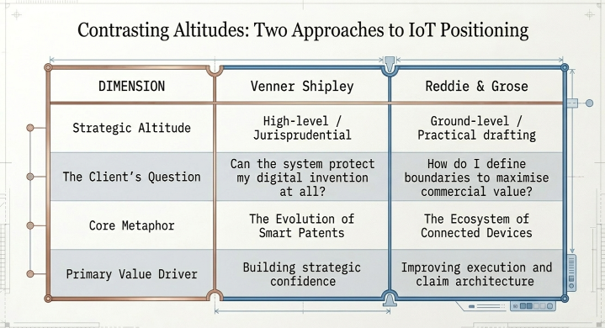
The main difference lies in altitude. Venner Shipley operates at a higher conceptual level. Its communication explains Industry 4.0 as part of a broad transition in technology and patent law. The emphasis is on smart patents, computer implemented inventions and the continuing ability of the patent system to protect digital industrial innovation.
Reddie & Grose operates closer to the drafting and protection logic of specific IoT inventions. Its communication asks how a patent can become commercially useful when the invention exists in an ecosystem. The emphasis is on claim context, technical interaction and the practical structure of the invention.
One could describe the difference as follows: Venner Shipley frames Industry 4.0 as a patent system challenge. Reddie & Grose frames IoT as a patent architecture challenge.
That distinction is valuable because both perspectives are needed. Companies working in Industrial IoT often need confidence that their software heavy, data enabled or simulation based inventions can be protected at all. They also need practical guidance on how to describe those inventions so that the protection matches the business reality. The first perspective builds strategic confidence. The second improves execution.
What IP Practice Groups Can Learn From This
The first lesson is that emerging technology marketing becomes stronger when it identifies the real uncertainty clients face. In Industry 4.0, the uncertainty is not simply technical. Clients may already understand their machines, sensors and software. What they may not understand is where the protectable invention sits. Is it in the device, the control logic, the model, the communication architecture, the data processing method, the simulation or the interaction between these elements?
Venner Shipley addresses this uncertainty by connecting Industry 4.0 to the evolution of patentability for computer implemented inventions. Reddie & Grose addresses it by showing that IoT claims become stronger when the ecosystem is part of the invention story. Both approaches are more useful than a generic statement that the firm advises on IoT.
The second lesson is that IP practice groups should avoid treating Industrial IoT as one homogeneous sector. The field cuts across manufacturing, logistics, energy, healthcare, consumer devices, robotics, telecommunications and software. A convincing IP Subject Matter Expert should therefore explain the control points in the system, not just the technology category.
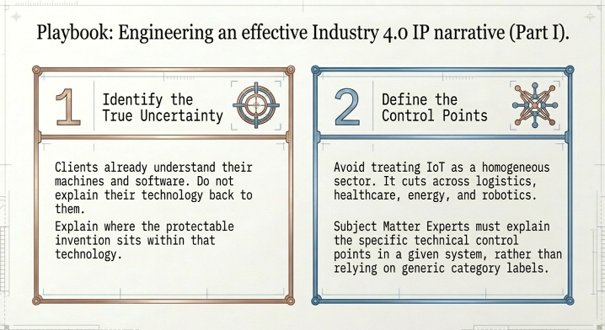
The third lesson is that good thought leadership can make legal complexity commercially intelligible. Clients do not necessarily need an abstract explanation of European software patent law. They need to understand why a predictive maintenance algorithm, a digital twin or a connected production line may require a different protection strategy from a traditional mechanical improvement.
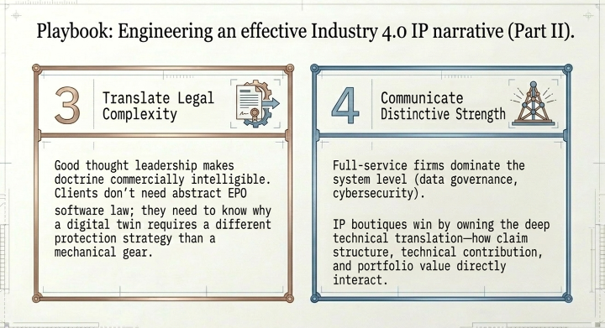
The fourth lesson is that IP boutiques can compete effectively in emerging technology fields when they communicate their distinctive strength. Full service law firms often frame IoT through regulation, data governance, product liability and cybersecurity. IP boutiques can bring something different: a deeper explanation of how technical contribution, claim structure, patentability and portfolio value interact.
Why This Matters for IP Business Development
For IP business development, the comparison between Venner Shipley and Reddie & Grose shows that thought leadership is not mainly about having content on a trending topic. It is about owning a useful interpretation of that topic.
Industrial IoT and Smart Manufacturing are attractive themes because they sit exactly where many companies experience uncertainty. Their products are becoming connected. Their machines generate data. Their software increasingly determines performance. Their competitive advantage may lie in system behaviour rather than in a visible mechanical feature. At the same time, they may not know whether their existing IP processes are able to identify, capture and protect that new value.
This creates an opportunity for IP practice groups. The role of the IP Subject Matter Expert is not only to answer patentability questions after an invention disclosure has been written. It is to help companies recognise where the invention is located in a cyber physical system. That may require a different conversation with engineers, product managers, data teams and business leaders.
Venner Shipley’s framing is useful because it gives clients a broader confidence narrative: the patent system can adapt, but the strategy must understand how digital industrial inventions fit within evolving rules for computer implemented inventions. Reddie & Grose’s framing is useful because it gives clients a practical action narrative: describe and claim the IoT invention in the context of the ecosystem that creates its technical and commercial value.
Together, the two approaches show how IP boutiques can build market visibility without becoming generic technology commentators. They can speak from their core competence, but connect that competence to the business realities of Industry 4.0. That is the essence of strong IP business development. The expertise remains legal and technical, but the communication makes it relevant to market transformation, investment decisions and competitive positioning.
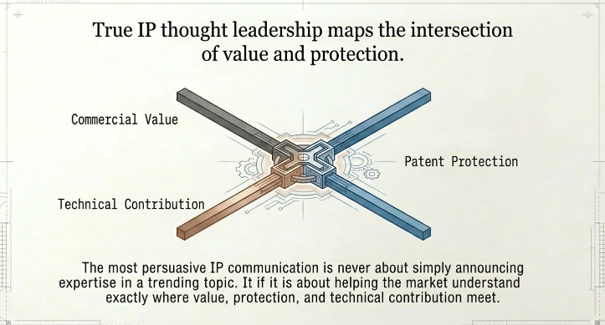
The learning point is not that every IP firm should communicate in the same way. The opposite is true. Venner Shipley and Reddie & Grose are interesting precisely because they do not tell the same story. One emphasises the evolution of smart patents in the fourth industrial revolution. The other emphasises commercially useful claim strategy for IoT ecosystems. Both are credible. Both are useful. And together they show that in Industrial IoT, the most persuasive IP communication is not about announcing expertise. It is about helping the market understand where value, protection and technical contribution meet.
_______________
This post draws on the following publicly available materials:
Venner Shipley
Industry 4.0: Will the revolution lead to more smart patents?
https://www.vennershipley.com/insights-events/industry-4-0-will-the-revolution-lead-to-more-smart-patents/
Patenting the Internet of Things
https://www.vennershipley.com/insights-events/patenting-the-internet-of-things/
Reddie & Grose
Commercially useful patents for the Internet of Things
https://www.reddie.co.uk/2020/09/14/commercially-useful-patents-for-the-internet-of-things/
Internet of Things – Featured Insights
https://www.reddie.co.uk/tag/internet-of-things/
EPO study gives evidence for fourth industrial revolution
https://www.reddie.co.uk/2017/12/18/epo-study-gives-evidence-for-fourth-industrial-revolution/
Context
Patents and the Fourth Industrial Revolution
https://link.epo.org/web/fourth_industrial_revolution_2017__en.pdf