
Europe’s Hidden IP Bottlenecks: What the 2026 Index Reveals About Europe’s Next Innovation Challenge

Europe does not lack innovation activity. Across universities, startups, scale-ups, research institutes, industrial ecosystems and public funding programs, new technologies are being developed at impressive speed. Artificial intelligence, quantum technologies, robotics, digital health, GreenTech, industrial IoT, smart manufacturing, connected mobility and data-driven platforms are no longer distant future topics. They are becoming concrete fields of investment, research, market formation and strategic competition.
Yet there is a less visible question behind this technological momentum: where does the necessary IP expertise come from? This was the central theme behind the presentation of the IP Expertise Demand Index 2026 at the international CEIPI Summer School in Strasbourg. The Index, developed and observed by IPBA Connect for around 20 years in parallel with the Master for IP Law and Management, addresses a structural challenge that is becoming increasingly relevant for Europe’s innovation system. New IP needs arise faster than established IP service markets can always recognize, translate and serve them.
The problem is not simply a lack of patents. Nor is it a lack of excellent patent attorneys, lawyers, IP consultants or technology transfer professionals. The problem is more subtle: IP demand and IP supply do not always emerge at the same time, in the same language, or around the same categories. This is where the IP Expertise Demand Index becomes important.
From Patent Activity to Expertise Demand
Traditional IP indicators usually look at visible IP activity. They count patent applications, analyse filing trends, identify major applicants, compare technical fields or track litigation and licensing activity. These indicators are valuable because they show where IP is already happening. But they do not necessarily show where IP expertise is about to be needed.
The IP Expertise Demand Index starts earlier. It asks a different question: where is decision pressure emerging for the users of the IP system? Where do startups, universities, research organizations, scale-ups, investors, technology transfer offices and innovation-driven companies need IP orientation, even before they can formulate a classical IP mandate?
This distinction is crucial. A startup may not begin by asking for a patent application. It may ask what it can disclose to investors without losing control. A university may not begin by asking whether an invention is patentable. It may ask how research can be translated into a transfer-ready asset. A scale-up may not begin by asking for a freedom-to-operate opinion. It may ask what IP position is needed to secure financing, partnerships, market entry and international scaling.
All of these are IP questions, but they do not always appear as conventional IP service requests. They often emerge before a patent filing, before a licensing negotiation, before a due diligence process and sometimes even before the product or business model has been clearly defined. The Index is designed to detect this early-stage demand.
Why Digital and Emerging Technologies Change the IP Question
The need for such an Index becomes especially clear in digitally transformed and technology-driven business models. In more traditional industrial settings, the link between technology, product and IP right was often relatively direct. A technical solution was developed, patented, incorporated into a product and used to protect against imitation. In digital and emerging technology ecosystems, this logic is no longer sufficient.
A modern digital business model may combine a physical product, sensors, connectivity, analytics, software, data services, user interfaces, cloud infrastructure, platform access and recurring service revenue. Customer value often no longer arises from one protected invention alone, but from the interaction between multiple layers of a system. This changes the IP question. It is no longer only about what invention can be patented. It becomes a question of where the control point in the business model is located.
That control point may lie in the algorithm, the data, the interface, the user experience, the system architecture, the training process, the regulatory evidence, the platform access, the brand, the standard, the workflow, the integration know-how or the service layer. This shift can be seen across many familiar examples. Spotify does not merely compete through access to music files. Its value proposition depends on personalization, taste profiles, playlists, user experience and reliable digital delivery. Sonos connects hardware with digital service functionality and multiroom experience. Google enters new ecosystems such as automotive not only through devices, but through data, content, voice interfaces and user interaction.
Kindle is not just an e-reader; it is part of a platform, contract and content ecosystem. Mastercard protects interoperability as a strategic asset. Philips and Signify show how a technological transformation in lighting can evolve into licensing structures, connected light points and “light as a service.” In each case, IP is not just a legal layer at the end of innovation. It becomes part of business model design. This is precisely why IP expertise must be available earlier and in a more strategic form.
The Structural Origin of the IP Expertise Gap
The recurring gap between demand for IP expertise and the available supply of IP services has a structural origin. Innovation moves along new value creation patterns, while service markets move along established categories. Patent attorneys, lawyers and IP consultants are typically organized around recognizable and billable tasks: patent drafting, prosecution, opposition, freedom-to-operate analysis, portfolio review, contract drafting, licensing, enforcement or litigation. These services are essential, but they usually become visible when a mandate can already be clearly formulated.
Emerging IP needs often arise before that point. A founder may not know whether the relevant asset is a patentable invention, a trade secret, a dataset, a software workflow, a regulatory file, a platform position or a customer access model. A technology transfer officer may face publication pressure, uncertain ownership structures, public funding conditions and unclear spin-off pathways. A scale-up may struggle with open-source dependencies, customer pilots, background IP, data access, investor expectations and future litigation risks at the same time.
The user has an integrated business problem. The service market often offers specialized IP instruments. This creates a translation gap. The demand side speaks the language of funding, market entry, product roadmap, customer pilots, regulation, investor confidence, partnership risk and scaling. The supply side often speaks the language of patentability, priority, claim scope, FTO, licensing, enforcement, trademarks, designs and contracts. Both languages are valid, but they do not automatically connect.
The IP Expertise Demand Index makes this disconnect observable. It identifies fields where users increasingly need IP support but where visible, accessible and strategically framed expertise is not yet sufficiently present.
What the 2026 Index Measures
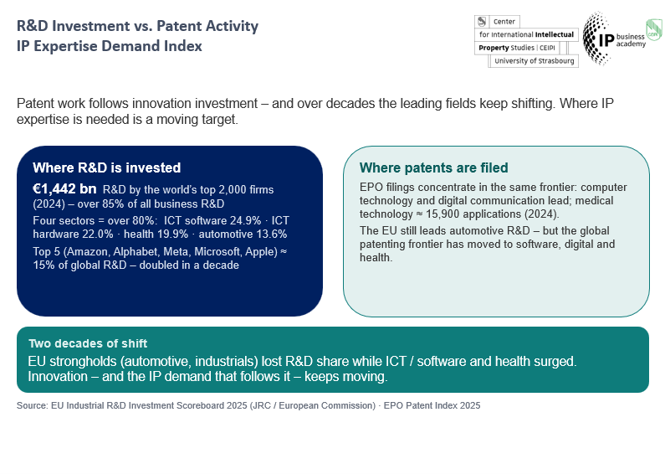
The 2026 edition of the Index is built around the idea that expertise demand cannot be understood from patent data alone. It must be derived from several signal groups. The first dimension is market momentum: where investments are flowing, where startups are emerging, where public programs, corporate initiatives, product launches and industrial partnerships are forming.
The second dimension is IP relevance. This dimension asks whether IP is strategically important in the field. It looks at whether patents, trade secrets, data rights, software protection, design rights, trademarks, standards, licensing, freedom to operate or regulatory evidence are likely to shape competition. The third dimension is decision pressure. It asks whether companies, universities or ecosystems are forced to make IP-related decisions soon because of regulation, standardization, funding conditions, market entry, partnerships, financing rounds or litigation risk.
The fourth dimension is audience accessibility. It asks whether the relevant users are identifiable and reachable, such as startups, scale-ups, TTOs, investors, research consortia, corporate innovators or IP departments. The fifth dimension is the expert visibility gap. It asks whether there are already visible IP experts positioned for this field, whether they speak the language of the users, and whether their services are framed around the actual business and technology questions rather than only around classical legal categories.
This fifth dimension is particularly important. It is where the Index differs from a technology trend report or a patent landscape. The Index is not only about where innovation is happening. It is about where IP expertise is needed and where the advisory market may not yet be sufficiently visible or aligned.
The 2026 Demand Fields
The 2026 edition covers a broad range of European innovation fields. These include GreenTech topics such as battery circularity and recycling, hydrogen and electrolysis, smart grids and storage, and clean mobility infrastructure. They include MedTech and Digital Health fields such as AI-based diagnostics, connected and surgical devices, digital health data platforms, implants and 3D printing.
The Index also looks at quantum technologies, robotics and autonomous systems, industrial IoT and smart manufacturing. It includes cross-cutting fields such as UPC software patent enforcement, SEP/FRAND and standards, and the new importance of GUI protection under the EU Design Act. This diversity matters because the Index does not treat emerging technologies as broad buzzwords. It decomposes them into concrete expertise markets.
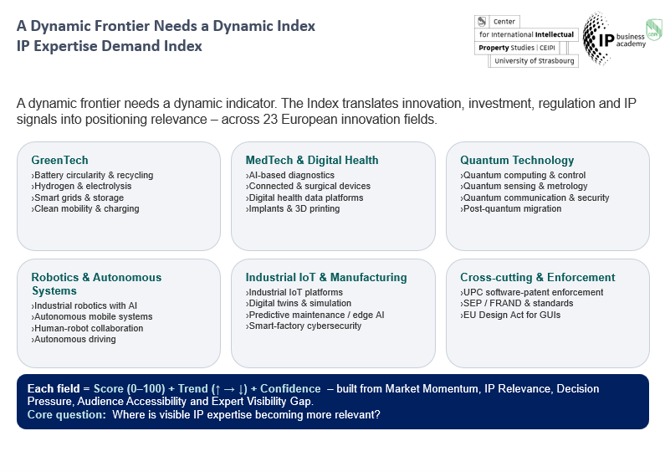
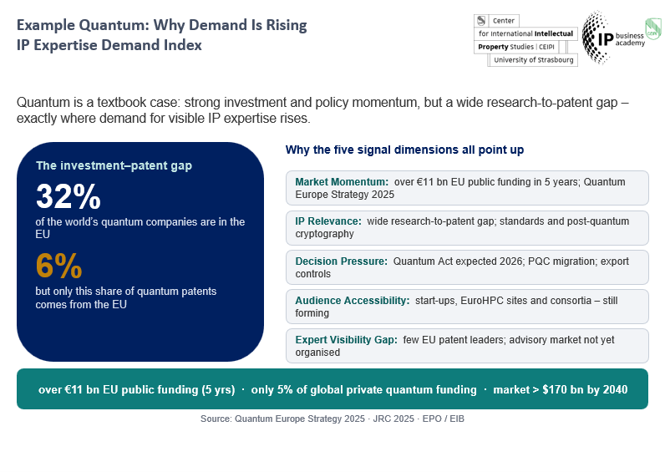
Quantum is a good example. “Quantum” as a label is too broad to be useful for IP positioning. Quantum computing hardware, quantum software, quantum simulation, quantum communication, post-quantum security migration, quantum sensing and enabling technologies each raise different IP questions. They involve different users, different assets, different timelines and different advisory needs.
The same is true in robotics. Industrial robotics with embedded AI is not the same as autonomous mobile systems, human-robot collaboration or autonomous driving. Each field has its own mix of patents, software, data, system FTO, safety standards, liability questions, trade secrets and ecosystem dependencies. A serious IP demand index must therefore segment emerging fields according to IP logic, not according to fashionable labels.
Why the Index Matters for Europe
For Europe, this is not only a professional services question. It is an innovation policy and competitiveness question. Europe is strong in research, engineering, public funding, industrial competence and regulatory sophistication. But technological strength does not automatically become economic control. It must be translated into assets, positions, partnerships, standards, licensing models, enforceable rights, data governance and scalable business models.
This translation requires IP expertise. If that expertise arrives too late, innovation actors may publish too early, disclose too much, sign weak collaboration agreements, misunderstand FTO risks, neglect software or data assets, miss standardization opportunities or fail to build investable IP positions. The result is not necessarily immediate legal failure. More often, it is a gradual loss of strategic optionality.
The Index therefore treats IP expertise as part of Europe’s innovation infrastructure. Just as startups need access to capital, labs, talent and markets, they also need access to the right IP expertise at the right time. Just as universities need technology transfer structures, they need strategic IP translation capacity. Just as scale-ups need financing and customers, they need IP positions that support growth, partnerships and resilience. The Index shows where this infrastructure is under pressure.
A Market Signal for IP Experts
For patent attorneys, IP consultants, lawyers and strategic advisors, the Index is also a market signal. It shows where demand is likely to emerge before the advisory market is fully organized. That creates a positioning opportunity. The question is no longer whether an IP expert should generally “do AI” or “do GreenTech” or “do quantum.” That is too broad. The more important question is which specific IP expertise field can be credibly occupied.
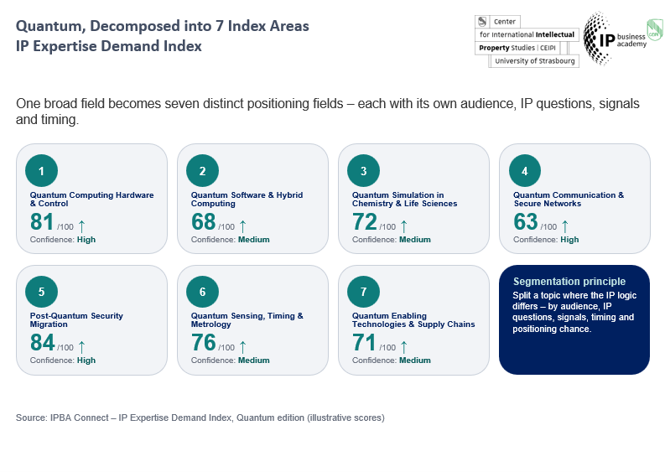
IP for AI-based diagnostics is different from IP for foundation models. IP for battery recycling is different from IP for hydrogen electrolysis. IP for robotic system FTO is different from IP for human-robot interaction. IP for post-quantum migration is different from IP for quantum sensing. IP for digital health data platforms is different from IP for connected surgical devices.
The Index helps experts sharpen their market positioning around real user needs. This requires more than technical knowledge. It requires the ability to translate. IP experts must connect technology, business model, regulation, financing, market access and legal instruments. They must help users understand which IP decisions matter, when they matter and how they affect strategic options. In this sense, the Index is not only a demand map. It is a positioning map for IP expertise.
The Core Message of the 2026 Edition
The core message of the IP Expertise Demand Index 2026 is clear: Europe’s next IP bottleneck is not simply the number of patents. It is the timely availability and visibility of strategic IP expertise in emerging fields. Innovation creates IP demand before the IP market has a name for it.
The role of the Index is to make that demand visible. It connects investment momentum, technological change, patent activity, regulatory pressure, user needs and expert visibility. It shows where users of the IP system need orientation before they know which mandate to give. It shows where IP professionals can become more relevant by positioning earlier, more clearly and closer to the real decision pressure of innovation actors.
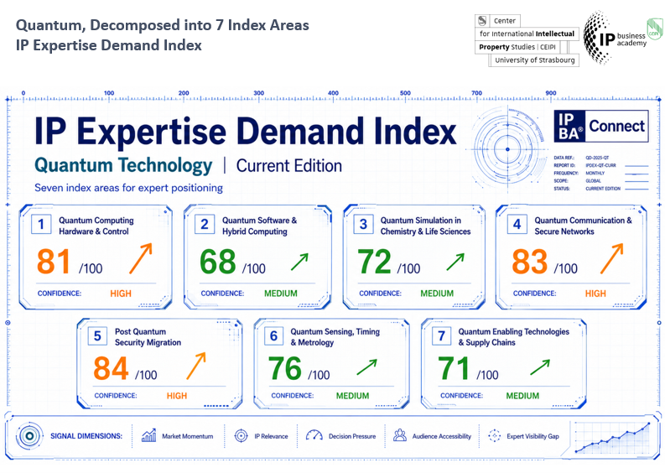
For Europe’s innovation system, this matters deeply. Research must become value creation. Technology must become market position. Public investment must become industrial capability. Startups and scale-ups must become globally competitive companies. None of this happens through IP rights alone. But none of it happens sustainably without the right IP expertise.
The IP Expertise Demand Index 2026 therefore invites a change of perspective. Do not only ask where patents are being filed. Ask where IP decisions will shape the future of an emerging field. Do not only ask which technologies are trending. Ask where users need strategic orientation and cannot yet find it easily. Do not only ask what services IP experts currently offer. Ask where their expertise will be needed next.
That is the real value of the Index: it turns weak signals into strategic orientation. It helps Europe see where IP expertise must be mobilized before the gap becomes a structural weakness. And it helps IP experts understand where they can contribute most meaningfully to the future of innovation.
The current IP expertise demand index 2026 was presented at the CEIPI Summer School on the 29th of June 2026 by Prof. Dr. Alexander Wurzer. You can find the presentation here.