
Dr. Urs Ferber on Quantum Patent Portfolios: Why Deep Tech IP Needs Commercial Direction

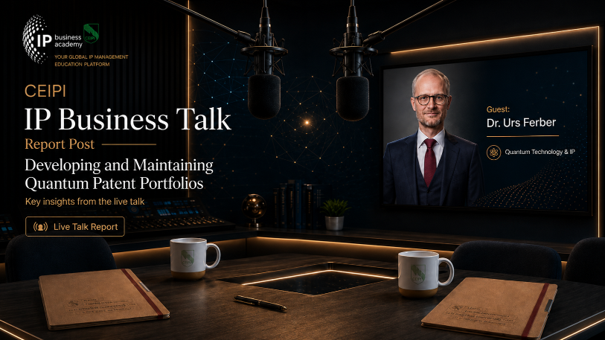
The CEIPI IP Business Talk with Dr. Urs Ferber focused on one of the most difficult questions in today’s deep-tech IP practice: how should quantum companies develop and maintain patent portfolios when the technology, the market, the product architectures and the competitive landscape are still evolving?
This was not a discussion about whether quantum inventions can be patented in principle. The more relevant question was how companies should decide what is worth protecting, when they should file, how broad their protection should be, and how a portfolio can remain useful while the underlying technology continues to move. That distinction shaped the whole conversation.
Dr. Urs Ferber, Partner and Patent Attorney at Mewburn Ellis in Munich, brought a particularly valuable perspective to this topic. His professional profile positions him as someone who helps start-ups and companies at the frontier of quantum technology and medtech build commercially valuable IP portfolios. It also highlights his role as a European and German Patent Attorney, his work in the Engineering team at Mewburn Ellis, and his experience with start-ups in shaping IP strategies that contribute to commercial success.
That combination was visible throughout the live talk. Ferber did not present quantum IP as a technical filing exercise. He presented it as a management discipline. The key question is not simply whether a technical idea is new or inventive. The key question is whether protecting that technical idea supports the company’s commercial roadmap, investor story, future freedom to operate and position in the emerging quantum ecosystem.
A rare combination: physics, start-up experience and IP strategy
Ferber’s credibility in the discussion came from the way he connected technical understanding with business relevance. At the beginning of the talk, he explained how he came into quantum IP: Mewburn Ellis saw quantum as a growing market and deliberately built a quantum team with people who have relevant technical backgrounds. Ferber, with his physics background and experience working with quantum start-ups, became part of that team and later took a leading role in it.
This matters because quantum technology is not a field where generic patent knowledge is enough. The subject matter can involve hardware architectures, algorithms, error correction, photonics, sensing, quantum communication, control systems, enabling components and software layers. A patent attorney advising in this space must understand not only the legal framework, but also the technical substance and the commercial context in which that technology may later create value.
Ferber’s profile also reflects this attitude. He emphasizes that he wants to understand the technical solutions of his clients and provide legal advice based on that understanding. That is precisely what the live talk demonstrated: a way of advising that starts from the technology, but does not stop there. The objective is not only to obtain patents, but to build portfolios that help companies succeed.
This is particularly important for start-ups. Many quantum start-ups originate from universities or research institutes. They often have highly sophisticated science, but their business model, product roadmap and commercial implementation may still be under development. Ferber’s approach fits this situation because it helps translate research-driven innovation into structured IP decisions. His recurring message was that patents must be aligned with the company’s commercial ambition.
Patents must serve the commercial roadmap
One of Ferber’s clearest statements in the live talk was that a patent is a commercial asset. Filing, prosecuting and maintaining a patent requires investment. For a start-up with limited resources, that investment must be justified. It is therefore not enough to ask whether an invention could be protected. Companies must ask whether protection would support their roadmap, their milestones and their business objectives.
This is where Ferber moved the discussion away from a simplistic filing logic. He explained that every start-up has, or should have, a roadmap: what it wants to achieve in the next two or three years, which milestones matter, and which technical developments support those milestones. Patent strategy should be aligned with that roadmap. If a patent application supports the commercial strategy, it may be worth filing. If it does not, it may be merely “nice to have” and therefore less valuable.
This is a highly practical view of IP. It avoids both extremes: filing everything because the technology is exciting, and filing too little because the market is still uncertain. Quantum companies often operate in a fluid environment where the dominant design is not yet clear. Ferber’s answer to this uncertainty is not paralysis. It is alignment. A company does not need to know the entire future of quantum computing, quantum communication or quantum sensing. But it does need to understand its own commercial direction well enough to identify which IP positions may matter.
Ferber also highlighted that patents can have functions beyond exclusion. A positive search report may help demonstrate to investors that the company is working in a technically distinctive area. For a start-up seeking funding, this can be important. The patent is not only a right to exclude competitors; it can also become part of the investor narrative. It can show that the company has made something technically meaningful and potentially defensible.
At the same time, Ferber was careful not to confuse patent ownership with freedom to operate. He noted that some investors may care even more about whether the company can operate in the future than about whether it has its own patent rights. This distinction is crucial. A patent does not automatically give permission to commercialize. Quantum start-ups need to understand both sides: what they can protect and where they may be blocked by others.
Timing, publication pressure and the discipline of early decisions
Another major theme of the live talk was timing. Quantum technology is strongly connected to academic research. Many inventors want or need to publish, whether for scientific reputation, PhD progress or funding-related visibility. In Europe, this creates a difficult situation because publication can destroy novelty. Ferber treated this as a practical problem that companies must actively manage.
His first point was simple: the issue must be considered early. Once the information is out, patent protection may no longer be available. But Ferber’s answer was not merely “file before publishing.” He offered a more nuanced and useful distinction: the scientific discovery and the commercial implementation may not be identical.
This distinction is extremely important for quantum start-ups and university spin-outs. A scientific publication may describe the discovery, the experiment or the theoretical result. The patent application, however, may focus on the practical implementation, the commercial application, the product architecture or the enabling technical detail that turns the discovery into a usable technology. If that separation is handled properly, scientific communication and patent protection can be coordinated rather than treated as mutually exclusive.
Ferber also stressed the importance of speed. In the start-up environment, speed is not only important for patent filing. It is important for the entire commercial activity. Competitors are moving, investors are watching, and public funding procedures may not always keep up with the pace of development. This was one of the strongest practical messages of the talk: quantum companies cannot afford to treat IP as an afterthought.
But speed does not mean rushing into weak filings. It means building an IP process that is close enough to R&D and business development to ask the right questions at the right time. What is being disclosed? What is commercially relevant? What might competitors do? What will investors want to see? What should be kept confidential? What should be filed now, and what can wait?
Ferber’s strength was to show that good quantum IP practice is not a single decision. It is a continuous conversation with the company.
Portfolio work must evolve with funding, business models and FTO
A further part of the discussion focused on funding models and portfolio maintenance. Ferber explained that public funding and private investment can create different dynamics. Public funding may be more accessible in early stages and may provide flexibility for exploratory development. Private investors, by contrast, often look more closely at the commercial roadmap and whether the patent strategy supports it.
This has direct consequences for IP advice. A patent strategy cannot be decided once and then remain fixed. As Ferber emphasized, the portfolio must be continuously reviewed against the company’s roadmap, funding situation and business plan. The company may move from public funding to private investment, from research proof-of-concept to product development, from a narrow technical use case to a broader platform. Each shift changes what the IP portfolio should do.
Ferber also connected IP strategy to business model design. A hardware-focused quantum company faces different IP questions from a company offering Quantum-as-a-Service, algorithmic solutions or software-based control technologies. If the product is a physical component, infringement may be easier to detect and jurisdictions may be selected around development, manufacturing and competitor locations. If the value lies in algorithms, software, services or internal technical processes, enforcement may be harder, and trade secret protection may sometimes be more attractive.
This led to one of the most important parts of the discussion: the relationship between patents and trade secrets. Ferber did not frame this as a simple choice. His view was much more practical. First, a company must identify what know-how it actually has. Then it must ask whether that knowledge should be patented, kept secret, contractually protected or managed in some other way. The answer depends on value, enforceability, disclosure risk, competitive context and whether the company would realistically enforce the right.
This is where Ferber’s advisory style became especially clear. He repeatedly returned to the importance of asking the right questions. The mistake is not always making the wrong decision. Often the mistake is never having the conversation in the first place. In fast-moving companies, development happens quickly and IP is addressed too late. Ferber argued for a closer alignment between IP, R&D and business strategy.
Freedom-to-operate is part of this same logic. Ferber described FTO as a tool that can shape business decisions. If one technical route is blocked, a company may pursue another. If third-party rights exist, licensing or collaboration may become more sensible than independent development. Sometimes the existence of another party’s patent position may even encourage a start-up to integrate external technology rather than solve every problem internally. In that sense, IP does not merely protect a strategy. It helps shape the strategy.
Why Urs Ferber’s competence matters for quantum companies
The live talk made one thing very clear: quantum IP needs experts who can make complexity actionable. Dr. Urs Ferber demonstrated exactly that capability. He combined technical understanding, patent law, start-up experience and commercial judgement into a coherent approach to portfolio building.
His central message was not that quantum companies need more patents. It was that they need better IP decisions. Those decisions must be aligned with the business roadmap, credible from a technical and legal perspective, useful for investors, conscious of FTO risks, sensitive to publication pressure and flexible enough to evolve with the company.
For users of the IP system, this is a decisive point. Quantum technology is not yet a mature market with settled product categories and stable value chains. It is an emerging ecosystem. In such an environment, IP advice must do more than document inventions. It must help companies understand where future control points may arise, where freedom to operate may be at risk, where disclosure must be managed, and where a patent can support funding, negotiation or strategic positioning.
That is the competence Ferber brought into the CEIPI IP Business Talk. He did not reduce quantum IP to legal formalities. He showed how patent strategy becomes part of deep-tech company building. For quantum start-ups and scale-ups, this can make the difference between having a collection of patent filings and having a portfolio that supports commercial success.
The strongest takeaway from the live talk is therefore simple: in quantum technology, IP must be early, informed and continuously aligned. It must move with the science, the funding, the market and the business model. Urs Ferber’s contribution showed what this kind of IP expertise looks like in practice.
Those interested in the background regarding quantum technology and IP can find the IPBA Connect Industry Focus “Quantum Technology and the Structural Lag of IP Decision-Making” here.
Dr. Urs Ferber
 Dr. Urs Ferber is a Partner and Patent Attorney at Mewburn Ellis LLP in Munich. He is a European and German Patent Attorney and works in the firm’s Engineering team. His professional focus lies at the intersection of science, technology and commercialisation, particularly in quantum technology and medtech.
Before joining Mewburn Ellis, Urs Ferber worked for several years as a patent attorney at Flügel Preissner Schober Seidel. At Mewburn Ellis, he first served as Senior Associate before becoming Partner in April 2024. His academic background includes physics studies at the University of Ulm and University College Dublin, where he completed his PhD. His technical expertise includes biophysics, optics and microscopy.
In his own professional profile, he emphasises that he helps build commercially valuable IP portfolios for start-ups and companies at the frontier of quantum technology and medtech. He also highlights his experience in shaping IP strategies that contribute to the commercial success of start-ups while remaining attractive and motivating for inventors.
Mewburn Ellis quantum practice group
The quantum practice group at Mewburn Ellis positions itself as an interdisciplinary IP resource for companies working in quantum computing, quantum sensing, quantum communication, quantum software, control systems, QPU architectures, enabling technologies and related deep-tech fields.
Its communication is particularly strong because it does not isolate quantum IP from the business context. Instead, it explains how IP connects to commercialisation, investment readiness, technical roadmaps, scaling, collaboration and ecosystem development.
This makes Mewburn Ellis an important example of how IP firms can make emerging technology fields legible to the market. In quantum technology, users of the IP system often do not yet know exactly which IP questions they should ask. Strong IP communication therefore helps them understand where future value may arise, where control points may emerge, and why IP decisions need to be made earlier and more strategically.