
Strategic IP Management Decision Case with Ralf Klädtke: IP Autonomous Industrial Inspection

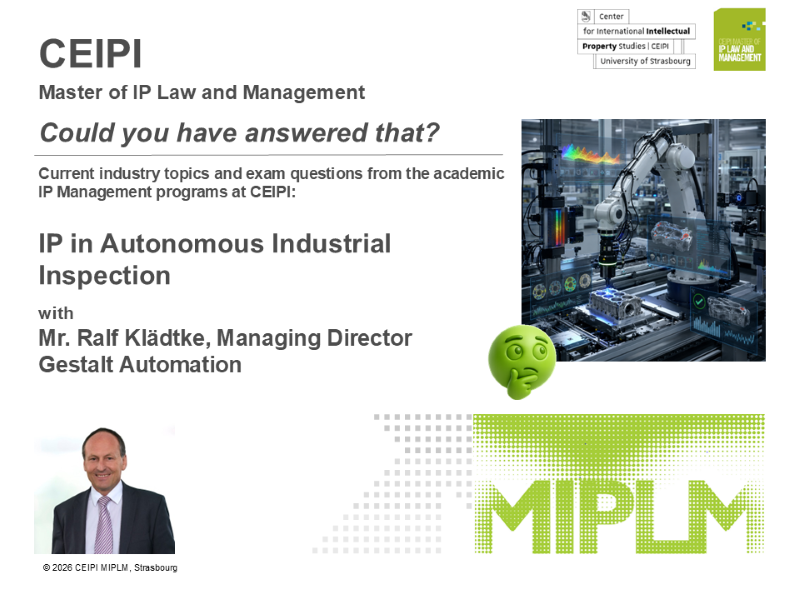
Autonomous industrial inspection cells are no longer only about automating visual inspection or replacing manual quality checks with faster machines. They are increasingly becoming strategic decision systems within high-volume manufacturing environments. In such systems, value is not created by one camera, one robot, one sensor or one AI model alone.
It emerges from the reliable integration of robotic handling, hyperspectral imaging, advanced sensor fusion, AI-supported quality decisions, calibration know-how, production experience and customer-specific process adaptation. The decisive competitive advantage may therefore lie less in the visible inspection cell itself than in the architecture that turns complex manufacturing data into trusted quality decisions in real time.
This creates a strategic IP challenge for industrial automation companies. Autonomous inspection cells may become valuable because they detect material defects, identify process deviations, support production stability, improve yield and create decision confidence in manufacturing environments where reliability, speed and traceability matter.
Yet the same system architecture that enables industrial deployment, customer-specific learning and international scaling also raises difficult questions about ownership, disclosure and control. AI models may improve through customer production data. Defect libraries may reflect highly specific manufacturing experience. Calibration methods, data structures, deployment routines and process-specific optimizations may become more valuable than any isolated technical feature.
The Ralf Klädtke case highlights exactly this tension in the context of autonomous industrial inspection cells. The company’s competitive position does not arise from a single patentable invention. It results from the way sensors, software, AI models, calibration expertise, operational know-how and customer-specific data are combined into a reliable industrial solution.
This is closely connected to the shift described in the IP Business Academy analysis “The Robotics Strategy Gap”. The article argues that robotics companies are increasingly building autonomous systems connected to sensors, AI models, control software, operational data, simulation environments, cloud infrastructure and human workflows, and that IP must move from a narrow protection function toward an integrated decision system for embodied intelligence.
Here you find the findings of this study: “The Robotics Strategy Gap: What Autonomous Systems Companies Need, and What IP Advice Still Often Fails to Integrate”.
Against this background, the CEIPI IP Business Academy integrates practice-based questions from industry into its teaching. These questions help students understand IP not only as a legal protection tool, but as a management instrument for strategic business decisions in complex technology environments. In autonomous industrial systems, this means asking not only what can be patented, but what must be controlled, disclosed, kept secret, contractually governed or shared in order to create sustainable enterprise value.
We are therefore pleased to include this industry case study with Ralf Klädtke, who brings a practitioner perspective to the question of IP strategy for autonomous industrial inspection cells.
His practical question focuses on a central issue for AI-supported industrial automation: how should a company structure its IP strategy when the most valuable assets may sit in sensor fusion, AI training methods, defect libraries, calibration expertise, customer-specific optimization, operational data and the trusted use of manufacturing knowledge?
The case shows why robotics and autonomous industrial systems require a hybrid IP management approach that connects patents, trade secrets, contracts, data governance, customer trust and commercialization strategy. It also shows why the success of an IP strategy should not be measured by the number of rights filed, but by the business value created through sustainable differentiation, stronger customer relationships, licensing opportunities, freedom to operate and long-term enterprise value.
Decision Context
A mid-sized industrial automation company has developed autonomous inspection cells for high-volume manufacturing environments. The solution combines robotic handling, hyperspectral imaging, advanced sensor fusion and AI-supported quality decisions to detect material defects and process deviations in real time.
The company’s competitive advantage does not arise from a single technical invention. It results from the intelligent integration of sensors, software, AI models, calibration methods, production know-how and customer-specific process adaptation into a reliable industrial solution.
As AI technologies become increasingly accessible, differentiation shifts from individual algorithms to system architecture, customer-specific learning, operational experience and trusted use of production data. Industrial customers increasingly expect exclusive value from AI models trained with their own manufacturing data.
The management team now faces a strategic business decision before scaling internationally. Competitors are entering the market with similar AI-based solutions, while customers request deeper access to system interfaces, operational data and AI capabilities.
The key question is not simply how to protect technology. It is how an IP Strategy can best support sustainable competitive advantage, customer trust, commercialization opportunities and long-term enterprise value.
The Decision
Before expanding internationally, the company must decide how to structure its IP strategy to support long-term business success rather than simply maximizing legal protection.
Management must determine which technologies create sustainable competitive advantage and therefore justify patent protection, which know-how should remain confidential, and which customer-specific developments should be governed through contractual agreements. The objective is to balance protection, commercialization, customer trust and operational flexibility.
One option is to build a visible patent portfolio around externally observable system functions, inspection workflows, platform interfaces and safety-relevant technologies. Such patents may strengthen market positioning, investor confidence, licensing opportunities and corporate valuation, provided they offer effective protection and can realistically be enforced.
Another option is to retain the most valuable knowledge as trade secrets, including AI training methods, defect libraries, calibration expertise, deployment know-how and customer-specific optimization. Where AI models are trained using customer production data, management must also determine whether the resulting intellectual property should remain company-owned or become customer-specific IP to strengthen trust and long-term customer relationships.
The decision is therefore not simply whether to patent or maintain secrecy. It is how intellectual property should be managed to maximize business value, support sustainable competitive differentiation and generate an appropriate return on investment from IP activities.
Why This Decision Is Difficult
The difficulty lies in balancing legal protection with commercial value. Every IP decision requires management to evaluate not only whether an invention is patentable, but whether the expected business benefits justify the costs of patenting, maintaining and enforcing the resulting rights.
A patent may strengthen market positioning and increase company valuation, but it also discloses technical knowledge. If competitors can design around the patent or infringement cannot realistically be detected and enforced, publication may create more value for competitors than protection for the company.
In autonomous industrial systems, competitive advantage rarely results from individual components. Sensors, cameras and robotics platforms often originate from specialized suppliers with their own IP portfolios. Sustainable differentiation is therefore created through system integration, software functionality, intuitive user experience, AI-supported decision-making and customer-specific process optimization.
Artificial intelligence introduces additional strategic questions. AI models continuously improve through operational data, yet industrial customers increasingly expect that knowledge generated from their own production data remains customer-specific or customer-owned. Balancing proprietary platform capabilities with customer trust and contractual IP ownership therefore becomes an important management decision.
The challenge is therefore not to maximize patents or secrecy. It is to identify which intellectual property creates measurable competitive advantage, can realistically be monetized, strengthens customer relationships and generates a sustainable return on investment while preserving the company’s freedom to operate.
Executive / Practitioner Perspective
From a practitioner perspective inspired by Ralf Klädtke’s industrial leadership experience, this is fundamentally a CEO/CTO business decision rather than an IP administration exercise. Intellectual property should not be managed to maximize the number of patents, but to strengthen competitive positioning, enable commercialization and increase long-term enterprise value.
Management should first identify where sustainable competitive advantage is actually created. In industrial automation, this is rarely an individual invention. It is typically the result of system architecture, intelligent software, customer-specific process integration, operational know-how and continuously improving AI-supported functionality.
Patents should therefore be filed selectively where they provide effective and enforceable protection for externally visible system functions or strategically important platform technologies. Where disclosure would weaken the company’s competitive position without creating sufficient legal protection, trade secrets and contractual safeguards may provide greater business value.
Particular strategic attention should be given to customer-specific AI. Industrial customers increasingly expect that knowledge generated from their production data remains exclusive to them. Clearly defined ownership of customer-specific AI models and data-driven improvements can become a significant differentiator by strengthening trust, long-term partnerships and customer retention.
Ultimately, IP strategy should be managed like any other strategic investment. Management must continuously evaluate the expected protection effect, implementation costs, enforcement feasibility, commercialization potential and contribution to sustainable competitive advantage. The success of an IP strategy is not measured by the number of patents filed, but by the business value created through commercialization, licensing opportunities, stronger market positioning and sustainable competitive differentiation.
Implication for IP Management Education
This case demonstrates why IP management education in robotics and autonomous systems must move beyond questions of patentability and legal protection. The real challenge is enabling business leaders to use intellectual property as a strategic management tool that creates sustainable competitive advantage, strengthens customer trust and increases long-term enterprise value.
Students and practitioners must learn to connect technology architecture with business strategy, portfolio management, commercialization opportunities, customer-specific data governance, enforcement feasibility and return on investment. They should be able to evaluate not only what can be protected, but also what should remain confidential, what should be contractually governed and where customer-specific intellectual property creates greater business value than exclusive ownership by the technology provider.
In autonomous industrial systems, the most successful IP strategies are not those with the largest patent portfolios. They are those that effectively combine patents, trade secrets, contractual arrangements and data governance to support business growth, preserve freedom to operate and create measurable value for both the company and its customers.
Ultimately, IP management is not primarily about protecting inventions. It is about making strategic business decisions that transform innovation into sustainable market differentiation, profitable commercialization and long-term enterprise value.
Ralf Klädtke
 Ralf Klädtke is Managing Director of Gestalt Automation in Berlin, an AI-driven industrial automation company specializing in Smart Inspection Solutions that combine artificial intelligence with advanced imaging technologies such as hyperspectral sensors for real-time quality control in manufacturing environments. His profile describes him as an entrepreneurial CEO, CTO, Executive Board Member and VP with broad leadership experience in strategy, restructuring and transformation, business development, project management, engineering and operations across automotive, aerospace, security and defense, railways and industrial automation. At Gestalt Automation, his responsibilities cover strategy, business development and sales, project and product management, engineering, operations, quality management, finance, procurement and HR, with a focus on strategic reorientation, efficiency improvement, LEAN processes, KPI development and cultural change.
Before joining Gestalt Automation, Ralf held senior executive roles at TE Connectivity, ZKW Group, Schaltbau Holding, ZEISS Group, Airbus Defence and Space, MAN Technologie and the German Aerospace Center. At TE Connectivity, he served as CTO Transportation Solutions and Managing Director, where he developed a growth-focused technology strategy, introduced a Generative AI strategy and led major productivity, sustainability and operational excellence initiatives. Earlier, he held global CEO, CTO, board and vice-president roles in automotive lighting, transportation technology, optronics, space systems and defense programs, including responsibility for major international transformation, M&A and portfolio strategy projects. He holds a Dipl.-Ing. degree in Aerospace Engineering from the Universität der Bundeswehr München and additional education in marketing, finance and business administration from AKAD University.