Beyond Patents: What the ASML–ZEISS Story Really Teaches About Sustainable Competitive Advantage

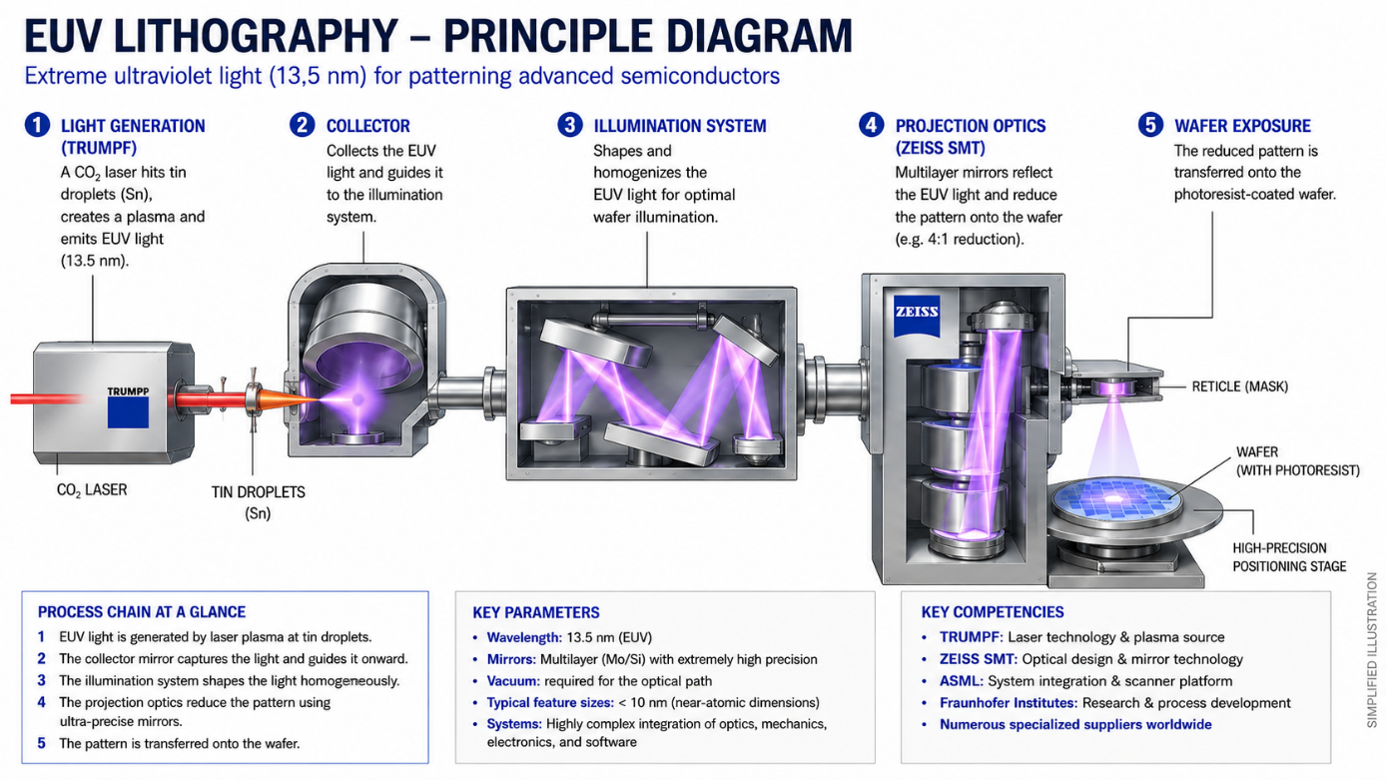
The story of ASML and Carl Zeiss SMT in EUV lithography is often told as a story of technological superiority. That is understandable, because the technology is extraordinary. Extreme ultraviolet lithography enables the production of the most advanced microchips by using light with a wavelength of 13.5 nanometres. The systems involved combine optics, lasers, plasma physics, vacuum technology, mechatronics, software, metrology and manufacturing know-how at a level of precision that is difficult to imagine from the outside.
But from the perspective of strategic IP management, the more interesting question is not simply how many patents are involved. The deeper question is how a company can turn valuable technological resources into sustainable competitive advantages. This is where the Resource-Based View of the firm becomes useful.
The Resource-Based View does not start with market share or product features. It starts with the resources and capabilities of a firm. A company achieves superior performance when it controls resources that enable it to create value in a way competitors cannot easily reproduce. In the classic VRIN logic, those resources must be valuable, rare, imperfectly imitable and non- or imperfectly substitutable.
The ASML–ZEISS EUV story shows very clearly that IP is not the resource itself. Rather, IP is one of the mechanisms through which valuable resources acquire the characteristics that make them strategically sustainable. IP does not create the technological capability from nothing. It helps to protect, structure, combine, preserve and appropriate the value of that capability.
EUV as a resource story, not as a patent story
It would be too narrow to describe EUV lithography as the result of a strong patent portfolio. Patents are certainly important, but they are only one part of the explanation. The real resource is the accumulated capability to develop, manufacture, integrate and continuously improve an industrial system of almost unimaginable complexity.
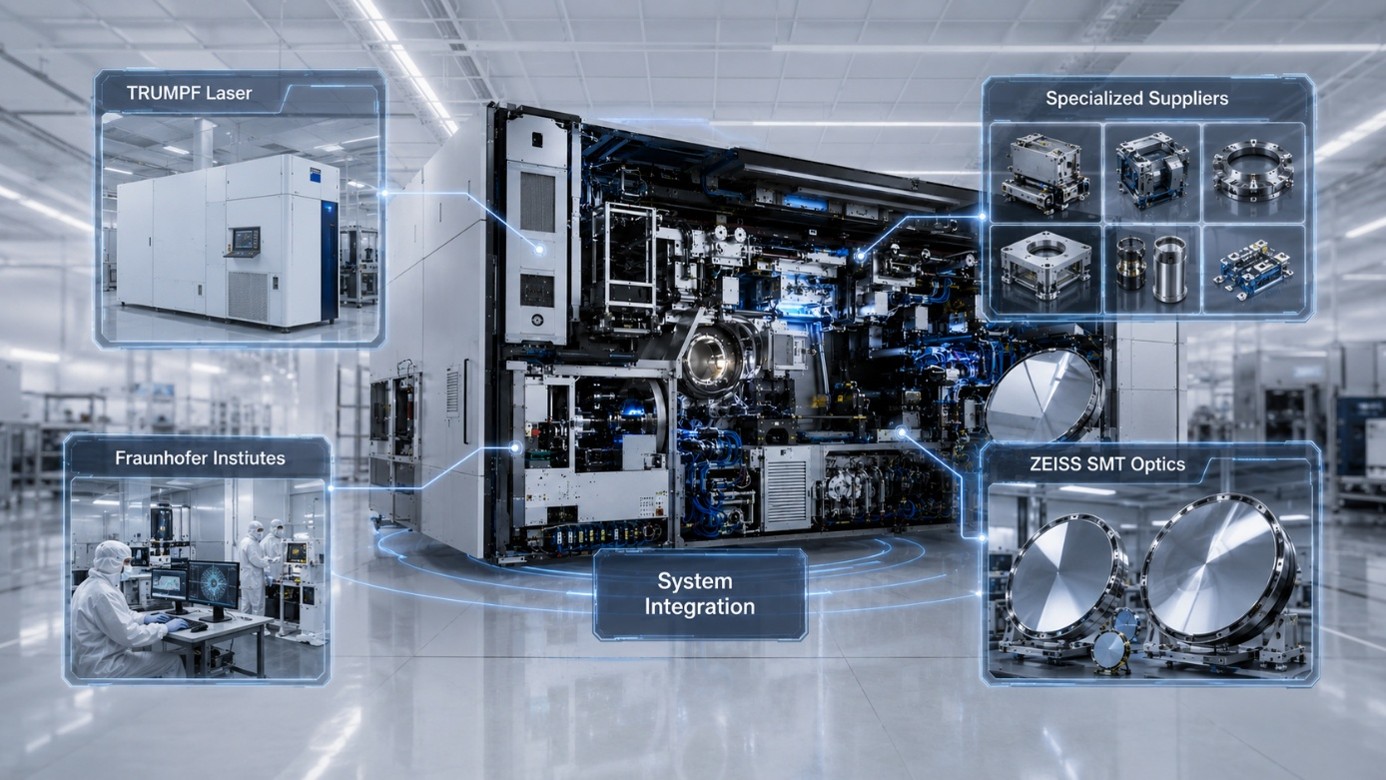
This capability is not located in a single component. It sits in the interaction between ASML as system integrator, Carl Zeiss SMT as the provider of the optical system, TRUMPF as a key contributor to the laser technology for the EUV light source, Fraunhofer institutes and many other specialized suppliers. EUV is therefore not only a machine. It is a resource system.
That distinction matters. A machine can be photographed, described and technically analysed. A resource system is much harder to copy. It consists of routines, trust, supplier qualification, engineering memory, process knowledge, tacit expertise, investment discipline and the ability to coordinate many forms of knowledge across organizational boundaries.
From an RBV perspective, the central strategic resource is therefore not “EUV technology” in the abstract. It is the capability to make EUV technology industrially reliable, economically usable and continuously improvable. This capability is valuable because it enables chip manufacturers to continue scaling semiconductor performance. It is rare because very few organizations can combine the necessary scientific, industrial and organizational capabilities. It is difficult to imitate because much of the knowledge is embedded in people, processes, equipment, supplier relationships and accumulated learning.
How IP changes the quality of resources
The RBV perspective becomes especially powerful when we stop treating IP as a separate asset category. In many management discussions, patents are placed next to other assets as if they were simply another item on the balance sheet of competitive advantage. The ASML–ZEISS case suggests a better interpretation.
- IP changes the strategic quality of resources.
A technical capability may be valuable because it solves a difficult customer problem. But value alone is not enough. If competitors can quickly copy the capability, rents disappear. IP helps prevent this erosion by making certain technical solutions exclusive, by increasing imitation costs, by shaping access to complementary technologies and by clarifying who may use which knowledge in which context.
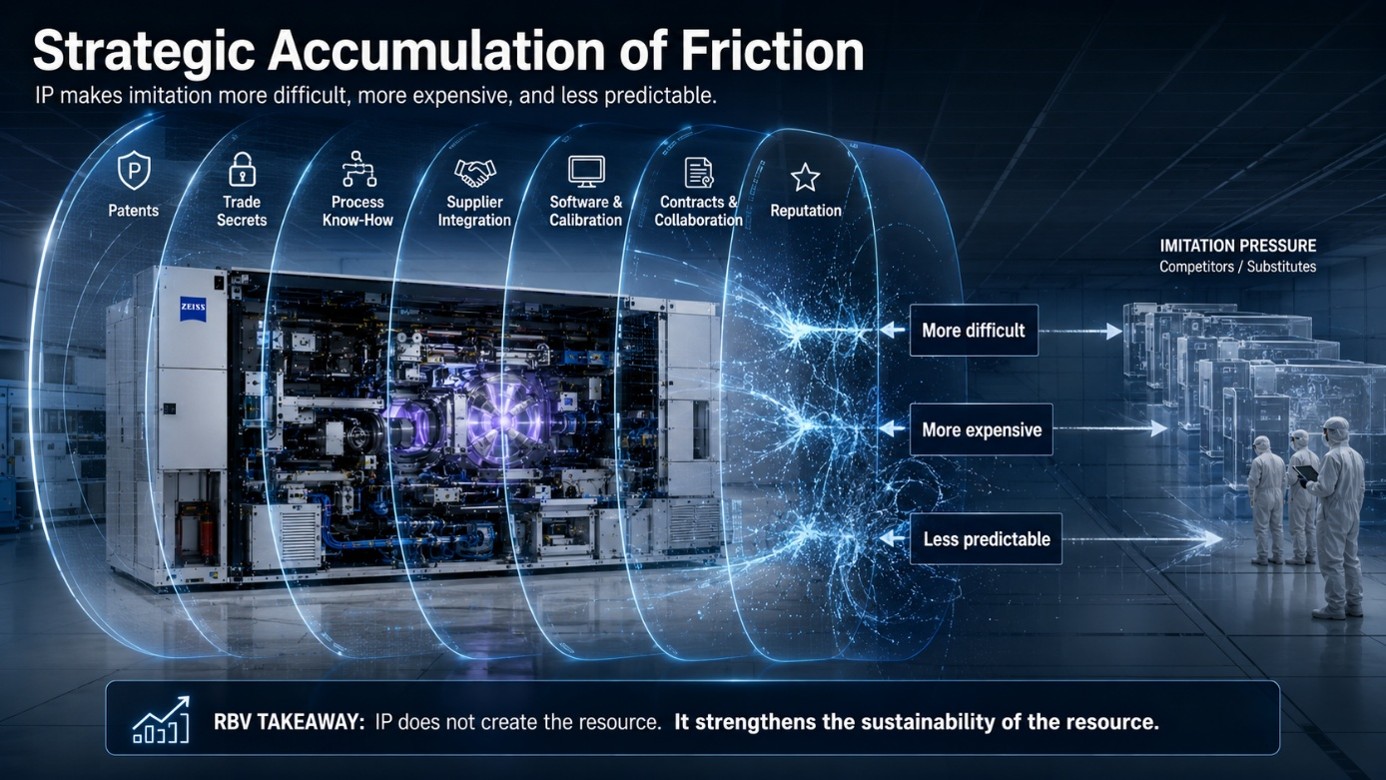
In the EUV case, patents help protect selected inventions and system elements. Trade secrets protect manufacturing processes, tolerances, calibration methods, supplier know-how and other forms of knowledge that are not visible in the finished product. Contracts structure cooperation between partners and suppliers. Licensing arrangements and cross-licensing can reduce uncertainty, create freedom to operate and stabilize the industrial ecosystem. Reputation, supported by technological leadership and protected performance claims, reinforces trust in the platform.
This is the strategic role of IP in the Resource-Based View. It does not turn every patent into a competitive advantage. Rather, it helps a company ensure that its truly valuable resources become rarer, harder to imitate and harder to substitute.
Why imitation is harder than copying a technology
The most important lesson from EUV is that imitation is not the same as technical understanding. Competitors may understand the basic principles of EUV lithography. They may understand that tin droplets are turned into plasma, that EUV light must be reflected rather than refracted, and that mirrors must be manufactured and aligned with extreme precision. But understanding the principle is not the same as reproducing the industrial capability.
This is where RBV adds analytical depth. A resource is imperfectly imitable when competitors cannot recreate it without enormous time, cost, uncertainty and organizational learning. EUV lithography is a strong example because the relevant knowledge is distributed across many layers. Some of it is codified in patents. Some of it sits in engineering drawings. Some of it is embodied in machines. Some of it exists only in routines, supplier relationships and practical experience accumulated over decades.
IP contributes to this imperfect imitability in several ways. Patents can prevent direct copying of protected technical solutions. Trade secrets preserve the invisible knowledge behind manufacturing and scaling. Contractual IP rules keep collaboration from becoming uncontrolled knowledge leakage. Portfolio positions can also block alternative routes where competitors might try to build substitutes around the core technology.
The result is not a simple legal barrier. It is a strategic accumulation of friction. Each layer makes imitation more difficult, more expensive and less predictable. This is precisely how IP supports sustainability in the Resource-Based View.
Cooperation without losing control
The ASML–ZEISS story is also important because it shows that sustainable competitive advantage does not always arise inside a single firm. In deep technology, many critical resources are distributed across ecosystems. No single organization possesses all knowledge, equipment and capabilities required to bring a technology such as EUV into industrial production.
This creates a strategic tension. Companies need cooperation to create value, but cooperation also creates the risk of losing control. Knowledge must be shared, interfaces must be defined, suppliers must be integrated and joint development must be organized over long periods of time. Without IP management, this kind of collaboration can become strategically dangerous.
In this sense, IP acts as coordination infrastructure. It defines what each partner brings into the relationship, what remains background IP, what becomes jointly developed foreground IP, what may be commercialized, what must remain confidential and how future developments can be used. The purpose is not only legal protection. The purpose is to make cooperation possible without dissolving the resource position of the participating firms.
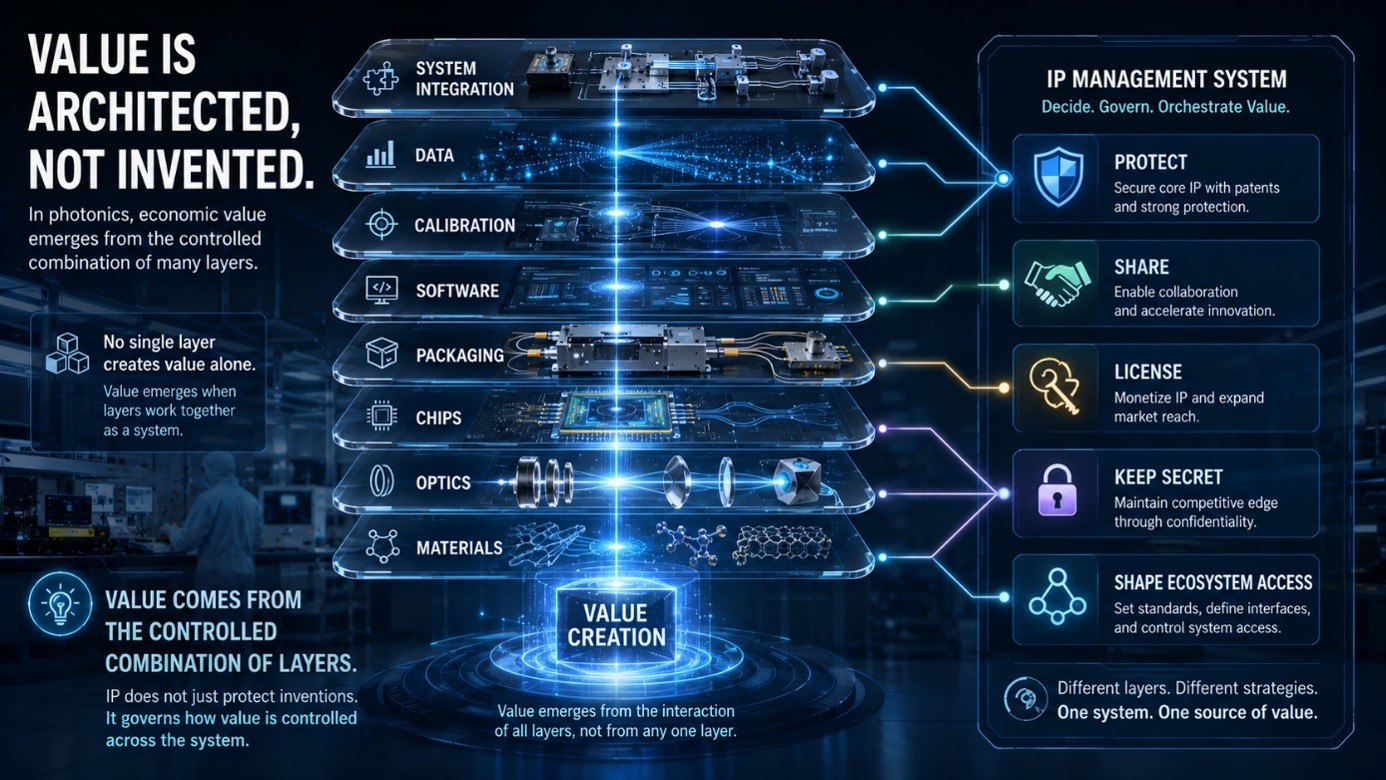
This is particularly relevant for photonics and optical technologies more broadly. Many photonically enabled systems depend on materials, optics, chips, packaging, software, calibration, data and system integration. The economic value rarely sits in one isolated invention. It emerges from the controlled combination of many layers. IP therefore becomes the management system that decides which layers are protected, which are shared, which are licensed, which are kept secret and which are used to shape ecosystem access.
The broader IP management lesson
The ASML–ZEISS EUV story is therefore not primarily a story about patent strength. It is a story about resource sustainability. It shows how valuable capabilities can be made more durable through the intelligent combination of patents, trade secrets, contracts, licensing, ecosystem governance and reputation.
For strategic IP management, this changes the starting point. The first question should not be: What can we patent? The first question should be: Which resources explain our future competitive advantage? Only after that does the IP question become meaningful. Which aspects of the resource should be patented because they are visible and technically protectable? Which aspects should remain secret because they are process-based and difficult to reverse engineer? Which partnerships need contractual IP architecture? Which positions should be used for blocking? Which elements support licensing, standards or market access?
This approach is especially important in fields such as photonics, quantum technologies, robotics, medical technology and advanced manufacturing. In all these areas, competitive advantage increasingly depends on layered systems rather than single inventions. The value may sit in an optical architecture, a manufacturing process, a calibration routine, a software-controlled measurement principle, a supplier qualification process or a platform relationship with customers.
The EUV example teaches that sustainable resource-based advantage requires more than protection. It requires the continuous shaping of resource characteristics. IP must help make valuable capabilities rare. It must help make them difficult to imitate. It must help prevent easy substitution. It must help the firm or ecosystem appropriate the returns from what it has built.
That is the real strategic meaning of IP in the Resource-Based View. IP is not simply an asset beside other assets. It is a transformation mechanism. It turns technological resources into defensible strategic positions.
This is why the ASML–Carl Zeiss SMT story is so useful for IP management education. It demonstrates that the strongest competitive advantages are rarely explained by one patent, one product or one legal right. They emerge when valuable resources are deliberately structured so that competitors cannot easily access, reproduce or replace them.
EUV lithography is therefore more than a technological success story. It is a management case for how IP can contribute to the sustainability of resource-based competitive advantage. The lesson is clear: companies should not ask whether they have enough patents. They should ask whether their IP system makes their most valuable resources more sustainable.