
DIN 77006 and ISO 56005: Why IP Needs a Management System

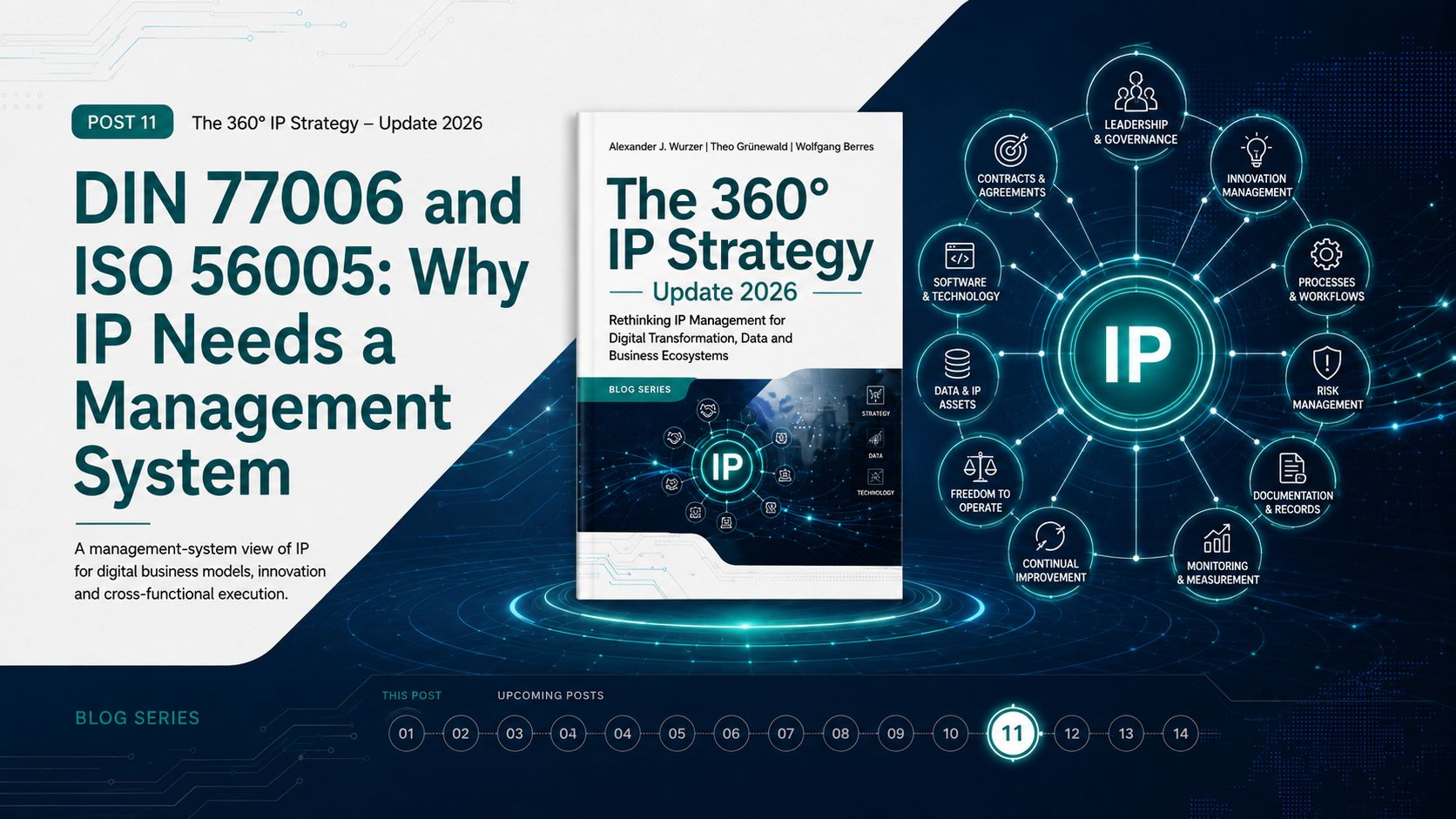
The original 360° IP Strategy already contained a management-system idea, even before today’s standards gave it a formal structure. IP should not begin with the right itself or with the administrative needs of a patent department. It should begin with business objectives, customer value and the people who must make protection, freedom of action and differentiation operational across the company. Strategy, processes, tools, responsibilities and controlling had to work as one coherent system.
That principle has become more important. Digital business models distribute IP-relevant decisions across software development, data governance, procurement, marketing, cybersecurity and partnerships. Selecting open-source code, negotiating ownership of supplier-created software, defining an interface or changing a model-training pipeline can affect ownership, confidentiality, third-party risk, protectability and bargaining power, even when nobody describes the choice as an IP decision.
The decisive update since the book appeared is that this logic is now supported by formal frameworks. DIN 77006 formulates requirements for intellectual property management systems. ISO 56005 provides guidance on placing IP inside innovation management. Together they make a simple point: IP cannot be managed reliably as a sequence of isolated legal cases. It needs an operating system connecting strategy with repeated decisions, evidence, accountability and learning.
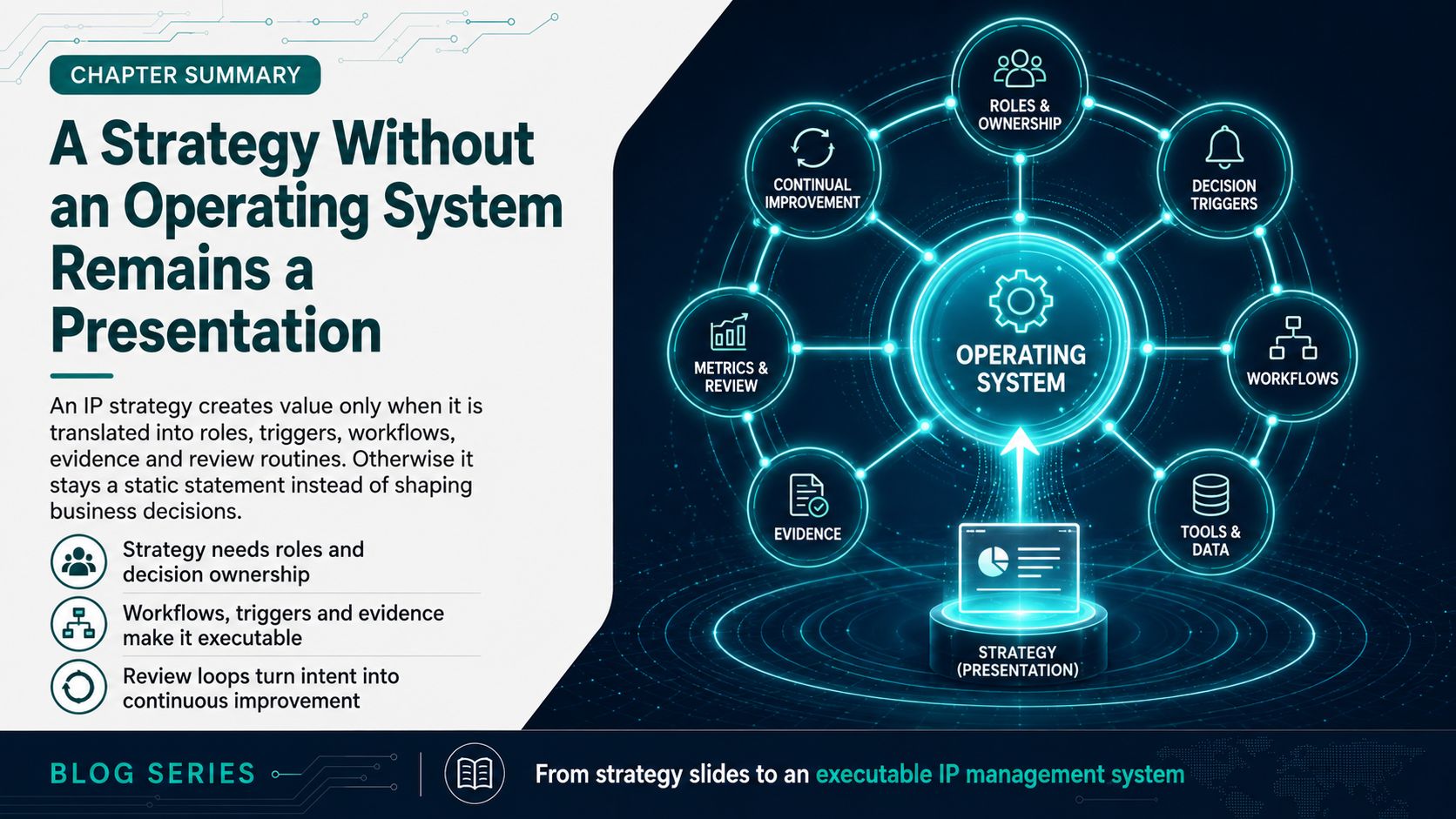
A strategy without an operating system remains a presentation
Many companies have an IP strategy in the narrow sense. They have portfolio principles, filing criteria, jurisdiction rules and budgets. Some also have statements about protecting innovation, securing freedom to operate or strengthening market position. Yet these statements often remain detached from the places where commercial outcomes are shaped.
The problem becomes visible in everyday work. Who translates a business objective into a concrete IP requirement? When must a roadmap decision trigger a search, ownership review or secrecy assessment? Who decides whether a result should be patented, kept confidential, published, licensed, contributed to open source or left unprotected? Who accepts the risk when a launch proceeds despite an unresolved third-party position? Without defined pathways, strategy depends on personal initiative and memory.
A management system closes this gap. It connects strategic intent with recurring situations, assigns decision rights, specifies inputs and outputs, and creates escalation routes. It does not require the IP function to make every decision. It ensures that the right people decide at the right time with sufficient information. The system may use launch gates, collaboration checklists, portfolio reviews, risk registers and management reports. These instruments matter because they are connected.
This changes the meaning of IP responsibility. The IP department remains the centre of legal and methodological expertise, but it cannot own all facts or consequences. R&D understands technical alternatives, product management knows the roadmap, procurement controls supplier relationships, and software teams know repositories and dependencies. Management owns objectives, resources and risk acceptance. The system must combine these perspectives without dissolving accountability.
An IP strategy becomes executable only when translated into roles, triggers, workflows, evidence and review routines. The management system is not an addition to strategy; it is the mechanism through which strategy becomes organisational behaviour.
DIN 77006 makes IP structured, auditable and connected to leadership
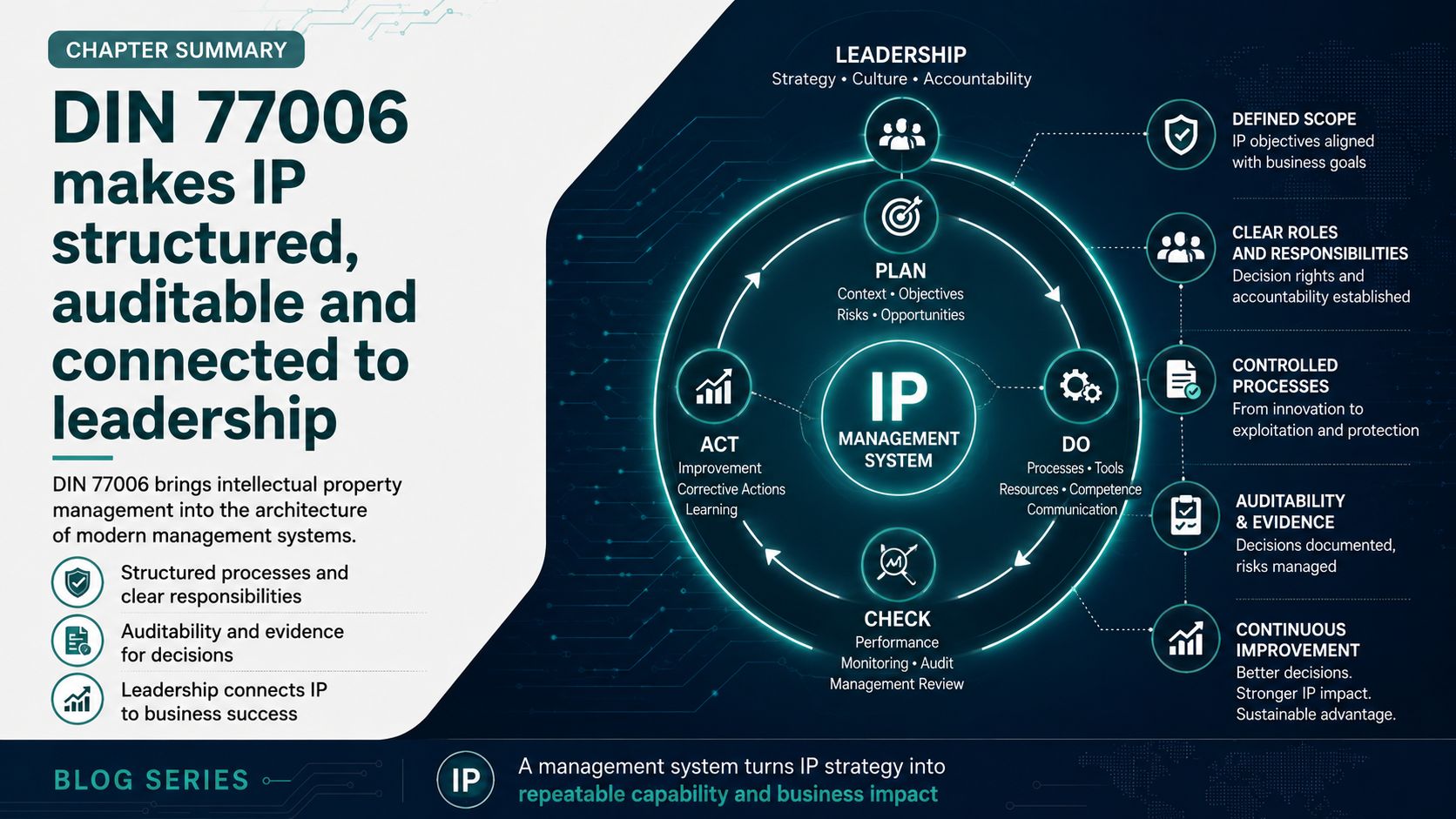
DIN 77006 brings IP into the familiar architecture of management systems. Its importance is not that it invents new legal tasks. Patent administration, brand protection, risk analysis, enforcement, licensing and trade secret management existed before the standard. Its contribution is to connect such activities through requirements concerning organisational context, leadership, planning, support, operation, performance evaluation and improvement.
This creates a different starting point. Instead of asking whether individual files are handled correctly, management asks whether the overall system is appropriate for the company’s objectives, business model and risk situation. Is the scope clear? Are responsibilities assigned? Are resources and competences adequate? Are relevant processes controlled? Is performance reviewed? Are deficiencies corrected? These questions move IP from specialist execution into corporate governance.
Leadership is essential because only top management can resolve the trade-offs that IP creates. A broader filing programme competes with other investments. Strong secrecy may conflict with collaboration speed. Interface control may conflict with ecosystem adoption. A cautious FTO position may delay a launch. Licensing can create revenue while enabling future competitors. Such choices concern growth, risk appetite, market design and resource allocation.
Auditability does not mean producing documents for their own sake. It means being able to show why a decision was taken, who was responsible, what evidence was considered and whether the intended outcome was reviewed. This is valuable when personnel change, investors conduct due diligence, disputes arise or management must show that a known risk was handled responsibly.
The Plan–Do–Check–Act logic turns the system into a learning cycle. The organisation plans objectives and measures, operates the processes, checks performance and changes the system when assumptions, technologies or markets evolve. A portfolio rule may no longer fit a service model, or a trade-secret process may fail when development moves to cloud collaboration.
DIN 77006 gives IP management a requirements-based structure that makes leadership, responsibilities, operational quality and continuous improvement visible. Its value lies not in standardising strategic choices, but in ensuring that the organisation can make, execute and review those choices coherently.
ISO 56005 places IP inside the innovation process
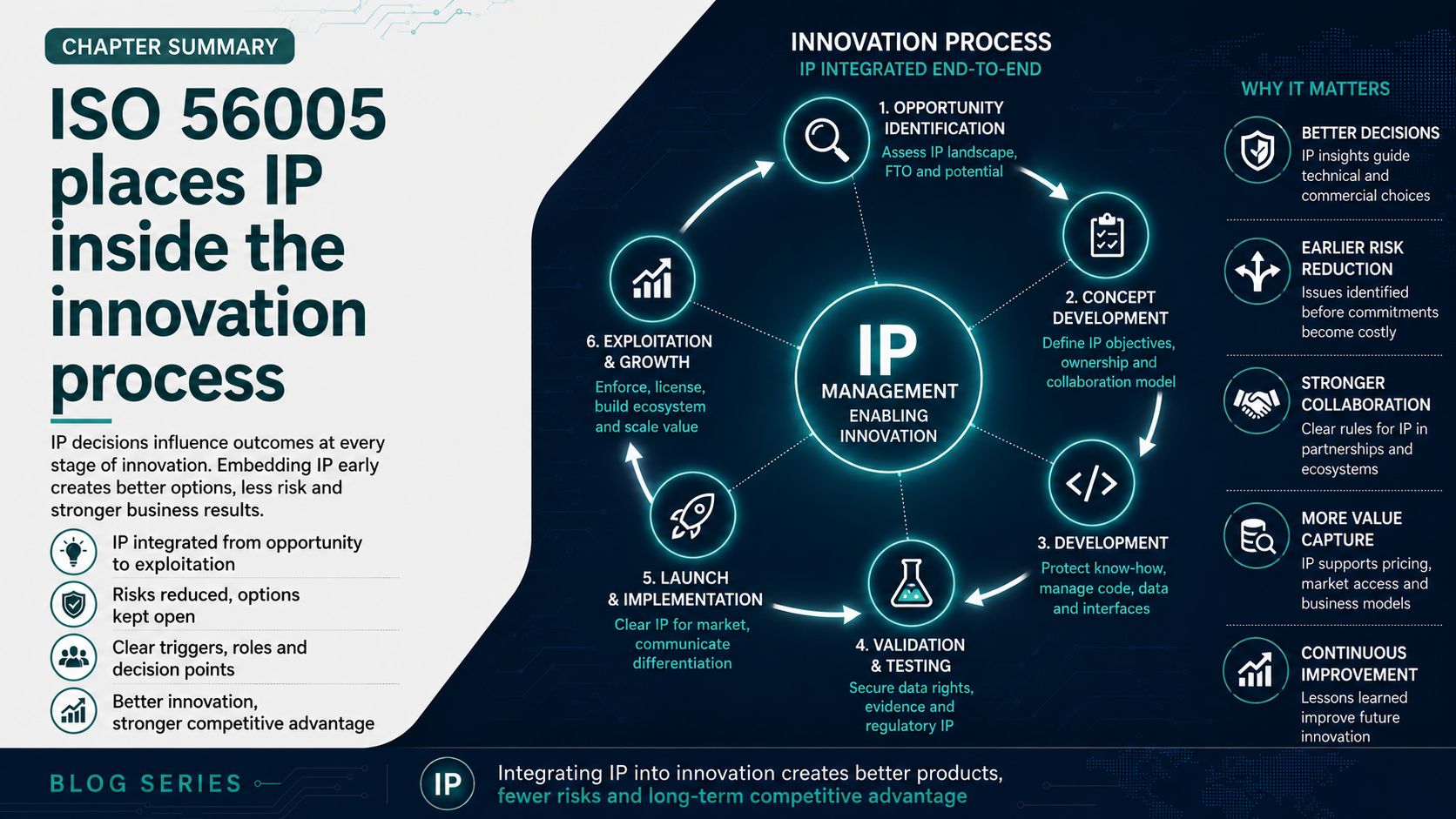
ISO 56005 approaches the challenge from innovation management. It provides guidance for creating an IP strategy that supports innovation, establishing systematic IP management within innovation processes, and applying consistent tools and methods at strategic and operational levels. This matters because IP value is usually created, or lost, before a formal legal procedure begins.
Innovation projects make choices that shape future IP positions. Teams define problems, select architectures, choose data sources, involve partners, publish results and decide what to build internally. By the time an invention disclosure reaches the IP department, important options may have disappeared. Prior disclosure may have destroyed novelty. A supplier may own essential code. A dataset may lack sufficient usage rights. A workaround may be too expensive because the architecture is fixed.
Embedding IP in innovation does not mean placing a patent attorney in every meeting. It means defining risk- and value-based triggers. A low-risk internal experiment may require no formal review. A strategic platform interface, external development project, AI training pipeline or market-entry decision may require early IP input. The depth of review should grow with maturity, commitment and potential impact.
ISO 56005 also supports a broader understanding of IP tools. The instrument may be a patent, trade-secret classification, copyright rule, design right, trademark clearance, licence, data-access agreement, contractual mechanism or evidence trail. The correct choice follows the innovation objective and intended business effect rather than a preference for one right.
The connection with innovation management improves opportunity recognition. IP can structure partnerships, define contributions, create licensing options, secure access to complementary assets, shape standards and make an innovation more investable. When IP enters early, it can influence the design of the opportunity rather than merely protect the final output.
ISO 56005 makes IP part of the innovation logic from opportunity identification through development, collaboration and exploitation. It ensures that IP decisions accompany value creation instead of arriving after decisive technical and commercial commitments have been made.
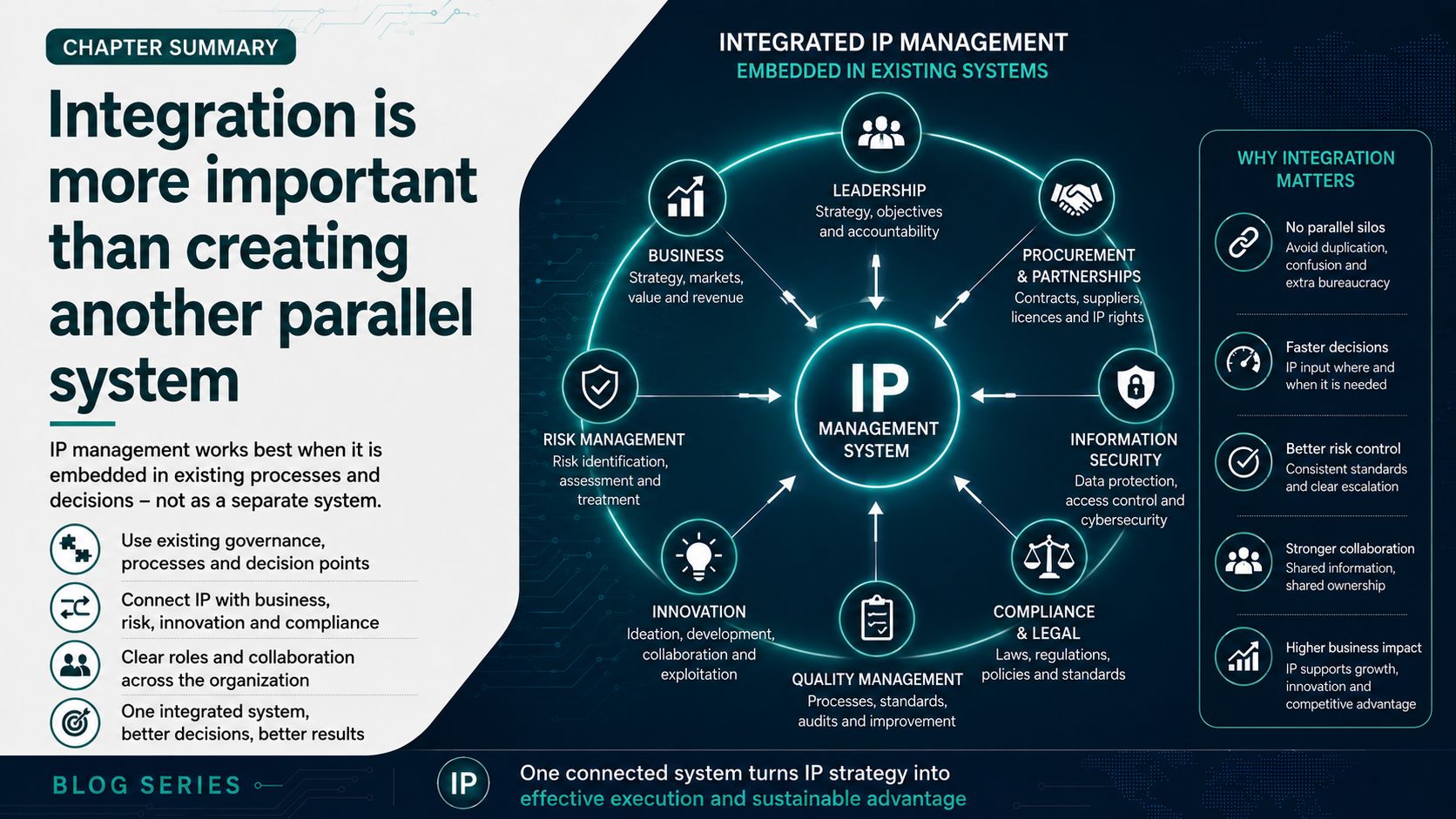
Integration is more important than creating another parallel system
A weak implementation would build a separate IP bureaucracy beside quality, innovation, risk, compliance and information-security systems. That creates duplicate approvals, competing taxonomies and documentation experienced as friction. The better interpretation is integration.
Most organisations already have decision points where IP questions naturally belong. Product development has roadmap and release reviews. Quality management has process ownership and audits. Risk management has thresholds and escalation. Procurement has contract approval. Information security has classification and access control. The IP management system should use these structures wherever possible.
Integration begins with interfaces. A collaboration process should trigger questions about background IP, results, publication, confidentiality, data rights and exit scenarios. A software release should connect licence compliance, third-party components, ownership and FTO issues. A new brand process should include clearance and domain strategy. Data governance should identify whether critical datasets can be accessed, reused, shared and defended. A portfolio review should connect rights with products, services, markets and business objectives.
Common language is another benefit. Management-system terminology makes IP understandable outside the legal function. Objectives, risk owners, controls, evidence, deviations, corrective actions and management review are familiar concepts. This reduces the tendency to treat IP as a black box and makes it easier to connect IP decisions with budgets, roadmaps and accountability.
Digital tools can support integration, but software is not the system. A workflow platform may document approvals and link assets to projects. It cannot decide which customer benefit deserves exclusivity, which risk is acceptable or which evidence is strategically meaningful. Technology should reduce coordination effort and preserve traceability, while decision quality remains a management task.
The most effective IP management system is not a separate universe owned by the IP department. It is a connected layer within the company’s existing management architecture, adding IP-specific expertise and controls where business decisions already occur.
Proportionality turns the standard from bureaucracy into capability
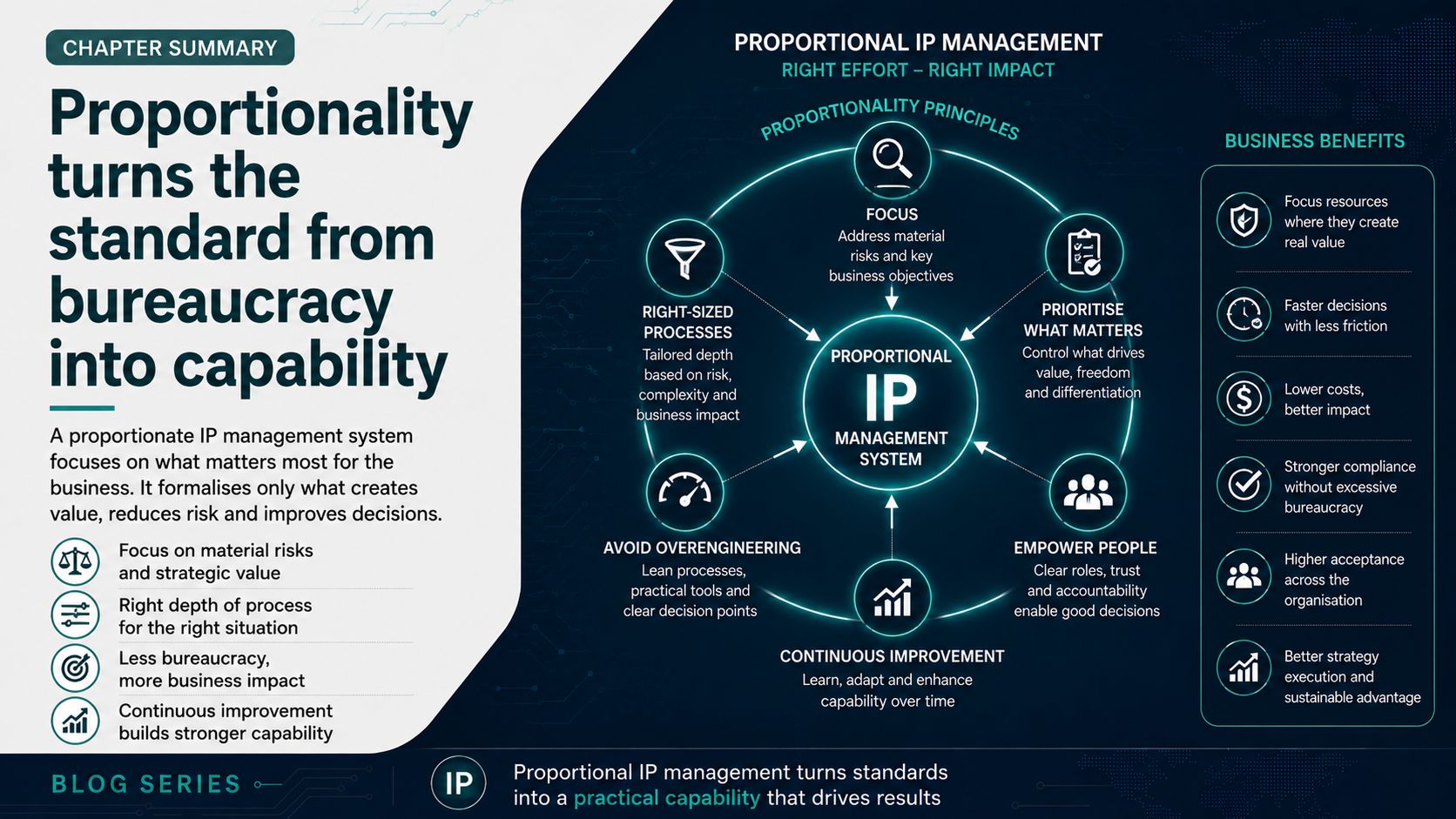
The strongest objection to management systems is the fear of bureaucracy. That fear is justified when organisations equate quality with maximum documentation, apply identical controls to every project or copy templates without understanding the decisions they support. A system becomes counterproductive when compliance activity consumes more value than the risks it controls.
Proportionality is the answer. The system should reflect company size, maturity, sector, business model, collaboration intensity and exposure. A scale-up with one core platform needs a different configuration from a diversified industrial group. A medical technology company may require strong evidence and regulatory interfaces, while a software company may prioritise open-source governance, data rights and trade-secret controls.
Implementation should begin with the business, not the clauses. Management identifies the value architecture, critical IP risks, strategic objectives and recurring decision situations. The organisation then maps existing practices, finds material gaps and defines a target system. Priority should go to processes where failure could destroy value, block market access, weaken enforceability or create unacceptable exposure. Formalisation can grow as the organisation learns.
Useful evidence is created as a by-product of good decisions. A recorded reason for patenting or not patenting supports portfolio review. A contribution log supports ownership clarity. A documented trade-secret classification supports enforcement. A risk acceptance record preserves institutional memory. A management review links findings to resources and corrective action. Documentation is valuable when it enables continuity, accountability and learning.
The final test is performance. Does the system identify IP needs earlier? Does it preserve freedom of action? Does it improve ownership clarity, trade-secret protection, portfolio alignment and exploitation options? Are responsibilities understood? Are decisions faster because pathways are clear? Are recurring failures reduced? Standards provide the framework, but these business effects determine whether it is alive.
A proportional IP management system replaces ad hoc reaction with repeatable capability while preserving judgement and speed. It should formalise what is necessary, integrate what already exists and continuously improve what produces better strategic decisions.
Supplementary content on the IPBA® platform:
Why Companies Need Systematic IP Management
Explains why isolated IP measures create fragmentation and person-dependent routines, and how a system perspective provides orientation without requiring overengineering.
👉 Read more
IP Management within the Management System
Shows how IP interfaces with quality, risk, compliance, information security and corporate governance, including the allocation of accountability, authority and execution.
👉 Read more
The Role of DIN 77006 in IP Management
Positions the standard as a framework for benchmarking, auditability, management communication and the incremental development of IP capabilities.
👉 Read more
Connecting Innovation and IP: The ISO 56000 Perspective
Clarifies how innovation governance and IP management complement each other without confusing innovation responsibility with specialist IP execution.
👉 Read more
A Systemic Approach to Building IP Management
Provides a practical perspective on moving from fragmented activities towards a coherent system of objectives, roles, processes and improvement routines.
👉 Read more
DIN 77006: A Blueprint for Strategic IP Management
Explains the management-system structure of DIN 77006, its connection with leadership and governance, and the role of PDCA in continuous improvement.
👉 Read more
Step by Step – How to Implement DIN 77006
Offers a concrete implementation sequence covering current-state assessment, gap analysis, target-state design, internal review and possible external conformity assessment.
👉 Read more
Towards an Integrated IP Function for Companies – Role-Specific IP Needs According to DIN 77006 and ISO 56005
Demonstrates how the standards can be translated into department-specific responsibilities and benefits for R&D, legal, marketing, finance and business development.
👉 Read more
Applying DIN 77006 and ISO 56005 in GreenTech
Provides an industry example showing why complex innovation ecosystems require repeatable, documented and cross-functional IP processes rather than isolated filing activity.
👉 Read more
Achieving Sustainable Business Success: IP Management the WILO Way
Illustrates how a company can connect protection, external observation, respect for third-party rights and portfolio impact within a continuously evaluated IP framework.
👉 Read more