
Scaling Proprietary Technology: How IP Management Shapes the Next Stage of Growth

A process technology has moved beyond the laboratory. Demonstration projects have produced valuable experience, industrial partners see commercial potential, and discussions now concern engineering packages, local deployment and licensing. For the management team, this is an important achievement. It also introduces a question that becomes more consequential with every installation: how can the company enable its partners to succeed while strengthening its own position across future projects?
This question often emerges through ordinary business decisions. An engineering partner needs detailed documentation. A prospective licensee asks for access to operating parameters. A local implementation generates an improvement that could benefit installations elsewhere. Each request may be reasonable. Taken together, these decisions shape who can reproduce the process, who learns from its operation and who can participate in the opportunities that follow.
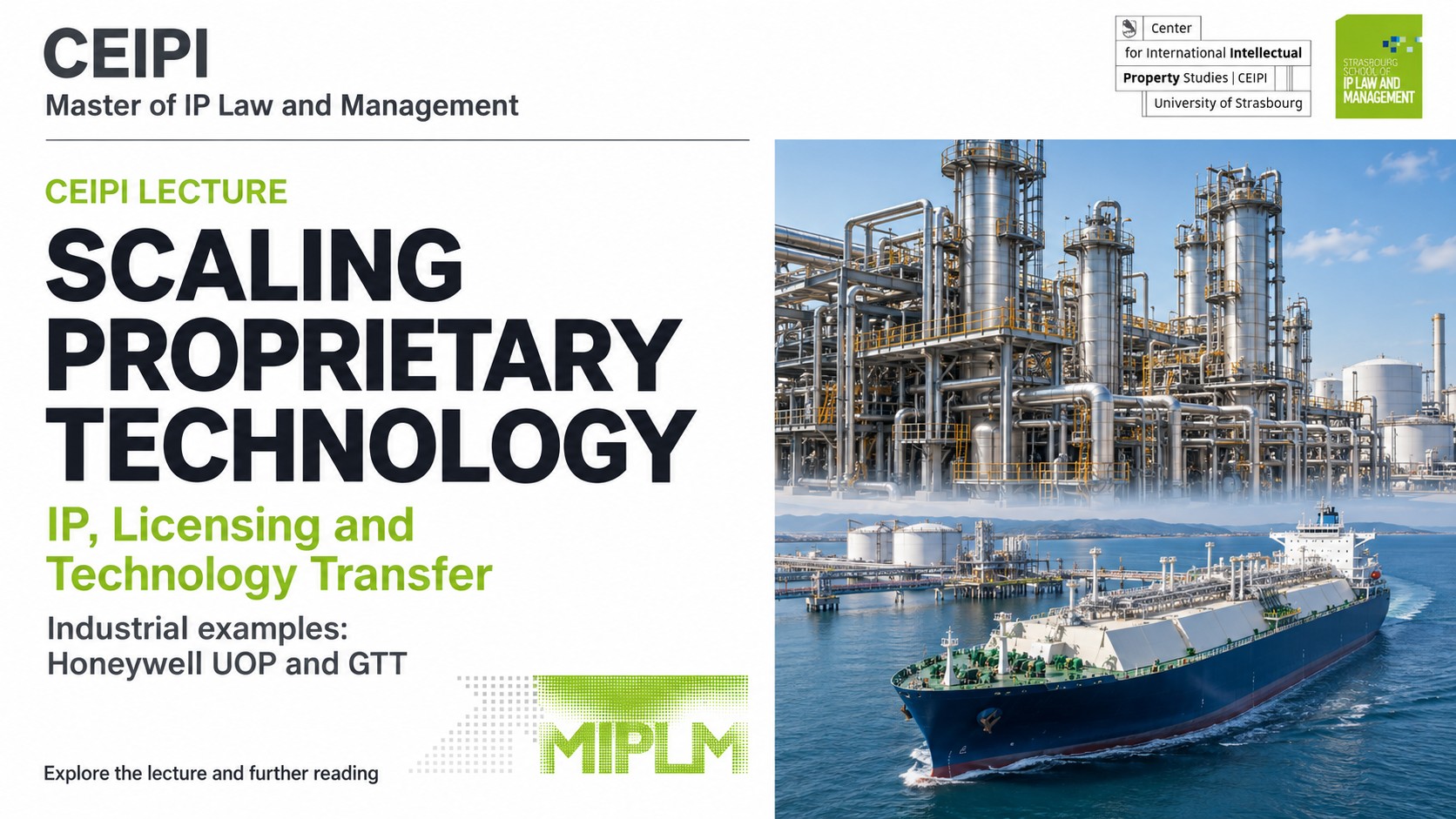
The CEIPI lecture Scaling Proprietary Process Technologies: IP, Licensing and Technology Transfer for Sustainable Business Growth examines this stage of development. It connects familiar commercial challenges with established management theory and industrial practice. For technology companies preparing further deployments, it provides a way to examine how their existing partnerships can support a repeatable and economically attractive business.
A company’s competitive advantage usually combines several assets. Patents may protect technical solutions, while confidential know-how explains how to achieve reliable performance. Engineering documents make implementation possible. Operating experience reveals which adjustments matter under different conditions. Some of this knowledge is documented; some remains with the people who have spent years making the process work. Each element has a different role in commercialisation and calls for a considered decision about access.
Consider an improvement developed during commissioning. The immediate priority is to make the installation perform. The wider management questions concern whether the technology provider can use that improvement elsewhere, whether it has access to the information needed to do so, and how the partner benefits from contributing. Ownership, practical access and permission to reuse knowledge are distinct issues. Addressing them together can help individual projects contribute to a growing body of capabilities across the business.
Established theory helps explain why these choices matter. David Teece’s work on profiting from technological innovation examines the relationship between protection, complementary assets and economic returns. A technology developer may depend on partners for engineering, financing or market access, and those dependencies influence the distribution of value. Jay Barney’s resource-based perspective helps identify which capabilities remain valuable and difficult to reproduce. Oliver Williamson’s transaction cost economics explains why commitments to a particular relationship create a need for adaptation and safeguards. These perspectives give management a vocabulary for decisions it already encounters.
Industrial practice makes the possibilities more tangible. Honeywell UOP’s Ecofining technology illustrates how licensing connects to implementation in renewable fuels. In 2019, Honeywell announced that St1, a Finnish energy company, had licensed Ecofining for its Gothenburg refinery and that basic engineering design was complete. In 2024, Honeywell reported that the site had started using the technology to produce sustainable aviation fuel. The biorefinery’s stated design capacity was 200,000 tonnes of renewable fuel per year. This offers a concrete European example of the progression from a technology licence to industrial use. Honeywell’s St1 project report also describes adoption of its SAF technologies across more than 50 licensed sites.
The lesson concerns the capabilities around the licence. UOP’s service offering includes commissioning support, troubleshooting and unit testing. For an emerging process-technology business, this raises a useful design question: which elements can become a repeatable core package, and where will customers continue to need specialist support? The answer affects staffing, delivery costs and opportunities for further revenue. UOP demonstrates an established industrial approach, although the public evidence does not isolate the profitability of Ecofining licences.
GTT provides a complementary example. Its membrane containment technologies reach industrial application through shipyards. In January 2025, GTT announced a technical assistance and licence agreement with Hengli, following a qualification process that included study cases and construction of a Mark III mock-up. Partner capability therefore formed part of the route to deployment. GTT’s 2025 group results reported revenue of €803 million and an EBITDA margin of 67.5%, with newbuilds contributing 92% of revenue. These figures show the economic significance of a business centred on repeated technology deployment. They also reflect GTT’s established position and the LNG investment cycle, which limit direct financial comparison with an emerging technology provider. GTT–Hengli agreement, GTT annual results.
Together, these examples open up a practical set of choices. A licence can sit alongside a defined engineering package. Partner qualification can support reliable implementation. Agreed access to project learning can benefit subsequent installations. Payment structures can distinguish initial access from delivery effort and continuing operational value. The appropriate combination depends on the technology, the partners’ contributions and the provider’s commercial ambitions. Companies already engaged in licensing can use these principles to assess how well their arrangements support the next several projects.
This is also where specialist IP expertise becomes valuable. Developing a coherent approach requires an understanding of how technical knowledge, commercial responsibilities and contractual permissions interact. The IPBA platform provides routes into these connected subjects through CEIPI teaching, dIPlex explanations and documented expert discussions. The lecture’s further-reading selection includes strategy, know-how management and valuation, alongside Andreas Jacob and Tomas Geerkens’s discussion of licensing strategy and execution. Readers can explore both the foundations and how practitioners apply them.
A forthcoming expert model solution will take the next step by applying this framework to the accompanying practical question. It will examine which capabilities should remain strategic control points, what partners need for successful deployment, and how improvement rights and remuneration can support future applications. Its value lies in the reasoning that connects these choices into a workable approach, including the trade-offs that management needs to assess.
Explore the lecture slides below with your next deployment in mind. Which knowledge will leave the organisation? What will the partnership learn? And how will that experience strengthen the business you want to build across future projects? The thirteen slides provide a structured starting point, two industrial examples and further reading for a closer examination of those decisions.
