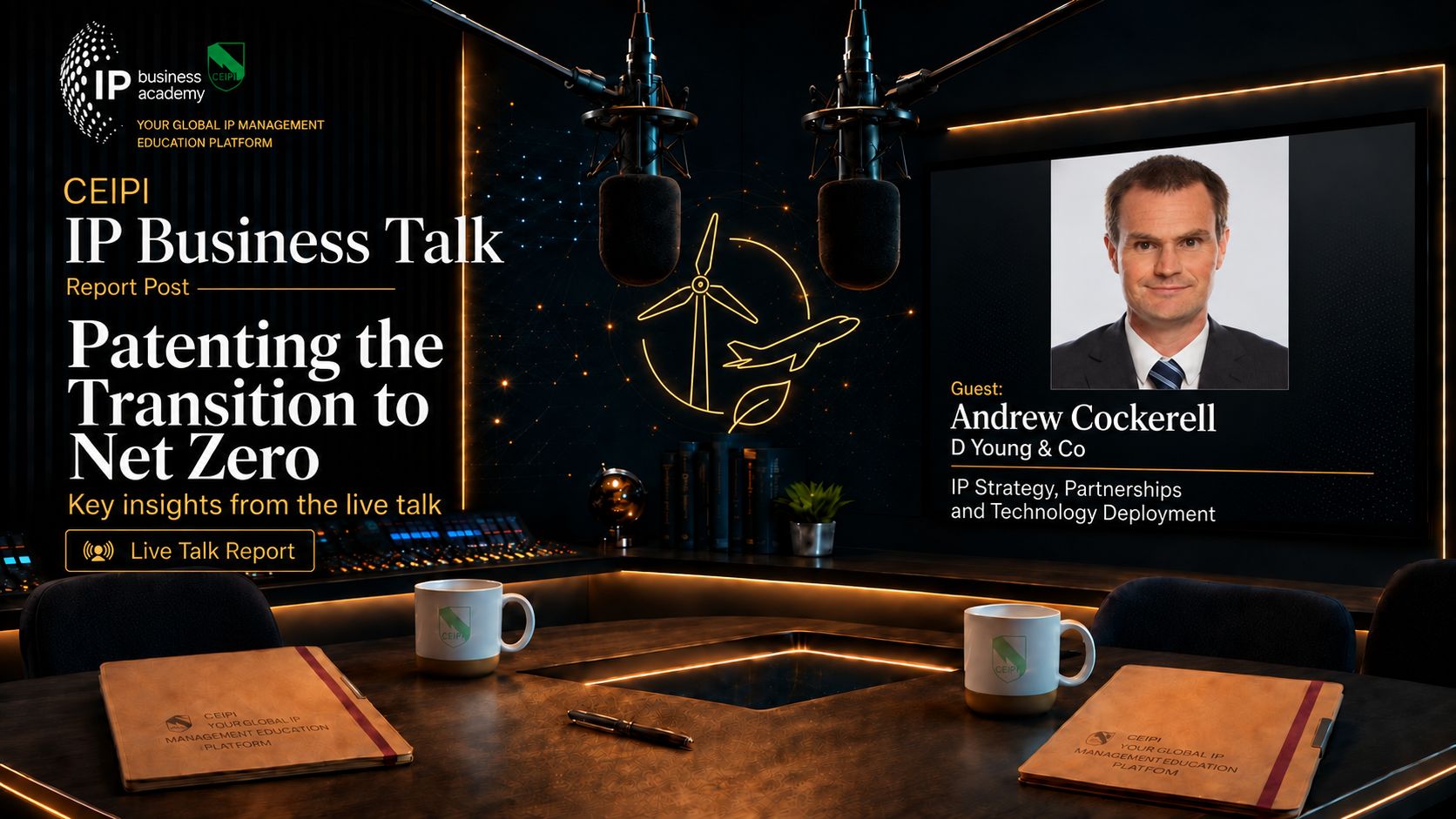
Patenting the Transition to Net Zero with Andrew Cockerell

Bringing a new energy or aviation technology into industrial use depends on developments across an entire system. Fuels, propulsion, infrastructure, components and digital technologies have to work together. For companies contributing to that transition, IP strategy needs to consider where their technology will create value, which partners will help bring it into use and when protection will become commercially relevant.
In the CEIPI IP Business Talk on 7 October 2026, Andrew Cockerell, Partner at D Young & Co, joined Prof. Dr. Alexander J. Wurzer to explore these relationships. The discussion connected patent strategy with industrial cooperation, emerging standards, international filing decisions and the different timescales shaping the transition to net zero.
Valuable IP can emerge beyond a company’s own products
Cockerell began with the interdependence of sustainable technologies. Aviation and energy operate within complex, heavily regulated environments. A breakthrough needs complementary technologies, suitable infrastructure and organisations capable of implementing it. An individual company’s contribution therefore has to be understood within the wider system.
This perspective also changes how businesses identify potentially valuable IP. During development, a company may produce an invention that it has no intention of using itself. Another organisation further along the value chain may nevertheless need that contribution to make its own technology work.
Wurzer explored the management challenge behind this situation. Patent budgets are often easier to justify when an invention maps directly onto a planned product. An exclusive position elsewhere in the value chain requires a broader explanation of its commercial purpose.
Cockerell pointed to assignments and development agreements as ways of putting such contributions to use. Cooperation can generate rights that are more relevant to one participant than another. Considering those possibilities early helps companies connect ownership and access arrangements with the capabilities each partner needs.
Emerging standards create questions for today’s portfolio
The need for technologies to work together led the conversation towards standardisation. Cockerell suggested that standards and potentially standard-essential patents could become more relevant as sustainable aviation and energy systems develop. Compatibility across markets may become a significant consideration as new technologies move towards widespread deployment.
He presented this as an expectation about future developments. The precise standards, technical choices and institutional arrangements remain dependent on how the respective industries evolve. Drawing on experience with telecommunications, Cockerell described the challenge of filing while future technical requirements are still taking shape. Companies may initially seek protection for approaches they believe could become relevant, then refine their decisions as search results and technical developments provide more information.
This creates a demanding investment question, particularly for smaller businesses. A filing can preserve an opportunity, but the company needs to reassess whether further expenditure remains justified. The prospect of inclusion in a future standard is one possible consideration within that assessment.
Early filings require decisions under uncertainty
Wurzer asked Cockerell to clarify what makes an early application speculative. The exchange distinguished uncertainty about patentability from uncertainty about future commercial adoption. In a rapidly developing field, companies may have limited visibility into work taking place elsewhere. At the same time, they cannot know with confidence which technical approach will ultimately reach industrial scale. A company developing hydrogen-related technology, for example, may face uncertainty about both the surrounding patent landscape and the infrastructure through which its invention could be deployed.
Cockerell emphasised that a patent’s commercial significance may become clearer only years after filing. Search results, competitors’ activities and industry choices gradually provide evidence that was unavailable at the outset. Wurzer connected this observation with scenario-based management. Businesses make investments today on the basis of assumptions about future markets. IP strategy belongs within that same process. Teams need to explain the assumptions supporting a filing and revisit them as the market develops.
Cockerell also questioned the tendency to treat grant as the inevitable destination of every application. Where the technical or commercial rationale has weakened, further prosecution may no longer justify its cost. An application’s publication may still have defensive significance, even where the applicant decides against pursuing a granted right.
Patent portfolios need to reflect different technology lifecycles
The transition to net zero brings together technologies with very different development and adoption periods. Some approaches may provide an intermediate step. Others require substantial infrastructure investment and may remain relevant over a much longer period. Cockerell argued that companies should consider these differences when managing their portfolios. Protection for a technology with a short commercial window raises different timing questions from protection for a system expected to enter widespread use only after a lengthy development process.
The discussion therefore connected portfolio review with the expected life of the technology. Does the protected contribution still support the direction in which the industry is moving? Is the likely deployment period consistent with the remaining commercial usefulness of the right? Does continued expenditure reflect a credible opportunity? These assessments require regular attention. Technical progress can change the value of an application during examination, just as changing market conditions can affect the relevance of an existing patent. Keeping the portfolio aligned with those developments helps management direct resources towards positions that continue to serve the business.
Patent trends reveal international ambitions
The conversation then turned to what companies can learn from publicly available patent information. Cockerell began with a qualification about timing: published patent data provides a delayed view of inventive activity. Any interpretation needs to account for that gap.
He described a shift in the green patent data he had reviewed towards greater international filing activity by Chinese applicants. Alongside China’s substantial domestic activity, he highlighted increased use of international applications and European filings.
For businesses assessing competition, this distinction matters. Domestic filing volumes and efforts to obtain protection abroad indicate different aspects of an applicant’s activity. International filings can warrant closer investigation into the markets a company may be preparing to enter. The discussion also connected geographical choices with funding and potential partners. Cockerell described how a licensing relationship in another jurisdiction could, in some circumstances, help a technology participate in locally supported development opportunities.
That possibility requires a specific commercial rationale. Filing widely in the hope of eventually finding licensees can quickly become expensive. A useful territorial strategy considers where suitable partners, deployment opportunities and relevant resources may come together.
Technology transfer brings protection and access into the same discussion
An audience question about WIPO GREEN opened a wider exchange about technology transfer. How should companies think about protection when their objective includes encouraging the spread of sustainable technology? The discussion placed licensing alongside the need for broader adoption. A company can seek a protected position while making its technology available through agreed terms. The commercial and environmental objectives depend on how those arrangements support practical implementation.
Cockerell also discussed the relationship between territorial protection and the technical information disclosed through publication. A global sustainability challenge brings this geographical dimension into focus: the markets in which rights are sought may differ from the places where a technology could eventually be useful.
The choice between patenting and retaining know-how as a trade secret adds another consideration. Companies need to assess what they are prepared to disclose, what knowledge remains necessary for implementation and how cooperation can help the technology reach further users.
For IP management, these questions connect protection decisions with the intended route to adoption. The relevant arrangements need to reflect both the innovator’s contribution and the capabilities required from others.
Accelerated examination needs a commercial reason
One of the clearest practical messages concerned the timing of patent examination. Cockerell encouraged companies to understand the procedural options that can affect the pace of their applications and to connect those options with their business objectives.
Wurzer raised the value of keeping possibilities open while technologies and markets develop. Cockerell agreed that pending applications can have a strategic role, including through divisional or continuation strategies where available and appropriate. Conversely, developments in the market may create a reason to pursue an examination outcome more quickly. An application that becomes closely relevant to an emerging commercial technology may warrant a different approach from one whose intended use remains uncertain.
The question is therefore why a particular right is needed at a particular time. What development has changed its relevance? Which commercial decision would greater certainty support? How does that timing fit the rest of the portfolio? This approach makes examination speed part of coordinated IP management. Companies benefit from discussing timing deliberately with their advisers as their technologies, partnerships and commercial priorities evolve.
IP strategy develops with the route to industrial use
The closing exchange brought together several dimensions of the discussion: geography, funding, policy, technology development, deployment and market acceptance. Each can influence the usefulness of a patent position.
A sustainable technology needs to become part of an operating system of suppliers, partners, infrastructure and users. Its commercial prospects depend on how those relationships develop and whether the company can retain a valuable role within them.
The talk showed why those relationships belong in the conversation between management, technical teams and IP advisers. They provide the context for deciding what to protect, where to seek rights, which cooperation arrangements to pursue and when a particular patent outcome will support the business.
Andrew Cockerell
 Andrew Cockerell is a Partner and UK and European Patent Attorney at D Young & Co. He holds an MEng in Aeronautical Engineering from Imperial College London and became a Chartered Engineer in 2014. Before entering the patent profession, he worked at Airbus and Rolls-Royce, gaining experience in aerodynamics and engineering. His practice covers physics, engineering and IT, with a particular interest in renewable energy and green technologies.
Andrew advises businesses and academic institutions on patent protection, portfolio strategy and patent analysis, connecting technical development with commercial objectives. His analysis of worldwide green patent trends provided the starting point for our article GreenTech IP and the journey from invention to investable growth. Building on his attention to smaller innovators, funding and commercialisation, the article explores how ownership, access and partnership arrangements can help sustainable technologies develop into scalable businesses.
Explore the wider context in our GreenTech Industry Focus.