Protecting the Technology Core as Modular Energy Systems Scale with Dr. Arthur Singer

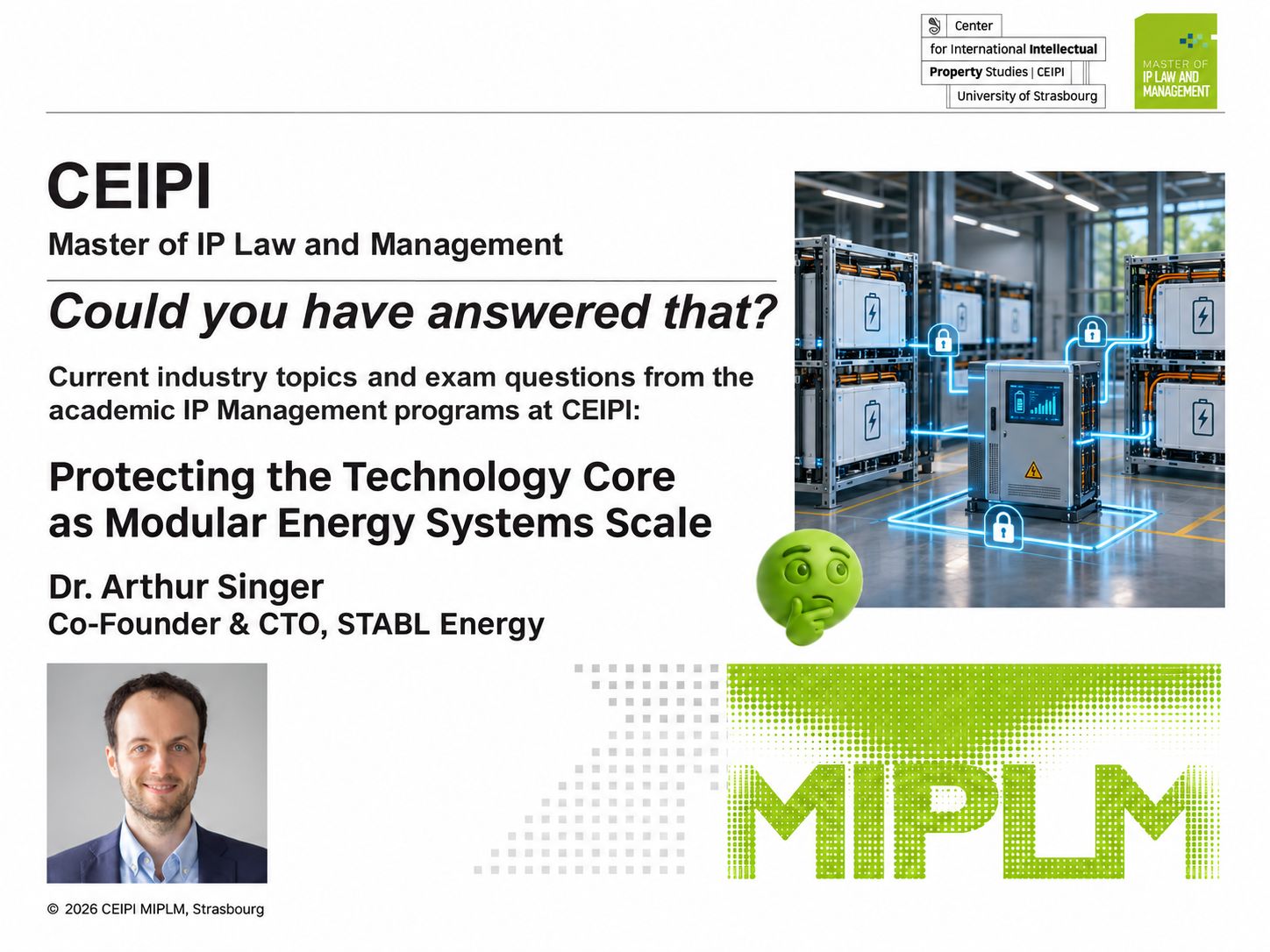
A growing technology company needs to deliver customer projects quickly while building capabilities that remain valuable across its product range. In modular energy systems, those capabilities often emerge from the interaction of electronics, control software and system architecture. The IP decision is which developments justify patent investment, which knowledge should remain internal and what technical access partners need to implement the solution.
These choices connect protection directly with development speed and commercial scale. A patent may support several products or open a new application area, while confidential know-how can preserve valuable internal capabilities. Access arrangements also matter: a partner may be able to use a function through a web interface without receiving the underlying implementation as downloadable software.
Practice-based questions at the CEIPI IP Business Academy help future IP managers examine these decisions in a concrete business setting. We are pleased to present this case with Dr. Arthur Singer, Co-Founder and CTO of STABL Energy. He reviewed the question and confirmed that the choice between patenting and confidentiality reflects recurring decisions in practice. His feedback also highlights the need for a shared understanding between engineering and business leadership that fits the realities of a growing company.
Arthur Singer explains the practical relevance in the following statement, translated from German:
“As a young, fast-growing company, we need to combine speed with innovation. Patents are quite expensive and take a long time to be granted, so we generally patent inventions that benefit the entire portfolio or secure moves into new application areas. Keeping know-how confidential and using it only internally is a valid approach that we regularly follow. For this reason, we also regularly consider which information we can provide to which partner and in what form we make it accessible, for example through a web interface that performs a particular action rather than through a download. The questions raised are therefore relevant to us.”
The following fictional mini case study abstracts these challenges for teaching. It invites students to justify protection and access choices without prescribing a single solution.
Mini Case Study
A growing technology company develops modular energy storage systems for industrial and infrastructure applications. Its competitive advantage comes from the interaction of electronic components, technical control software and system architecture. This combination allows components with different characteristics to operate reliably within a common system and supports adaptation to changing customer requirements.
Customers value efficiency, availability and the ability to expand or modify installations over time. As the company moves into larger projects and additional markets, its development team must support a wider range of operating conditions and integration requirements. Each project creates opportunities to improve the technology, while increasing pressure to deliver quickly and reuse engineering work.
The CTO must determine which developments belong to the common technology core and which should remain specific to an installation. A modification developed for one customer may later become valuable across the product range. Conversely, incorporating every project requirement into the common architecture may increase complexity and make the company dependent on particular components or interfaces.
Growth also requires decisions about the technical access given to suppliers and integration partners. Providing interfaces, configuration information and selected technical documentation can make deployment easier. The company must determine how much access is necessary, which capabilities it should retain internally and how improvements arising during collaboration may be used in future projects.
The company has patent protection for elements of its technology. Further developments may concern electronic architecture, control methods, component integration and system operation. The management challenge is to decide how patents, confidential know-how, contractual rights and freedom-to-operate assessments should support the development roadmap. These choices must preserve commercially valuable differentiation while allowing efficient delivery, collaboration and expansion.
Practical Question
How should the CTO structure IP management so that improvements generated during development and customer integration strengthen a reusable technology core and a defensible market position as the business scales?
1 . Which technical capabilities and interactions should receive priority for protection, and how should the company choose between patenting and retaining confidential know-how, taking account of commercial relevance, possible alternative implementations and the ability to detect infringement?
2 . How should access to interfaces, technical documentation and project-specific implementations be organised so that partners can integrate the systems effectively and the company can reuse its technology across customers and markets?
3 . At which development and commercial milestones should invention capture, portfolio review and freedom-to-operate assessment influence decisions, and how should limited resources be allocated between protecting the existing architecture and emerging applications?
Why This Question Matters in Practice
Companies developing modular industrial technologies create value through the interaction of multiple technical layers. Their commercial advantage may depend on how components are controlled, combined and adapted to operating conditions. IP management must identify the capabilities that explain customer value and determine how those capabilities evolve during development.
Scaling increases the importance of distinguishing reusable technology from project-specific engineering. Decisions about disclosure, access and rights to results can affect whether improvements support a broader product portfolio, remain restricted to one project or become available to other market participants. Those consequences influence development costs, deployment speed and future bargaining power.
Limited resources make selectivity essential. Students must explain when a patent investment could support several products or emerging applications and when confidentiality offers a useful alternative. Commercial relevance, alternative implementations and the practical ability to identify infringement belong in that assessment. The way a function is made available to a partner can also influence how much underlying knowledge is exposed.
Future IP managers need to translate these choices into a common understanding and workable agreements shared by engineering, product management and business leadership. The approach should support timely decisions at relevant development and commercial milestones, with responsibilities clear enough for teams to act. Students should justify the level of coordination required and explain when changes in technology, partner access or market expansion call for a fresh assessment.
Accompanying Lecture
IP Strategy for Modular Technologies: Protecting the Core and Enabling Scale
- Identify the reusable technology core: Connect customer value, technical differentiation and development roadmaps to IP priorities.
- Design protection and access: Combine patents, confidential know-how and collaboration rights, considering alternative implementations and enforceability.
- Integrate IP into scaling decisions: Link invention capture, portfolio review and freedom-to-operate assessment to development milestones, customer projects and market expansion.
About Dr Arthur Singer
 Dr. Arthur Singer is Co-Founder and Chief Technology Officer of STABL Energy, a Munich-based company developing modular battery storage systems for industrial and commercial applications. He holds a diploma in electrical engineering and information technology from the Technical University of Munich and an MBA from the Collège des Ingénieurs in Paris and Munich. After working at Siemens, he researched modular power electronics for battery storage systems at the University of the Bundeswehr Munich. He co-founded STABL Energy in 2019.
His work connects power electronics and battery system development with the practical demands of building a growing technology business. STABL’s modular approach enables batteries with different characteristics to operate within a shared storage system and supports the continued use of batteries in stationary applications. His contribution to this case brings the CTO perspective to decisions about portfolio-wide inventions, confidential know-how and the technical access given to partners as products and applications expand.