
Control the Knowledge Transfer: Turning field experience into protected product capabilities and useful customer guidance

A Proposed approach for the examination case
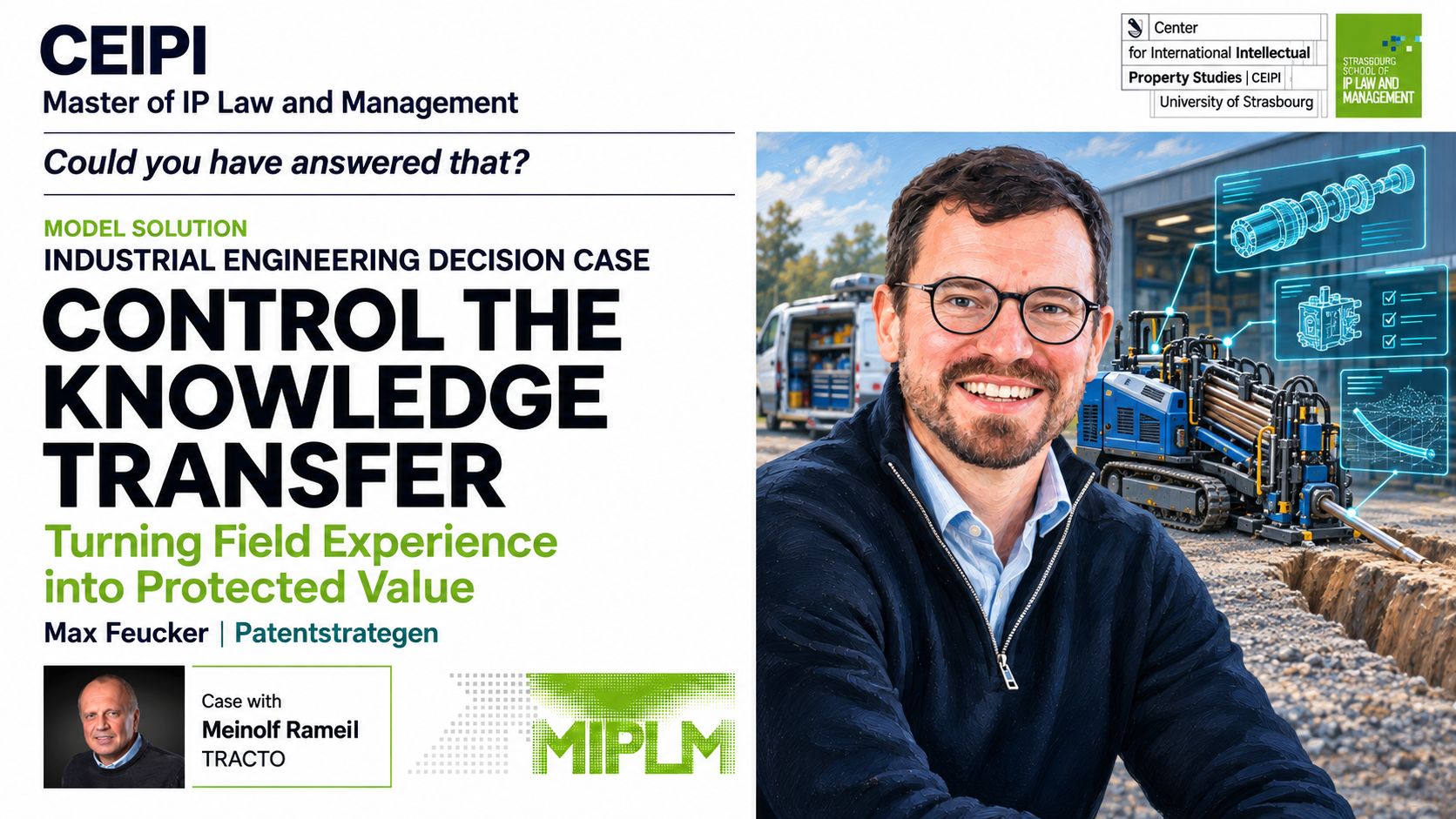
This proposed solution addresses the approved examination case “Turning Field Experience into Protected Value”, developed with Meinolf Rameil. It recommends a defined transfer decision whenever valuable application knowledge moves into a product, service instruction or external training package. The approach and illustrative examples are editorial proposals for Max Feucker’s review. They do not describe verified internal processes or imply his endorsement.
1 Starting point and central IP question
The case concerns an established manufacturer of specialist machinery for infrastructure applications. Customers benefit from reliable equipment, practical operating expertise and technical support. Improvements emerge through development, field use and service. Management wants to carry useful experience across machine variants and customer groups while allocating limited engineering and protection resources carefully.
The decision becomes difficult when the same knowledge serves several purposes. A service finding may support an internal diagnostic method, an improved component and a customer training module. Each destination creates different benefits and exposes different information. External contributions, incomplete technical evidence and uncertain applicability complicate the choice.
This solution focuses on the transfer boundary between those destinations. It builds on the lecture’s sequence of identification, evaluation, decision, protection and reuse, concentrating on the content and conditions of each knowledge transfer. Internal teams retain responsibility for identifying and documenting candidates; external IP advice begins with a defined assessment request.
Original decision case: Turning Field Experience into Protected Value, developed with Meinolf Rameil.
Lecture foundation: AI Supported IP Management in Industrial Engineering
Strategic guiding question: Which knowledge should move to which recipient, in what form and under which conditions, so that application experience strengthens future products and customer performance?
2 Proposed position and core model
The proposed thesis is: Every commercially significant knowledge transfer should have an explicit purpose, a defined recipient and a deliberate boundary around the technical knowledge being disclosed.
Control the Knowledge Transfer treats disclosure as a business design decision. Customer guidance may accelerate adoption and reduce avoidable support work. Internal methods may improve service consistency. Product integration may spread an advantage across an installed base. The company should invest in the form of transfer that supports its chosen commercial objective and remains workable for the recipient.
The proposed Knowledge Transfer Map has four dimensions: Purpose, Recipient, Exposure and Conditions. Its unit is a specific transfer, such as issuing a training module, approving an internal service method or incorporating a mechanism into a product. One technical improvement can generate several transfers with different outcomes.
This perspective follows editorially from Feucker’s public emphasis on manageable IP processes, useful information and transparent coordination with manufacturing SMEs. It gives his specialist assessment a concrete interface with engineering and business decisions. The model is newly proposed here and is not attributed to him as an established method.
Further Reading: This podcast episode connects process improvement with commercial IP use and digital coordination. It supports the proposed focus on a practical assessment interface for each knowledge transfer.
👉 #62 IP Process Management Essentials
3 Applying the position to value creation
Mechanical improvements can improve reliability or performance across several products. Their outward visibility may make confidentiality difficult after delivery. Where commercial life, competitive relevance and technical evidence justify further work, the company should commission patent assessment before a planned disclosure. Development investment also depends on whether the improvement can be manufactured and supported consistently.
Application methods and machine settings contribute through faster setup, more stable operation or reduced wear. Their value may depend on conditions that experienced technicians recognise but have never recorded. The company should document applicability and exceptions before transfer. Customer instructions can communicate validated actions while an internal method retains additional diagnostic detail, provided customers still receive everything needed for safe and effective use.
Service histories and performance observations support learning across deployments. Their significance depends on provenance, comparability and permission to reuse relevant information. A generalised lesson may be transferable even when a customer report remains restricted, but that distinction requires review of the actual information and commitments. Removing a customer name alone does not establish permission.
Training materials convert expertise into repeatable customer capability. Their commercial purpose may include adoption, equipment performance and service efficiency. The release decision therefore covers explanations, images, demonstrations and answers to likely questions. Material shared in a live demonstration can reveal more than its slides suggest.
Further Reading: This Research Nugget explains how firms renew capabilities as opportunities and conditions change. It helps frame field learning as an input to future product and service capabilities in the proposed solution.
👉 David Teece’s Dynamic Capabilities
4 Operating the Knowledge Transfer Map
Purpose asks: What business outcome requires this transfer? The internal sponsor states the intended benefit, affected applications and next decision date. A candidate with no credible use remains documented for reassessment rather than automatically receiving protection expenditure.
Recipient asks: Who needs which knowledge to achieve that outcome? The team identifies the relevant engineers, service staff, customers or partners and their intended actions. It specifies the minimum sufficient content for each audience, including operating limits and necessary safety information.
Exposure asks: What capability could the recipient or a competitor reconstruct? Engineering explains what becomes visible through hardware, instructions, demonstrations or repeated use. The IP adviser assesses the implications of that exposure, possible protection routes and unresolved rights questions using the supplied evidence. Unknown exposure requires further examination before release.
Conditions asks: What must be completed before the transfer may proceed? The record names required technical validation, permission checks, protection actions, access restrictions and the approval owner. It produces one of four decisions: release as specified; release a revised package; hold for named evidence or action; or decline the proposed transfer. Each hold has an owner and review date. Commercial priority cannot override unresolved permission or technical safety requirements.
Consider an illustrative service finding: a revised setup sequence reduces wear under a particular operating condition. The dossier contains a proposed component change, technician observations and photographs from a customer site. Engineering first checks whether the result is repeatable. Max receives a concise request covering the potential technical contribution, intended disclosure, contributors and open permissions.
The resulting proposal might release validated operator guidance, retain the detailed diagnostic method internally and hold the component drawings for patent assessment. Customer photographs are replaced or cleared before use. If the sequence itself exposes the entire valuable method, management must explicitly assess that disclosure rather than assuming the internal document remains an effective secret.
Further Reading: This glossary entry connects IP decisions with development and commercial milestones. It supports reviewing the transfer package before a demonstration, product release or training event makes the decision difficult to reverse.
👉 Milestone-Based IP Management
5 Implementation and portfolio organisation
The minimum dossier should capture the technical change, source evidence, contributors, known disclosures, intended recipient and date, expected business use, and unresolved questions. References to existing records keep duplication low. Engineers validate technical content; the service or product sponsor supplies business context. A named internal coordinator checks completeness and obtains missing information.
Max’s proposed role begins with specialist assessment of selected candidates. He identifies protection options, disclosure implications, rights questions and further examination needs, then returns an actionable recommendation. Approved protection work follows within his expertise. Contractual, data or other questions outside the agreed scope require an appropriate specialist. Management owns investment choices and authorises transfer after the relevant technical and legal checks.
A proposed twelve-week pilot should cover one product family and one upcoming knowledge-transfer event. During the first four weeks, teams record the existing effort and decision delays and select a manageable sample. The next four weeks test the dossiers and specialist interface. The final four weeks complete a real transfer where the operational calendar permits and compare results with the baseline.
Portfolio records should connect each capability to its patent candidates, restricted methods and approved transfer versions. Investment can then follow credible growth paths: use across additional products, repeatable service delivery or customer training. Filing, maintenance and documentation expenditure should be reviewed against these paths. A capability with little reuse potential may still justify protection if its individual commercial importance is high.
Further Reading: This contribution considers how IP processes must remain workable as a business expands. It supports linking the proposed portfolio records and review effort to actual product and service growth paths.
👉 Why is IP process optimization important for growing companies?
6 Adapting to new dependencies
A transfer decision applies to a specified context. A new recipient, territory, product version or partner may change the relevant permissions, competitive exposure and practical effectiveness of protection. Reusing a training package with a distribution partner, for example, requires examination of onward sharing and access to any supporting technical information.
Supplier-controlled components or software can limit implementation choices. The company should assess whether a proposed solution requires licences, access to interfaces or ongoing support, and whether a substitute is economically feasible. Existing protection for the company’s own contribution does not settle third-party freedom to operate. Relevant scope and further searches must be defined for the intended implementation and market.
Reviews should be triggered by a new competitive product, a changed interface, evidence that previously restricted knowledge has become observable, or a shift towards remote support. Options may include revising the package, negotiating permissions, changing the implementation or accepting wider disclosure for a documented business benefit. Monitoring effort should reflect commercial exposure.
Further Reading: This contribution connects filing strategy, risk detection and the commercial use of IP. It supports reopening transfer decisions when new dependencies or competitive information change the original assessment.
👉 How can optimized IP processes help to reduce IP risks and improve IP usage?
7 Practical decision overview
The table applies the approach to distinct parts of the illustrative improvement. Protection measures require assessment for the specific content and intended use; the routes below are proposed decision directions.
| Knowledge element | Intended destination | Proposed control | Decision before transfer |
| Component mechanism | Product and technical documentation | Patent assessment and controlled drawings | Assess exposure, contribution and investment before disclosure |
| Diagnostic method | Internal service teams | Restricted access, documented method and training | Validate conditions and assign an accountable owner |
| Operator sequence | Customer guidance | Approved instructions with defined scope | Confirm effective use and accept the assessed exposure |
| Customer observations | Cross-project learning | Permission review and separated records | Clear reuse or exclude restricted source material |
| Training package | Customers or service partners | Version control and agreed permitted uses | Approve content, audience and demonstration boundaries |
The measures must work together. An internal confidentiality label cannot resolve disclosure through a public demonstration. Copyright in training materials does not by itself control the technical method they explain. A contract may govern a recipient’s conduct while the product still reveals the mechanism to others. Review therefore follows the actual route by which knowledge becomes accessible.
Further Reading: This Research Nugget examines coordinated protection across different elements of a business asset. It supports matching each part of the transfer package to complementary legal, organisational and technical measures.
8 AI support and recurring governance
AI can assist internal teams by grouping authorised service records, finding related observations and drafting candidate summaries. Access must follow source permissions, including when retrieval combines documents from different projects. Each summary should point to its evidence and distinguish an observed result from a suggested generalisation. Deployment settings, information retention and access to outputs need internal approval.
Verification should address human error as well as model error. Reviewers compare claims with original records, search for contradictory examples and record uncertainty before seeing a suggested ranking where practical. A sample of unselected records helps detect missed candidates. A second review is appropriate for consequential external disclosures. Merely assigning a person to approve AI output provides insufficient assurance.
Quarterly reviews should examine decision lead time, dossier rework, review effort, unapproved disclosures, and whether recipients successfully used the released knowledge. These measures distinguish a faster workflow from a better commercial outcome. The pilot should expand only if verified benefits justify its total effort; otherwise simplify the process or discontinue the AI component. Approved transfer versions and access records must remain traceable.
Further Reading: This contribution explains how shared information, cost visibility and workflow management support coordinated IP work. It provides an operational foundation for maintaining transfer records and reviewing the proposed process over time.
👉 How can digital IP tools help to make IP work more efficient?
Result
Control the Knowledge Transfer proposes an explicit decision for each movement of commercially significant application knowledge. Purpose, Recipient, Exposure and Conditions connect business intent with practical disclosure choices. The operating record defines what may move, to whom, in which version and after which actions. Internal teams retain the learning process; specialist advice supports protection and rights decisions.
The intended effect is broader productive use of field experience with more deliberate control of competitive exposure and protection expenditure. Benefits must be demonstrated through actual use and measured effort. The proposal creates a basis for repeatable product and service capabilities without assuming a particular financial return.
Which knowledge should the company transfer today, to whom and under which conditions, to strengthen tomorrow’s competitive advantage?
Expert profile Max Feucker
 Max Feucker is a patent attorney with a background in physics and Managing Director of dipas Patentanwalts GmbH, operating under the Patentstrategen brand in Ratingen. His public professional focus includes manufacturing SMEs, strategic patent advice and making IP processes manageable where employees handle these matters alongside other duties. His published service profile covers employee training, invention disclosure, competitor monitoring and access to current IP information. The firm describes digital transparency and regular strategic discussions as elements of its client work.
On the digital IP lexicon dIPlex, Feucker is the featured expert for IP Process Management. The associated contributions address invention capture, process development for growing companies, risk reduction and digital workflow support. His content is also featured in episode #62 of IP Management Voice, “IP Process Management Essentials”. These resources connect organised information and repeatable processes with commercial IP use. They provide a documented basis for selecting a solution perspective concerned with the quality of the interface between internal engineering knowledge and external assessment.
