Data Control and IP Strategy in Industrial IoT

Connected industrial machines generate valuable operating data, but the ability to produce data does not automatically determine who can access it, use it or build services around it. As manufacturers connect products with cloud platforms, analytics and customer systems, competitive advantage increasingly depends on how data rights, technical capabilities and contractual arrangements fit together. For companies, this makes data control an important part of IP strategy.
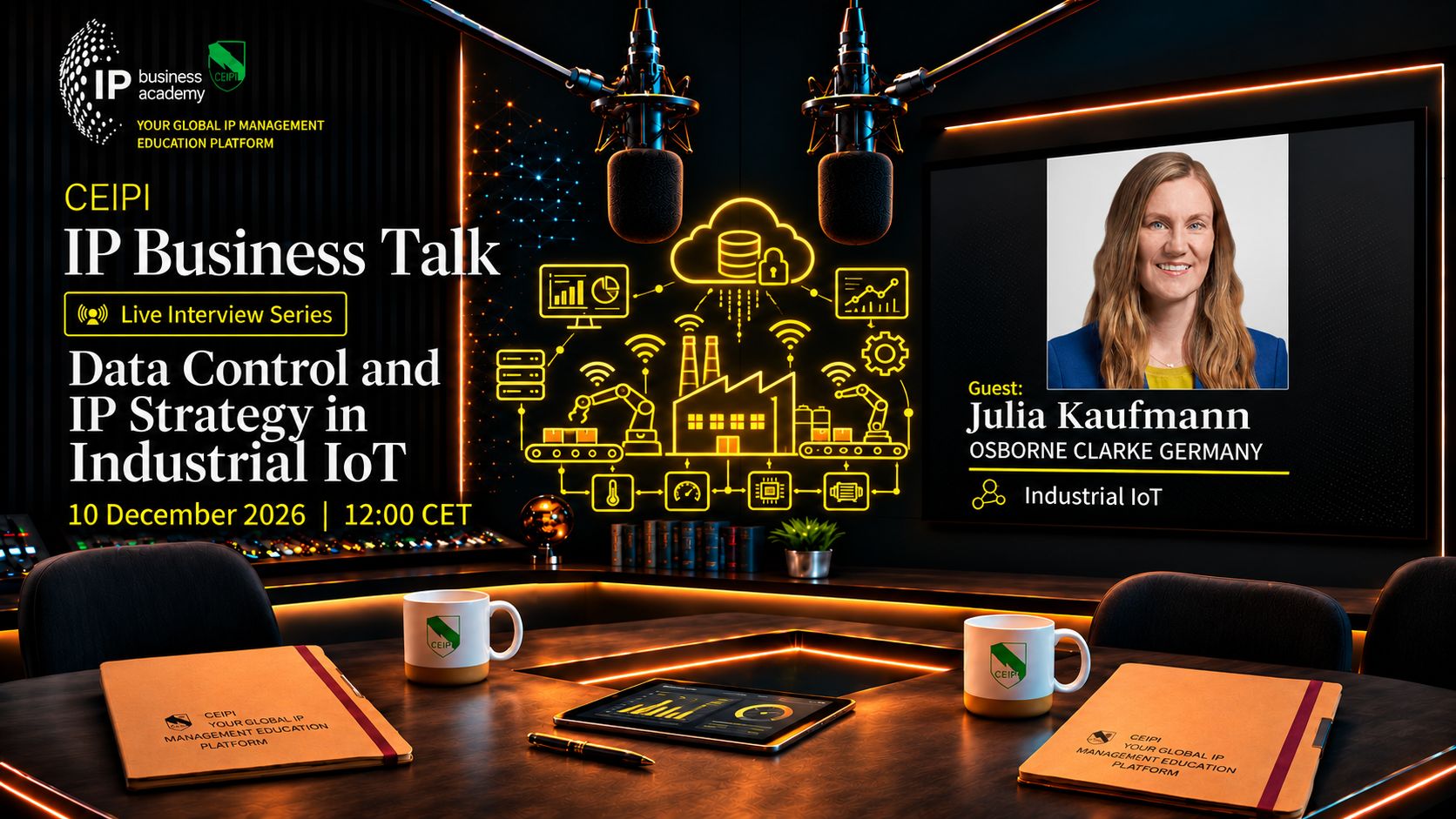
On Thursday, 10 December 2026, at 12:00 PM CET, Julia Kaufmann, Partner at Osborne Clarke Germany, will join Prof. Dr. Alexander J. Wurzer for a live CEIPI IP Business Talk on Data Control and IP Strategy in Industrial IoT. The conversation will explore where value is shifting in connected industry, how the EU Data Act affects established data practices, where different protection mechanisms leave gaps and which decisions manufacturers need to make before bringing connected products to market.
👉 Join the live conversation on LinkedIn
Understanding where value is created in connected industry
The first theme concerns the changing relationship between physical products, operational data and control over the use of that data. A machine can produce extensive information about its performance, operating conditions and maintenance needs. Yet the commercial opportunity may arise only when that information can be combined, interpreted and used to deliver a service.
Consider an equipment manufacturer that offers predictive maintenance to its customers. The sensors and machine remain essential, but the business model also depends on data access, analytics and the ability to use information across installations. Who can obtain the data? Who can combine it with other sources? And who can turn the resulting insights into a customer offering? The discussion will examine whether value is moving from the product to the data itself, or increasingly to control over access and use.
Adapting competitive advantage to the EU Data Act
The second theme examines what the EU Data Act means for companies that have traditionally treated machine and operational data as part of their proprietary advantage. The regulation establishes new rights for users of connected products to access certain generated data and to have it made available to third parties under defined conditions.
Imagine an industrial equipment supplier whose connected machines transmit operational information to its own service platform. A customer may want to share relevant data with an independent maintenance provider or integrate it into a factory-wide analytics system. For the supplier, this raises questions about product design, contractual arrangements, confidentiality and the distinction between data that must be made available and information that may require particular safeguards. The talk will explore how industrial companies can rethink their competitive position when data access can no longer be considered solely on the basis of who built the machine.
Closing the gaps between patents, software and data rights
The third theme considers the way patents, trade secrets, software, contracts and data rights interact in connected industrial systems. Protecting an important technical feature does not necessarily secure control over the data flows or services on which the commercial offering depends.
A manufacturer might have strong patent protection for a sensor arrangement or machine-control method, while the connected solution also relies on third-party software, external cloud infrastructure, customer data access and interfaces used by service partners. Each layer may be governed by different legal and commercial arrangements. The discussion will look at where companies risk protecting one part of the product effectively while overlooking dependencies elsewhere in the system, and how those gaps can affect future business models.
Making data and IP decisions before market launch
The fourth theme connects data control with the decisions made during product development. Questions about what a connected product records, how data can be accessed, which interfaces are available and what users may do with the information can become difficult to resolve once the technical architecture and commercial promises are established.
Consider a company designing a new generation of networked industrial equipment. Before launch, it must think about which data its customers will need, what services it hopes to provide, how third-party access may work and which capabilities it needs to preserve for future innovation. These choices involve engineering, product management, legal advisers and commercial teams. The conversation will examine which questions about IP, data rights and business models are best addressed before a product enters the market rather than after customers and partners begin relying on it.
Connecting data control with the wider Industrial IoT ecosystem
These themes connect directly with our Industry Focus on Industrial IoT, which examines how connected machines, sensors, software, digital twins, data flows and service-based models are changing the logic of IP management. In connected industry, commercial value often arises across several interacting layers rather than from one protected component. Data access, interoperability, cybersecurity, standards and contractual control therefore increasingly shape the practical value of an IP position.
The upcoming talk offers industrial companies, IP managers, product leaders and advisers an opportunity to examine how these questions come together when connected products move from engineering projects to scalable offerings.
👉 Explore our Industry Focus on Industrial IoT
Julia Kaufmann
 Julia Kaufmann, LL.M., is a Partner at Osborne Clarke Germany. She advises national and international companies on information technology, data licensing and privacy law, cybersecurity, artificial intelligence, e-commerce and digital transformation. Her work spans technology, media and communications as well as life sciences and healthcare.
She has extensive experience with cross-border privacy and compliance projects, the implementation of IT tools with AI components, and legal questions arising in technology-driven business models. Her perspective connects data-related regulation with the practical decisions companies face when developing and operating digital products and services.
👉 Read Julia Kaufmann’s profile at Osborne Clarke
Join Julia Kaufmann and Prof. Dr. Alexander J. Wurzer on Thursday, 10 December 2026, at 12:00 PM CET for this live CEIPI IP Business Talk on Data Control and IP Strategy in Industrial IoT.
👉 View the event details and join the conversation on LinkedIn