
Visible IP Episode #1 Part 2/2: What Strong Positioning Looks Like for IP Experts

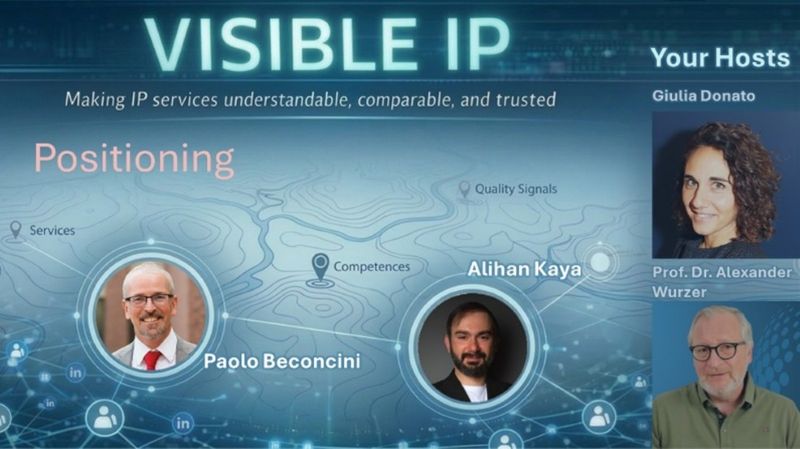
In the second part of Visible IP Episode #1 within the CEIPI IP Business Live Talks, the conversation with Giulia Donato turned from client journeys to a closely related but distinct question: what does strong positioning actually look like for intellectual property experts? This is not a cosmetic issue. It is not about polishing a headline, adding a slogan to LinkedIn, or trying to appear more visible in a generic sense. In the IP field, positioning is much more fundamental. It determines whether the market can understand what an expert stands for, why that person is relevant, and what kind of trust should be attached to their name.
This matters because IP experts often work in an environment where excellence is difficult to recognize from the outside. The most valuable matters are usually confidential. The most impressive strategic decisions often remain invisible. Even highly experienced professionals can therefore appear interchangeable if they do not create a recognizable public profile around their expertise. That is why positioning is not a superficial marketing layer added on top of professional work. It is the communicative structure that allows expertise to become identifiable and memorable.
The discussion with Giulia Donato explored this challenge through two very different examples of digital expert marketing: Paolo Beconcini and Alihan Kaya. Both show that strong positioning in the IP world is not achieved by saying “this is what I do” once and hoping the market will remember. It is built through repeated signals, thematic coherence, and a visible pattern of interpretation that others begin to associate with a specific person.
What Positioning Means for IP Experts
For IP experts, positioning means creating a clear and credible association between a person and a specific field of relevance. It is the process by which the market learns not only what someone knows, but what they are especially known for. That distinction matters. Many professionals are competent. Far fewer are clearly remembered.
 The white paper on personal branding and expert branding makes this point very clearly. It argues that technical expertise and legal precision remain essential, but they are no longer sufficient on their own to secure visibility, trust, and sustainable engagement. Today, clients, founders, investors, public institutions, and business partners increasingly evaluate expertise through digital channels before any direct contact takes place. That means reputation is no longer built only in conference rooms, referral networks, or specialist publications. It is also built through what can be seen online, repeatedly and coherently.
Here you can download the White Paper “Personal & Expert Branding for IP Experts” free of charge which provides a detailed explanation of how the client journey concept is applied to the business development of IP experts.
In that sense, positioning is not identical with self promotion. A well positioned IP expert does not simply claim authority. They make their expertise legible. The white paper highlights three principles that are especially relevant here: authenticity, focus, and consistency. Authenticity means that communication must match real experience and real competence. Focus means that the expert cannot try to own every topic at once, but must become recognizable in a clearly defined area. Consistency means that visibility has to be repeated over time if it is to become memorable.
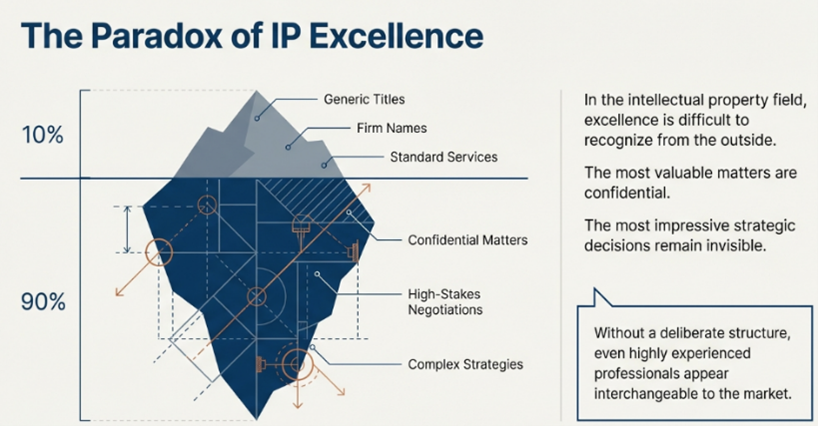 This is particularly important in IP because the profession is full of general competence but relatively few experts who are clearly associated with a sharply defined field. Positioning helps solve that problem. It turns broad capability into a distinct market signal. It helps a professional become the person others think of when a certain issue, industry, or strategic challenge arises.
Why Good Positioning Is More Than Visibility
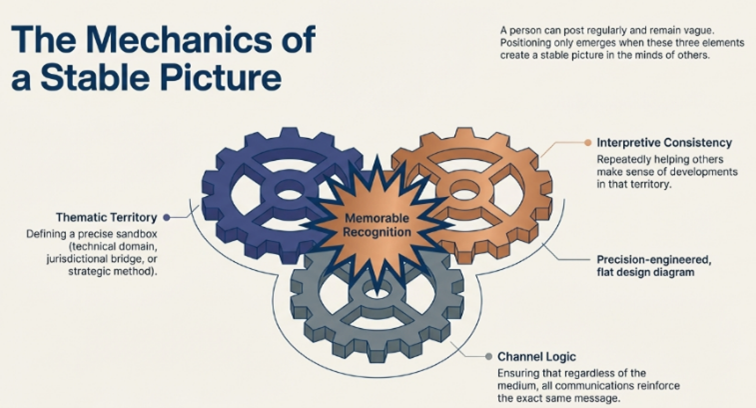
One of the most valuable insights in the conversation with Giulia Donato was that positioning should not be confused with mere online activity. A person can post regularly and still remain vague. They can appear often without becoming memorable. Positioning only emerges when repeated communication creates a stable picture in the minds of others.
For IP experts, that stable picture usually rests on several elements. The first is a clearly defined thematic territory. This could be a technical domain, a market challenge, a jurisdictional bridge, or a strategic method. Without such a territory, communication may generate attention but not recognition.
The second element is interpretive consistency. It is not enough to mention a topic occasionally. Strong positioning develops when an expert repeatedly helps others understand developments in that field. They comment, explain, compare, and contextualize. Over time, this creates what Giulia described in the discussion as a form of topic ownership. The person becomes associated not only with information, but with a distinctive way of making sense of that information.
The third element is channel logic. Positioning does not always happen through one channel alone. Some experts build it through a newsletter, others through interviews, podcast appearances, expert pages, community platforms, or combinations of these. What matters is not the number of channels, but whether they reinforce the same message.
 The personal branding white paper adds an important strategic perspective here. It explains that a strong digital footprint signals forward looking professionalism and the ability to translate complex knowledge into accessible insights. That is especially relevant in IP. Clients are not just looking for technical correctness. They are looking for experts who can connect technical, legal, and commercial realities in a way that feels clear and usable. Positioning makes that capacity visible before a formal mandate begins.
The Paolo Beconcini Example: Positioning Through Topic Ownership
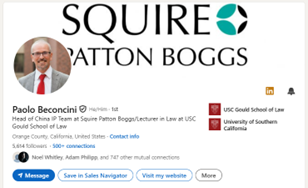 The first example discussed in this part of the episode was Paolo Beconcini. His field of relevance is clear and highly specific. He supports mainly western companies in matters related to IP enforcement practice in China. That alone already shows one of the core strengths of good positioning. It is not generic. It connects a geographic dimension, a strategic problem, and a concrete business need.
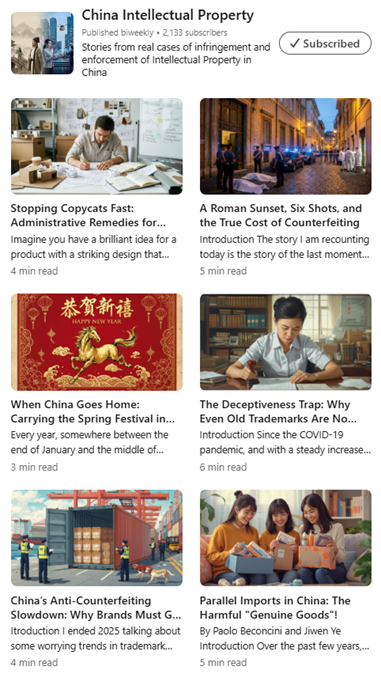
In the discussion, Paolo’s LinkedIn newsletter on China Intellectual Property was highlighted as the central positioning device. This is important because a newsletter allows more than occasional visibility. It creates continuity. It builds expectation. It gives the expert a recurring space in which a field of expertise can be developed over time rather than mentioned in fragments.
What makes Paolo’s approach especially strong is that he does not simply publish information. He repeatedly interprets events, developments, and contributions from others through the lens of his own expertise. This was one of the key observations in the conversation with Giulia. Positioning is not built by announcing a specialty once. It is built by returning to the same field from multiple angles and helping the audience understand what matters in that field.
This is where the idea of topic ownership becomes very useful. Paolo creates a coherent intellectual thread. Each contribution reinforces the last. Each new event becomes another opportunity to demonstrate judgment and perspective within the same thematic territory. That produces recognition. The audience begins to expect that if an issue related to China and intellectual property arises, Paolo will have something worth reading.
The white paper helps explain why this works. It emphasizes that focus and consistency are central principles of expert branding. Paolo’s newsletter format embodies both. The focus is clear. The rhythm is repeated. The result is not just visibility, but a durable association between person and subject. That is exactly what strong positioning should achieve.
The Alihan Kaya Example: Positioning Through a Wider Ecosystem
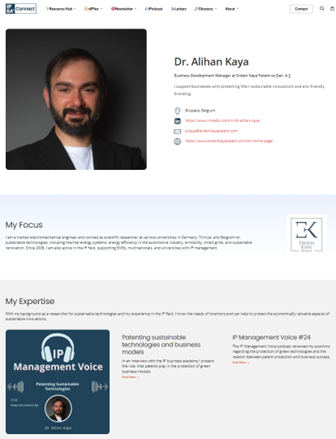
The second example, Alihan Kaya, demonstrates a different route. His positioning does not emerge from the classic profile of a traditional attorney. Instead, it draws on an intersection of economic perspective, technological understanding, and strategic relevance. His thematic field connects intellectual property, sustainable technologies, circular economy, and the market entry dynamics of European and Asian actors.
This already shows another important lesson about positioning. A strong position does not always come from fitting neatly into an existing professional category. Sometimes it comes from connecting several fields that, together, create a distinctive point of view. In Alihan Kaya’s case, the combination itself is part of the signal.
According to the discussion with Giulia, one of the most interesting features of his positioning is that it is not built primarily through his own LinkedIn channel. Instead, it is reinforced across a broader ecosystem of external platforms and formats, including interviews, contributions in the digital IP lexicon, podcast appearances, and other forms of curated content. This gives his positioning a different texture from Paolo’s. It is less centered on one recurring personal publication stream and more on a network of reinforcing appearances.
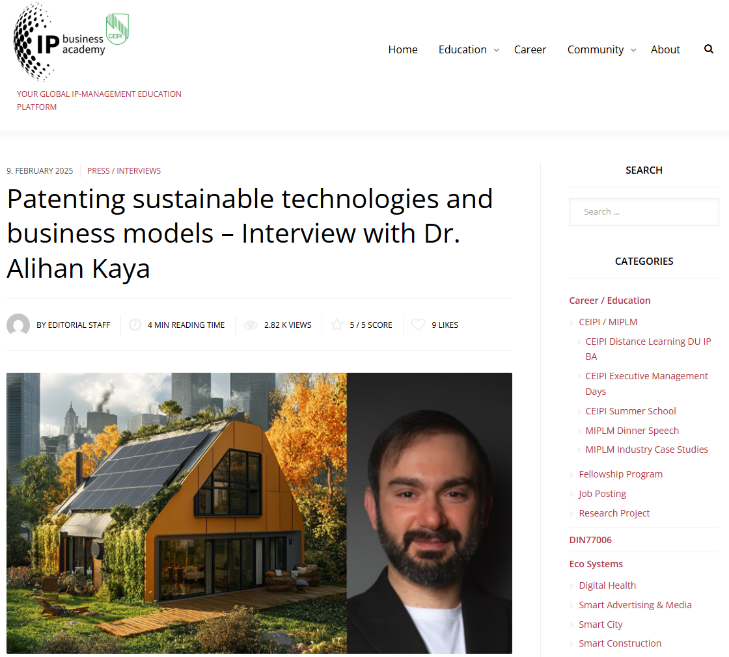
Giulia identified this as a major strength. When expertise is confirmed across several respected channels, credibility is carried not only by self description but also by the surrounding environment. That creates two advantages. First, it expands reach beyond the expert’s immediate personal network. Second, it strengthens trust because the positioning is validated through multiple contexts.

The personal branding white paper is highly relevant here as well. It explains that expert branding for IP professionals is not about advertising, but about systematically demonstrating expertise in a credible way across formats. It also highlights the role of interviews, blogs, podcasts, and community programs as effective channels for expert communication. Alihan Kaya’s example shows what that looks like in practice. His position is built not by a single claim, but by repeated thematic coherence across a range of platforms.
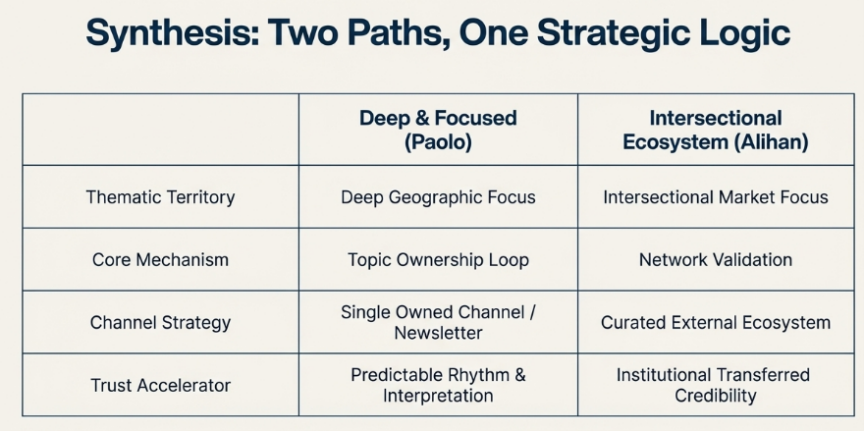 Taken together, the two examples from Visible IP Episode #1 show that there is no single formula for positioning IP experts. Paolo Beconcini demonstrates the power of repetition within a tightly defined thematic stream.Alihan Kaya demonstrates the value of building recognition through a broader ecosystem of curated channels. The methods differ, but the strategic logic is the same. In both cases, positioning is created by making expertise visible in a focused, credible, and repeatable way.
That may be the central takeaway from this part of the conversation with Giulia Donato. Positioning for IP experts is not an act of self labelling. It is a long term process of becoming clearly associated with a field, a perspective, and a pattern of judgment. In a profession where much of the best work remains confidential, that process is not optional. It is how trust becomes visible before the first conversation even begins.