
Business Development in the Knowledge Economy: From Business Models to Agentic Transformation at CEIPI MIPLM Module 6

Business development in intellectual property management begins with a simple but powerful observation: modern economic value is increasingly built on knowledge. Technology, data, know how, organizational capabilities, brands, software, processes and industrial experience are not secondary assets anymore. They are central inputs into competitiveness, productivity and market position.
The lecture frames this shift historically, moving from the idea of the knowledge economy to the current emergence of the agent economy. Knowledge is no longer only something created by researchers or stored in organizations. It is now embedded in products, platforms, workflows, supply chains and AI enabled decision systems. This changes the role of IP management because IP is no longer just a legal function at the end of innovation. It becomes part of how companies understand markets, shape business models and organize value creation.
The industrial dimension is essential here. A knowledge economy still needs a productive base, scalable manufacturing and technology intensive industries. Business development therefore cannot be reduced to marketing or sales. It is about connecting technical capability with economic value, industrial scalability and defensible market positions.
The Business Model as the Bridge Between Technology and Value
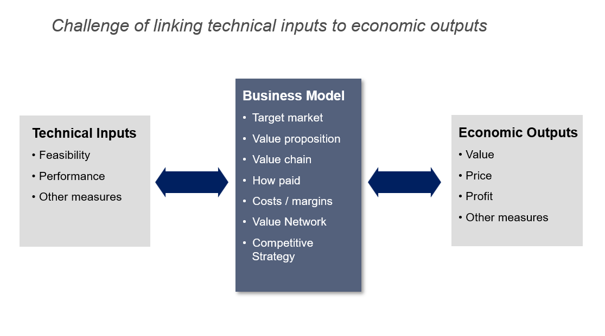
A central theme of the module is the business model. The business model explains how a company creates value, for whom it creates value, how it organizes the value chain and how it captures economic returns. In IP management, this is decisive because patents, trademarks, designs, copyright, data and trade secrets only matter strategically when they protect something that is economically relevant.
The lecture uses the business model as a cognitive map between technical inputs and economic outputs. Technical feasibility and performance do not automatically become market value. A company must translate them into a value proposition, a market segment, a revenue logic, a cost structure, a value network and a competitive strategy. This translation is exactly where IP strategy becomes part of business development.
The example of Xerox and Japanese low end copiers illustrates this point very clearly. Xerox protected an integrated copier system, including technology, supplies, service routines and recurring revenues. Japanese competitors entered with a different business model, based on affordability, modular machines, user serviceable cartridges and third party distribution. The lesson is not simply that one company had patents and the other had a workaround. The deeper lesson is that different business models require different IP priorities.
A similar logic appears in the comparison between Xerox Star and the IBM PC. Xerox aimed to control a complete high performance system, while IBM created a more open architecture that allowed third party hardware and software ecosystems to grow. This shows that IP strategy must be aligned with the architecture of the business model. Sometimes value comes from closed control. Sometimes it comes from standards, complements and scalable adoption.
Business Planning as a Discipline of Strategic Clarity
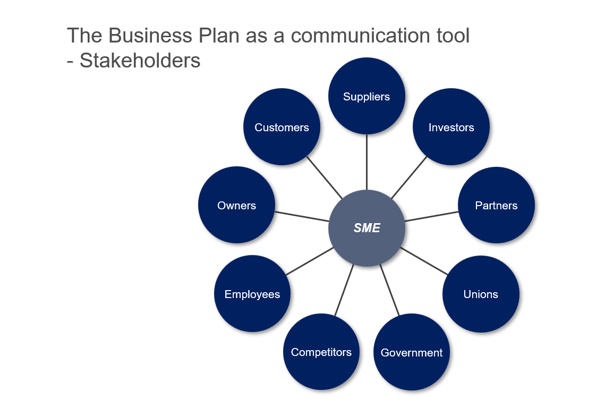
The lecture then moves from business models to business planning. A business plan is not merely a document written for investors. It is a communication tool, a management tool and a structured way to think through the business. It answers the essential questions: what the company offers, why customers buy it, who produces it, who sells it, who finances it and how the business becomes economically sustainable.
The module highlights the classic elements of a business plan, including executive summary, product or service description, market analysis, company structure, marketing and sales, organization, funding request, financials, implementation plan and risk factors. This structure matters because it forces managers to link words to numbers. A business plan must not only sound plausible. It must show assumptions, milestones, resources, revenues, costs, risks and financing needs.
For IP management, the business plan has an additional role. It must explain what is defensible in the business model. It must show whether IP protects the product, the value proposition, the revenue logic, the data layer, the brand, the process, the customer interface or the ecosystem position. Without that link, IP remains a legal inventory. With that link, IP becomes part of the business case.
This is especially important for investors, partners and boards. They do not only want to know whether a company has intellectual property rights. They want to know whether differentiation can be protected, whether margins can be defended, whether growth is scalable and whether market entry risks have been understood. A strong business plan therefore connects IP with monetization, risk reduction and strategic negotiation power.
Creating New Business Models Through External Innovation
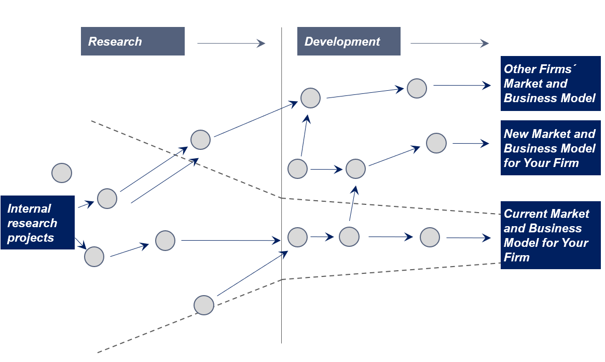
Business development does not happen only inside the boundaries of the firm. One of the major themes of the lecture is open innovation. Companies increasingly need access to technologies, capabilities and ideas that they do not fully own or develop internally. They must therefore learn how to identify, access, integrate and commercialize external innovation.
This changes the role of IP. In a closed innovation logic, IP is often used to exclude others and protect internal R&D outputs. In an open innovation logic, IP also becomes a coordination instrument. It helps define what can be shared, what must remain controlled, what can be licensed, what can be jointly developed and how partners can cooperate without destroying the value of their contributions.
Open innovation also creates organizational implications. It requires interfaces between legal, R&D, strategy, business development, finance and external partners. It requires absorptive capacity, meaning the ability to understand and use knowledge that comes from outside. It also requires clarity about ownership, access rights, background IP, foreground IP, confidentiality and commercialization routes.
The broader message is that business development increasingly means orchestrating access to knowledge. The most relevant technologies may sit in universities, startups, suppliers, platforms, customers or adjacent industries. IP management helps turn this distributed knowledge into a structured business opportunity.
Markets for Technology and the Limits of Transfer
The module also addresses markets for technology. Technology transfer makes technical knowledge economically usable by moving it from one organization or context to another. This can happen through licensing, sale of IP, know how transfer, training, documentation, open innovation, new business models or financing structures.
However, technology transfer is not automatic. It is strongly industry dependent because technologies differ in complexity, regulation, infrastructure, supply chains, life cycles and dominant types of IP. A software component can often be transferred differently from a semiconductor process, a pharmaceutical platform, a medical device, a manufacturing method or an industrial service model.
The lecture therefore places strong emphasis on the limits of technology transfer. Some knowledge can be codified in patents, documents, drawings or software. Other knowledge remains tacit and is embedded in people, routines, experience, manufacturing culture or trial and error. In complex industries, successful transfer often requires collaboration, training, personnel movement and long term integration.
This is where IP strategy becomes more nuanced. Protecting codified inventions is important, but not sufficient. Companies must also manage trade secrets, know how, interfaces, documentation, partner learning and operational capabilities. Markets for technology work best when the transfer object is clear, the rights are structured and the receiving organization can actually absorb and apply the knowledge.
IP Finance: Turning Intangibles into Funding Capacity
Another major block of the lecture is IP finance. If knowledge and intangible assets are central to value creation, then they must also become relevant for financing. The module discusses IP as an instrument for equity financing and debt financing, while also addressing the practical limits of using IP to obtain funding.
For equity financing, IP can strengthen the investment story. It can show that the company has protectable differentiation, scalable options, barriers against imitation and assets that support future growth. Patents, brands, software, data and know how can help investors understand why a company may capture value beyond short term execution.
For debt financing, the logic is more difficult. Lenders usually need reliable valuation, enforceability, liquidity and collateral structures. IP assets are often hard to value because their worth depends on context, use, market access, legal strength and complementary capabilities. This does not make IP irrelevant for debt financing, but it shows why IP finance requires careful valuation, documentation and risk analysis.
The larger point is that IP finance connects innovation to capital. It forces companies to explain how intangible assets support cash flows, growth options, licensing revenues, bargaining power or exit value. In modern business development, financing cannot be separated from IP strategy because investors and lenders increasingly need to understand where defensible value actually sits.
Change Management as the Organizational Side of Business Development
Business development is not complete when a strategy has been defined. It must be implemented, and implementation means change. The lecture therefore includes change management as a major theme. Change management deals with the people side of business change so that required business outcomes can actually be achieved.
The module emphasizes that change begins with pressure to adapt. This pressure can come from markets, customers, competitors, regulation, technology shifts or internal strategic goals. Before implementation starts, companies must diagnose what needs to change: products, processes, structures, culture, capabilities, leadership, technology or resource allocation.
Resistance is treated as a normal feature of organizational change, not as an exception. It may appear through objections, rumors, avoidance, fatigue, formalism or internal withdrawal. Business development must therefore include stakeholder analysis, communication, participation, negotiation and top management support.
This is highly relevant for IP management. New IP strategies often require new behaviors from engineers, product managers, sales teams, executives and external partners. A company may need to document knowledge differently, disclose inventions earlier, protect data more systematically, manage trade secrets more carefully or involve IP experts earlier in business decisions. Without change management, even a strong IP strategy remains theoretical.
Digital Business Transformation and the New Location of Value
The final part of the lecture moves into digital business transformation. Digital transformation changes not only tools and channels. It changes where value is created and captured. Products become connected, services become data rich, platforms become market infrastructures and workflows become software mediated.
In such an environment, IP management must look beyond classical product protection. Value may sit in data flows, user interfaces, algorithms, integration routines, platform access, ecosystem rules, customer relationships and process knowledge. The protectable asset is often not one isolated invention but a controlled configuration of technology, data, brand, customer trust and operational capability.
Digital transformation also changes business models. Companies shift from selling products to offering availability, outcomes, usage based services, subscriptions or platform access. This means that IP strategy must protect the economic logic of the digital business, not only the technical components. The central question becomes: which control points allow the company to capture value in a digital value network?
This brings the lecture back to its starting point. Business development is the discipline that links technology, market structure, finance, organization and transformation. IP management becomes the connective layer because it helps define what can be owned, controlled, shared, licensed, financed and defended.
The AI Transformation and the Agentic Economy
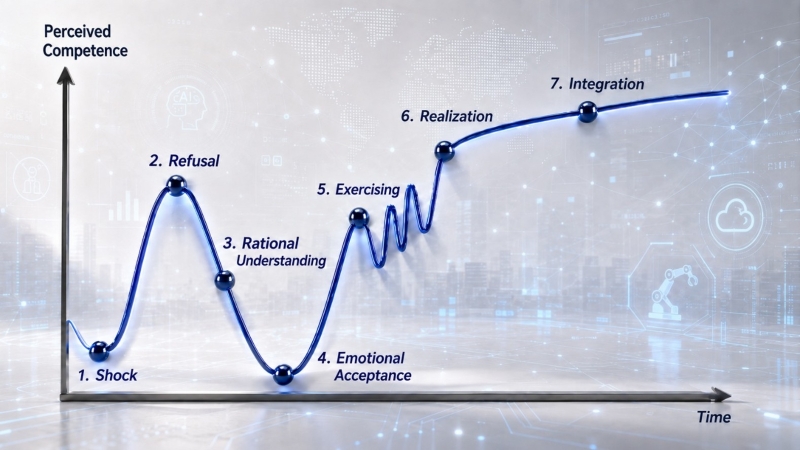
The lecture closes by extending the logic into the AI transformation. AI agents increasingly support, coordinate and execute economic activity across organizations, factories and markets. This does not mean that judgment, responsibility and strategy disappear. It means that the speed, structure and governance of business processes change fundamentally.
Agentic workflows can reduce hand offs, shorten cycle times and reorganize how work is coordinated. When agents interact with agents, new questions arise around authority, authentication, liability, interoperability and auditability. A company must ask not only how AI can improve existing processes, but what happens when competitors reorganize their processes around AI much faster.
For IP management, this creates new strategic questions. Proprietary data, domain expertise, models, workflows and adaptation speed may become more important than access to generic AI tools. The competitive edge may not come from having the best AI system, but from being able to reorganize business processes around AI faster and more responsibly than others.
This is the large line of the module: business development in IP management is no longer a peripheral topic. It is the discipline of turning knowledge into business models, business plans, technology markets, financing options, organizational change and digital transformation. In the emerging agent economy, the companies that understand this connection will not treat IP as paperwork. They will treat it as one of the central instruments for shaping future value creation.