
From Expert to Choice: What Makes Digital Marketing for IP Law Firms Work

At the ETL IP experience exchange, Authenticity in Digital IP Business Development, on March 24, 2026 in Berlin, Dr. Tobias Denk addressed one of the central questions facing IP law firms today: why do some firms become visible, memorable, and commercially relevant in digital markets while others remain largely invisible despite excellent technical expertise?
His answer was both reassuring and demanding. Successful digital marketing for IP law firms is not a matter of louder self-promotion, fashionable branding language, or constant online activity. It is a matter of structure. Visibility, as Tobias Denk made clear, is not a coincidence. It is the result of a deliberate architecture that translates real expertise into recognisable authority.
That message resonated strongly with the audience of IP professionals in Berlin, because it spoke directly to a tension that many firms experience. Patent attorneys and IP specialists often hesitate when the conversation turns to marketing. They do not want to “sell themselves.” They do not want to sound generic, over-polished, or disconnected from the seriousness of their profession. And yet the market has changed. Expertise that remains invisible does not automatically create trust, inquiries, or mandates. In digital business development, being good is no longer enough. A firm must also become understandable, visible, and credible to the right audience.
Visibility Is Not Coincidence
One of the strongest lines in the presentation was also one of the simplest: law firms rarely differ dramatically in what they do. They differ in how visible their expertise is to the market. This is an important distinction. It shifts the conversation away from technical quality alone and toward market perception.
 In many IP fields, the technical baseline among strong firms is already high. Clients may assume competence before they ever contact a firm. The real difference is whether a firm has created a visible reason to be chosen. Tobias Denk described this gap as the difference between invisible expertise and the visible firm. That image captures a painful truth. A great deal of legal expertise remains commercially underused, not because it lacks value, but because it has not been translated into a form that the market can recognise.
This is why digital marketing in the IP sector cannot be reduced to content production alone. Publishing more articles or posting more often on LinkedIn does not automatically solve the problem. If there is no structural logic behind the communication, visibility stays fragmented. The market may notice isolated signals, but it does not form a durable picture of authority.
Authenticity Through Systematics
A particularly helpful aspect of Tobias Denk’s contribution was the way he reframed authenticity. He did not present authenticity as spontaneity, informality, or personality performance. Instead, he connected authenticity with systematics.
That is a valuable shift, especially for IP law firms. Many professionals reject marketing because they associate it with intrusion, noise, or exaggerated self-staging. Tobias Denk offered another path. Effective business development does not require firms to adopt a foreign role. It does not require intrusive advertising. It requires them to translate their existing expertise into a logical, repeatable architecture.
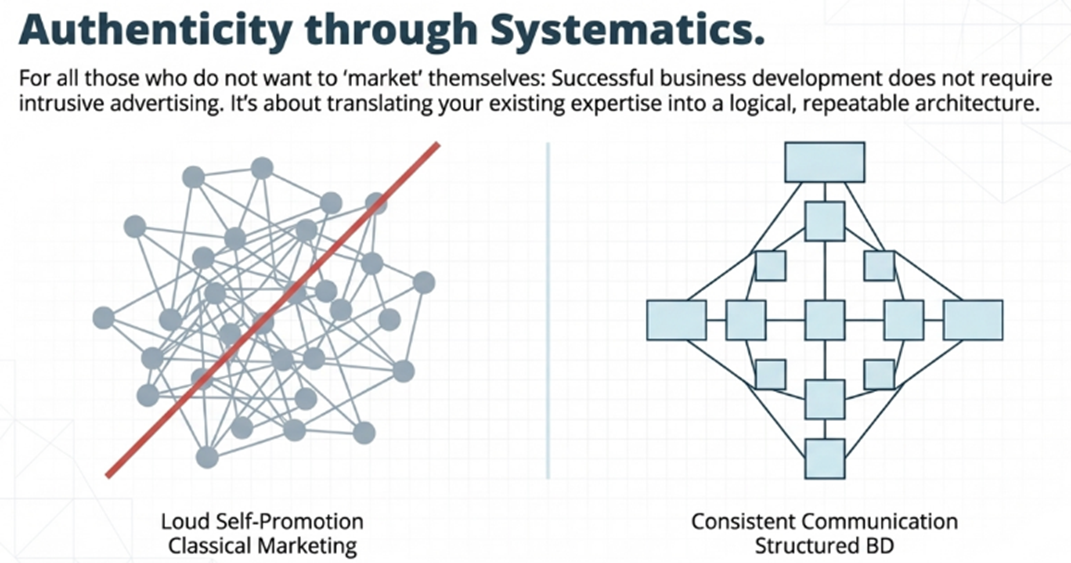 This distinction matters because it makes digital marketing more compatible with the professional identity of an IP law firm. The task is not to become a performer. The task is to communicate in a structured way that reflects the real strengths of the firm. In that sense, authenticity is not the opposite of strategy. Authenticity is strategy when the communication model actually fits the substance of the firm.
This also explains why many classical marketing efforts fail. They often produce activity without architecture. A firm publishes here, comments there, appears once on a panel, launches a newsletter, and then stops. The individual elements may be good, but they do not build cumulative recognition. Tobias Denk’s central point was that recognition grows when communication becomes systematic enough to create a clear pattern in the mind of the market.
The Four Dimensions of Visibility
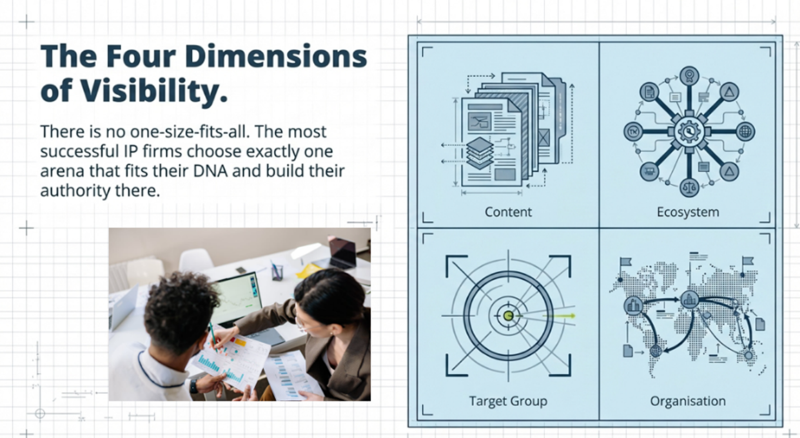
One of the most useful frameworks in the presentation was the model of four visibility dimensions: content, ecosystem, target group, and organisation. This framework helps explain why there is no one-size-fits-all formula for digital success in the IP market.
 Some firms build authority primarily through content. They become known because they explain a complex field better than others and do so repeatedly. Some firms gain visibility through ecosystem presence. They are perceived as close to the relevant market environment, the critical players, and the conversations that shape outcomes. Others stand out through target-group relevance by translating IP into the business language of a specific audience. Still others create authority through structure by signaling reliability, international coordination, and repeatable delivery capacity.
The strategic importance of this model lies in its exclusivity. Tobias Denk made clear that the most successful firms do not try to dominate all four dimensions at once. They choose one area that fits their DNA and build their authority there. This is a major lesson for IP law firms that try to imitate broader legal marketing trends without first clarifying what kind of authority they can credibly own.
Digital marketing becomes effective when a firm makes a clear strategic choice. Without that choice, communication remains mixed, and mixed communication rarely creates strong positioning.
Four Law Firms, Four Authority Models
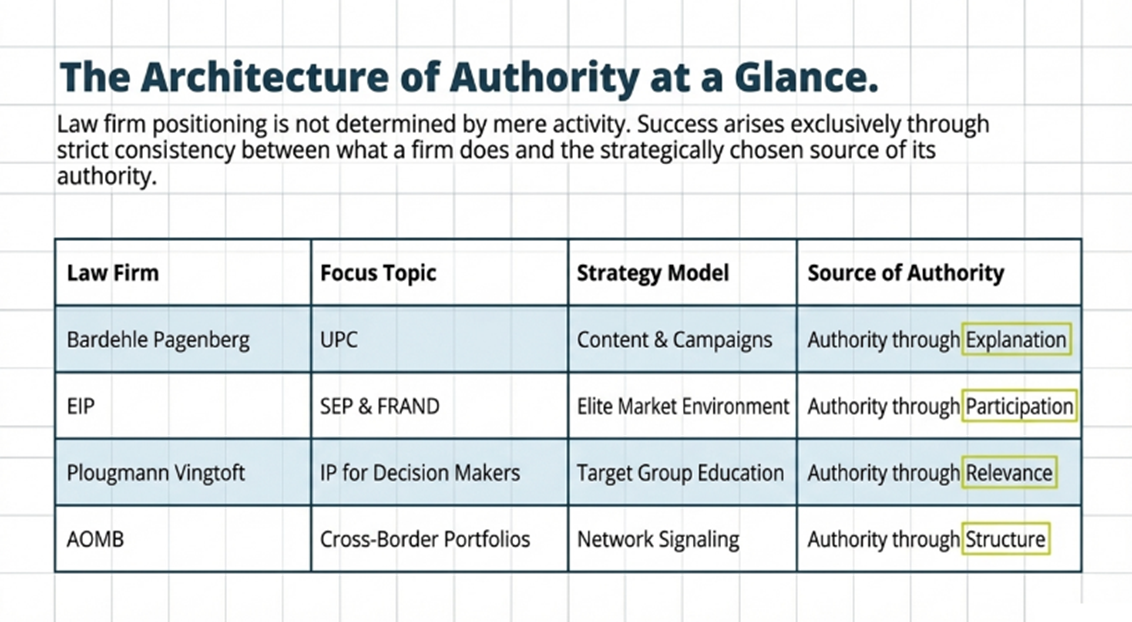
To make the framework tangible, Tobias Denk used four law firms as examples of distinct authority models.
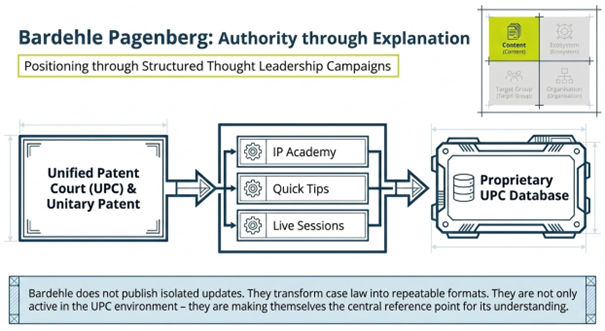 Bardehle Pagenberg represented authority through explanation. The firm’s visibility grows not through isolated updates, but through structured thought leadership around a core issue such as the Unified Patent Court and the Unitary Patent. In this model, content is not treated as occasional commentary. It becomes a repeatable format. Education becomes a positioning tool. The firm does not merely react to developments. It becomes a central reference point for understanding them.
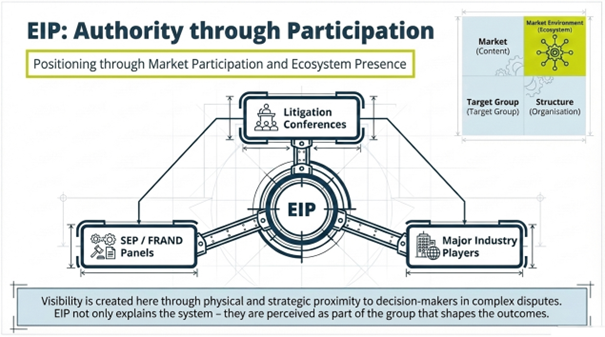 EIP illustrated authority through participation. Here the decisive factor is proximity to the market environment. Visibility emerges through participation in litigation conferences, SEP and FRAND panels, and strategic closeness to major industry players. In this model, the market does not perceive the firm only as an observer explaining the system. It begins to see the firm as part of the group shaping outcomes inside that system.
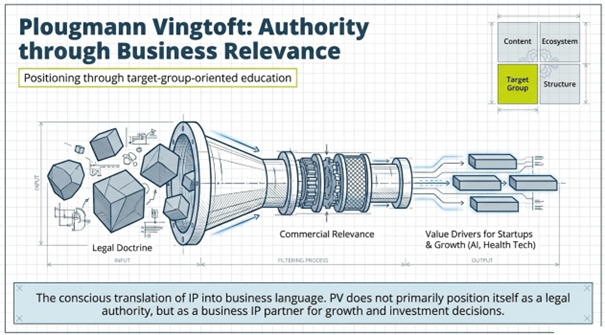 Plougmann Vingtoft showed authority through business relevance. Instead of foregrounding legal doctrine, the communication translates IP into the language of value creation, investment, and growth. That makes the firm more understandable for decision-makers outside the legal field. It positions the firm not just as a legal expert, but as an IP partner for commercial decisions.
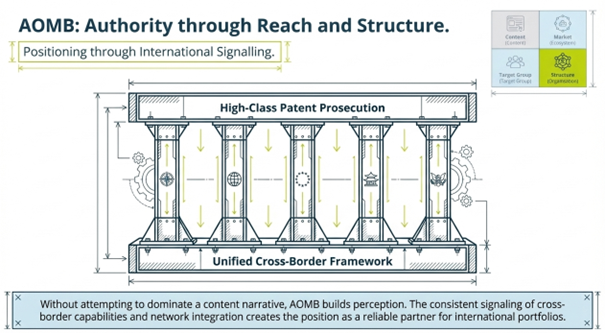 AOMB stood for authority through reach and structure. The firm does not primarily attempt to dominate a specific content narrative. Instead, it builds credibility through consistent international signaling, cross-border capabilities, and a visible network structure. The signal here is reliability at scale. For clients with international portfolios, that kind of structure can itself become the source of trust.
These examples were powerful because they showed that digital marketing success does not depend on a universal playbook. It depends on fit. A firm becomes more convincing when its source of visibility matches the way it actually creates value.
The Architecture of Authority
Another strong insight from the presentation was the idea that law firm positioning is not determined by mere activity. It emerges through strict consistency between what a firm does and the strategically chosen source of its authority.
This is where many digital marketing efforts lose force. Firms are active, but the activity is not aligned. They publish technical articles, attend conferences, post recruiting updates, comment on legal changes, and perhaps experiment with video or interviews. But if these signals do not point toward one recognisable authority model, the market receives movement without meaning.
Tobias Denk’s framework makes an important correction. Digital marketing should not begin with the question, “What content should we post next?” It should begin with the question, “Why should this market remember us?” Once that answer is clear, communication becomes easier to design. Formats, channels, and messages can then be organised around a coherent logic.
This is a particularly valuable thought for IP law firms because their expertise is often complex, highly specialised, and not immediately understandable to broader business audiences. Structure creates recognisability. Recognisability creates trust. And trust, over time, creates mandate potential.
From Isolated Topic to Business Development Campaign
One of the most practical parts of the presentation was the model for how isolated topics can generate targeted new mandates. Tobias Denk described this as a shift from ad hoc communication to a continuous system.
The sequence was clear. First, isolate a topic, for example a field such as UPC. Second, choose the relevant authority model. Third, build a repeatable format. Fourth, define the touchpoints that can lead toward mandates.
This sounds simple, but it corrects a major weakness in traditional professional communication. Too often, firms begin with content creation before deciding what role that content should play in the business development process. As a result, even high-quality publications remain detached from commercial consequences.
A repeatable format changes that. It gives the market a stable place to encounter the firm’s thinking. It creates continuity. And it increases the chance that a single topic develops into a broader pattern of trust.
Just as importantly, the final step focuses on mandate-relevant touchpoints. Live sessions, practical tools, follow-up formats, and structured interaction points help bridge the gap between content visibility and real inquiry. This is the place where many firms still underperform. They inform the market, but they do not design the next step.
The System Error in Traditional Legal Marketing
Perhaps the sharpest critique in the presentation came in Tobias Denk’s diagnosis of traditional legal marketing. The most common error, he argued, is that the process stops after a one-time publication. A specialist article is published, but no repeatable format follows and no predefined touchpoints are created. The chain breaks.
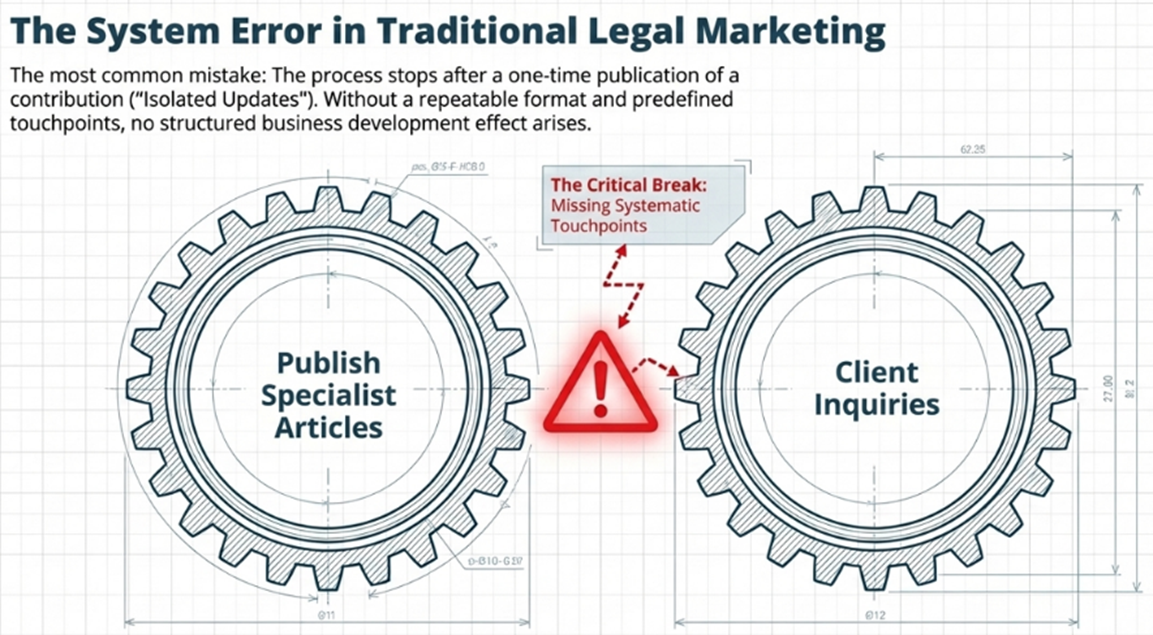 This image is highly convincing because many firms can recognise themselves in it. They invest considerable intellectual effort into a publication, a talk, or a legal update, but then treat the output as complete in itself. From a marketing perspective, however, the real issue is what happens after publication.
Without systematic touchpoints, there is no structured business development effect. One article alone does not build a market position. It may show competence, but it rarely creates a durable relationship with the audience. Tobias Denk’s analysis therefore moves the discussion away from output metrics and toward system design.
For IP law firms, this is particularly relevant because many of their topics are too sophisticated to produce immediate commercial conversion. Trust is built through repetition, framing, and continuity. A market chooses a firm not only because of one strong signal, but because the firm has become recognisable over time.
Form Follows Function
The concluding idea of the presentation captured the entire logic in one sentence: form follows function. Authentic business development does not mean playing a foreign role. It means choosing the visibility strategy that fits the DNA of the law firm.
This may be the most important success factor of all. Digital marketing in the IP sector works when it is strategically selective and professionally believable. Firms do not need to imitate consumer brands or general business influencers. They need to become more intentional about how their real strengths are made visible.
That is why the presentation was so valuable at the ETL IP event. It offered more than a marketing concept. It offered a language that IP professionals can actually work with. It showed that digital marketing is not a cosmetic add-on to legal expertise. It is the design of how that expertise becomes choice.
In the end, that may be the central business development challenge for IP law firms in 2026. The question is no longer whether they have expertise. The question is whether they have chosen the right source of authority and built a communication system around it. The firms that do this well will not simply appear more active online. They will become easier to trust, easier to remember, and easier to choose.
That is the real blueprint of visibility.
About the author
 Tobias Denk is a business development strategist specializing in intellectual property law firms. He helps patent attorneys and IP experts build visibility and generate mandates through content-driven platforms. His work focuses on turning complex IP expertise into trusted market positioning in a credence goods environment.