Authenticity in Digital IP Business Development: A Strong Signal from Berlin at ETL IP

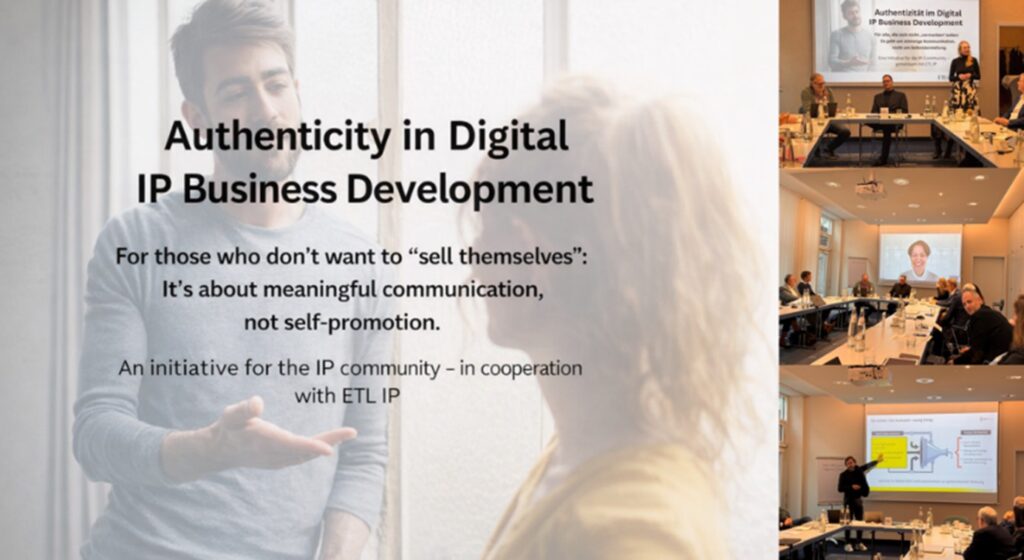
On 24 March 2026, ETL IP in Berlin hosted a focused event on a topic that many IP professionals feel every day, even if they do not always name it so directly: how can patent attorneys and IP law firms become visible in a credible way, without slipping into empty self-promotion? The answer discussed throughout the day was both practical and demanding. Authentic digital business development does not begin with louder marketing. It begins with clarity, structure, relevance, and the courage to communicate in a way that fits the real DNA of a firm.
The event brought together 24 participants, all IP experts representing law firms. That alone made the atmosphere unusually productive. This was not a generic marketing audience. It was a room full of professionals who understand expertise, client trust, legal complexity, and the difficulty of turning intellectual authority into real market recognition. The result was a day of serious exchange, concrete reflection, and intensive conversation on site at ETL IP in Berlin. Only Maria Boicova Wynants joined remotely via livestream. Everyone else was in the room, which gave the discussions a remarkable intensity and immediacy.
What made the event stand out was the interplay between the five presentations. Each talk approached the challenge from a different angle, but together they formed a coherent picture. The day moved from authenticity and personal positioning, to AI and market transformation, to structured visibility strategies, to formats and follow up, and finally to the question of how complex IP topics can be translated into narratives that actually create demand.
 Dr. Diana Taubert, Managing Director, ETL IP Patentanwaltsgesellschaft mbH (LinkedIn)
It’s always inspiring to see how interested patent attorneys, both in law firms and in industry, are in innovation and its potential, and how keen they are to innovate. The key message of this meeting was: Find your own truth and communicate it; define who you are and what you offer. Be specific.
_____________________
Maria Boicova Wynants: Authenticity as a Strategic Asset
Maria Boicova Wynants opened an essential line of thought, even from a distance. Her presentation framed authenticity not as a soft personal value, but as a strategic asset. That distinction mattered. In professional services, especially in IP, authenticity is often misunderstood either as spontaneity or as a stylistic choice. Maria argued for something more rigorous. Trust, she showed, grows out of predictable quality. Authenticity is about integrity. And recognisability does not emerge by accident.
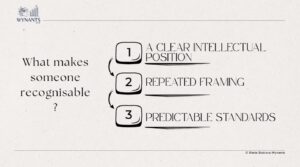 Her structure was elegant and precise. What makes someone recognisable? First, a clear intellectual position. Second, repeated framing. Third, predictable standards. This gave the audience a powerful reminder that a strong personal or firm level presence is not built through random activity. It is built through disciplined consistency. In a field where many professionals hesitate to become more visible because they do not want to “sell themselves,” that message landed well.
Equally important was her distinction between personal tone and oversharing. Maria showed that authenticity does not require exposure for its own sake. Instead, it calls for calibrated self disclosure. Personal experience becomes useful when it is processed into insight. That idea resonated strongly with the audience, because it offered a path between two extremes: sterile technical communication on one side, and performative personal branding on the other.
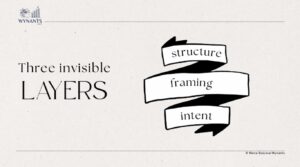 Her presentation also highlighted why simple communication is not accidental. Behind it sit three invisible layers: intent, framing, and structure. This was one of the themes that echoed through the later discussions. Many participants clearly recognised that simplicity in professional communication is not a matter of reducing substance. It is a matter of mastering substance well enough to translate it. Maria closed with the question that changes everything: what do I believe about my work that I am ready to be known for? It was a fitting starting point for the day, because it turned business development back into a question of professional conviction.
Johannes Ernicke: AI and the Future of Business Development for Law Firms
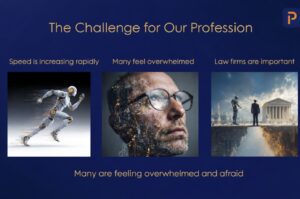
If Maria’s contribution addressed authenticity as a question of integrity and recognisability, Johannes Ernicke shifted the focus to disruption and adaptation. His presentation on AI in law firm business development introduced a sense of urgency that sharpened the entire event. He began with a simple but striking comparison: markets are often not disrupted by a direct digital version of the same old model. They are displaced by players who redefine the logic of value creation.
This was highly relevant for IP law firms, because, as Johannes argued, AI is not touching only peripheral administrative work. It is reaching into the core of legal and patent related value creation. He described the speed of change as extreme, and he explicitly acknowledged that many professionals feel overwhelmed or anxious. That honesty mattered. Instead of treating AI as a trendy toolset, he positioned it as a structural transformation that demands strategic response.
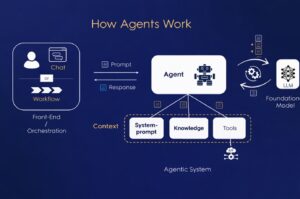
 A particularly useful distinction in his talk was the contrast between AI chat and agentic AI. What is currently visible to most professionals is only the surface. Beneath that lie more advanced agentic systems, combining prompts, system instructions, knowledge, tools, orchestration, and workflows. This shifted the conversation from individual tool usage to deeper questions about how firms may redesign communication, services, and internal processes.
Johannes identified three business development opportunities: communication, new value creation depth, and AI workflows. This triad opened a broader perspective. AI is not only about efficiency. It can reshape how firms explain complex issues, how far they move into adjacent problem solving, and how they organise client relevant workflows. His slides on the law firm value chain also encouraged participants to reflect on where traditional firms focus today, and where new competitive pressure may arise.
 The discussions after his talk were especially animated. Participants were not debating whether AI matters. They were wrestling with what kind of response is worthy of the profession. How do firms remain trusted advisors when machine support becomes more powerful? Which parts of the value chain should remain strongly human? Where does technological adoption create advantage, and where does it create sameness? Johannes did not reduce these questions to a simple answer. Instead, he framed them as leadership issues for firms that want to remain relevant and future capable.
 Johannes Ernicke, Managing Director at patenza GmbH (LinkedIn)
What encouraged me most in Berlin was the significant interest in practical and strategic exchanges. I conclude from this that many colleagues are now seeking guidance and clarity on professional regulations, as well as an open exchange of views.
_____________________
Dr. Tobias Denk: Digital Marketing for IP Law Firms
Dr. Tobias Denk then translated the broader theme of authenticity into a structured model for law firm positioning. His presentation, “From Expert to Choice,” was one of the clearest strategic contributions of the day. It began with a crucial insight: visibility is not luck. It is structure. IP law firms do not differ only in what they know or what they do. They also differ in how visible their expertise becomes for the market.
 Tobias argued that authentic business development is not about adopting a foreign role. It is about turning existing expertise into a logical and repeatable communication architecture. That idea helped bridge the discomfort many lawyers feel around marketing. He did not ask firms to become louder. He asked them to become more systematic.
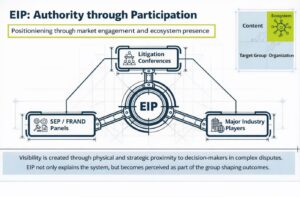
One of the key frameworks in his talk was the four dimensions of visibility: content, ecosystem, target group, and organisation. This was a useful corrective to the common assumption that better business development is mainly a content problem. Tobias showed that the most effective firms choose an arena that fits their strategic identity and then build authority there in a consistent way.
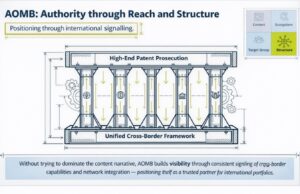 His case examples made this highly tangible. Bardehle Pagenberg stood for authority through explanation. EIP illustrated authority through participation in the relevant ecosystem. Plougmann Vingtoft showed authority through business relevance, translating IP into the language of growth and investment decisions. AOMB represented authority through structure and international signalling. These examples helped the audience see that there is no single formula for success. The right model depends on the source of authority a firm can credibly own.
The later slides sharpened the point even more. A business development campaign requires a sequence: isolate a theme, choose the right authority model, build a repeatable format, and define the touchpoints that can lead toward mandates. Tobias also named a frequent failure in classical legal marketing. Many firms publish a good article and expect interest to convert on its own. But without systematic follow up and repeated contact points, there is no real business development effect.
This triggered one of the most important discussions of the day: what does it actually mean for a firm to be “the right choice”? Participants explored the difference between general visibility and strategic recognisability. They also reflected on how firms can avoid looking interchangeable in markets where technical competence is often assumed. The answer was not more output. It was stronger design of the whole path from expertise to perception.
Theo Grünewald: Formats as Positioning Instruments
Theo Grünewald continued in that direction, but with a sharper operational focus. His presentation examined formats, especially events, as positioning instruments. The central warning was clear: high effort often produces very little return. Firms give talks, participate in panels, and organise events, yet see few direct new mandates, limited durable contact points, and low systematic recognition.
Theo challenged the expectation that excellent content by itself generates demand. A strong talk can create interest, but interest is not the same as commercial consequence. This distinction was one of the day’s recurring lessons. He reframed the role of the event itself. A presentation is not usually the place where the decision happens. It is the trigger for a process of review.
That review often begins only after the microphone is turned off. Theo described the invisible sequence very convincingly: participants hear a talk, find it interesting, then check the speaker’s LinkedIn profile, examine other published material, and form a composite judgment. In other words, the event does not stand alone. It activates digital judgement. That is why business development success depends on what surrounds the event, not only on what happens on stage.
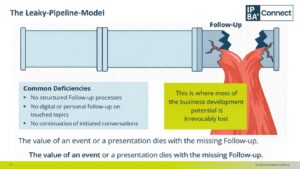 His leaky pipeline model made this operational. The biggest losses happen in three phases: before the event, during the event, and after the event. Beforehand, speakers often lack a clear target picture of what participants should understand about them. During the event, they may fail to set the agenda deliberately. Afterwards, the greatest potential is often lost through weak or absent follow up. This diagnosis was not cynical. It was liberating. It showed that poor results are usually not caused by weak expertise, but by missing strategic architecture.
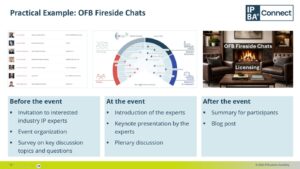 Theo’s practical example of the OFB Fireside Chats illustrated how an event can be designed as part of a full system: invitation, curation of discussion topics, expert framing, live exchange, summary, blog report, and continued communication. His final model was memorable: event, profile, content, follow up. When these elements work together, an event becomes both reference and teaser. It proves expertise and opens the next conversation.
The discussion following this session was especially practical. Participants compared their own speaking experiences and recognised how often events remain isolated moments instead of connected business development assets. There was a strong sense in the room that many firms already invest substantial effort in visibility, but too rarely turn that effort into cumulative market trust.
Dr. Jörn Plettig and Theo Grünewald: From Standard to Narrative
The final presentation, delivered by Dr. Jörn Plettig together with Theo Grünewald, brought the day to a strong conceptual close. Their topic was how business development can be built around current themes and trends, using DIN 77006 as an example. The opening diagnosis was sharp: in IP, technical agreement does not automatically create demand. A topic may be professionally accepted and still attract little implementation activity.
 This is where their notion of the expert paradox became powerful. DIN 77006 can receive positive resonance within the IP community and still remain a low priority for companies. Why? Because organisations are not only asking whether something is sensible in theory. They are also asking what problem it solves, what internal consequences it triggers, and whether the entry point feels manageable.
The presentation analysed the typical, logical, but often ineffective response from experts. When firms sense hesitation, they explain the standard, list its benefits, and pitch implementation. Yet this often misses the real mechanics of business decision making. Information does not create relevance on its own. Implementation advice can come too early. Generic benefits are rarely concrete enough to create action.
What matters, they argued, is the shift from norm to context. Instead of beginning with the standard, one should begin with the company situation: rising complexity, more interfaces, greater pressure for steering and transparency. In that frame, DIN 77006 appears not as an abstract requirement, but as a structuring instrument and reference framework.
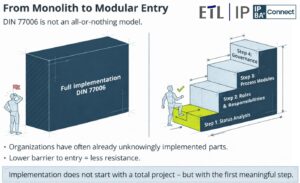 This logic was then expanded beyond DIN 77006. Many IP themes share the same challenge. They are explanation intensive, organisationally relevant, and initially hard to grasp. Therefore, they require context, interpretation, and a modular entry. The presentation’s strategic synthesis was excellent: a new IP topic needs context, not only technical explanation; it needs a manageable entry, not a giant project; and it needs visible proof that theoretical work can produce measurable operational relief.
The case based proof points, including differentiated entry paths and practical examples, made the argument highly convincing. The discussion after this final session showed how strongly the audience connected with the idea. Good topics do not prevail by themselves. Well framed topics do. That insight linked back beautifully to the whole event.
 Dr. Jörn Plettig, Site Manager, ETL IP Patentanwaltsgesellschaft mbH (LinkedIn)
Framing is not just a buzzword; it is the way in which one contextualises one’s own actions and identity in the business world. The seemingly abstract DIN 77006 becomes much more appealing to decision-makers when it is understood to be a benchmarking tool for IP management, with the aim of continuous improvement.
_____________________
Why the Event Was a Success
What made this event such a strong success was not only the quality of the individual presentations. It was the coherence between them. Across all five talks, a common message emerged: authentic digital business development in IP is not performance. It is architecture.
Maria Boicova Wynants showed that authenticity depends on integrity, recognisability, and disciplined simplicity. Johannes Ernicke showed that AI is changing the competitive environment and forcing firms to rethink where and how they create value. Tobias Denk demonstrated that visibility becomes effective only when it is structured around the right source of authority. Theo Grünewald explained why events and formats only work when they are embedded in a full system of positioning and follow up. Dr. Jörn Plettig and Theo Grünewald finally showed how even excellent IP topics fail unless they are translated into context, narrative, and manageable entry points.
The 24 participants did not consume these talks passively. They tested them against their own realities. They compared experiences, challenged assumptions, and continued the conversation intensively on site. That may be the clearest sign of the event’s quality. It created not only agreement, but movement. Participants left with sharper language, better frameworks, and more realistic strategies for turning expertise into trust and trust into opportunity.
In that sense, the Berlin event did exactly what it set out to do. It made a difficult subject tangible. It gave IP law firms a more mature vocabulary for business development. And it showed that authenticity in digital IP business development is not the opposite of strategy. It is what strategy looks like when it is aligned with professional substance.
References:
 Martin Schlosser, Patent Attorney / Owner of the law firm Dr. Martin Schlosser (LinkedIn)
For me as a patent attorney with focus on alternative dispute resolution (ADR), the conference provided valuable insights on how to promote mediation and arbitration in the IP community. I’m looking forward to continuous cooperation with IPBA.
 Hauke Schmidt-Martens, Patent Attorney / Owner at Schmidt-Martens IP (LinkedIn)
The Berlin event highlighted that adapting IP business development to current disruptions is no longer optional. I’m convinced that authenticity remains the cornerstone of success in this digital age. Moving forward, I will leverage the insights from the IP Business Academy to refine my strategic approach and stay ahead in this evolving field.
 Uwe Schriek, Patent Attorney at Pfenning, Meinig & Partner mbB (LinkedIn)
What I particularly enjoyed about our event was the very open discussion. I found it especially helpful for our firm’s branding to realise that focusing on our unique selling points is much more effective than presenting ourselves as a law firm (or a lawyer) that can do it all.
 Dr. Hans-Lothar Arth, Patent Attorney / Senior Partner at ABK Patent Attorneys (LinkedIn)
It was a great event! AI is probably the biggest challenge that this profession has faced so far.