
From Invention Discipline to Portfolio Power: The IP Habits That Make or Break Strategy

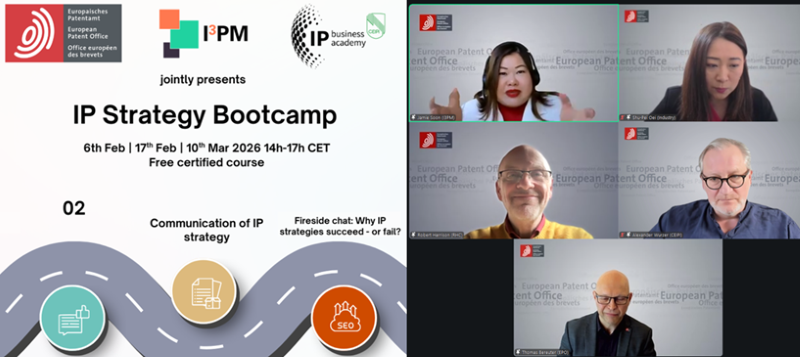
This Fireside Chat as a part of the 2026 IP Strategy Bootcamp which is organized by EPO-I3PM-CEIPI was designed to create productive tension, not polite overlap. The central idea was a “triangle” of three moments in IP work: deciding whether an invention deserves protection, turning protected IP into business value, and building the organisational ability to execute those decisions consistently.
The discussion featured Dr. Shu Pei Oei, Robert Harrison, and Prof. Dr. Alexander Wurzer, moderated by Dr. Jamie Soon PhD and Thomas Bereuter. What followed was a rapid, decision anchored conversation that kept returning to one theme: most IP strategies fail in the transitions between invention discipline, claims and portfolio choices, value extraction, and organisational readiness.
Warm up: The single most damaging IP habit
The opening question asked each speaker for one sentence on the most damaging IP habit they see.
Shu Pei argued that a core mistake is reducing IP to “just a right.” Her point was that “intellectual property” is broader than formal rights, and organisations harm themselves when they treat IP as paperwork rather than as the protection and use of creations of the mind.
Alex answered from an execution angle. Even good strategies fail when the organisation lacks a decision system: clear ownership, responsibilities, cadence, and explicit trade-offs. Treating IP as documents instead of governance was framed as a habit that quietly kills strategy.
Robert added a portfolio reality check. Patents are often the most expensive part of IP, and organisations frequently file without understanding why. The damaging habit is not simply “filing too much,” but filing by default, because an invention reached an invention disclosure memo stage, not because it earned a business case.
Theme 1: Selectivity versus ambition
The first theme explored the tension between being selective and staying ambitious.
Robert was asked where companies most often overestimate invention value at the disclosure stage. He highlighted a common bias: “unique in our company” is confused with “unique in the world.” He also warned against treating the European Patent Office as the only reference point for patentability, since global prior art realities can differ. His practical message was twofold: first, identify what is truly protectable and not merely internally impressive; second, once protectable subject matter is found, test whether it matters economically. He used the idea of “pinpoint” inventions, where narrow protection can still be valuable if it forces competitors through the same narrow path.
Shu Pei was asked the mirror question: where do companies underestimate the future strategic value of inventions they almost did not protect. Her answer focused less on the invention itself and more on what happens after filing. Value emerges through use, which demands time, resources, and coordinated choices. She framed this as an opportunity for IP leaders: help the organisation see where the IP could create options, shape narratives, enable partnerships, or open additional domains, and not only where it blocks competitors.
Alex was then asked when organisations become capable of being selective without becoming conservative. His answer linked selectivity to learning. Selectivity becomes healthy when it is evidence based, tied to explicit risk choices, and supported by mechanisms that let teams learn from outcomes rather than fear mistakes. Risk management, in this view, is not avoiding risk. It is actively choosing and managing it.
A vivid thread here was categorisation. The group discussed portfolio categories like “Alpha, Beta, Gamma” patents, recognising that legal quality alone does not define business importance. Some assets are worth fighting for because they are commercially critical, even when grant prospects are difficult. That is a governance issue, not a drafting issue.
Theme 2: IP strategy and the C-suite reality
This section moved into the boardroom.
Alex addressed what the C-suite actually listens to when IP asks for budget, patience, or strategic freedom. His core point was that leadership responds to business logic: risk, timing, return potential, negotiation leverage, resilience, and time to market. A “stack of paper” does not win support. A decision narrative does.
Thomas sharpened the communication challenge. IP loses credibility fastest when it refuses to translate. He used the idea that leaders revert to their comfort zone under pressure. If the CEO is financially oriented, legal technicalities will not land. If the CEO is technical, different framing may work. The burden is on IP leaders to speak in the receiver’s language, not their own.
Shu Pei added that readiness for value extraction rarely arrives as a single boardroom moment. It is the outcome of preparation: operational excellence, cross functional alignment, and building the maturity that lets leadership put power behind a plan.
Theme 3: Maturity, timing, and letting go
On the question of when an organisation should stop filing, Robert argued that successful companies should never stop thinking about the IP they create, but the emphasis can shift over time. Sometimes the right move is fewer patents and stronger trade secret discipline, or more attention to brand. The key is not constant filing. It is constant strategic reflection.
When asked why value extraction strategies fail, the discussion repeatedly returned to coordination. Strategies fail when IP is developed in isolation from product, marketing, branding, and commercial teams. You may need many patents to enter certain negotiations, but you might only need one to face an injunction. Both realities demand cross functional planning.
Alex closed this theme with a governance signal: when IP decisions move from ad hoc escalation to a cross functional portfolio board with real stop go authority, clear roles, and budget allocation across risks and opportunities, the organisation is ready to evolve its IP strategy.
Closing round: One uncomfortable truth each
Robert’s uncomfortable truth was uncertainty. IP is not engineering. It is full of grey areas that must be managed, not eliminated.
Shu-Pei’s uncomfortable truth was that IP leaders cannot hide. Decisions are expected, and AI will increase information access across organisations, raising expectations that IP leadership will cut through noise and align the company.
Alex offered a budget truth: IP must earn its budget every year by translating activity into decision relevance. Long term payback is real, but year by year credibility still needs to be maintained.
The lasting message was clear: IP strategy is not patents, frameworks, or portfolios alone. It is stewardship of ideas through decisions, use, and organisational capability, with the courage to connect ambition to execution.
The speakers in this fireside chat as a part of the 2026 IP Strategy Bootcamp which is organized by EPO-I3PM-CEIPI:
Dr. Shu Pei Oei
Dr. Shu Pei Oei is Head of Global IP at PALFINGER. She leads companywide IP topics that connect protection choices with business priorities, not just legal formality. Her fireside chat contributions focused on the value that comes from how an organisation chooses to use IP and commits time and resources after filing. She highlights IP leadership as an internal bridge between invention creation, strategic options, and execution readiness.
Dr. Robert Harrison
Dr. Robert Harrison is a founding partner of SONNENBERG HARRISON and has worked in intellectual property since 1990. He is registered as a German, French, and European patent and trademark attorney. With an academic background in physics, his technical work spans areas such as semiconductors, photonics, telecommunications, and computer science. In the fireside chat, he brought a portfolio discipline perspective, stressing selectivity and the business rationale behind filing decisions.
Thomas Bereuter
Thomas Bereuter is Innovation Networks Manager at the European Patent Academy at the European Patent Office. He is a Certified Licensing Professional with over 25 years of experience in international commercialisation of early stage technologies.
He has founded and supported numerous high tech start-ups and university spin offs.
In the Bootcamp context, he represents the operational leadership angle, pushing for decision clarity, measurement discipline, and cross functional alignment.
Dr. Jamie Soon Kesteloot
Dr. Jamie Soon Kesteloot is President of the I3PM International Institute for Intellectual Property Management. She is trained in chemistry, nanotechnology, and microelectronics, and works in innovation and R&D at Essilor in France. She is also noted as an EU ambassador for MIT Innovators Under 35.
For the IP Strategy Bootcamp, she is listed among the speakers representing I3PM and helping connect IP strategy with how leaders communicate and decide.
Prof. Dr. Alexander Wurzer
Prof. Dr. Alexander Wurzer has worked in IP management since the mid-1990s and leads the Steinbeis Transfer Institute for Intellectual Property Management. He is course director at CEIPI, University of Strasbourg, and was appointed Professor Associé at the university. He established the IP Business Academy for IP management at CEIPI and regularly teaches for the Institutions of national innovation systems around the globe.