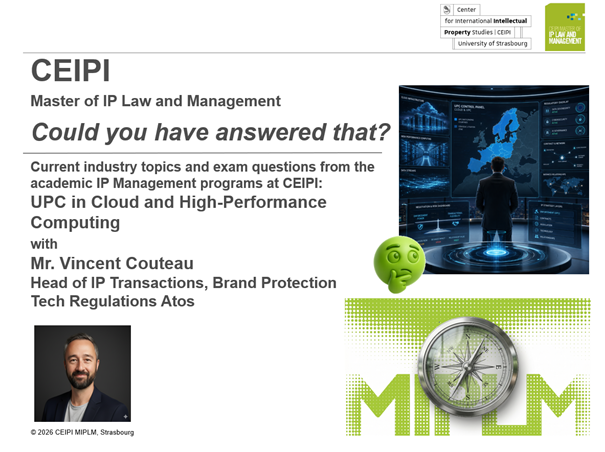
IP Decision Case UPC Vincent Couteau. Centralized Enforcement vs. Transactional Flexibility in Cloud and High-Performance Computing

In cloud infrastructure and high-performance computing, IP decisions rarely stand alone. They sit inside complex business architectures shaped by data processing, distributed systems, long-term enterprise contracts, public-sector requirements, cybersecurity, data sovereignty, and AI governance.
This makes the UPC strategically relevant in a very specific way. Centralized enforcement may increase negotiation power, litigation leverage, and transactional pressure across Europe. At the same time, it can concentrate risk, reduce room for jurisdiction-specific arrangements, and affect relationships with customers, regulators, suppliers, and technology partners.
The broader challenge is reflected in the UPC Strategy Gap analysis, which argues that companies increasingly need support not only with UPC litigation, but with the strategic business situations created by the new enforcement environment. The article highlights that the market often still frames UPC expertise through procedure and litigation credentials, while companies need orientation where enforcement, portfolio strategy, competitive dynamics, governance, licensing, and risk management intersect.
Here you find the Findings of the study: “The UPC Strategy Gap in Europe”
This IP Decision Case applies that gap to a transaction-heavy technology environment. The key question is not simply whether the company should use the UPC. The real question is how centralized enforcement should be balanced against transactional flexibility, regulatory exposure, and long-term ecosystem positioning. In cloud and HPC, the UPC is not just a court option. It becomes a strategic variable in how IP, contracts, regulation, and business models are aligned. Here is the evaluation of this UPC decision case by Vincent Couteau:
“In distributed computing and sovereign‑oriented cloud deployments, patents are rarely strategized in isolation. They are embedded in long‑term service models, public‑sector contracts and regulated deployment environments. Whilst the UPC offers a powerful enforcement option for many industries, B2B and B2G cloud and distributed infrastructures are deeply influenced by sovereignty, regulatory constraints, and contractual architecture. This strongly conditions IP strategy and requires careful alignment with transaction design, regulatory exposure and ecosystem stability.”
Decision Context
A global technology company provides cloud infrastructure and high-performance computing (HPC) solutions, operating in a highly regulated and rapidly evolving environment. Its business model relies on large-scale data processing, distributed architectures, and long-term enterprise contracts, often involving public sector clients and critical infrastructure.
Intellectual property plays a central role in structuring partnerships, enabling technology transfers, and supporting complex transactions, including joint ventures, outsourcing arrangements, and cross-border service delivery. At the same time, regulatory requirements related to data sovereignty, security, and AI governance increasingly shape how technologies can be deployed and monetized.
With the introduction of the Unitary Patent and the Unified Patent Court (UPC), the company faces new strategic options regarding enforcement across Europe. However, enforcement decisions can no longer be viewed in isolation. They directly interact with contractual frameworks, regulatory exposure, and long-term business relationships.
The Decision
Should the company leverage centralized enforcement under the UPC to strengthen its position in negotiations, transactions, and disputes, or should it adopt a more selective and decentralized approach in order to preserve flexibility across jurisdictions, regulatory environments, and contractual structures?
Why This Decision Is Difficult
This decision reflects a convergence of multiple dimensions that must be reconciled:
- Enforcement Leverage vs. Transactional Optionality
Centralized enforcement can enhance negotiation power in licensing and commercial agreements. However, it may reduce flexibility in structuring transactions that depend on jurisdiction-specific arrangements or regulatory constraints. - Legal Certainty vs. Regulatory Complexity
While the UPC offers a unified forum, cloud and HPC activities are subject to fragmented regulatory frameworks (e.g., data localization, cybersecurity, AI regulation). Enforcement actions may trigger implications beyond IP, affecting compliance and operational models. - Risk Concentration vs. Distributed Exposure
Centralized decisions can create significant, system-wide consequences. In an environment where technologies are deeply embedded in service delivery models, adverse outcomes may affect multiple business lines simultaneously. - Strategic Signalling vs. Relationship Management
Enforcement actions in this domain are not purely adversarial. They can influence long-term partnerships, ecosystem dynamics, and the company’s position in multi-party environments involving customers, regulators, and technology partners. - Interdependence of IP, Contracts, and Business Models
IP rights are often embedded in broader contractual frameworks governing access, usage, and value distribution. Enforcement decisions must therefore be aligned with transaction structures, revenue models, and governance mechanisms.
Practitioner Perspective
In cloud and high-performance computing, intellectual property is closely intertwined with how value is created, transferred, and protected across complex ecosystems.
The UPC introduces powerful enforcement capabilities, but their relevance depends on how IP is positioned within the broader business architecture. In transaction-heavy environments, IP is not only an asset to be enforced, but also a tool for structuring deals, managing risk, and enabling scalable business models.
Centralized enforcement may offer advantages in negotiations and disputes, particularly where technologies are widely deployed across jurisdictions. However, in highly regulated and contract-driven environments, flexibility remains critical. Decisions must account for regulatory constraints, transaction design, and the need to maintain long-term relationships.
The role of the UPC is therefore not fixed. It becomes relevant at the intersection of strategic intent, risk tolerance, and the operational realities of global technology businesses.
Implication for IP Management Education
This case highlights the need to integrate IP decision-making into broader business and regulatory contexts.
IP professionals must be able to operate at the intersection of legal frameworks, transaction structures, and strategic objectives. This includes understanding how enforcement decisions interact with contracts, regulatory requirements, and business models in complex, technology-driven environments.
Vincent Couteau
 Vincent Couteau LL.M., CLP is a senior in-house legal leader with over 20 years of cross-border experience in technology-driven organizations. He currently serves at Atos as Head of Intellectual Property Transactions, Brand Protection, AI and Tech Regulations, working at the intersection of IP, data, AI, transactions, risk management and regulatory change.
His career spans Atos, Worldline, Siemens, KU Leuven and Taylor Wessing, combining private practice, technology transfer, M&A, litigation and global IP governance. Dual qualified as a Belgian attorney and solicitor in England and Wales, he brings strong expertise in licensing, brand protection, software, emerging technologies and scalable legal frameworks.

