
How to Secure Market Value in the Quantum Age with IP: Important industry topic with Dr. Bernd Burchard

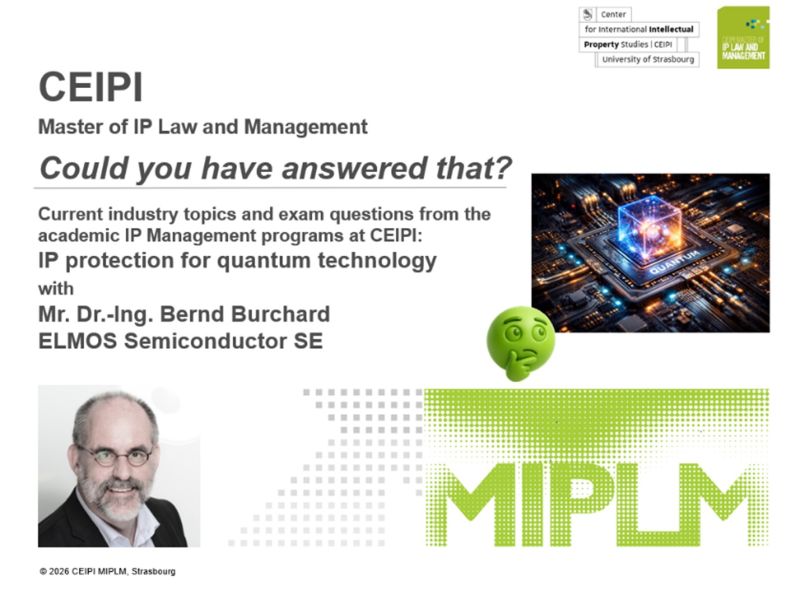
The demand for IP services, IP competence, and strategic support in the field of quantum technologies is steadily increasing. To better understand this development, the CEIPI IP Business Academy recently conducted an Open Foresight Board study in Europe, which confirmed the growing need for practical guidance at the interface of quantum technology, business development, and intellectual property management.
Here you find the Findings of this study: “The Quantum IP Gap”
Against this background, the CEIPI IP Business Academy continuously adapts its teaching content in close exchange with practitioners from industry and advisory services. The aim is to ensure that concrete practice relevant questions and real industrial needs are systematically integrated into the training programs.
Quantum technology is a dynamically evolving technological and economic field of action. We are therefore particularly pleased to collaborate with experts from industrial practice. The following practice question was contributed by Dr.-Ing. Bernd Burchard, Vice President IP Management at Elmos Semiconductor SE, who is also a member of the Open Foresight Board of the CEIPI IP Business Academy.
Practical Question Bernd Burchard
Mini Case Study
A technology company has developed a security-relevant innovation based on an emerging deep-tech principle with potential applications in digitally connected and trust-sensitive environments. The solution has moved beyond the purely experimental stage and now faces the challenge of commercial deployment through partnerships, ecosystem integration, and real-world implementation.
The commercial environment is still highly dynamic. Competing technical approaches coexist, market expectations are not yet fully stabilized, and the future structure of the value chain remains uncertain. At the same time, the company cannot simply communicate its technological solution openly, because disclosure may weaken its strategic position. However, overly restrictive protection may also slow adoption, reduce collaboration opportunities, and hinder broader market acceptance.
The company recognizes that its competitive advantage may not lie in one isolated technical feature alone, but across a broader set of elements, such as architecture, implementation know-how, validation methods, quality assurance, system compatibility, reliability, manufacturability, and interoperability with third-party infrastructures. In addition, industry standards may play an important role in shaping adoption and competitive positioning.
Question:
How should such a company design its IP strategy? What should be protected through patents, what should remain confidential, what should be governed contractually, and which parts of competitive advantage may depend less on formal IP rights than on certification, integration capability, reliability evidence, customer trust, and ecosystem position? Which technological features are suitable for inclusion in standards in order to support market adoption, and which features should remain outside standardization in order to preserve strategic differentiation?
Why this is highly practice relevant
This question is highly relevant in practice because, in many emerging technology fields, competitive advantage rarely depends on a single invention in isolation. Instead, it is often distributed across technical design choices, implementation know-how, validation processes, supply chain positioning, interoperability, and the ability to translate technical performance into trusted use in real commercial settings.
For that reason, the core IP management challenge is usually not limited to the question of patentability. The more important issue is how to build a protection architecture that supports commercialization, collaboration, and market entry without giving away the basis of long-term differentiation too early. This includes balancing patents, trade secrets, contracts, standards, and non-IP-based trust factors such as reliability, certification, and ecosystem credibility.
That makes this a highly practical question for IP management, because it reflects the real strategic complexity companies face when bringing advanced technologies into uncertain and evolving markets.
Dr.-Ing. Bernd Burchard
 Bernd Burchard is Vice President IP Management at Elmos Semiconductor, where he is responsible for all aspects of IP management and has led the function since 2017. He combines long-standing industrial leadership in semiconductors with deep expertise in quantum technologies, quantum sensing, and quantum cryptography. Before taking over IP management, he held several senior roles at Elmos in production strategy, quality management, failure analysis, customer quality, and sales and design controlling.
His career also includes positions in academia and technology leadership. He worked as a lecturer in physics and astronomy at Ruhr University Bochum and as an assistant professor at FernUniversität in Hagen, with a scientific focus on quantum technologies, power devices, optoelectronic components, and high-temperature electronics. Earlier in his career, he held leadership roles at Infineon and Siemens, working on AI-based speech technologies, business development, circuit design, and microsystems.
Alongside his industrial work, Bernd Burchard has contributed to research, patents, and the broader development of IP practice in Germany. His profile reflects a rare combination of science-to-business thinking, semiconductor industry experience, and advanced knowledge in commercially relevant quantum technologies.