Know-how Management: Why companies need to understand what only they know

Every company has knowledge that does not appear on the balance sheet, is not always written into patents, and is often not even fully visible to management. It lives in engineering routines, customer conversations, laboratory shortcuts, manufacturing adjustments, software configurations, supplier relationships, service experience, design choices, and thousands of small decisions that teams make every day. This is the hidden layer of corporate value: the knowledge that makes a company faster, better, more reliable, more adaptive, or simply harder to copy.
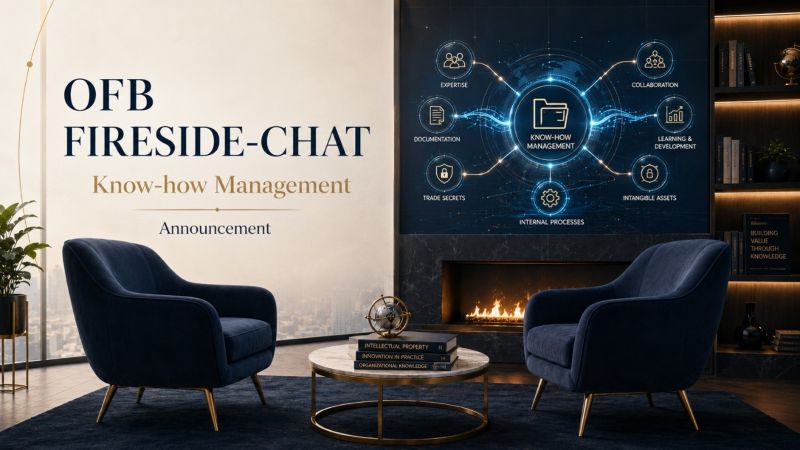
This is why Know-how Management will be the topic of an upcoming OFB Fireside-Chat. The discussion will focus on a question that many companies underestimate until something goes wrong: What does the company actually know that gives it an advantage, and how is this knowledge protected, used, shared, documented, and kept alive? In practice, know-how is often treated as something that somehow exists in the organization, but not as something that needs a clear management system.
That gap becomes critical in a business environment where innovation cycles are shorter, employee mobility is higher, cooperation networks are broader, and digital tools make knowledge easier to store, copy, transform, and transfer. The issue is no longer only whether a company has patents, trademarks, designs, copyrights, or trade secrets. The deeper issue is whether the company understands the knowledge architecture behind its competitive position.
Know-how is not just what is secret
A common misunderstanding is that know-how only matters when it is legally protected as a trade secret. That view is too narrow for business practice. Some know-how must indeed remain confidential and be protected through access controls, contracts, documentation, and clear internal procedures. Other know-how must be shared inside the organization so that teams can use it, improve it, and turn it into better products, services, processes, and decisions.
The real management challenge lies in this tension. If know-how is locked away too tightly, it cannot create value across the organization. If it is shared too loosely, it may lose its protective character, become impossible to trace, or leave the company without anyone noticing. Good Know-how Management therefore begins with a simple but demanding question: Which knowledge needs to be protected, which knowledge needs to circulate, and which knowledge needs to be converted into formal IP rights, documented processes, software, data assets, standards, or training systems?
This makes Know-how Management a strategic topic, not only a compliance topic. It is about understanding how value is created inside the company and where that value is vulnerable. It connects IP management with innovation management, HR, IT security, product development, business development, legal, procurement, and corporate leadership.
The invisible asset problem
Many companies are surprisingly weak at identifying their own knowledge assets. They know what products they sell, what patents they own, what contracts they have signed, and what revenue they generate. But they often struggle to explain which internal capabilities create the margin, the speed, the customer trust, the product quality, or the technical advantage behind those numbers.
This becomes visible in moments of transition. A senior engineer leaves. A project team is reorganized. A supplier relationship changes. A software tool is replaced. A production process is moved to another site. A key customer asks for technical adaptation. Suddenly, the company discovers that essential knowledge was not properly documented, not clearly owned, not systematically transferred, or not understood outside a small group of people.
Know-how Management is therefore also a continuity discipline. It helps companies avoid becoming dependent on isolated individuals, informal routines, undocumented workarounds, or historical memory. The goal is not to remove human expertise from the organization, but to make sure that expertise can be recognized, protected, transferred, and developed without destroying the creativity and experience that created it in the first place.
From individual experience to organizational capability
One of the most difficult questions in Know-how Management is the movement from personal knowledge to organizational knowledge. Companies rely heavily on people who know how things really work. These people understand why a product behaves in a certain way, why a customer always reacts to a specific argument, why a technical solution failed three years ago, or why a process works only if certain conditions are respected.
This knowledge is extremely valuable, but it is fragile. If it remains only personal, the company cannot scale it. If it is documented badly, it may become misleading. If it is formalized too rigidly, it may lose the judgment and context that made it useful. The challenge is to create structures that preserve experience without flattening it into empty checklists.
This is where Know-how Management becomes a design task. Companies need formats for capturing lessons learned, documenting technical decisions, mapping critical capabilities, structuring expert knowledge, and connecting knowledge to business priorities. They also need incentives, because people do not automatically share what they know. Knowledge sharing must be made useful, valued, safe, and connected to the way work is actually done.
The link between know-how and IP strategy
Know-how is often the missing middle between innovation and IP protection. Not every valuable insight can or should be patented. Not every process is suitable for publication. Not every competitive advantage can be expressed as a legal right. At the same time, not every internal insight should simply remain undocumented or informally protected.
A strong IP strategy asks what should be patented, what should be kept secret, what should be published defensively, what should be embedded into contracts, what should be captured in software or data structures, and what should be transformed into standards, training, or operational routines. Know-how Management provides the raw material for those decisions. Without it, IP strategy risks becoming detached from the real sources of value inside the company.
This is especially relevant in technology fields where advantage is distributed across systems rather than located in a single invention. In AI, robotics, GreenTech, MedTech, industrial software, manufacturing, materials, and platform based business models, the valuable knowledge often lies in integration. It sits in the combination of technical judgment, data history, testing experience, customer insight, regulatory knowledge, and operational refinement. Protecting that combination requires more than filing individual IP rights.
Employee mobility and the boundaries of knowledge
Know-how Management also becomes increasingly important when people move between companies, projects, and ecosystems. Employees naturally carry experience with them. At the same time, companies need to protect confidential knowledge, trade secrets, customer specific information, technical documentation, source code, development history, and strategic roadmaps. The boundary between personal skill and company protected know-how is often difficult to manage after the fact.
That is why companies need clear structures before conflicts arise. Onboarding and offboarding processes are not only HR procedures. They are IP relevant moments. Project documentation, access rights, confidentiality classifications, clean team structures, invention disclosure processes, and exit interviews all shape whether a company can later show what was protected, who had access, and how knowledge moved through the organization.
The same applies to collaborations. Joint development projects, supplier integration, customer specific engineering, university partnerships, open innovation formats, and ecosystem projects all require clear rules for background knowledge, newly created results, confidential information, use rights, publication rights, and post project exploitation. Without Know-how Management, collaboration can create value and uncertainty at the same time.
AI changes the knowledge question
Artificial intelligence adds a new layer to Know-how Management. AI tools can help companies search, structure, summarize, classify, and reuse internal knowledge. They can make hidden patterns visible and reduce the dependency on individual memory. But they can also create serious risks if confidential information is entered into unsuitable systems, if outputs are accepted without validation, or if knowledge generated by the company becomes mixed with external data and unclear rights positions.
The key question is not simply whether companies should use AI for knowledge work. The more important question is how AI changes the lifecycle of know-how. What is captured? What is inferred? What is reused? What is exposed? What remains confidential? What becomes part of a model, a workflow, a prompt structure, a decision system, or a documentation layer?
This makes AI governance and Know-how Management closely connected. Companies need rules for what may be entered into AI systems, how outputs are checked, how internal knowledge bases are structured, and how sensitive expertise is separated from general information. The companies that get this right will not only protect knowledge better. They will also use knowledge more intelligently.
Why this OFB Fireside-Chat matters
The upcoming OFB Fireside-Chat will address Know-how Management as a practical business issue. The focus will not be on abstract definitions, but on the questions companies face when knowledge becomes a decisive asset. How can critical know-how be identified? How can it be protected without blocking collaboration? How can companies avoid losing knowledge through employee turnover, project transitions, outsourcing, or digital tool changes? How can IP management become closer to the real knowledge processes inside the company?
These questions matter because many companies are already knowledge based without managing themselves as knowledge based organizations. They invest in innovation, digitalization, AI, sustainability, and new business models, but the underlying knowledge structures often remain fragmented. In such situations, value can be created in one part of the company and lost in another. A technical advantage can exist for years without being properly protected. A market insight can shape a business model without ever being recognized as an intangible asset.
Know-how Management gives companies a way to close that gap. It helps them understand what they know, where it matters, who controls it, how it is protected, and how it becomes useful for future growth. It also creates a bridge between people, processes, technology, and IP strategy. That bridge is becoming more important as corporate value increasingly depends on intangible assets that are difficult to see, but very easy to lose.
Further reading and contact
For readers who would like to explore the topic in more depth, the related dIPlex Deep Dive Know-how Management provides a structured perspective on how know-how Management is a question of understanding which knowledge makes a company valuable, how that knowledge is created, how it is shared, how it is protected and how it remains usable when people, projects, partners and technologies change:
The Deep Dive complements the upcoming OFB Fireside Chat by looking on how companies can identify, protect and use their critical knowledge without locking it away from the people and processes that need it.
For questions regarding the Open Foresight Board or the upcoming OFB Fireside Chat, please contact:
Theo Grünewald
Secretary of the CEIPI IP Business Academy’s Open Foresight Board
theo.gruenewald@ipbaportal.com
More details on the upcoming OFB Fireside Chat will follow soon.