Autonomous Mobility in European IP Marketing: How Kilburn & Strode and Withers & Rogers Frame Robotics and Autonomous Systems Differently

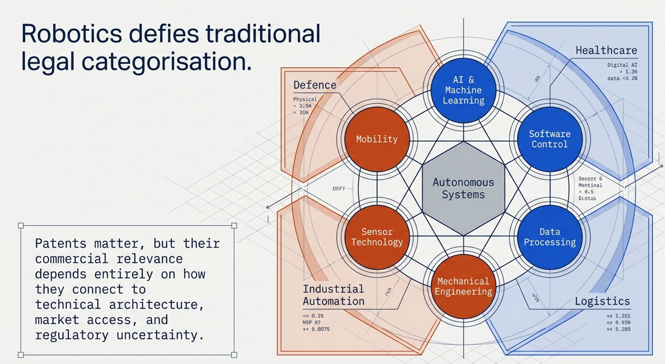
Robotics and autonomous systems are no longer a narrow engineering niche. They sit at the intersection of artificial intelligence, sensor technology, mechanical engineering, software control, data processing, mobility, healthcare, defense, logistics and industrial automation. This makes the field especially interesting for IP practice groups, because it cannot be communicated convincingly through a single legal category. Patents matter, of course. But the commercial relevance of patents depends on how they are connected to technical architecture, market access, investment readiness, regulatory uncertainty, freedom to operate and the long term positioning of the innovating company.
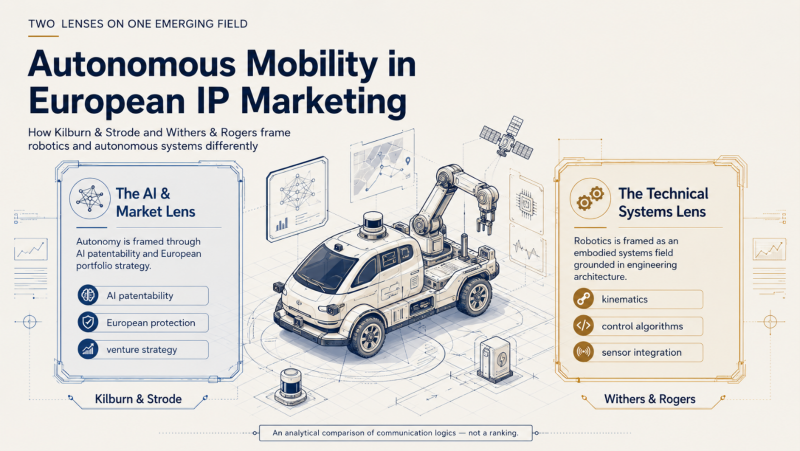
This is why the way law firms frame robotics and autonomous systems in their public communication is revealing. It shows which part of the client’s problem they choose to make visible. Some firms present the field primarily as a patentability challenge for software and AI enabled inventions. Others present it as an engineering system challenge, where protection must cover platforms, kinematics, control algorithms, sensors, navigation and human machine interaction. Both approaches are legitimate. Neither is inherently better. But they attract attention from different client situations and create different expectations about the role of the IP advisor.
Kilburn & Strode and Withers & Rogers offer a useful European comparison for exactly this reason. Both are IP focused firms with strong technical credentials. Both can speak credibly to emerging technologies. Both are relevant to autonomous mobility and robotics. Yet they do not frame the market in the same way. Kilburn & Strode appears to position the topic through the lens of AI, machine learning, European patent strategy and proximity to Silicon Valley technology companies. Withers & Rogers, by contrast, makes robotics and autonomous systems visible as a dedicated sector group, with a broad technical vocabulary covering consumer, industrial and medical applications.
The comparison is not a ranking. It is an observation of communication logic. It asks how two European IP practice groups make the same emerging field understandable, relevant and commercially meaningful for potential clients.
Kilburn & Strode: Positioning robotics through AI, autonomous mobility and European patent strategy
Kilburn & Strode does not appear to present robotics primarily through a standalone robotics practice page. The stronger public signal comes from its AI and machine learning positioning, its reference to self-driving vehicles, its European IP work for technology companies, and its visible connection to the San Francisco innovation ecosystem. This creates a specific communication frame: autonomous systems are understood as part of a broader AI patentability and global portfolio strategy problem.
On its AI and Machine Learning sector page, Kilburn & Strode emphasizes the complexity of patenting AI and machine learning inventions in Europe. The page refers to experience across AI innovation, technical academic backgrounds and practical work on patent applications ranging from medical image segmentation to reasoning models for self-driving vehicles. The important point is not simply that self-driving vehicles are mentioned. The important point is that autonomous mobility is placed inside the broader problem of protecting AI based inventions before the patent office. That is a very specific framing choice.
In this communication logic, autonomous vehicles become an example of a wider issue: how to protect software based and AI enabled inventions in Europe when patentability depends on technical contribution, claim drafting, disclosure quality and the ability to translate algorithmic performance into a legally recognizable technical effect. For clients developing autonomous mobility technologies, that matters. The innovation may be experienced in the market as a vehicle, a robot or a transport service. But in patent terms, much of the protectable substance may sit in perception models, prediction models, planning methods, control logic, sensor fusion or decision making systems.
Kilburn & Strode’s public reference to TuSimple adds another layer. The firm states that it began working with TuSimple to help secure European patent protection for autonomous trucking. This is not merely a technology description. It is a market narrative. Autonomous trucking is presented as a future transport infrastructure, not just as a technical feature inside a vehicle. The reference connects European patent protection with a broader commercial vision: autonomous freight networks, safety, efficiency and environmental impact. For an IP practice group, this is a strong way to show that European patent advice can be relevant to global mobility companies whose business models are not confined to Europe.
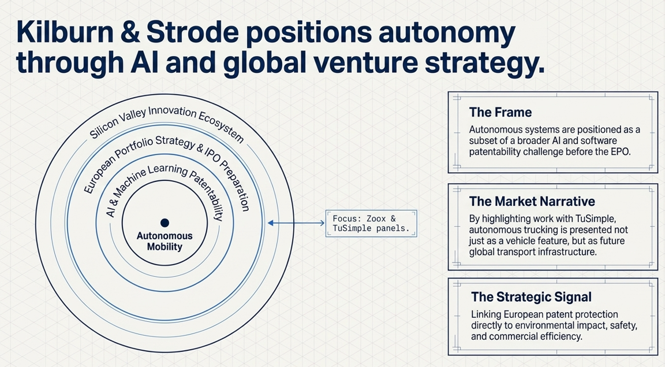
The Berkeley Collaboration IP Series reinforces this positioning. The event materials show Kilburn & Strode engaging with AI, semiconductor and healthcare technologies, with panels involving in house counsel and technology companies. In that context, autonomous driving appears through speakers and profiles connected to companies such as Zoox and TuSimple. The emphasis is on global filing strategies, effective in house IP teams, freedom to operate, portfolio strength analysis and patent due diligence as companies approach IPO or commercial scale. Again, the communication does not isolate robotics as a standalone engineering category. It treats autonomous systems as part of a global technology portfolio challenge.
This creates a distinctive business development signal. Kilburn & Strode’s public material seems designed to speak to sophisticated technology companies that already understand the strategic value of European patent protection, but need help translating complex AI and software inventions into robust IP assets. The implicit audience includes venture backed companies, scale ups, US technology companies seeking European protection, and in house IP teams managing international portfolios. The positioning is not simply “we understand robotics.” It is closer to “we understand how AI heavy autonomous technologies can be protected, assessed and positioned in Europe.”
That is a strong communication logic for an IP Subject Matter Expert working at the intersection of AI, software and autonomous mobility. It shows that the expert’s value does not lie only in knowing patent law. It lies in understanding how a technology company’s future market position may depend on the quality of its European protection strategy, especially when the core invention is not a conventional mechanical component but a learning, sensing or reasoning system embedded in a physical product.
Withers & Rogers: Positioning robotics as a dedicated technical systems field
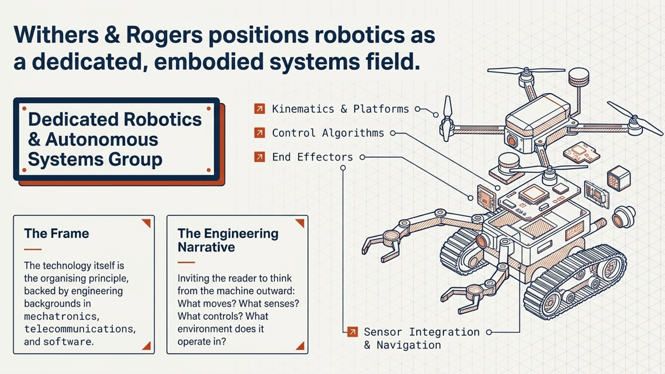
Withers & Rogers communicates robotics and autonomous systems in a different way. The firm has a dedicated Robotics & Autonomous Systems Group, and this is a meaningful distinction. The topic is not only embedded in AI, automotive or software. It is made visible as its own sector, with a technical vocabulary that signals direct familiarity with the architecture of robotic systems.
The Robotics & Autonomous Systems Group describes itself as made up of UK and European patent attorneys with engineering backgrounds in mechatronics, telecommunications and software. This is already a clear positioning statement. The firm is not leading with regulatory uncertainty, investment readiness or litigation risk. It is leading with technical understanding. The message is that robotics clients need advisors who can understand the inventions at the level where software, control, sensing, movement and physical interaction come together.
The page refers to protecting innovations from platforms, kinematics and end effectors to the control algorithms that govern and guide robotic systems. It also distinguishes known environments, open environments, single assets and swarms. This vocabulary matters because it mirrors the way engineers and product teams think about robotics. A mobile robot in a warehouse, a surgical robot, a social robot, a radiation mapping UAV and an autonomous vehicle may all involve autonomy, but they do not raise exactly the same IP questions. The protectable invention may sit in the mechanical configuration, the interaction between sensors and actuators, the navigation method, the control architecture, the mapping process, the user interface or the training and deployment of AI models.
The technical breadth of the Withers & Rogers framing is also visible in the examples it uses. The firm refers to autonomous vehicles and social robots on the consumer side, unmanned systems navigation algorithms and SLAM in industrial robotics, radiation mapping UAVs, USV conversion modules, oil and gas downhole technologies, surgical robots and assisted living components. This is a broad systems map. It places robotics across sectors rather than reducing it to autonomous cars. It also signals that the practice group is not only interested in AI as a patentability topic, but in robotics as a family of embodied technologies that operate in physical environments.
The firm’s AI and Automotive materials support this picture. Its AI practice refers to work involving autonomous vehicles, industrial control and machine learning patent applications, as well as strategic advice on trade secrets, freedom to operate, infringement opinions and oppositions. Its Automotive Group refers to innovations such as V2X communication and autonomous fleet management. Taken together, these materials suggest a layered positioning: robotics is a dedicated technical field, but it is connected to AI, software, automotive systems and broader IP strategy.
This is an important contrast to Kilburn & Strode. Withers & Rogers appears to make the technology itself the organizing principle. The firm’s communication invites the reader to think from the robotic system outward: What is the platform? What moves? What senses? What controls? What environment does the system operate in? What level of autonomy is involved? What part of the system creates the technical contribution? This is highly relevant to patent work, because the answer to those questions often determines how a patent application should be drafted and where the strongest protection may lie.
For IP business development, this type of positioning can be powerful because it builds trust through technical specificity. A robotics company may not immediately know whether it needs a patent attorney, a software specialist, a mechanical engineer, a trade secret strategy or freedom to operate work. But it will recognize a practice group that speaks its technical language. The marketing logic is not primarily to say that the firm understands the market. It is to show that the firm understands the machine.
The connecting element
The connecting element between Kilburn & Strode and Withers & Rogers is autonomous mobility as a European IP challenge for AI enabled, software intensive and physically embodied technologies. Both firms can credibly speak to technologies where machine learning, sensing, navigation, control and mechanical systems interact. Both firms also position themselves as technically competent European IP advisors, rather than as general legal commentators on innovation trends.
This makes the pairing especially useful for a comparative blog post. The common field is not merely “robotics” in an abstract sense. It is the question of how European IP practice groups communicate expertise in technologies that are both digital and physical. Autonomous systems must perceive the world, interpret data, decide on action, move safely and often coordinate with other systems. From an IP perspective, this creates a demanding translation task. The invention may be spread across hardware, software, training data, model architecture, control methods, user interaction, sensor configuration, communication protocols and system integration.
Both firms address that translation task, but they enter it from different sides. Kilburn & Strode enters through AI, machine learning, autonomous driving and European patent strategy for globally scaling technology companies. Withers & Rogers enters through the robotics system itself, using sector specific technical vocabulary and a dedicated practice group structure. That is the shared basis for comparison.
The difference
The main difference lies in the first frame offered to the market.
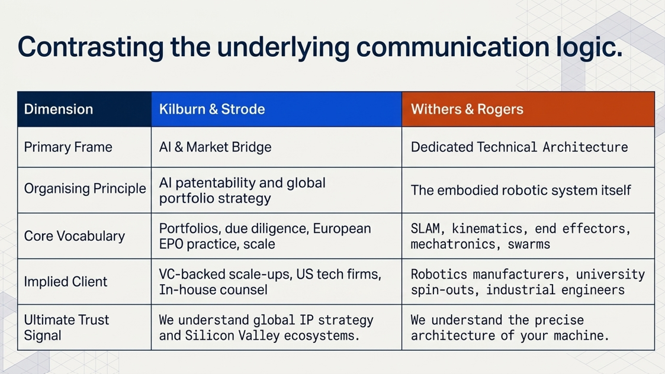
Kilburn & Strode seems to frame autonomous systems as an AI and European patent strategy problem. The visible emphasis is on patenting AI and machine learning, understanding EPO practice, supporting global technology companies and linking European protection to commercial milestones such as portfolio strength, freedom to operate, due diligence and scale. Autonomous mobility appears as one particularly important use case within that broader AI patent strategy.
Withers & Rogers seems to frame robotics and autonomous systems as a technical systems field. The visible emphasis is on engineering backgrounds, mechatronics, software, telecommunications, kinematics, end effectors, control algorithms, SLAM, UAVs, surgical robots and autonomous vehicles. AI is important, but it is not the only organizing category. The robotics system itself is the center of gravity.
This difference matters because positioning shapes the client’s perception of relevance. A venture backed autonomous driving company with US roots may be especially receptive to a message about European AI patentability, global filing strategy and portfolio readiness. A robotics manufacturer, university spin out, medical robotics developer or industrial automation company may respond more strongly to a practice group that describes the technical architecture of robotics in its own language.
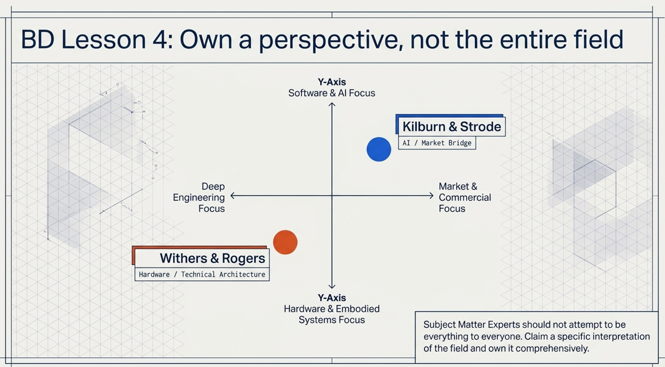
Neither approach is superior in general. Each is coherent. Kilburn & Strode’s framing is more market bridge oriented. Withers & Rogers’ framing is more technology architecture oriented. One starts with the IP strategy challenge of AI enabled autonomy. The other starts with the technical reality of robotic systems.
What IP practice groups can learn from this
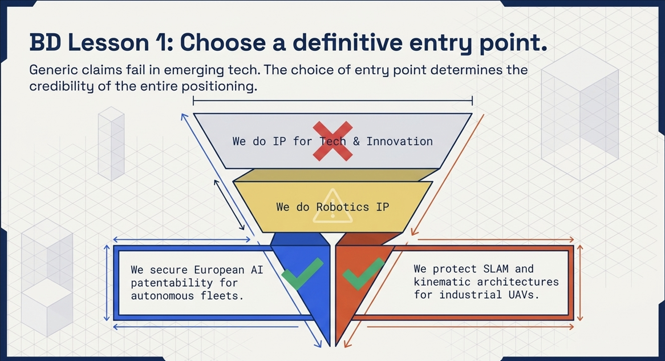
The first lesson is that emerging technology marketing becomes stronger when it chooses a clear entry point. Robotics and autonomous systems are too broad to be communicated effectively through generic innovation language. A practice group must decide what it wants to make visible first. Is the message about AI patentability? Technical system understanding? Freedom to operate? Venture readiness? Regulatory uncertainty? Industrial deployment? Safety critical applications? Collaboration and licensing? The choice of entry point determines the credibility of the whole positioning.
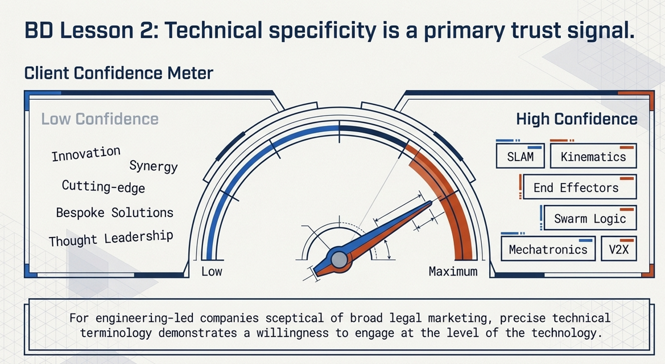
The second lesson is that technical specificity is not a detail. It is a trust signal. Withers & Rogers’ use of terms such as SLAM, kinematics, end effectors, swarms and unmanned systems navigation shows that the firm is willing to communicate at the level of the technology. This can be especially effective for engineering led companies that are skeptical of broad legal marketing. For such clients, a precise technical term may create more confidence than a general statement about innovation.
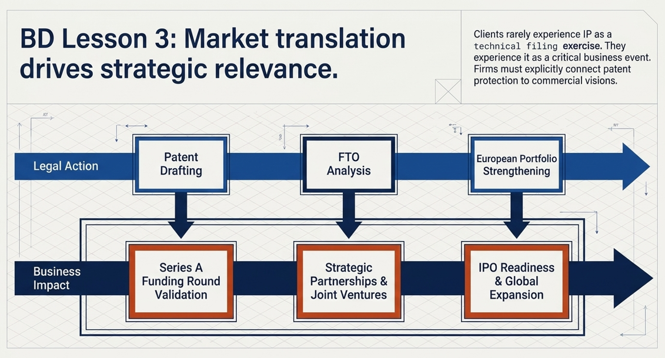
The third lesson is that market translation is equally important. Kilburn & Strode’s communication shows how autonomous mobility can be linked to European patent protection, Silicon Valley proximity, portfolio strategy, due diligence and global filing decisions. This is valuable because many clients do not experience IP as a technical filing exercise. They experience it as part of investment, expansion, partnership, IPO preparation, competitive positioning and risk management.
The fourth lesson is that an IP Subject Matter Expert should not try to own every possible aspect of robotics. A stronger approach is to own a specific interpretation of the field. One expert may become visible for AI patentability in autonomous vehicles. Another may become visible for industrial robotics and technical system protection. Another may focus on medical robotics, human robot interaction, drones, defense autonomy, or data and control architectures. The marketing challenge is not to mention robotics everywhere. It is to make a recognizable perspective visible.
Why this matters for IP business development
For IP business development, robotics and autonomous systems are a useful test case because they expose the weakness of generic expertise claims. Many firms can say that they advise on AI, software, engineering and patents. Fewer can show, through their public communication, how those capabilities come together in a specific market problem. The firms that do this well help clients understand why IP advice should be involved earlier, not only after an invention disclosure has been prepared.
The comparison between Kilburn & Strode and Withers & Rogers shows two credible ways to create that relevance. Kilburn & Strode’s framing is helpful where the commercial question is how AI heavy autonomous technologies can be protected in Europe as part of a global portfolio strategy. Withers & Rogers’ framing is helpful where the client needs confidence that the advisor understands the technical structure of robotic systems across consumer, industrial and medical contexts.
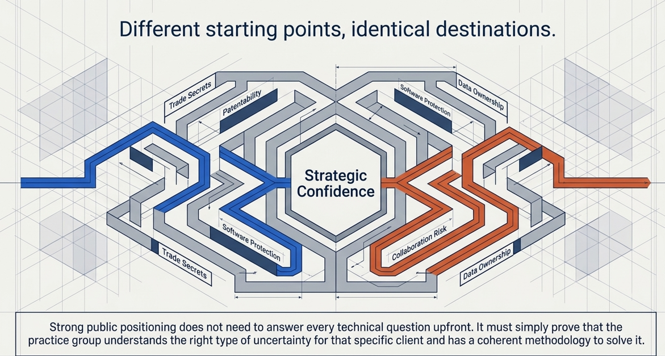
For an IP practice group, the deeper business development point is that communication should reduce the client’s uncertainty. Robotics companies face uncertainty about patentability, disclosure, freedom to operate, trade secrets, software protection, regulatory exposure, collaboration, data ownership and market timing. A strong public positioning does not need to answer every question. It needs to show that the practice group understands the right type of uncertainty and has a coherent way of working through it.
That is why comparative analysis of law firm positioning is useful. It does not tell us which firm is better. It shows how expertise becomes visible. In emerging fields such as robotics and autonomous systems, visibility is not created by listing all relevant legal services. It is created by framing the technology in a way that matches the client’s strategic situation. Kilburn & Strode and Withers & Rogers both do this, but they do it from different starting points. One makes autonomous systems legible as an AI and European patent strategy challenge. The other makes them legible as a technical robotics systems challenge. For IP business development, that difference is the real insight.