
When MedTech Becomes a Digital Health System: What Mewburn Ellis and HGF Show About IP Positioning in Connected Healthcare

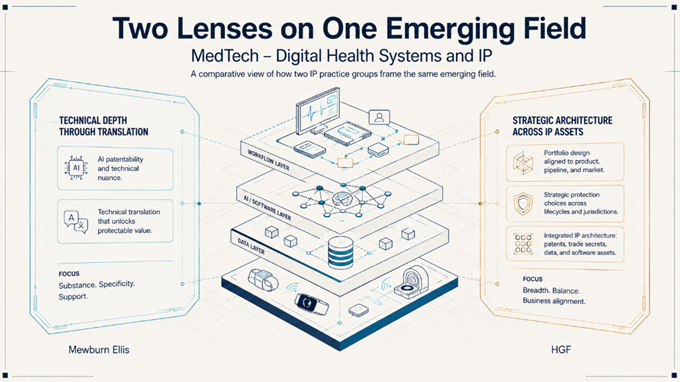
MedTech is no longer easy to describe as a field of physical devices alone. A medical device may still have sensors, implants, catheters, imaging components, robotics, diagnostic modules or monitoring hardware. But the value increasingly sits in the interaction between device, software, data, clinical workflow, AI model, regulatory evidence and commercial adoption. This is why MedTech and Digital Health have become such an important test case for modern IP communication. The question is no longer only how to protect a device. It is also how to protect a learning system, a diagnostic method, a patient data flow, an algorithmic improvement, a software enabled workflow, a platform relationship or a clinically relevant decision architecture.
This shift creates a strong opportunity for IP and patent firms. They can show that they understand not only the legal mechanics of patent protection, but also the business consequences of IP choices in a system-based healthcare market. The two firms considered here, Mewburn Ellis and HGF, are useful for comparison because both have visible public content around MedTech, Digital Health, AI and software related medical innovation. Both appear to communicate from the perspective of patent professionals who understand technical complexity. Yet they frame the opportunity in different ways.
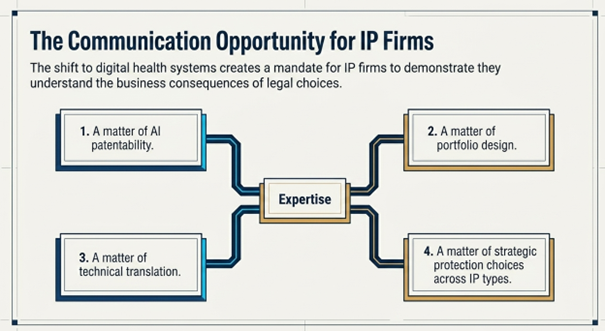
This is not a ranking. It is a positioning analysis. The purpose is to understand how two IP practice groups communicate around the same field and what this says about IP business development. For IP Subject Matter Expert positioning, such comparisons are valuable because they show how expertise becomes visible through framing. The same topic can be presented as a matter of AI patentability, as a matter of portfolio design, as a matter of technical translation, or as a matter of strategic protection choices across patents, trade secrets, copyright and data assets.
Mewburn Ellis: Positioning analysis
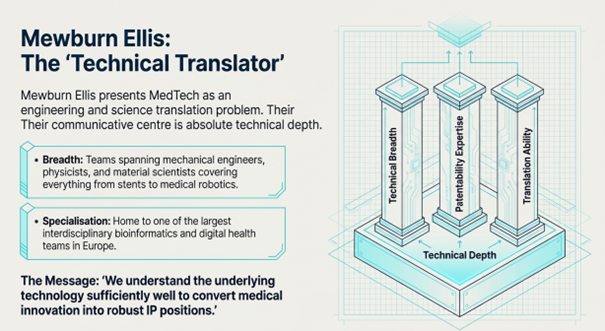
Mewburn Ellis presents MedTech through a broad but technically precise lens. Its Medical Technology page places the sector in the context of healthcare innovation, ageing populations and cost pressure in health systems. The firm emphasizes that its engineering patent team includes mechanical engineers, electrical engineers, physicists and material scientists, and that this technical composition allows it to cover medical technologies from stents and catheters to implantable sensors, medical robotics, biomaterials, medical imaging and software based diagnostics using machine learning and AI. It also states that it has an interdisciplinary bioinformatics and digital health team, described as one of the largest in Europe.
This is an important signal. Mewburn Ellis does not appear to present MedTech merely as a legal category. It presents MedTech as an engineering and science translation problem. The communicative center is technical depth. The firm seems to tell the market: we understand the underlying technology sufficiently well to convert medical innovation into robust IP positions. That message is especially relevant in MedTech because inventions often sit between mechanical function, software, diagnostics, clinical data and AI enabled analysis.
The firm’s AI in MedTech content strengthens this impression. Its public material highlights expertise in medical and biological data analysis, multimodal learning on health data, bioinformatics, medical image processing, pharmacokinetics, core AI, explainable AI and generative AI in healthcare. The content also refers to patentability, IP strategy, opposition, drafting and prosecution in this field. This combination suggests a positioning logic built around technical credibility and patent system navigation.
Mewburn Ellis also frames Digital Health at a practical patent level. Its article on patenting digital health apps sets out key considerations for healthcare apps and identifies the author as a patent attorney specializing in computer implemented inventions, AI, bioinformatics and digital health, including EPO prosecution and appeal work on software and business method applications. This is a clear signal to digital health companies: software-based healthcare inventions may be difficult to protect, but they are not outside the patent conversation if framed correctly.
A further useful point is the firm’s attention to diagnostics and AI. Its Diagnostics and AI page describes AI as a tool to support medical professionals by applying algorithms to real world patient data. It places computer aided diagnosis alongside bioinformatics and digital health and frames it as an area growing because of advances in core AI and machine learning. Again, the framing is not simply “we do patents for medical devices.” It is closer to: we understand the technical and legal boundary conditions under which AI becomes protectable in a medical context.
The overall positioning of Mewburn Ellis therefore seems to rest on three pillars. First, technical breadth across MedTech subfields. Second, patentability expertise in software, AI and medical use contexts. Third, an ability to translate emerging healthcare technologies into claims, prosecution strategies and strategic IP advice. This is a strong IP Subject Matter Expert style of communication because it makes invisible expertise visible through specific technology categories and practical protection challenges.
HGF: Positioning analysis
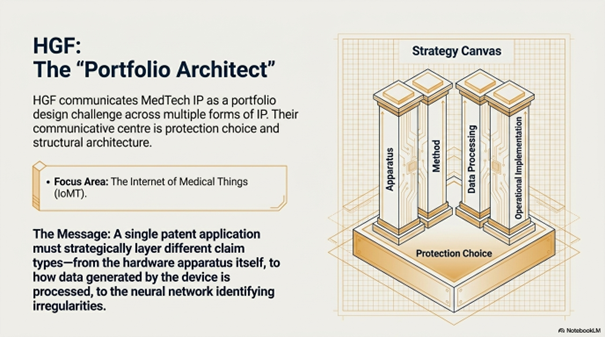
HGF also has strong Digital Health and MedTech material, but the communicative emphasis appears somewhat different. HGF’s content often frames Digital Health as a protection choice problem across multiple forms of IP. Its article on the Internet of Medical Things addresses connected medical devices and explains that the EPO may grant patents for AI in such devices, for example a neural network in a heart monitoring apparatus that identifies irregular heartbeats. The article also emphasizes that a single patent application may include different claim types covering the apparatus, how it is made and used, and how data generated by the device is processed and used.
This is a more architecture oriented framing. The issue is not only whether a device can be patented. The issue is how the IP position is structured around apparatus, method, use, data processing and technical implementation. That is highly relevant for Digital Health systems, because the protectable value may sit in several layers at once.
HGF’s more recent content on trade secrets in MedTech and Digital Health makes the difference especially clear. The article identifies proprietary datasets used to train or validate AI models, AI model weights and tuning parameters, data filtering and preprocessing techniques, manufacturing parameters and clinical datasets as possible trade secret candidates. It explains that trade secrets require secrecy, commercial value derived from secrecy and reasonable steps to keep information secret, and then discusses organizational measures such as trade secret registers, policies, employee training, access restrictions and entry and exit procedures.
This is a very business relevant framing. It recognizes that not everything valuable in Digital Health should necessarily be patented, and not everything valuable is visible in a product. Some of the most important assets may sit inside the model, the dataset, the validation process or the operational know how. HGF therefore communicates MedTech IP as a portfolio design challenge, where patents are important but not always sufficient.
A similar message appears in HGF’s material on protecting Digital Health inventions through patents and trade secrets. The video overview states that Digital Health inventions in Europe raise challenges because they are fast moving and cross disciplinary, and that patents and trade secrets can shape IP portfolios for software based medical technologies. The language is careful, practical and portfolio oriented. It tells innovators that the protection strategy must reflect the nature of the technology and the commercial role of the asset.
HGF’s article on protecting Digital Health innovation in the AI revolution also stresses that some AI implementations may be commercially valuable but still fail to meet the technical effect requirement under patent law. It then points beyond patents to trade secrets and copyright. This is a particularly important communication signal. It does not overpromise patent protection. Instead, it frames the IP advisor as someone who helps make realistic choices under uncertainty.
HGF therefore appears to position itself less as a pure AI patentability thought leader and more as a practical IP strategy firm for complex Digital Health assets. Its public content repeatedly asks: what should be patented, what should be kept secret, what can be protected through other rights, and what internal systems are needed to make these choices reliable? This is especially valuable for MedTech companies that are building products where algorithms, datasets, clinical validation, device operation and regulatory evidence are intertwined.
The connecting element
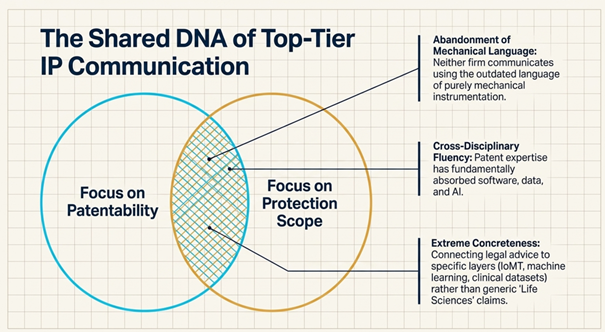
The connecting element between Mewburn Ellis and HGF is clear: both firms treat MedTech and Digital Health as areas where patent expertise must absorb software, data and AI. Neither firm appears to communicate MedTech only through the older language of mechanical devices or traditional medical instrumentation. Both recognize that the new MedTech environment is cross disciplinary.
Both firms also connect legal advice to technical specificity. They do not merely state that they advise healthcare companies. They discuss AI, machine learning, medical imaging, bioinformatics, connected devices, software based medical technologies, Internet of Medical Things, datasets, claim types and trade secret management. This is precisely the level of concreteness that makes a practice group credible in a complex technology market.
The shared strategic message is that Digital Health requires a more refined IP conversation than many companies may expect. The invention may not sit in one component. It may sit in how clinical data is processed, how AI output supports diagnosis, how a wearable device creates medically relevant feedback, how software interacts with hardware, how evidence is generated, or how proprietary training data improves performance. In such a context, patent attorneys must become translators between technical reality, legal protectability and commercial value.
The difference
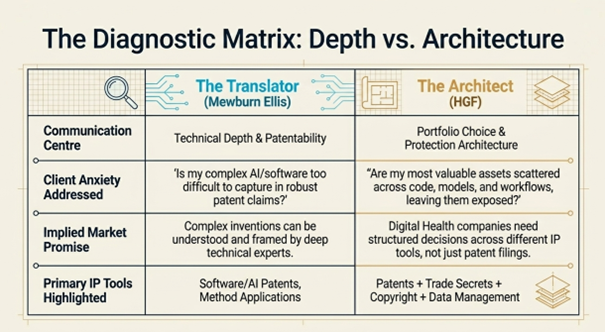
The main difference seems to be one of communication center.
Mewburn Ellis appears to frame MedTech and Digital Health primarily through technical depth and patentability in advanced technologies. Its public material highlights the firm’s technical teams, engineering and science backgrounds, AI specialists, diagnostics, bioinformatics, imaging, robotics and software patenting. The implied market promise is that complex MedTech inventions can be understood, framed and protected by advisors who can handle the technical substance and the patent law boundary conditions.
HGF appears to frame the same field more through portfolio choice and protection architecture. Its public content gives substantial attention to the limits of patentability, the role of trade secrets, data assets, AI model parameters, clinical datasets, internal confidentiality systems and combined IP strategies. The implied market promise is that Digital Health companies need structured decisions across different IP tools, not just patent filings.
This difference matters. In one framing, the core question is: how can technically complex AI and software based MedTech inventions be made patentable and commercially useful? In the other framing, the core question is: which parts of the Digital Health system should be protected by patents, which by secrecy, which by copyright or other tools, and how should the company organize itself around those choices?
Both are valid. Both are needed. But they speak to slightly different client anxieties. Mewburn Ellis speaks strongly to the innovator who worries that the technology is too complex, too software based or too AI based to be captured in robust patent claims. HGF speaks strongly to the innovator who worries that valuable assets are scattered across code, data, models, workflows and know how, and that a patent only approach may leave value exposed.
What IP practice groups can learn from this
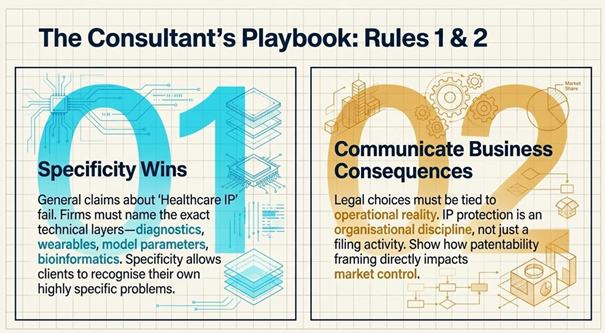
The first lesson is that modern MedTech positioning works best when it is specific. General claims about Life Sciences or Healthcare IP are not enough. The firms that become visible in this field name the technical layers: AI, diagnostics, connected devices, imaging, software, datasets, model parameters, wearables, bioinformatics and clinical data. This specificity allows potential clients to recognize their own problems.
The second lesson is that IP practice groups should communicate the business consequence of legal choices. HGF’s trade secret content is a good example. By discussing datasets, model weights, preprocessing techniques and internal procedures, the firm makes clear that IP protection is not only a filing activity. It is also an organizational discipline. Mewburn Ellis does something similar from another angle by showing that patentability in AI based MedTech depends on how the technical application is framed.
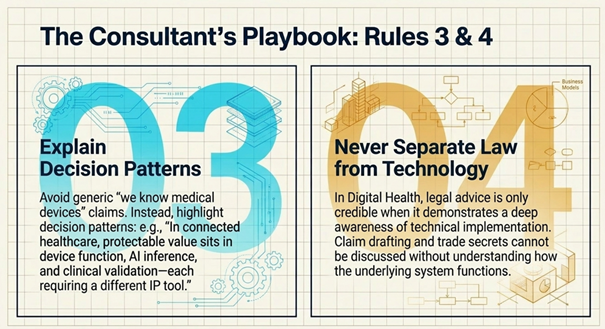
The third lesson is that IP Subject Matter Expert positioning becomes stronger when it avoids generic expertise claims and instead explains decision patterns. A strong MedTech IP expert does not simply say: “we know medical devices.” A stronger expert says: “in connected healthcare, the protectable value may sit in device function, data processing, AI inference, user interaction, clinical validation or manufacturing know how, and each layer may require a different IP tool.”
The fourth lesson is that the best communication does not separate law from technology. In Digital Health, legal advice becomes credible when it shows awareness of technical implementation. Patentability, trade secrets, data strategy and claim drafting cannot be discussed meaningfully without understanding how the system works.
Why this matters for IP business development
For IP business development, this comparison is useful because it shows how a practice group can own a theme without making it a ranking claim. Mewburn Ellis and HGF both occupy the MedTech and Digital Health space, but they do not need to say the same thing. One can lead with advanced technical patentability and AI enabled MedTech. The other can lead with protection choices, trade secrets and portfolio architecture. Both approaches make the firm’s expertise easier to understand.
This matters because clients rarely search for “excellent patent attorney” in the abstract. They search for someone who understands the problem that is becoming urgent in their own organization. A Digital Health founder may be concerned about whether a software based diagnostic method is patentable. A MedTech company may worry that its most valuable asset is a clinical dataset that cannot be disclosed. A product team may be uncertain whether to claim a device, a method, a data processing step or a workflow. A legal team may need to align patent strategy with confidentiality systems and future collaboration agreements.
In such situations, visible thought leadership does more than create awareness. It reduces perceived translation risk. It tells the market that the firm understands the real shape of the problem. For IP and patent firms, this is the central business development opportunity in MedTech. The field is moving from device protection toward system protection. That shift requires IP experts who can speak about technology, legal constraints and commercial control in one coherent language.
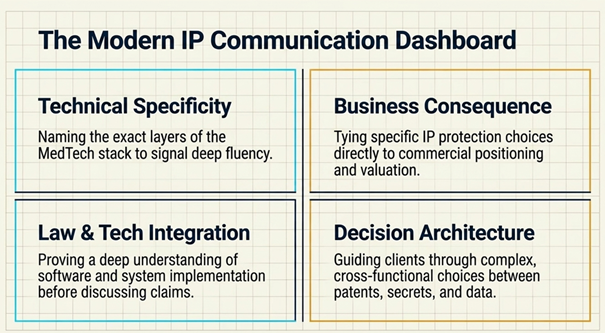
The strongest learning from the Mewburn Ellis and HGF comparison is therefore not that one approach is superior. It is that MedTech IP communication has become plural. A firm can credibly position itself through AI patentability, technical depth and prosecution expertise. A firm can also credibly position itself through protection architecture, trade secret discipline and portfolio design. The most persuasive IP Subject Matter Expert communication will often combine both logics: technical precision on what can be protected, and strategic clarity on why a particular protection choice supports the company’s future position in a connected healthcare system.
_______________
This post draws on the following publicly available materials:
Mewburn Ellis
Medical Technology
👉 https://www.mewburn.com/patent-advice-medical-technology
Spotlight on MedTech
👉 https://www.mewburn.com/spotlight-on-medtech
Spotlight on AI MedTech
👉 https://www.mewburn.com/spotlight-on-ai-medtech
Diagnostics and AI
👉 https://www.mewburn.com/diagnostics-and-ai-patent-advice
How to patent your healthcare apps: 5 key considerations
👉 https://www.mewburn.com/forward/how-to-patent-your-healthcare-apps-5-key-considerations
HGF
The Internet of Medical Things
👉 https://www.hgf.com/knowledge-hub/articles/the-internet-of-medical-things/
The Secrets of MedTech and Digital Health
👉 https://www.hgf.com/knowledge-hub/articles/the-secrets-of-medtech-and-digital-health/
Protecting Digital Health Innovation in the AI Revolution
👉 https://www.hgf.com/knowledge-hub/articles/protecting-digital-health-innovation-in-the-ai-revolution/
Cost-Conscious IP Solutions for MedTech and Digital Health AI Innovators
👉 https://www.hgf.com/knowledge-hub/articles/cost-conscious-ip-solutions-for-medtech-and-digital-health-ai-innovators/
Bioinformatics and Digital Health including AI
👉 https://www.hgf.com/bioinformatics-digital-health-jan-2025/
AI & Software
👉 https://www.hgf.com/sector-groups/technology-engineering/ai-software/