When Technology and IP Become Boardroom Questions: What the CTO Spring Forum 2026 Revealed About AI and IP Leadership with Dr. Diana Taubert

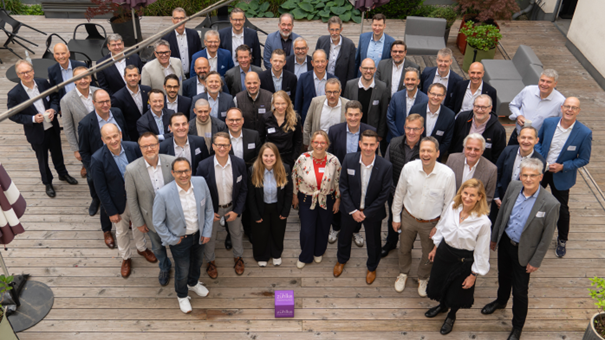
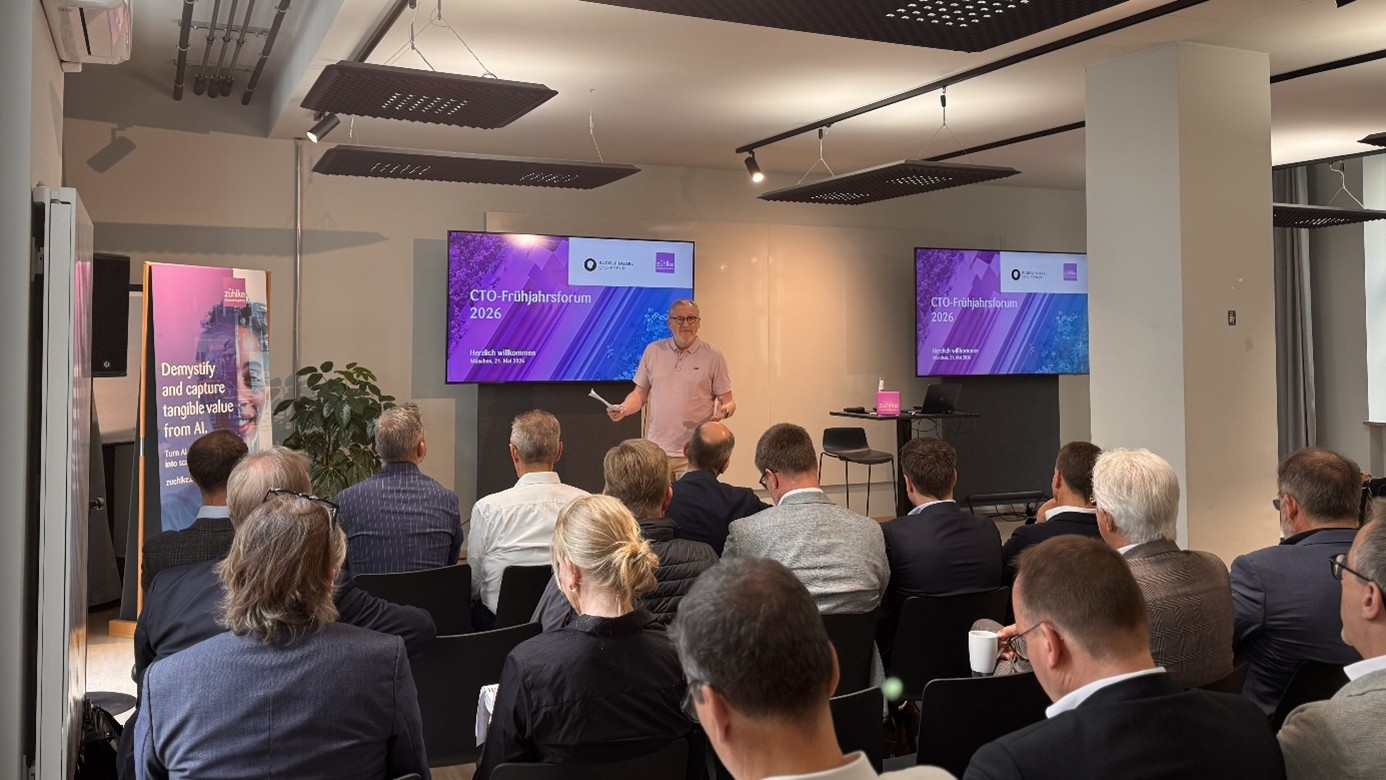
The CTO Spring Forum 2026, held on 20 and 21 May in Munich, made one thing very clear: technology is no longer a topic that can be managed only within research, development or product departments. It has become a central leadership issue. This year’s forum, organized by the Rudolf Diesel CTO Forum together with Zühlke, focused on three themes that are now shaping the agenda of technology companies: artificial intelligence, humanoid robotics and the communication of intellectual property at board level.
At first glance, these three themes may seem separate. AI is about algorithms, data and automation. Humanoid robotics is about machines that can interact with the physical world in more human-like ways. IP communication is about making patents, know-how and intangible assets understandable for senior decision-makers. But the forum showed that these topics are closely connected. They all point to the same structural change: technology is becoming more complex, more systemic and more strategically relevant.
The forum opened with a broader leadership perspective. Prof. Dr. Niko Kohls spoke about resilience and future skills as the basis for successful leadership in a volatile world. His contribution framed the entire event. In a world shaped by geopolitical uncertainty, economic pressure, digital transformation and constant information overload, leadership can no longer rely only on planning and control. Leaders need to create orientation, build resilience and help organizations remain capable of acting under uncertainty.
This was an important starting point, because the technological themes of the forum were not presented as isolated trends. They were discussed as leadership challenges. The key question was not simply what new technologies can do. The deeper question was how companies can turn technological change into strategic capability.
Artificial intelligence as an organizational transformation
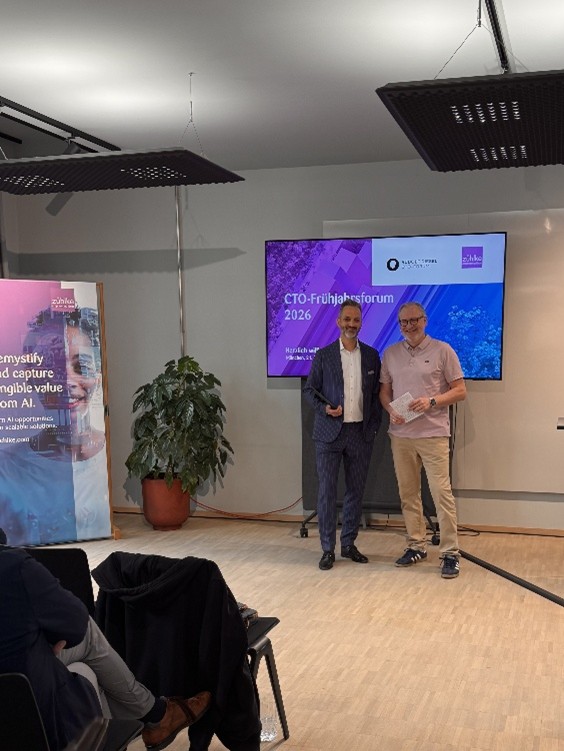 Artificial intelligence was the most visible theme of the forum. The AI update by Peter Güntzer and Dr. Andreas Liebl highlighted current developments and practical use cases. Both speakers brought complementary perspectives: Zühlke’s applied technology and business view, and the perspective of the Applied AI Initiative at UnternehmerTUM, one of Europe’s major innovation platforms. The session made clear that AI has moved beyond isolated experimentation. Companies are now asking how AI can be embedded in value creation, research and development, leadership and decision-making.
A particularly concrete example came from Marco Cardinale, CTO of Alfred Kärcher SE & Co. KG. His session on Kärcher’s AI journey with Google Gemini addressed the path from mindset activation to R&D transformation. This wording is important. It shows that AI transformation does not begin with a tool. It begins with a change in the way people think, collaborate and develop products.
For many companies, the first phase of AI adoption was tool-centered. Employees tested applications, teams explored productivity gains and organizations looked for quick wins. But the Kärcher example pointed to a deeper question. How does AI change the entire product development process? How does it affect cross-functional collaboration? How does it help teams generate, test and refine ideas? And how can a global technology company ensure that AI becomes a real value contributor rather than a collection of disconnected experiments?
For CTOs, this creates a new responsibility. They are no longer only responsible for assessing technologies. They must shape the organizational conditions under which these technologies can create value. This includes data availability, process design, employee capability, cultural readiness and governance. AI therefore becomes a transformation topic, not just a technology topic.
This was further reinforced by Prof. Dr. Feiyu Xu’s contribution on AI-driven co-leadership. Her session asked how AI changes corporate leadership and what role AI systems may play as co-pilots in management decisions. This question goes to the heart of modern executive decision-making. AI can analyze large volumes of information, identify patterns, prepare scenarios and support decision processes. But it does not remove responsibility from management.
In fact, the opposite is true. The more AI enters decision-making, the more important human judgment becomes. Leaders must understand what AI can and cannot do. They must know when to trust a system, when to challenge it and when to bring in contextual knowledge that cannot easily be captured in data. AI can support leadership, but it cannot replace accountability.
This has direct consequences for CTOs. They need to translate AI capabilities into decision architectures. They must ensure that AI systems are not only technically powerful, but also understandable, reliable and aligned with business priorities. The future of AI in companies will therefore depend less on isolated technical excellence and more on the quality of integration into leadership, strategy and operational routines.
Humanoid robotics as a symbol of systems complexity
The second major theme of the forum was humanoid robotics. Darius Wilke, Vice President Commercial at Hexagon Robotics, spoke about AI adoption for humanoid robotics. This topic made visible how closely AI, robotics and industrial transformation are now connected.
Humanoid robotics attracts attention because it is tangible. Unlike abstract AI systems, humanoid robots give technology a physical presence. They move, perceive and interact in environments shaped by human activity. But the strategic importance of humanoid robotics goes far beyond the visible machine. These systems combine AI, sensors, actuators, software, safety concepts, data processing, human-machine interaction and industrial use cases.
This makes humanoid robotics a perfect example of a broader shift. Industrial products are no longer defined mainly by mechanical performance. Increasingly, they are defined by the interaction of hardware, software, data and services. A humanoid robot is not only a machine. It is a cyber-physical system.
That connection became even clearer in Reka Leisztner’s contribution on cyber-physical systems and the transition from hardware thinking to systems thinking. Her session addressed a challenge that many CTOs know very well: market requirements are increasing rapidly, while products are becoming more interconnected, software-based and service-oriented. Traditional approaches are no longer sufficient when the product itself becomes part of a larger system.
Systems thinking therefore becomes a core leadership capability. Companies must understand how different technical layers interact. They must manage interfaces, data flows, software updates, platform dependencies, safety requirements and business models together. This is particularly relevant in robotics, but it also applies to many other industries, from MedTech and mobility to energy, industrial automation and smart connected products.
For CTOs, this means that the role of technology leadership is changing. It is no longer enough to optimize individual components. The strategic question is how the components work together to create market value. The competitive advantage may lie in a sensor, an algorithm, a mechanical design, a software architecture or the integration of all these elements into a reliable system.
Humanoid robotics therefore stands for more than an emerging technology field. It stands for a new industrial logic. The winners will not necessarily be those with the best single component. They will be those who understand the system, control the critical interfaces and translate technical complexity into usable solutions.
Why IP must reach the boardroom
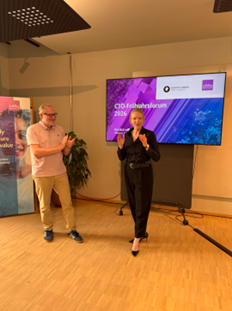 The third central theme of the forum was the communication of IP at board level. This topic was especially visible in Dr. Diana Taubert’s contribution to the CTO initiative and the Industry Council on Competition. Her presentation emphasized why intellectual property deserves a strategic place on the agenda of CTOs, especially in family-owned technology companies. She also introduced the idea of IP benchmarking as a way for CTOs to assess whether the company’s IP setup truly fits its business strategy.
This is a crucial point. In many companies, IP is still understood primarily as protection against imitation. Patents, trademarks, designs and know-how are seen as legal instruments that secure existing innovation. This view is not wrong. But it is incomplete.
In an environment shaped by AI, robotics, software, data and connected systems, IP becomes a strategic management instrument. IP defines options to act. It shapes cooperation models. It influences negotiation power, investment decisions, market access, standardization, platform strategy and company value.
This is why IP must be communicated differently at board level. Reporting the number of patent filings, grants or renewals is not enough. These metrics may be useful, but they rarely explain the strategic contribution of IP. Boards think in terms of growth, risk, competitive position, capital allocation, market access and enterprise value. IP must be translated into exactly that language.
The better questions are therefore not: How many patents do we have? The better questions are: Which strategic options do we secure? Which future markets become accessible? Which dependencies do we avoid? Which cooperation positions do we strengthen? Which technologies can we credibly control? Which risks do we identify early? And where does IP make innovation measurable?
This is where the three themes of the forum come together. If AI transforms R&D, companies must understand which data, models, workflows and outputs create protectable or controllable value. If humanoid robotics creates new system architectures, companies must understand which layers of the system are strategically decisive. If cyber-physical systems combine hardware, software and services, companies must understand how IP maps the value logic of the whole system.
For CTOs, this creates a major opportunity. They can move IP out of a defensive legal corner and position it as part of strategic technology leadership. IP can help explain why certain technologies matter, where market value is created and how innovation can be translated into lasting competitive advantage.
One shared message
AI, humanoid robotics and IP communication may look like three separate themes. But the CTO Spring Forum 2026 showed that they are part of the same transformation. AI changes how companies think and decide. Humanoid robotics shows how technology becomes more systemic and physically integrated. IP communication determines whether the strategic value of these developments is understood at board level.
The core message of the forum was clear: technology companies need new forms of leadership for a world in which innovation is faster, more complex and more interconnected. CTOs must not only understand technologies. They must translate them into strategy, organizational capability and market position.
This is why the CTO role continues to gain strategic relevance. CTOs are becoming interpreters of technological change, architects of systems thinking and translators between engineering, business and the boardroom. In this new environment, AI is not just a tool, robotics is not just hardware and IP is not just legal protection.
Together, they mark a new reality of industrial leadership. Technology has become a boardroom language. Companies that learn to speak this language clearly will be better prepared to turn complexity into strategic advantage.