
Photonics in Motion: How Light-Based Technologies Turn IP into a Strategic Infrastructure Question

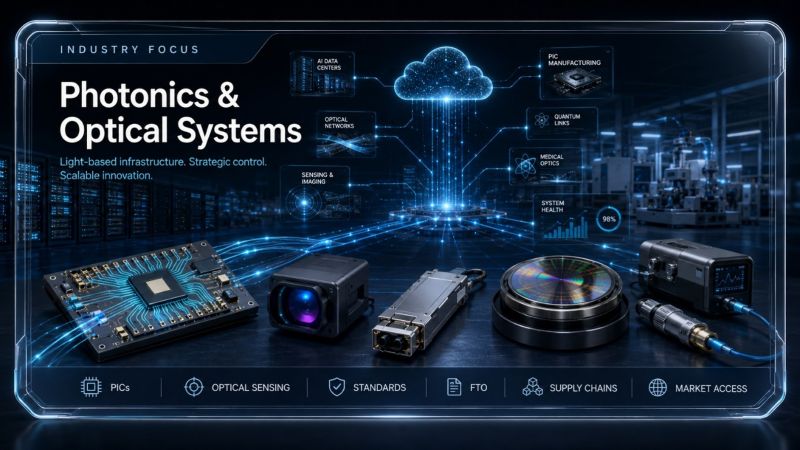
Photonics is no longer only a field of optical components, laboratory breakthroughs or specialised engineering. It is becoming part of the infrastructure of AI, data centres, sensing, medical diagnostics, industrial manufacturing, quantum technologies and advanced semiconductor systems. This matters for strategic IP management because it shows how IP is moving from a narrow legal protection function into a decision system for control, collaboration, market access, risk management and competitive positioning.
From optical component to industrial infrastructure
A visible signal of this shift is the acceleration of silicon photonics and co-packaged optics in AI infrastructure. NVIDIA’s 2025 announcement of photonics-based networking switches for AI factories is more than a product announcement. It shows that light-based technologies are moving into the core of large-scale computing systems. In parallel, Europe’s PIXEurope initiative aims to establish an open-access pilot line for photonic integrated circuits, covering fabrication, packaging, testing and reliability across the PIC supply chain.
These developments point in the same direction. Photonics is moving from the periphery of innovation systems into their operational core. Optical interconnects, photonic integrated circuits, LiDAR, depth sensing, hyperspectral imaging, optical metrology, medical optics and quantum photonics are not isolated technology niches. They are becoming enabling layers for industries that depend on speed, bandwidth, precision, energy efficiency, miniaturisation and data quality.
This is why Photonics & Optical Technologies should be treated as an IP management field, not simply as an optics sector. The decisive question is not only whether a lens, laser, sensor or waveguide can be patented. The more strategic question is where control arises in a layered value chain: in materials, device architecture, chip design, packaging, process know-how, calibration, software, data interpretation, standards, supply chains or customer-specific system integration.
The transition from future promise to practical decision pressure
For many years, photonics carried the aura of a future technology. It was associated with research institutions, advanced laboratories, specialised components and long development cycles. That perception is changing. Photonics is becoming commercially actionable because several pressures are converging at the same time.
AI workloads require faster and more energy-efficient data movement. Advanced manufacturing requires higher precision and inline measurement. Robotics and autonomous systems require richer perception data. Medical diagnostics increasingly use optical measurement and imaging. Quantum technologies depend on highly specialised photonic components, detectors and communication systems. Semiconductor ecosystems are looking at photonic integration, advanced packaging and new material platforms.
Andrew Thompson and Iris Buckley capture this transition in their analysis of the UK photonics landscape. They observe that “patent filing trends show the photonics sector is on the rise” and connect patent activity with the broader rise of investment-backed photonics companies. Their most important strategic signal is that “strong patent portfolios can help attract investments.” For IP management, this is a decisive shift. A patent portfolio is not only evidence of invention. In a capital-intensive field, it becomes part of the story a company tells to investors, partners, customers and potential acquirers.
Matthew Bannister’s analysis of photonics innovations enabling AI adds another layer. He describes photonics as a key enabler for AI by supporting optical connectors, photonic integrated circuits and high-bandwidth data transfer. But he also points to a timing problem: product cycles may be shorter than patent grant cycles. His conclusion is not that patents become irrelevant. It is that the goal is “less of a ‘more patents’ approach” and more “the right coverage.” That phrase captures the move from patent accumulation to portfolio architecture.
Why photonics changes the IP management question
Photonics is strategically difficult because the value of an innovation is rarely located in one visible object. A photonic system can combine materials, nanostructures, waveguides, lasers, detectors, electronic drivers, software, signal processing, calibration data, thermal management, packaging and testing procedures. The final product may be easy to describe, but the economic control points may sit elsewhere.
This changes the IP management question. It is no longer enough to ask whether an optical invention is patentable. Companies need to ask which layer of the system should be patented, which layer should remain confidential, which layer is exposed through product use, which layer may become standardised, which layer creates freedom-to-operate risk and which layer will matter most in negotiations with partners or investors.
Olivier Martinez addresses one of the central decision gaps in this field: the temptation to rely too heavily on trade secrets. His warning is clear: “UK photonics companies should adopt a balanced IP strategy that includes selective but strategic patent filings.” The point is not that trade secrets are unimportant. In photonics, process know-how can be extremely valuable, especially in fabrication, alignment, coating, waveguide manufacturing, test procedures and yield optimisation. But trade secrets alone can be fragile when companies scale internationally, seek funding, enter partnerships, face employee mobility or need enforceable rights in key markets.
Michele Moresco makes the broader management point directly. He writes that photonics IP strategy must go “beyond simple patent procurement.” That is the right framing. In a layered photonics business, IP strategy must include patents, trade secrets, licensing, freedom-to-operate, internal disclosure processes, joint development rules, competitor monitoring and litigation readiness. A company that treats these as separate legal tasks may miss the strategic pattern. A company that manages them together can turn technological complexity into business control.
IP as coordination infrastructure across ecosystems
Photonics innovation is rarely produced by one actor alone. It often emerges from cooperation between universities, startups, foundries, equipment suppliers, system integrators, materials providers, standard-setting bodies, investors and customers. This is particularly visible in photonic integrated circuits, where design, fabrication, packaging, testing and reliability may sit across different organisations.
That is why IP becomes coordination infrastructure. It clarifies what each participant brings into a collaboration, what is created jointly, who can commercialise which results, how background IP is preserved, how foreground IP is allocated and how later product generations can be developed. Without this structure, collaboration may accelerate technical progress but weaken strategic control.
Carles Puente i Baliarda’s ICFO programme on Understanding Patents in Photonics is useful precisely because it connects patents to business and technology, not only law. The programme refers to “Patent Based Business Models,” “Patent Engineering,” “IP Product Development” and “Locking the Value of Technology Assets.” This is a strong early formulation of what has now become a broader management reality. Photonics companies do not only need protection for inventions. They need a way to translate technology assets into business models, licensing options, investment narratives and market positions.
Iouri Kobiako von Gamm makes a similar point for rapidly evolving quantum and photonic technologies. In his IAM interview, he states that “tailor-made patent drafting and filing strategies” can function as financial and strategic tools. That is important because many photonic technologies are developed by university spin-offs, startups and specialised deep-tech companies. For them, IP budget is not unlimited. Filing decisions must be linked to funding, commercialisation, partnerships and future negotiation leverage.
New uncertainties: where does control really arise?
The rise of photonics creates several decision gaps that are not purely legal. The first is the patent-versus-trade-secret decision. If the relevant advantage can be reverse engineered from a product, patent protection may be essential. If the advantage lies in process parameters, tolerances, calibration methods or yield optimisation, secrecy may be more appropriate. But this choice cannot be made invention by invention in isolation. It must be aligned with the business model, the product roadmap and the likely collaboration architecture.
The second decision gap concerns freedom to operate. Photonics systems often combine old and new technologies. Foundational patents may sit in research institutions, acquired companies, legacy portfolios or specialised component suppliers. As products move from prototype to market, FTO becomes not only a legal clearance task but a design input. It can influence architecture choices, sourcing, partnership structures and standards participation.
The third gap concerns standards and interoperability. Optical communication, AI infrastructure, automotive sensing and industrial systems all depend on interfaces. Once a market begins to converge around standards or de facto technical architectures, IP positions can shape access, bargaining power and risk. Bannister’s observation that implementation-path IP can influence design choices in standardised environments is particularly relevant here.
The fourth gap concerns supply chains. Photonics depends on specialised materials, substrates, components, equipment and manufacturing capabilities. If a company controls only the visible product but not the process knowledge, supplier relationships or material alternatives behind it, its IP position may be weaker than its patent count suggests.
Iain McIntyre’s Photonics IP Update shows how broad this field has already become in disputes and patent-office activity. His October 2025 roundup covers “32 cases concerning various technologies,” including displays, imaging, sensors, medical applications, optical communications, AR/VR, wearable optical devices and laser-based manufacturing. The message is simple: photonics IP is not confined to one courtroom category or one technical niche. It is spreading across many industrial applications.
Why fragmented advice is not enough
The market for IP advice often remains organised around separate services: patent drafting, prosecution, FTO, oppositions, litigation, licensing, trade secret policies, contracts, standards advice and due diligence. Each is important. But in photonics, the business problem often sits between them.
A startup developing a photonic AI accelerator does not only need a patent application. It needs to know which parts of its architecture will survive product cycles, which process innovations should remain secret, whether its packaging approach creates FTO risk, how collaboration with a foundry affects ownership, what investors will expect to see and how future standards may change the value of its claims.
An established company using optical sensing in industrial automation does not only need clearance for one product feature. It needs to understand whether the valuable asset is the sensor, the calibration routine, the data model, the machine integration, the service layer or the customer-specific process knowledge. Each answer leads to a different IP strategy.
This is the advisory gap. Too much advice is still delivered as an isolated legal answer to an isolated legal question. Photonics increasingly requires integrated orientation across technology, business and IP. The IP expert’s role is not only to explain rules. It is to help companies decide where value is created, where control can be built and where exposure becomes strategically relevant.
The role of IP experts in light-based innovation systems
Strategic IP experts can act as translators in photonics ecosystems. They translate between R&D teams, management, investors, commercial partners, standardisation groups, courts and regulators. Their contribution is not limited to saying whether an invention can be patented. They help decide which IP option fits the business logic.
That role is especially important because photonics often sits between established industries. A photonic integrated circuit may belong partly to optics, partly to semiconductors, partly to telecoms, partly to AI infrastructure and partly to advanced manufacturing. A medical optical sensor may belong partly to diagnostics, partly to data governance, partly to device regulation and partly to platform strategy. A quantum photonics system may raise questions of patentability, dual use, public funding, export control, standardisation and commercialisation at the same time.
The strategic IP expert therefore needs to see more than claims. They need to see the decision architecture: where to file, what to keep secret, when to publish, how to structure collaborations, how to monitor competitors, how to preserve FTO, how to support investment, how to prepare enforcement and how to align the portfolio with the product roadmap.
Strategic implications
Photonics & Optical Technologies are becoming part of the infrastructure of modern innovation. Companies that understand this early will not only protect inventions more effectively. They will make better decisions about control, collaboration, funding, standards, supply chains and market access.
The first implication is that photonics portfolios must be designed around layers of value, not around isolated inventions. The second is that patents and trade secrets must be managed together, because the protectable idea and the scalable know-how may sit in different parts of the system. The third is that FTO and standards strategy need to enter earlier, before technical architecture becomes locked in. The fourth is that IP should support investment and partnership narratives, especially for startups and spin-offs. The fifth is that advisory work in this field must become more integrated, because fragmented answers cannot resolve system-level decision pressure.
Photonics is therefore not a peripheral IP topic. It is a test case for a broader shift in strategic IP management. As light-based technologies move into AI infrastructure, sensing, healthcare, manufacturing, quantum systems and semiconductor value chains, IP becomes the control layer that helps organisations decide where they can act, where they depend on others and where competitive advantage can be built.
Sources:
NVIDIA – “NVIDIA Spectrum-X Photonics Co-Packaged Optics Networking Switches to Scale AI Factories”
https://nvidianews.nvidia.com/news/nvidia-spectrum-x-co-packaged-optics-networking-switches-ai-factories
European Commission – “Photonics | Shaping Europe’s digital future”
https://digital-strategy.ec.europa.eu/en/policies/photonics
CORDIS / European Commission – “PIXEurope: Advanced Photonic Integrated Circuits Pilot Line for Europe”
https://cordis.europa.eu/project/id/101213727
Olivier Martinez – Page White Farrer: “UK Photonics companies risk falling behind by relying on trade secrets over patents”
https://www.pagewhite.com/news/uk-photonics-companies-risk-falling-behind-by-relying-on-trade-secrets-over-patents
Andrew Thompson / Iris Buckley – EE Times: “UK Photonics: Innovation, Investment, and the IP Landscape”
https://www.eetimes.com/uk-photonics-innovation-investment-and-the-ip-landscape/
Carles Puente i Baliarda – ICFO: “Understanding Patents in Photonics”
https://www.icfo.eu/download-file/files/event_documents/25012021112903000000.pdf
Matthew Bannister – Page White Farrer: “Patenting strategy for photonics innovations enabling AI”
https://www.pagewhite.com/news/patenting-strategy-for-photonics-innovations-enabling-ai
Iain McIntyre – Laser Focus World: “Photonics IP Update: October 2025”
https://www.laserfocusworld.com/executive-forum/article/55328254/photonics-ip-update-october-2025
Iouri Kobiako von Gamm – IAM Strategy 300 Global Leaders Interview
https://www.iam-media.com/survey/strategy-300-global-leaders/2026/article/iouri-kobiako-von-gamm
Michele Moresco – Laser Focus World: “Build an effective IP strategy in photonics”
https://www.laserfocusworld.com/executive-forum/article/55286693/build-an-effective-ip-strategy-in-photonics