
Practical Question Franz B. Wittwer: Where Is the Real IP Control Point in Connected MedTech Systems?

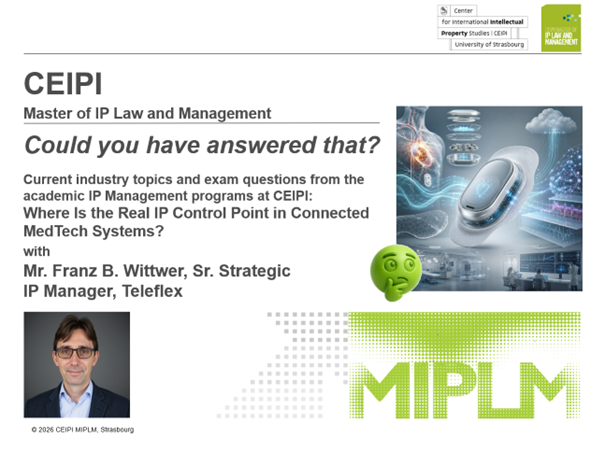
Connected MedTech is changing the logic of IP strategy. In many digital health systems, the decisive value is no longer located in one visible product. It emerges across several layers: sensors, signal capture, data processing, clinical interpretation, workflow integration, cloud infrastructure and the service model surrounding the device.
This creates a new strategic challenge for MedTech companies. A company may have a technically mature device and still remain exposed if its IP position protects only the outer hardware layer. In connected cardiac monitoring, for example, the economic bottleneck may lie in how physiological signals are transformed into clinically useful information, how this information enters hospital workflows, or how the resulting service relationship is structured.
This is exactly the type of shift described in the CEIPI IP Business Academy analysis “The MedTech Strategy Gap”. The study shows that MedTech companies increasingly need IP support that goes beyond classical device protection. They need advice that connects technology, clinical adoption, platform dependencies, data-enabled services and commercial control.
Here you find the findings of this study: “The MedTech Strategy Gap: What Connected Healthcare Companies Need, and What IP Advice Still Often Fails to Integrate – IP Business Academy”
Against this background, the CEIPI IP Business Academy integrates practice-based questions from industry into its teaching. These questions help students understand IP not only as a legal protection tool, but as a management instrument for strategic decision-making in complex innovation systems.
We are therefore pleased to include this industry case study with Franz B. Wittwer, Senior Strategic IP Manager at Teleflex. His practical question focuses on a central issue for connected healthcare companies: how to identify the layer in a connected medical device system that should become the primary IP control point. Here the evaluation of this case by Franz B. Wittwer:
“This case is highly relevant for MedTech companies in the growing connected health space. It highlights a key IP dilemma: while device-based innovation is relatively easy to protect, it is becoming less central as value shifts toward service-based offerings. These services rely on complex technology stacks, that are often owned or patented by third parties (including large tech companies) and are more difficult to protect due to extensive prior art and limitations in protecting software- and process-based IP.”
The case asks whether exclusivity should be built around the physical device, the data processing logic, the clinical workflow integration, or the surrounding service model. This decision matters before validation studies, investment decisions, collaborations, licensing discussions and market expansion, because it determines whether the company protects the layer that actually creates technical differentiation, clinical adoption and future bargaining power.
Mini Case Study
A European MedTech company is preparing the next generation of a connected cardiac monitoring device. The hardware is mature, the clinical team is planning validation studies, and management expects the new product to support a data enabled service model after market launch.
During development, however, the team realizes that the real competitive advantage may not sit in the device itself. It may lie in the way physiological signals are captured, filtered, interpreted and integrated into the clinical workflow. The company also depends on external sensor components, cloud infrastructure and hospital IT interfaces. At the same time, competitors are filing around wearable health monitoring, signal processing and remote patient management.
The IP team is asked for a recommendation before the next investment decision. A classical patent filing for the device housing and sensor arrangement would be possible, but it may not protect the economic bottleneck. Keeping parts of the signal processing logic confidential could preserve know how, but may weaken the company’s position in investor discussions, collaborations and future enforcement.
Practical Question
How should a MedTech company decide which layer of a connected medical device system should become the primary IP control point: the physical device, the data processing logic, the clinical workflow integration, or the surrounding service model?
Why This Question Matters in Practice
This question becomes relevant when a medical device company moves from a stand alone product toward a connected health system. It typically arises before clinical validation, platform integration, major fundraising, licensing discussions or European market expansion, because these moments force management to decide where exclusivity, and commercial leverage should be built.
The question matters especially for MedTech companies, digital health ventures, corporate innovation teams, strategic IP managers, product managers and business development leaders. These roles must understand whether the company is protecting what creates technical differentiation, what creates clinical adoption, or what creates future bargaining power.
The conditions are particularly critical when value is distributed across hardware, software, health data, algorithms, user interfaces, reimbursement logic and third party infrastructure. Under these conditions, a patent strategy that only protects the physical product may leave the company exposed, while an overly secretive approach may reduce investment credibility and collaboration strength.
In practice, the decision is strategic and economic, while also taking IP and legal considerations into account. It strongly influences whether the company controls the layer that matters most for market access, whether competitors can design around the visible product, whether partners can appropriate the data enabled service model, and whether the portfolio supports future licensing, enforcement, investment and acquisition scenarios.
Franz B. Wittwer
 Franz B. Wittwer is a Senior IP and Innovation Manager with deep experience in the life sciences, biotechnology and medical device industries. He currently serves as Senior Strategic Intellectual Property Manager at Teleflex, where he leads innovation and intellectual property initiatives across multiple R&D programs. His professional background combines strategic IP management, innovation management, university technology transfer and product-related business roles in MedTech, including many years at BIOTRONIK and earlier work with NHS Innovation in the United Kingdom.
He holds a PhD in Molecular Biology and Genetics from the University of Zurich, an MBA from Warwick Business School with a focus on innovation management, project management and entrepreneurship, and an MSc in Management of Intellectual Property from Queen Mary University of London. In addition to his industry roles, he has also worked as a postdoctoral researcher at the University of Cambridge and the University of Zurich and has taught in the MedTech business program at Università della Svizzera italiana.