Why the 4P Concept Must Be Reinterpreted for Platform Markets

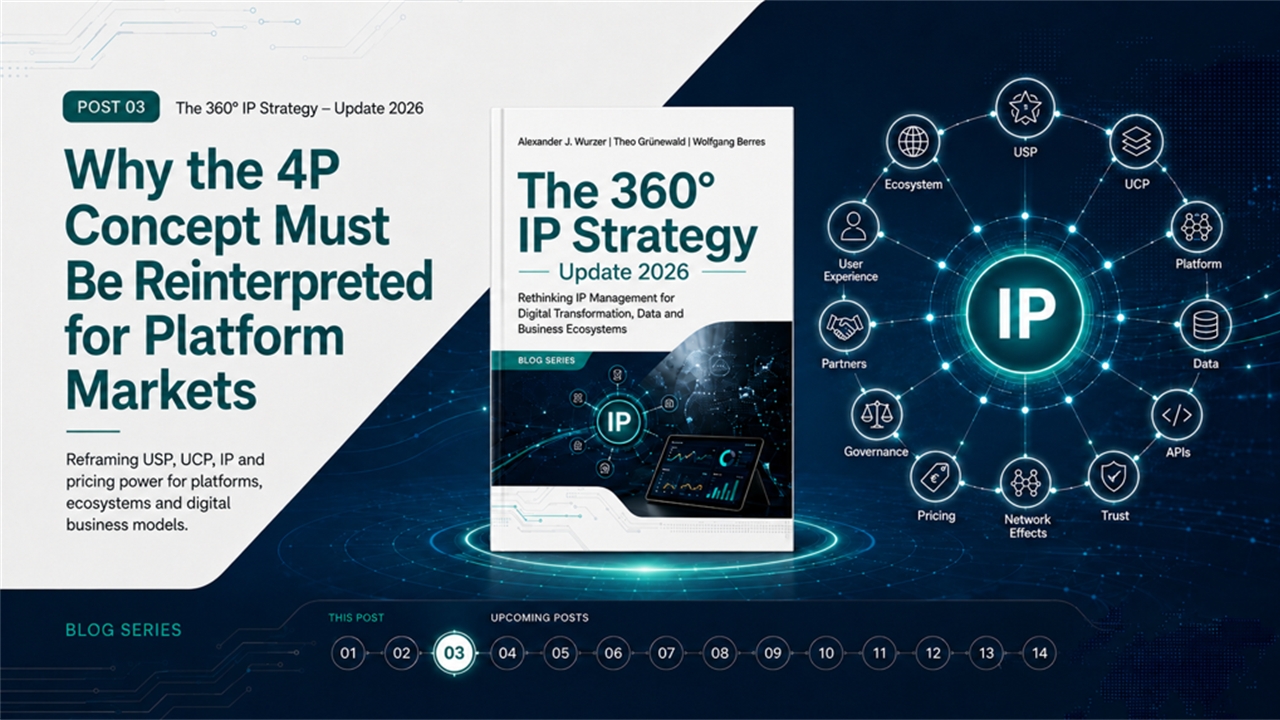
The 4P concept remains highly relevant in platform markets, but each element must be reinterpreted. The USP is no longer a single product feature; it is a system of participation that creates value for users, partners, developers and other ecosystem actors. The UCP is expressed not only through messages, but through interfaces, dashboards, certifications, rules and user experience. IP must protect more than technology: it must govern selective openness, data access, APIs, software, brands, contracts and partner rights. Pricing power also changes. It may appear as subscriptions, transaction fees, retention, licensing income or stronger bargaining positions. The modern formula is clear: a networked USP, an experiential UCP and governance-oriented IP create sustainable ecosystem value capture.
The 4P logic still works, but the strategic object has changed
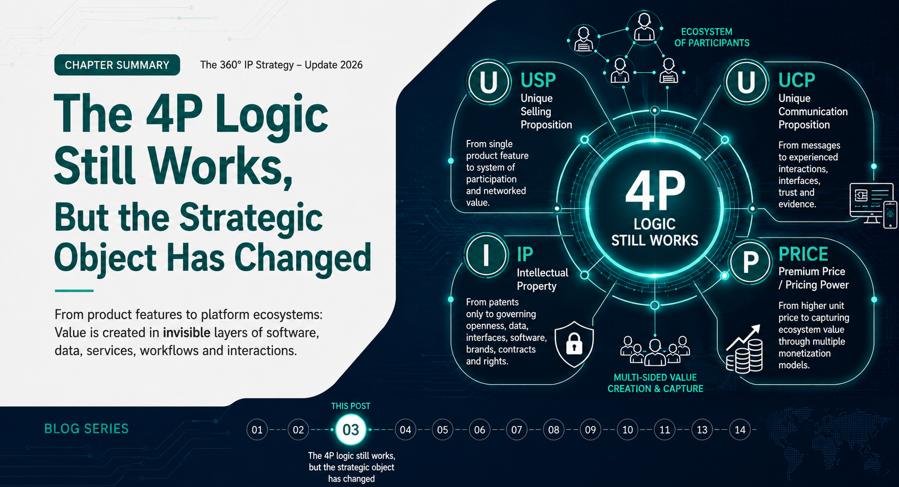
The original 4P concept connected four elements that are often managed separately: a unique selling proposition, a unique communication proposition, intellectual property, and the ability to achieve pricing power. Its strength was not the terminology, but the sequence. A company should understand which customer benefit makes its offer meaningfully different, communicate that benefit clearly, and use IP to make the relevant differentiation defensible. If this protected promise meets genuine willingness to pay, the company can defend margins instead of competing only on price. That logic remains valid. What has changed is the object to which it must be applied. In a traditional product market, the offer could often be analysed as a relatively self-contained product. In a platform market, value emerges through interactions between users, partners, developers, data providers and service companies. The customer does not simply buy a superior feature. The customer enters a system that may become more useful as more participants join, more data is generated, more services are connected and more routines are built around it.
The “customer” is therefore no longer necessarily one buyer. Developers need attractive technical conditions and credible commercial rules. End users need convenience, trust and choice. Partners need access to demand. Enterprise customers need integration, reliability and governance. A proposition that is unique for one group may be unattractive to another, so the platform must align several value propositions at once. The economic effect also becomes more complex. Pricing power may appear as a subscription premium, but also as a transaction fee, higher retention, lower acquisition costs, licensing income, better revenue sharing or the ability to subsidise one participant group to grow another. The formula should not be abandoned; it should be expanded into a system for understanding how value is created, perceived, protected and captured across a network. This also changes the management conversation: the platform must be assessed not only as a technology or channel, but as an architecture of incentives whose stability depends on several groups choosing to participate repeatedly. The enduring contribution of the 4P concept is its insistence on connecting customer value, communication, exclusivity and economic effect. In platform markets, each element must be analysed across multiple actors and interactions rather than around one product and one purchase decision.
The platform USP is a system of participation
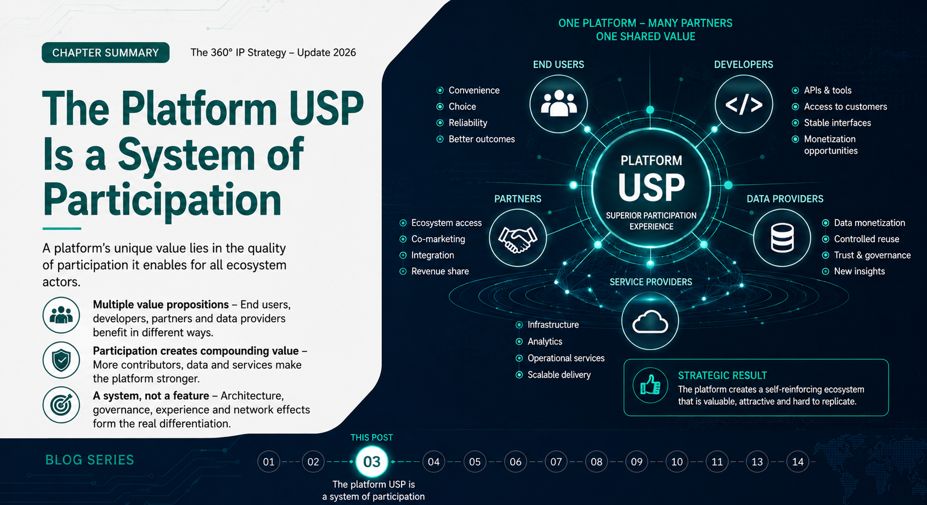
A platform USP rarely consists of one isolated feature. Its distinctive value often lies in the quality of participation it enables. A marketplace may be valuable because it offers liquidity, trusted transactions and efficient matching. An industrial platform may stand out through interoperability, reliable data flows and integration into existing operations. A software ecosystem may attract users because applications work together and third-party developers continually expand functionality. The USP is distributed across architecture, network effects, governance and experience. The platform owner must therefore identify why each participant joins, remains active and invests. End users may value convenience and breadth. Developers may value access to customers and stable interfaces. Hardware partners may value certification and compatibility. Data providers may value monetisation and controlled reuse. The overall proposition succeeds only when these benefits reinforce one another.
Network effects can strengthen the position, but they are not a substitute for strategy. More participants can also produce congestion, weak contributions, security problems or declining trust. A strong platform therefore needs mechanisms that maintain quality while the system scales: curation, authentication, standards, dispute resolution, technical documentation, performance rules and predictable commercial conditions. The USP also depends on complementary assets. A sophisticated technical core may lose against a simpler alternative that offers better onboarding, stronger support, wider distribution, recognised certification or established integrations. Platform customers compare complete participation environments, not only technologies. Differentiation may lie in the combination of assets rather than in any single component. For IP strategy, “protect the platform” is too vague. Management must identify which elements make participation superior and which competitors could replicate, bypass or neutralise. These may include matching logic, data quality, workflow integration, developer tools, certification, accumulated feedback, brand trust or the allocation of rights and responsibilities. A platform USP is a structured promise to several groups: joining this system will create more value, less friction or lower risk than joining an alternative. The strategic task is to identify the architecture that makes this promise credible and difficult to reproduce.
The UCP becomes an experienced and trusted interface
In the original 4P logic, the unique communication proposition translated customer benefit into a message that could be understood and remembered. In platform markets, communication still matters, but it no longer occurs only through advertising, sales arguments or brand claims. The platform communicates whenever a user logs in, a developer reads documentation, a partner requests access, an algorithm recommends an option, or a dashboard displays performance. The UCP therefore becomes experiential. “Seamless integration” is credible only when onboarding is fast, interfaces are stable and data moves as promised. “Trusted marketplace” must be expressed through verification, ratings, transparent rules, security measures and reliable remedies. “Open ecosystem” must be visible in accessible APIs, understandable licensing terms, developer support and genuine opportunities for complementary innovation. Participants do not merely hear the proposition; they test it through interaction.
Interfaces become strategic communication assets. Their structure determines which benefits are visible, which actions appear easy and which performance indicators customers associate with value. Dashboards can turn invisible technical capability into evidence. Certifications can make quality and compliance legible. Service-level commitments can translate reliability into a commercial promise. Trust is especially important because platform participants accept dependencies. They may invest in integrations, upload data, build extensions or move transactions into the system. Their decision depends on confidence that the platform will remain secure, predictable and fair. Communication must therefore address governance: who controls data, how rules may change, how access can be withdrawn and how conflicts are handled. The UCP also has an internal dimension. Sales, product management, legal, cybersecurity, marketing and ecosystem teams must communicate the same promise. A platform cannot claim openness while its contracts impose unexpected restrictions, or claim customer control while its architecture prevents meaningful portability. Such contradictions are experienced immediately. In platform markets, the UCP is the total evidence through which participants recognise value and trust future behaviour. It is built from messages, interfaces, metrics, documentation, rules and lived experience, all supporting the same differentiated promise.
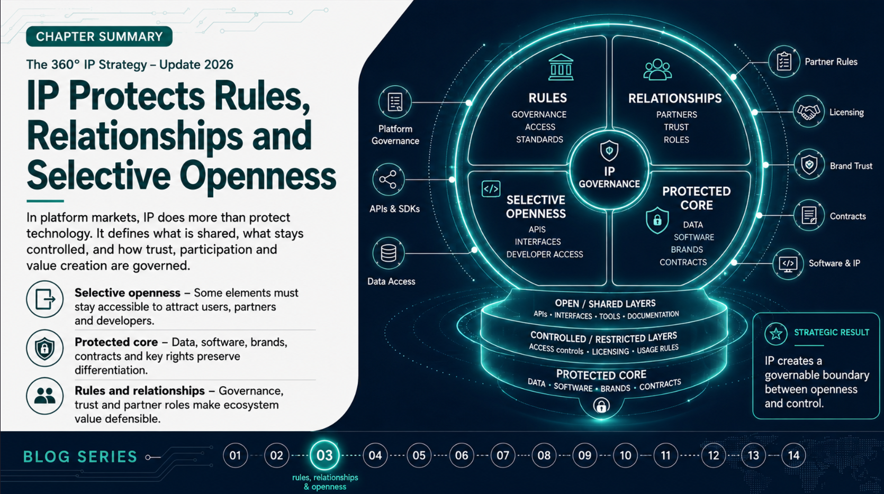
IP protects rules, relationships and selective openness
When value is distributed across a platform, IP cannot be reduced to patents protecting the technical core. Patents may remain important, but the defensible position usually depends on a layered architecture combining patents, copyright, trademarks, designs, trade secrets, database-related protection, contracts, technical controls and governance rules. The task is not to own more rights, but to shape who may use what, for which purpose and under which conditions. Platforms face a tension between control and openness. Too much control discourages developers, partners and users from investing. Too little control allows others to appropriate data, reputation, interfaces or innovations without contributing adequately. The relevant strategy therefore defines selective openness. Some elements must be accessible because they accelerate adoption; others must remain proprietary because they secure differentiation, trust, monetisation or bargaining power. APIs illustrate this balance. Documentation and standardised access expand the ecosystem, while authentication, licences, rate limits and use restrictions preserve control. Software development kits can encourage complementary innovation while copyright and contracts define permitted reuse. Data may be shared for specific services while cybersecurity, confidentiality measures and contractual governance protect the processes that generate and interpret it. Trademarks may be licensed to certified partners, turning brand trust into both an incentive and a control mechanism.
The allocation of rights between platform and participants is equally strategic. Who owns an extension created by a developer? Who may reuse customer-generated data? What happens to models trained on shared information? Can a partner continue using an interface after termination? These questions determine investment incentives, switching costs, innovation speed and value distribution. IP also protects the UCP. A distinctive interface, certification mark, visual language, reputation system or branded service promise may be central to how the platform communicates quality. If competitors can imitate those signals without reproducing the capability behind them, the connection between performance and market perception weakens. The platform role of IP is to create a governable boundary between what is shared and what remains controlled. A strong strategy protects the core, enables complementary innovation, clarifies rights and preserves the platform’s promise without suffocating the participation on which its value depends.
Price becomes value capture across the ecosystem
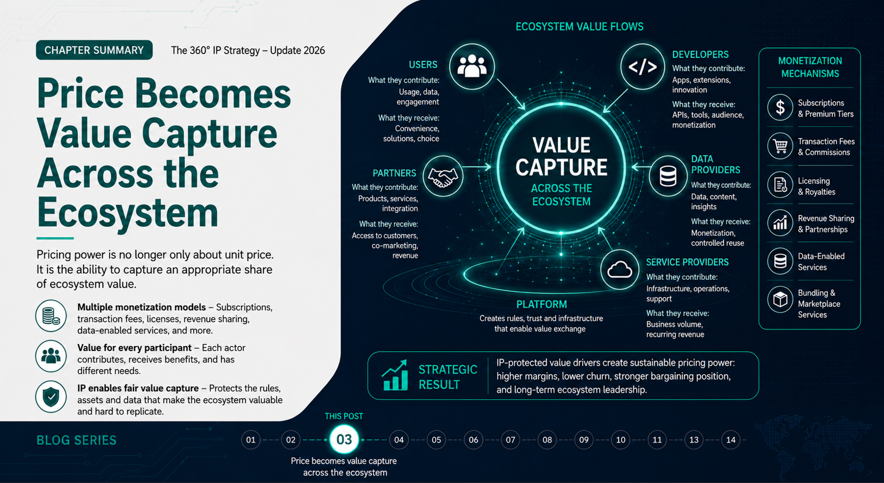
The final P is often described as premium price, but platform markets require a broader concept: pricing power as the ability to capture an appropriate share of ecosystem value. A platform may charge users, partners, advertisers, developers or transaction participants through subscriptions, usage fees, commissions, licences, premium tiers, revenue sharing, data-enabled services or bundles. Sometimes one side pays nothing because its participation increases the value available to another. This does not weaken the economic discipline of the 4P model. Management must still show how the USP, UCP and IP architecture support measurable effects. The difference is that the effect may not appear as a higher unit price. It may appear as lower churn, more transactions, deeper integration, higher lifetime value, better partner terms, less commoditisation or the ability to introduce adjacent services. Pricing power results from becoming relevant at a point participants do not want to lose.
Switching costs are one source of power, but they should not be confused with customer captivity. Sustainable platforms create positive dependence: users remain because integrated workflows, accumulated data, trusted relationships and complementary services make the system more valuable over time. IP can protect the mechanisms that generate this value, but pricing remains defensible only while participants perceive a fair exchange. Excessive extraction can trigger multi-homing, partner resistance, regulatory intervention or open alternatives. The updated 4P analysis should therefore trace value flows. Which participant contributes what? Who receives which benefit? Which assets enable the interaction? Where does the platform create exclusivity or reduce substitutability? Which monetisation mechanism reflects that contribution without undermining growth? These questions connect IP strategy directly to platform design and business model governance.
A useful modern translation of the formula is: networked USP plus experiential UCP plus governance-oriented IP creates ecosystem pricing power. This may produce a premium, but also retention, access, influence, licensing leverage or a privileged role in value distribution. The decisive point is that IP must support the chosen mechanism of value capture. The 4P concept remains relevant because it refuses to treat IP as an isolated legal inventory. In platform markets, it becomes a framework for designing a valuable participation system, making that value visible and trustworthy, protecting the rules and assets that sustain it, and converting ecosystem relevance into durable economic returns.
Supplementary content on the IPBA® platform:
Platform Business IP Management
Explains how platform openness, licensing, ecosystem roles, revenue sharing and control over interfaces must be coordinated through a dedicated IP strategy.
👉 Read more
Digital Business Ecosystem
Provides the conceptual framework for combining software, data, licensing, collaboration and portfolio management within multi-actor digital environments.
👉 Read more
Intellectual Property as a Strategic Lever in Ecosystem Business Models
Shows how IP defines ecosystem boundaries, protects core value drivers, attracts partners and supports network-based value propositions and dynamic revenue models.
👉 Read more
What Are Typical IP Strategies?
Deepens the relationship between distinctive positioning, customer perception, unique selling propositions, communication and the coordinated use of different IP instruments.
👉 Read more
The Power of a Clever IP Strategy – IP Management Pulse #28
Introduces customer journeys and touchpoints as strategic objects, helping translate an abstract platform proposition into observable and protectable user experiences.
👉 Read more
How Apple’s IP Strategy Creates Powerful Lock-In Effects in a Digital Ecosystem
Illustrates how integration, proprietary technologies, design, branding and seamless interaction create positive switching costs and ecosystem-level customer loyalty.
👉 Read more
Premium Personal Care: How IP and Design Drive Pricing
Demonstrates how technical performance becomes visible through design and customer experience, producing perceived differentiation and defensible pricing power.
👉 Read more
Protecting Digital Customer Journeys in the Medical Industry with IP Design: Case Study Ping An
Offers a practical example of treating a digital customer journey as a strategic product and protecting selected platform touchpoints through IP design.
👉 Read more
Complementary Assets
Explains why distribution, integration, brands, customer relationships and other complementary capabilities frequently determine whether protected innovation creates differentiation and premium returns.
👉 Read more
What Do Siemens, Novartis, Nestlé and Aesculap Think About the 360° IP Strategy and IP Design?
Connects the original 4P concept directly with customer benefit, enforceable exclusivity, price realisation and the practical transformation of corporate IP management.
👉 Read more