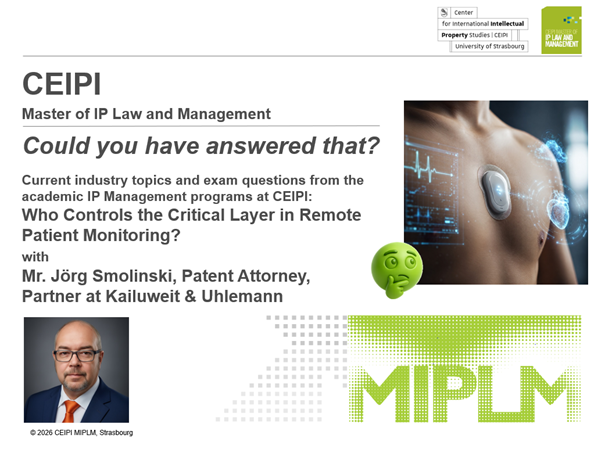
Who Controls the Critical Layer in Remote Patient Monitoring? Industry Case Study with Jörg Smolinski

The demand for IP services, IP competence, and strategic support in the field of MedTech and digital health systems is steadily increasing. Connected healthcare companies are no longer developing isolated medical devices. They are building integrated systems in which sensors, software, health data, cloud infrastructure, clinical workflows, AI-based signal interpretation, regulatory requirements and reimbursement models interact.
To better understand this development, the CEIPI IP Business Academy recently analyzed the structural mismatch between what connected healthcare companies increasingly need and what IP advice still often fails to integrate. The findings are summarized in the article “The MedTech Strategy Gap”. The central observation is that IP in MedTech is moving from a narrow protection function into a decision system for control, collaboration, market access, risk management and competitive positioning.
Here you find the findings of this study: “The MedTech Strategy Gap: What Connected Healthcare Companies Need, and What IP Advice Still Often Fails to Integrate – IP Business Academy”
Against this background, the CEIPI IP Business Academy continuously adapts its teaching content in close exchange with practitioners from industry and advisory services. The aim is to ensure that concrete practice-relevant questions and real industrial needs are systematically integrated into the training programs.
MedTech and digital health are dynamically evolving technological and economic fields of action. We are therefore particularly pleased to collaborate with experts from private practice. Jörg Smolinski is a patent attorney at Kailuweit & Uhlemann and works at the interface of medical technology, digital health systems and IP strategy.
The following industry case study addresses a question that is becoming increasingly relevant for connected healthcare companies: Where is the real IP control point in a remote patient monitoring system when value is not created by the visible wearable device alone, but by the way physiological data is transformed into clinically meaningful action?
Mini Case Study
A European MedTech company is preparing to launch a wearable sensor system for remote cardiac monitoring. The product combines a small skin-worn sensor, an app for patient interaction, cloud-based signal processing and a dashboard for clinicians. The business case is built around continuous monitoring, earlier intervention and recurring service revenues from hospitals and care networks.
Shortly before the next financing round, the management team realizes that the most valuable part of the system may not be the wearable sensor itself. The sensor can be sourced from specialist suppliers, the app can be redesigned, and cloud infrastructure is provided by external partners. The real differentiation appears to lie in how noisy physiological data is transformed into clinically meaningful alerts that fit into hospital workflows.
At the same time, competitors are filing patents around wearable sensor placement, signal processing, remote monitoring workflows and user feedback loops. The company must decide whether to invest in patent filings around the device architecture, the data processing method, the clinical workflow integration, or the service model that connects patients, clinicians and payers.
Practical Question
How should a MedTech company decide which layer of a remote patient monitoring system must be protected as the primary IP control point before scaling the product commercially?
Why This Question Matters in Practice
This question becomes relevant when a wearable or smart sensor product moves from technical prototype to clinical validation, fundraising, reimbursement discussions, strategic partnering or European market entry. At this stage, IP decisions are no longer just filing decisions. They determine whether the company can protect the layer that creates commercial leverage.
The question matters for MedTech start-ups, digital health companies, corporate innovation teams, strategic IP managers, product leaders and investors. These actors need to understand whether competitive advantage sits in the device, the sensor configuration, the signal processing logic, the clinical workflow, the patient interface, the data architecture or the service model.
The issue becomes especially critical when the company depends on third-party sensors, cloud infrastructure, external data environments, hospital IT systems or platform partners. Under these conditions, a patent portfolio focused only on the visible product may leave the company exposed at the level where value is actually created.
The economic implication is direct. If the wrong layer is protected, competitors may design around the hardware, imitate the service logic, capture the clinical relationship or control the data pathway. If the right layer is protected, IP can support investment, licensing, partner negotiations, freedom to act and long-term positioning in connected healthcare markets.
Jörg Smolinski
 Jörg Smolinski is a Partner at Kailuweit & Uhlemann Patentanwälte mbB in Dresden, where he advises international companies, start-ups and research organizations on the protection and commercialization of innovation in Germany and across Europe. His work focuses on patent prosecution, IP strategy and portfolio management, particularly in biotechnology, chemistry, medical technology and life sciences. He also supports foreign clients in navigating the European patent system, coordinating global IP strategies and aligning IP with commercial, investment and market-entry objectives.
He combines legal IP expertise with a strong scientific background in biochemistry, pharmacology, polymer chemistry and biocompatible materials research. Before becoming a partner at Kailuweit & Uhlemann, he gained experience as an in-house patent attorney at Heliatek, as a patent trainee at the German Federal Patent Court and the German Patent and Trademark Office, and as a research scientist at the Institute of Polymer Research in Dresden. In addition to his patent attorney practice, he has served as a lecturer for intellectual property and contributes to international discussions on patents, innovation and technology transfer as a speaker, lecturer and LinkedIn author.