
The New Target Matrix: Products, Services, Data Flows and Ecosystem Roles

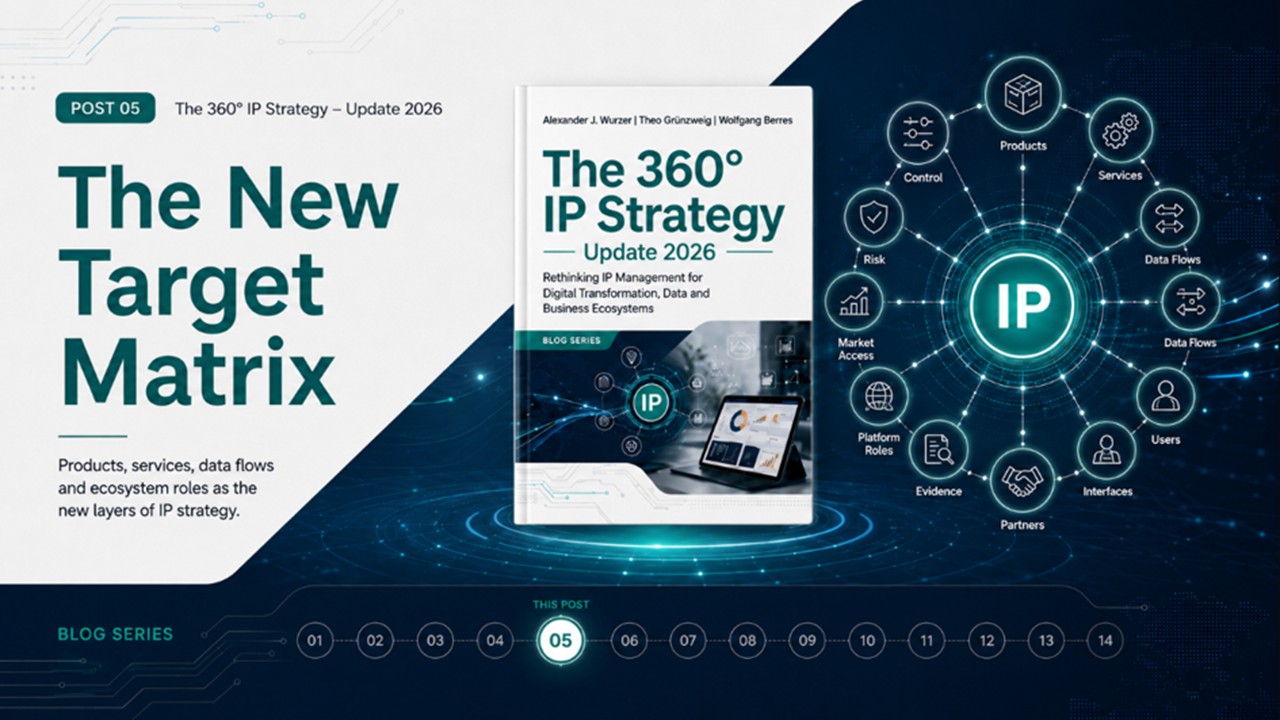
The original 360° IP Strategy introduced the target matrix as the bridge between strategic IP thinking and the concrete logic of the business model. The 360° perspective structured what IP should achieve: control risks, suppress imitation, shape the market position and communicate differentiation. The target matrix then asked what these effects meant for value creation, positioning, costs and revenues. It translated IP into business objectives that could be implemented, funded and monitored.
That translation task has become more demanding. A modern offering may combine a product, software, usage data, analytics, service workflows, regulatory evidence, interfaces and external partners. Value may depend on access rather than ownership, on availability rather than a one-time sale, or on an ecosystem role rather than a standalone product advantage. The target matrix therefore needs an extended field of vision. It must show not only what the company sells, but also which flows, relationships and control positions allow the business model to work.
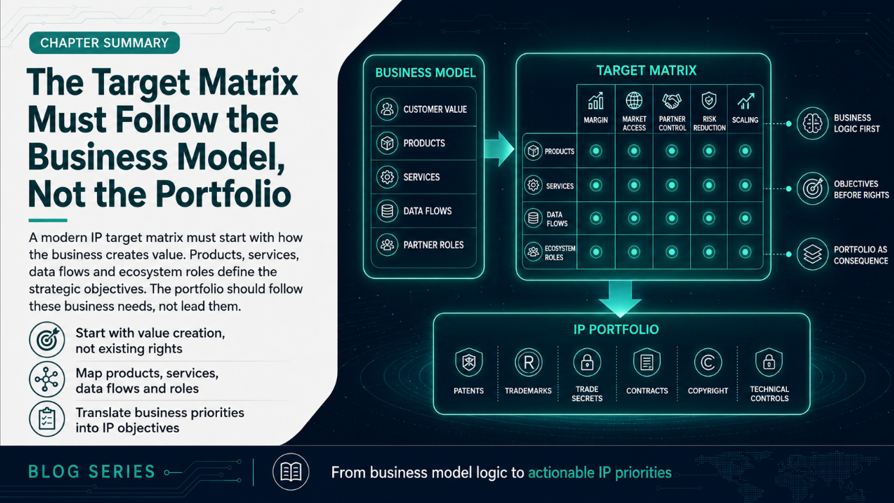
The target matrix must follow the business model, not the portfolio
A conventional portfolio review begins with existing rights: patents, trademarks, designs, copyright positions, trade secrets and licences. It asks where they are registered, what they cost and whether they should be maintained. Those are necessary questions, but they do not reveal whether the company controls the elements that determine commercial success. A valid portfolio can remain strategically weak when it protects yesterday’s architecture while value has moved into software, data or services.
The target matrix reverses the direction of analysis. It begins with the business model and projects the intended effects of IP into it. On the resource side, management asks which value-creation processes must remain operable and which resources must remain exclusive, secure or difficult to substitute. On the market side, it asks how IP should shape access, influence competition, support differentiation and help capture willingness to pay. This preserves the link between business-model realization, competitive positioning, costs and revenues.
The four classic IP tasks remain useful. Risk control protects freedom of action. Suppression of imitation preserves distinctive resources and capabilities. Market shaping creates barriers, options and bargaining positions. Communication of differentiation makes the protected advantage visible and credible to customers. The update expands the objects to which these tasks are applied.
A modern matrix should not contain goals such as “file more software patents” or “protect the platform.” It should contain business-specific effects: preserve access to the operational data required for the service; prevent competitors from reproducing a decisive workflow; retain the ability to set interface conditions; secure the right to use partner-developed code; or make validated performance evidence uniquely attributable to the company’s offer. The target matrix remains valuable because it forces IP activity to justify itself through the business model. Rights, contracts and technical measures become investments only when their intended economic effect is explicit.
Products are now only one layer of the value architecture
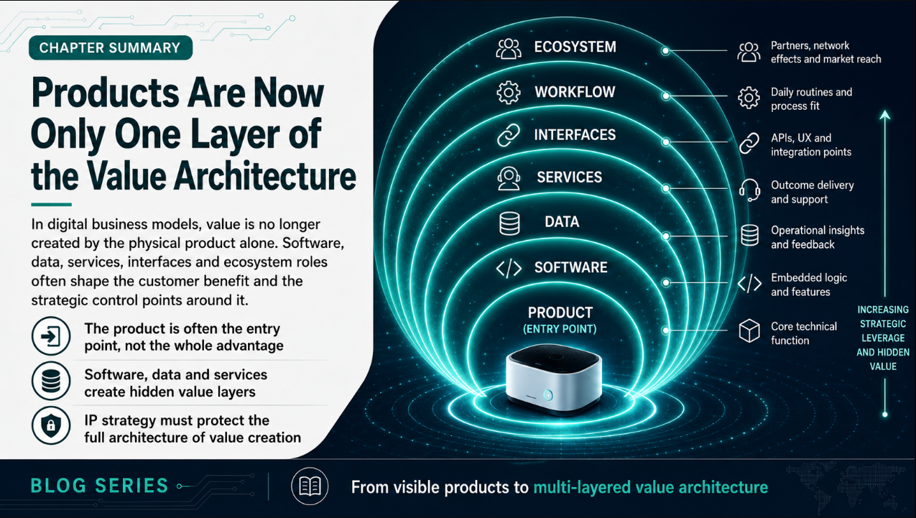
The physical product is increasingly the entry point into a larger value architecture. An industrial machine may create revenue through the initial sale, yet customer loyalty and margin may depend on predictive maintenance, remote optimization, spare-parts coordination, software updates and guaranteed uptime. A medical device may be differentiated by its sensor, but the more durable advantage may lie in the validated data flow, clinical workflow integration, cybersecurity documentation and regulatory evidence surrounding it.
The matrix must map several value layers at once. It should include product functions and technical components, but also services, software modules, data sources, data transformations, interfaces, user interactions, operational routines, compliance evidence and partner contributions. Each layer should be linked to the customer outcome it supports. This keeps the focus on economically relevant functions rather than everything digital.
Data flows require particular precision. “Customer data” is too broad to become a meaningful target. Management needs to know which data is generated, who may access and reuse it, which service depends on it, and whether use can continue when a relationship ends. The same discipline applies to services. The strategic object may not be the service label, but the diagnostic logic, response time, integration routine, evidence trail or accumulated operating knowledge that makes the service superior.
User interaction is another value layer. A dashboard may communicate performance, create trust and shape daily decisions. An API may determine who can participate in the system and under which conditions. A certification process may turn technical compatibility into a market-access mechanism. These elements influence customer perception and competitive behaviour without being conventional product features.
The modern unit of analysis is the value-creating function and the architecture that enables it. Products, services, data and interfaces belong in the same matrix because customers experience their combined effect, while competitors can attack each layer differently.
IP objectives must be written as business effects
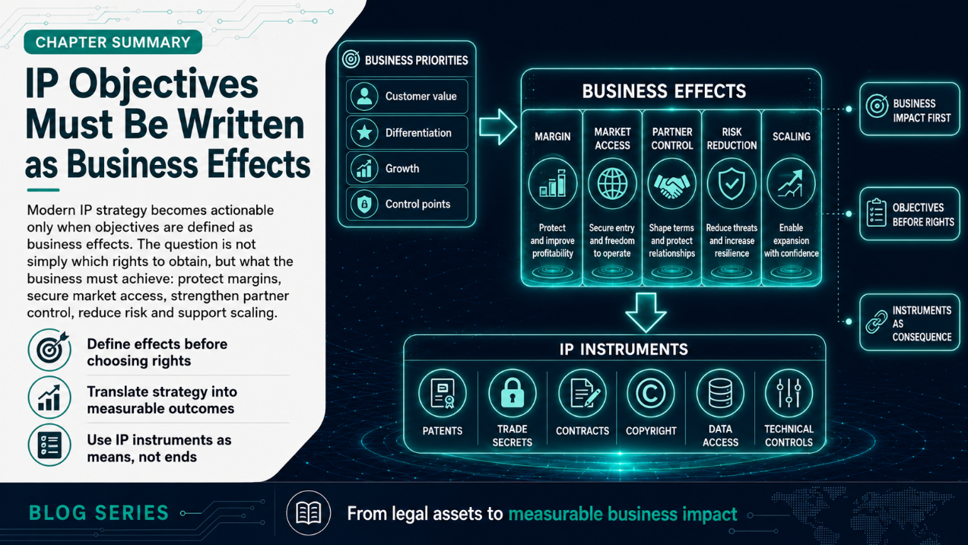
The matrix becomes operational when goals are formulated as business effects. “Protect the algorithm” does not explain why investment is justified. A stronger objective would be to prevent competitors from offering equivalent failure prediction without building a comparable data and validation position. “Secure the API” is equally vague. The relevant objective may be to preserve control over partner admission, maintain service quality and avoid dependence on a third-party integration layer.
Six effects are especially useful in digital and ecosystem-based models. Margin objectives protect differentiated customer value and reduce direct price comparability. Market-access objectives secure the rights, licences, standards positions or regulatory evidence needed to enter and remain in a market. Bargaining objectives strengthen the company’s position in negotiations with customers, suppliers, investors, platforms or licensees. Partner-control objectives define who may access assets, create complements, reuse data or commercialize improvements. Risk-reduction objectives preserve freedom of action and reduce exposure to infringement, leakage, ownership disputes or regulatory failure. Scaling objectives ensure that rights, permissions, architectures and contractual models continue to work across customers, releases, jurisdictions and partner networks.
Each effect should be connected to a threat scenario. What happens if a cloud provider changes its terms? Can a customer take the data and move the workflow to a competitor? Could a development partner claim ownership of an essential module? Can a rival reach the same customer outcome through a different technical route? Does the company possess the evidence needed to enforce confidentiality or prove the origin of software and data? Without a corresponding threat, a target remains too abstract for prioritization.
Each objective also needs an indicator. Margin protection may be reflected in reduced discount pressure or stronger retention. Market access may depend on secured licences or completed evidence packages. Partner control may be measured through documented rights, access rules and exit provisions. Scaling readiness may be tested by whether the model can be deployed for another customer or country without renegotiating its legal foundation.
The target matrix translates IP from legal categories into management outcomes. It shows what must change in the competitive position and how management can recognize whether the intended effect has actually been achieved.
Ecosystem roles make control relational, not merely proprietary
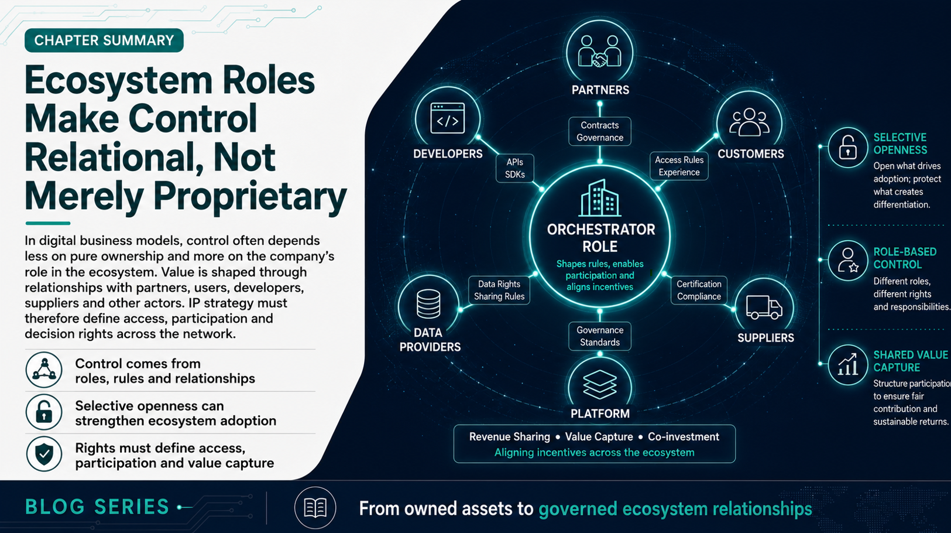
Digital value creation often crosses organizational boundaries. The company may act as product manufacturer, service provider, platform operator, data recipient, technology licensor or ecosystem orchestrator at the same time. Other actors may supply components, host infrastructure, develop applications, contribute data, certify compatibility, distribute the offering or provide access to customers. The matrix must therefore show roles and relationships, not only owned assets.
This changes the meaning of control. Strategic control does not always require complete ownership or closure. A platform may need open interfaces to attract complementors, but retain authority over certification, security requirements and commercial access. A manufacturer may share operational data with customers while keeping diagnostic models and fleet-wide benchmarks confidential. A technology provider may license a core component broadly but reserve specific fields of use, improvement rights or branding conditions. Selective openness becomes a design decision inside the matrix.
For each ecosystem role, management should clarify contribution, access, dependency and value capture. Who contributes technology, data, reputation, market access or regulatory capability? Who can replace whom? Which actor can bypass the company and reach the customer directly? Who owns improvements and derived data? Which rights survive termination? Which standards, interfaces or contractual conditions determine participation? These questions expose control gaps that a conventional IP list will not reveal.
Regulatory evidence should also appear as an ecosystem asset. In regulated markets, validated datasets, audit trails, quality systems, cybersecurity documentation and approval pathways can determine whether a product or service reaches the customer. They may be created jointly with laboratories, customers, suppliers or software providers. The company must understand not only who owns the underlying information, but also who may rely on it, reproduce it or use it to support another market position.
An ecosystem-oriented target matrix allocates control without destroying collaboration. It makes visible where openness creates adoption and where retained rights, evidence or decision authority are necessary to protect the company’s role in value creation.
The new target matrix becomes a living management instrument
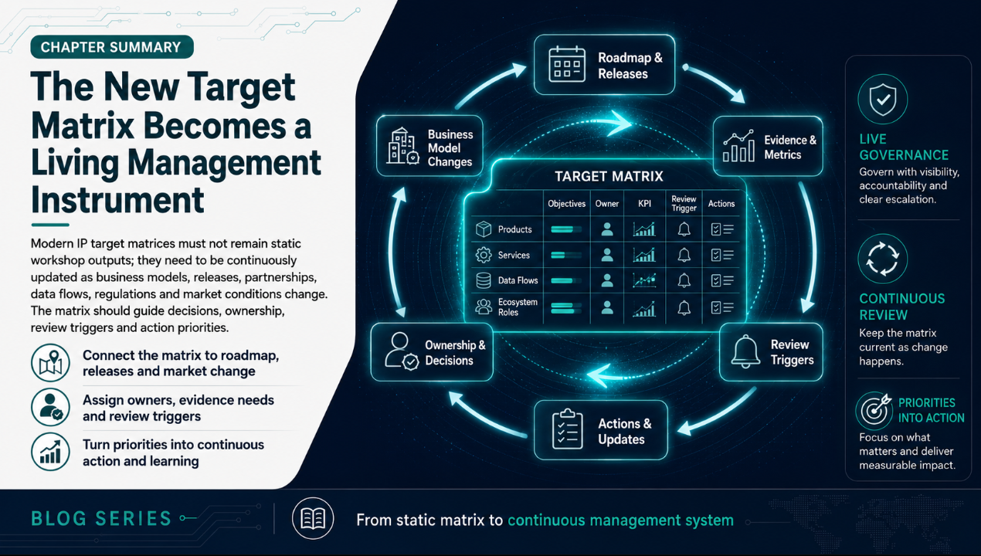
A target matrix should not remain a one-off workshop document. Digital business models change through releases, new data sources, software suppliers, customer integrations, regulatory requirements and partner relationships. Each change can alter value, threats and required control. The matrix must therefore be connected to the roadmap and reviewed when the architecture or commercial model changes.
Each priority objective should become a decision record. It needs an accountable owner, a defined business effect, the relevant value layer and ecosystem actors, the selected combination of rights and control mechanisms, an evidence requirement, a timing decision and a review trigger. The solution may combine patents, copyright, trademarks, designs, trade secrets, contracts, licences, technical access controls, cybersecurity measures, governance rules and documentation. The matrix should preserve why that combination was chosen.
Review triggers can be built into normal management processes. A new API, model provider, product release, data partnership, outsourcing decision, market entry or regulatory change should reopen the relevant matrix entries. Product management can confirm whether customer value has shifted. Engineering and data teams can identify architectural dependencies. Legal and IP teams can assess rights and contracts. Cybersecurity can test technical control. Business development can evaluate partner incentives and bargaining positions. Finance can compare the expected effect with the required investment.
The matrix also supports prioritization. Not every valuable element needs maximum protection, and not every protectable result deserves investment. Management can compare objectives according to business relevance, vulnerability, substitutability, timing, evidence readiness and expected economic effect. This directs scarce expertise and budgets where loss of control would have the greatest impact.
The new target matrix is the translation layer between business-model strategy, IP architecture and operational action. By keeping products, services, data flows, ecosystem roles and measurable business effects in one living system, it turns IP from a collection of rights into a disciplined method for controlling how value is created, defended and captured.
Supplementary content on the IPBA® platform:
IP Strategy Is a Functional Strategy
Explains why IP objectives must follow corporate and competitive strategy rather than develop independently inside the legal function. This provides the organizational foundation for using the target matrix across business units.
👉 Read more
Integration of IP into Common Management Concepts
Shows how IP can be incorporated into strategic planning, innovation management and resource allocation, supporting the matrix’s role as a bridge between IP expertise and established management processes.
👉 Read more
The Pillars of Operational IP Strategy
Connects strategic alignment, competitive intelligence, revenue relevance and financial impact. These pillars help convert entries in the target matrix into clear operational priorities.
👉 Read more
Operational IP Portfolio Management
Explains how IP assets can be mapped to products, services, business units and strategic functions and then reviewed as priorities evolve rather than maintained as an undifferentiated inventory.
👉 Read more
IP Business Intelligence
Demonstrates how IP information and broader business data can be connected to support investment decisions, portfolio alignment and the continuous monitoring of competitive and market developments.
👉 Read more
IP Awareness in Top Management
Addresses the leadership routines, reporting structures and decision processes required to make IP visible in budgeting, innovation governance, cooperation, market entry and strategic planning.
👉 Read more
Why Business Models and IP Strategy Must Be Designed Together
Clarifies why protection decisions should follow the economic logic through which an organization creates, delivers and captures value, making it particularly relevant to target-matrix design.
👉 Read more
Data Protection and Privacy: Why Companies Need to Understand Their Data Position
Shows how products, services and AI applications depend on identifiable data flows, permissions, contracts and technical architectures, making data control a central dimension of the updated matrix.
👉 Read more
Leveraging Intellectual Property as a Strategic Tool: The Laerdal Medical Case
Provides a practical example of controlling IP across the value chain and concentrating protection close to customer use cases, digital solutions and commercially decisive points of interaction.
👉 Read more
The Role of IP in Global Value Chains
Extends the analysis beyond company-owned resources and shows how intangible assets, suppliers, partners and external capabilities jointly shape value creation and competitive advantage.
👉 Read more