
Turning UPC Uncertainty into Client Intelligence: How Simmons & Simmons and CMS Frame the Unified Patent Court

The Unified Patent Court has quickly become more than a new venue for European patent litigation. It has become a communication test for IP practice groups. The legal substance matters, of course: jurisdiction, remedies, provisional measures, bifurcation, validity, infringement, opt-outs, damages, and the interaction with national courts all require careful legal analysis. Yet from a business-development perspective, the more interesting question is how law firms translate this legal uncertainty into a client-facing value proposition.
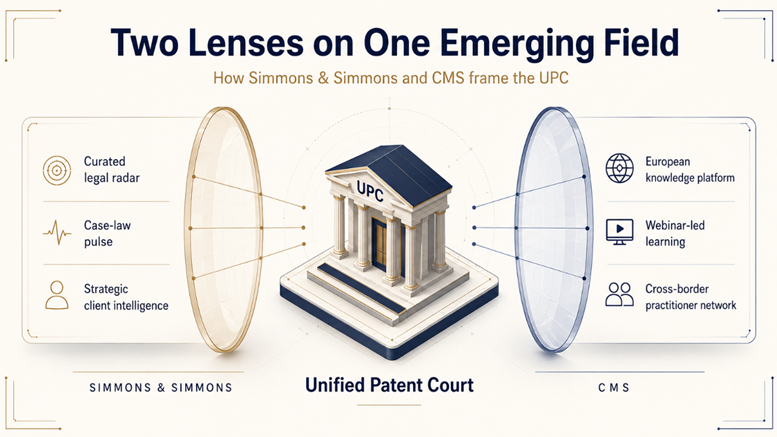
This is where Simmons & Simmons and CMS form a particularly useful pairing. Both firms have built visible public content around the UPC. Both treat the UPC as a continuing development rather than as a one-off launch topic. Both offer clients structured ways to follow case law, emerging litigation trends, and the practical implications of a court that is still building its procedural and substantive identity. Simmons & Simmons presents the UPC through a dedicated feature page centred on “UPC Pulse”, described as an in-house content series with case analysis, legal updates, and expert insights. CMS, by contrast, presents the UPC through a broader international knowledge infrastructure, including a UPC insight hub, webinar formats, and a 2026 UPC Case Law webinar series focused on key recent decisions and emerging litigation trends across Europe.
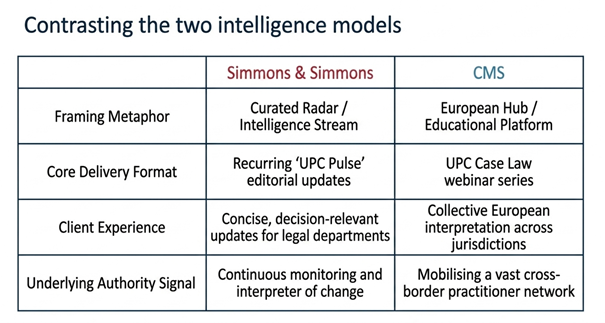
This comparison is not a ranking. It is not about which firm is “better” at the UPC. The more useful question is how two sophisticated IP practice groups communicate the same emerging court system differently. Simmons & Simmons appears to frame the UPC as curated strategic intelligence for clients who need to stay close to decisions as they happen. CMS appears to frame the UPC as a European knowledge platform, using its geographic reach and practitioner network to turn case law into a shared learning format. The distinction is subtle, but for IP business development it is highly instructive.
Simmons & Simmons: Positioning analysis
Simmons & Simmons’ UPC communication has a strongly editorial character. The firm’s dedicated UPC page is built around the idea of staying informed through “UPC Pulse”, which is described as an exclusive in-house content series providing case analysis, legal updates, and expert insights. The language suggests more than passive reporting. It positions the firm as a curator of litigation intelligence, someone who continuously monitors UPC developments and translates them into strategic guidance for business needs.
That framing is important. Many clients do not need every UPC decision in full doctrinal detail. They need to understand what a decision changes, whether it affects their portfolio, whether it alters litigation risk, and whether it should influence filing, opt-out, enforcement, settlement, or licensing strategy. Simmons & Simmons seems to address precisely that need by creating a recurring information format rather than relying only on individual alerts. The firm’s public wording around “recent and landmark UPC decisions” and continuous case-law monitoring creates the impression of a living legal radar.
The firm reinforces this positioning through its monthly “European patent disputes from the EPO and UPC” publication series. That series covers recent key decisions from the UPC, EPO, and other European courts, and explicitly links the UPC and Unitary Patent system to new opportunities and challenges for patent litigation and patent filing strategies in Europe. This is a useful framing choice because it avoids isolating the UPC as a procedural novelty. Instead, it places the UPC within the broader European patent-disputes landscape.

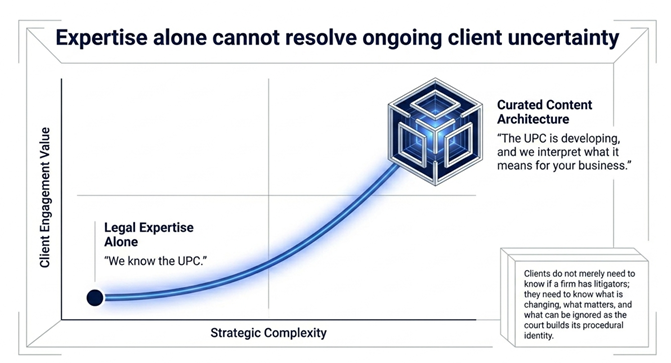
From a marketing perspective, this makes Simmons & Simmons’ UPC communication feel like an intelligence service for clients who are already operating in complex patent environments. The positioning does not merely say: “We know the UPC.” It says, more carefully: “The UPC is still developing, and we can help you interpret what those developments mean for your business.” That is a stronger business-development message because it addresses the client’s uncertainty rather than the firm’s expertise alone.
There is also a notable client-enablement logic. The firm’s “Key developments” page states that many important details of the UPC are only now being decided and that Simmons & Simmons is monitoring and analysing the impact of decisions as they are made. This is a careful but powerful claim. It acknowledges the unfinished nature of the court’s legal architecture and places the firm in the role of interpreter.
The result is a positioning that feels close to the in-house counsel’s daily problem. The in-house team does not merely ask whether the UPC exists or whether the firm has litigators. It asks what is changing, what matters, what can be ignored, and where a decision could alter internal risk assumptions. Simmons & Simmons’ communication appears designed for this ongoing decision environment.
CMS: Positioning analysis
CMS also treats the UPC as an evolving system, but the communication logic is different. The CMS approach appears broader, more networked, and more platform-like. Its UPC Case Law webinar series 2026 is described as marking the third anniversary of the UPC and bringing together CMS practitioners from across Europe to discuss key recent UPC decisions and emerging litigation trends. The series structure includes sessions such as “Jurisdiction & Validity”, which indicates an attempt to organise UPC learning around doctrinal and procedural pillars rather than around isolated updates.
That is a different form of authority-building. CMS does not only signal that it follows the court. It signals that it can mobilise a European practitioner network to explain the court’s development across jurisdictions. This is especially relevant for the UPC, because the court itself is transnational in ambition but still rooted in divisions, local practices, languages, and procedural learning. A firm with a broad European footprint can communicate UPC knowledge as a collective European capability rather than as the output of a single national litigation team.
CMS also uses webinar formats such as “Unified Patent Court, Two Years In”, which frames the UPC through milestones and insights from the first two years of operation. The event description notes that the UPC had nearly 900 cases filed by May 2025 and had established itself as a central player in patent litigation globally. That framing moves the UPC from novelty to institutional reality.
This is significant because clients are no longer only deciding whether the UPC will matter. They are increasingly deciding how much it already matters. CMS seems to speak to that transition. The question is not “What is this new court?” but “How do we understand the court’s first years, and how should that influence our litigation and portfolio choices now?”
The CMS positioning also carries a strong educational quality. The firm’s webinar-based approach turns the UPC into a repeated learning environment. This is not just content marketing in the narrow sense. It is a client-relationship format. Webinars allow clients to return, compare developments, hear different practitioners, and experience the firm as a guide through a developing legal system. That is especially valuable where the law is not yet settled and where the value of advice lies partly in pattern recognition.
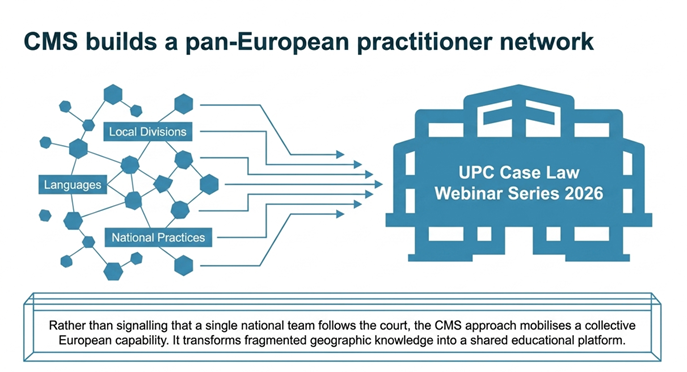
Compared with a single alert, a webinar series creates continuity. Compared with a static practice page, a recurring case-law format creates momentum. Compared with individual lawyer commentary, a cross-European practitioner format creates institutional scale. For a firm like CMS, this is a natural communication asset: the UPC can be framed as a legal system that requires a networked European view.
The connecting element
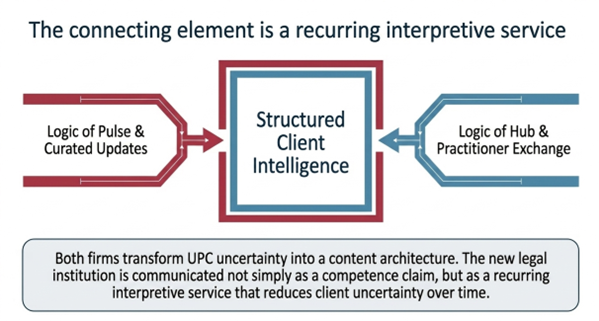
The connecting element between Simmons & Simmons and CMS is that both firms transform UPC uncertainty into structured client intelligence. They do not merely state that they advise on UPC litigation. They organise knowledge around the court’s ongoing development. This is why the pairing is interesting.
The UPC is still an evolving forum. Its decisions are shaping procedural behaviour, litigation strategy, jurisdictional reach, validity analysis, remedies, and the relationship between national and centralised European patent enforcement. In such a setting, clients need more than legal credentials. They need a way to keep pace with change. Both Simmons & Simmons and CMS respond to that need through formats that make change observable.
Simmons & Simmons does this through the logic of pulse, monitoring, analysis, and curated updates. CMS does this through the logic of hub, series, webinar, and European practitioner exchange. In both cases, the UPC becomes more than a legal practice area. It becomes a content architecture.
That is the shared lesson. A new legal institution can be communicated not simply as a competence claim, but as a recurring interpretive service. The firm becomes valuable because it reduces uncertainty over time.
The difference
The main difference lies in the client experience each communication model implies.
Simmons & Simmons appears to offer a more editorial and intelligence-led model. The phrase “UPC Pulse” is especially telling. A pulse is something regular, close to the body, and sensitive to change. The communication suggests that clients can stay close to developments without having to process every decision themselves. The firm’s monthly European patent disputes series adds to this by placing UPC developments alongside EPO and other European court decisions, giving clients a broader patent-disputes context.)
CMS, by contrast, appears to offer a more networked and educational model. Its UPC Case Law webinar series highlights practitioners from across Europe and organises the discussion around key decisions and emerging trends. This creates a sense of collective European interpretation. The firm’s “Two Years In” webinar framing also suggests a reflective milestone approach: where does the court stand now, and what has changed since launch?
Put simply, Simmons & Simmons seems to frame UPC as a stream of client-relevant intelligence. CMS seems to frame UPC as a European learning and interpretation system. Both are strong approaches, but they speak to slightly different client needs.
The Simmons & Simmons model may resonate especially with legal departments that want concise, recurring, decision-relevant updates. The CMS model may resonate especially with clients who want to understand the UPC as a broader European institutional development, with multiple jurisdictions, litigation cultures, and practitioner perspectives involved.
What IP practice groups can learn from this
The first lesson is that a new legal system should not be treated as a one-time launch campaign. The UPC did not stop being interesting once it opened. In many ways, it became more interesting once real cases started shaping the law. IP practice groups can learn from both firms that the most effective communication around an emerging court is cumulative. It needs rhythm, structure, and continuity.
The second lesson is that uncertainty can be a legitimate communication asset if handled carefully. Neither firm needs to overclaim certainty. In fact, the strongest positioning comes from acknowledging that many issues are still being decided. Simmons & Simmons does this explicitly by noting that important details of the UPC are only now being decided, while CMS addresses the same reality through case-law webinars and emerging-trends discussions.
The third lesson is that format matters. A practice page says, “We do this.” A tracker says, “We monitor this.” A recurring update says, “We interpret this regularly.” A webinar series says, “We help you learn this with us.” These are different business-development signals. They create different levels of trust.
The fourth lesson is that UPC communication should connect legal developments with client decisions. Patent owners are not interested in case law as abstract knowledge only. They want to know whether they should enforce, defend, opt out, seek unitary protection, prepare for revocation risk, coordinate national and UPC strategies, or rethink settlement leverage. The more clearly a firm connects UPC developments to those decisions, the more useful its communication becomes.
The fifth lesson is especially relevant for any IP Subject Matter Expert. Expertise alone is not enough. The market needs expertise translated into a recognisable format. A recurring series, a named content format, a webinar cycle, or a decision tracker can make expertise visible and memorable. It also gives clients a reason to return before they have an urgent mandate.
Why this matters for IP business development
For IP business development, the Simmons & Simmons and CMS comparison shows how law firms can turn a complex legal development into a relationship-building system. The UPC creates uncertainty, but uncertainty alone does not create mandates. Mandates arise when clients believe that a firm can help them interpret uncertainty better than they can interpret it internally.
That is why communication design matters. A law firm that publishes a single alert may demonstrate awareness. A law firm that creates a structured UPC content format demonstrates ongoing attentiveness. A law firm that links case law to strategy demonstrates relevance. A law firm that builds recurring knowledge formats creates repeated client touchpoints before a dispute or filing decision becomes urgent.
This is also where the UPC becomes a valuable case study beyond patent litigation. Many areas of IP are becoming more dynamic: AI, data access, platform ecosystems, sustainability technologies, standard-essential patents, digital health, quantum technologies, and software-enabled inventions all involve legal uncertainty, market uncertainty, and technical uncertainty at the same time. The business-development challenge is not only to explain the law. It is to help clients recognise patterns early enough to make better decisions.
Simmons & Simmons and CMS show two credible ways to do this. One can build an intelligence-led model, where the firm acts as a curated radar for developments. Or one can build a networked educational model, where the firm acts as a European interpretation platform. Both approaches move beyond generic expertise claims. Both make the practice group visible as a guide through change.
For IP practice groups, the broader message is clear: thought leadership becomes more valuable when it has architecture. A topic like the UPC should not be communicated as a pile of updates. It should be organised into a client journey. Clients should be able to see where they are in the development of the topic, what has changed, what remains uncertain, and what decisions may require attention.
That is the real business-development value of this pairing. Simmons & Simmons and CMS do not simply show that they know the UPC. They show two different ways of making UPC knowledge usable. One frames the new court through pulse, monitoring, and curated strategic updates. The other frames it through European learning, case-law discussion, and cross-border practitioner interpretation. For IP Subject Matter Experts and IP practice groups, that distinction is a useful reminder: the strongest market position often comes not from saying more, but from building a clearer system through which clients can understand what matters.
____________________
This post draws on the following publicly available law-firm materials:
Simmons & Simmons
Simmons & Simmons’ dedicated UPC feature page, especially the firm’s framing of “UPC Pulse” as an in-house content series offering “case analysis, legal updates and expert insights” on recent and landmark UPC decisions.
Source:
👉 https://www.simmons-simmons.com/en/features/unified-patent-court
Simmons & Simmons’ European patent disputes update format, which connects UPC developments with EPO and broader European patent-disputes case law.
Simmons & Simmons’ UPC Toolkit key developments page, especially the observation that many important details of the UPC are still being decided and that the firm monitors and analyses decisions as they are made.
CMS
CMS’s UPC Case Law webinar series 2026, including its framing around the UPC’s third anniversary, key recent UPC decisions, emerging litigation trends, and contributions from CMS practitioners across Europe.
Source:
👉 https://cms.law/en/deu/events/upc-case-law-webinar-series-2026
CMS’s webinar “Unified Patent Court, Two Years In”, including the milestone framing of the UPC after its first two years and the reference to nearly 900 cases filed by May 2025.
Source:
👉 https://cms-lbr.com/en/ang/events/unified-patent-court-upc-two-years-in