
What Makes Digital Marketing for IP Law Firms Work: HGF and COHAUSZ & FLORACK

Digital marketing for IP law firms is often misunderstood as a question of visibility alone. More posts, more rankings, more announcements, more practice pages. But visibility without structure rarely creates a clear market position. The real question is not whether a firm is visible, but whether the market can understand what the firm should be chosen for.
Successful digital marketing in the IP sector does not replace expertise. It translates expertise into recognisable authority. It helps potential clients connect a firm with a specific problem, sector, technology, jurisdiction or strategic decision. In that sense, digital marketing is not decoration. It is market orientation made visible.
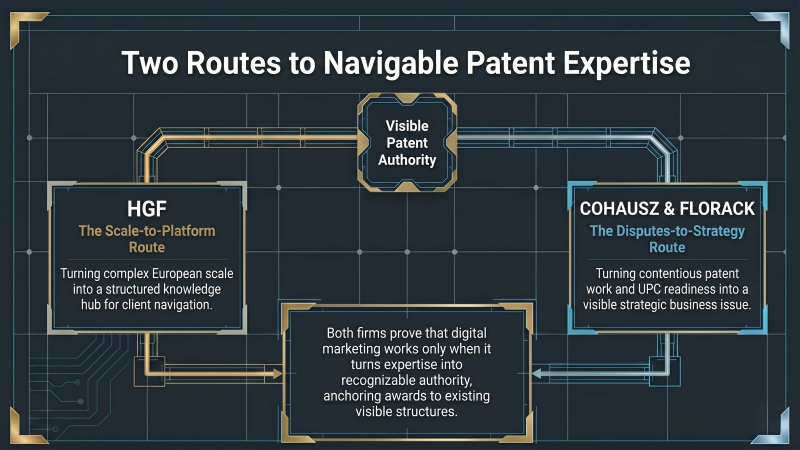
Two examples show how this can work in very different ways: HGF and COHAUSZ & FLORACK. HGF demonstrates how a large European IP firm can turn scale into a visible knowledge and sector platform. COHAUSZ & FLORACK shows how a patent law firm can make contentious patent work and UPC strategy digitally legible as a core strength.
HGF: Turning European scale into a knowledge platform
HGF is a strong example of the platform model in digital IP marketing. The firm won five awards at the Managing IP EMEA Awards 2026, including European Trademark Firm of the Year in the Patent & Trademark Attorney Firms category. HGF’s own award announcement presents the result not as an isolated achievement, but as recognition across a broad European IP service portfolio.
This matters because large IP firms face a specific marketing challenge. Scale alone is not a position. A firm may have many offices and specialists and cover many technical disciplines, but the market still needs to understand where its expertise becomes relevant. Without a clear digital architecture, scale can become confusing. The firm appears large, but not necessarily easy to choose.
HGF addresses this challenge through its Knowledge Hub, which brings together articles, legal updates, podcasts, events and sector-specific insights. The hub is not just a publication archive. It functions as a central interface between the firm’s technical expertise and the client’s decision environment. It allows users to enter the firm’s knowledge through topics such as UPC developments, RAND litigation, MedTech, digital health, SMEs, AI and trade marks.
This is a crucial best-practice point. HGF does not only communicate that it has expertise. It organises expertise so that different audiences can find themselves in it. An SME looking for practical IP support, a MedTech innovator dealing with connected devices, a digital health company protecting AI-based diagnostics or a brand owner navigating trade mark issues can each encounter a different but coherent entry point into the firm.
The firm’s digital health communication illustrates this particularly well. On its Digital Health page, HGF explains that digital health innovators must navigate software, data-centric technologies, AI-based diagnostics, life sciences and regulatory knowledge together. This is exactly the type of framing that turns legal expertise into client relevance. The client does not only see a service. The client sees a decision context: connected care, intelligent devices, software-driven medical technologies and the need for integrated IP protection.
The same logic appears in HGF’s content on protecting digital health inventions with patents and trade secrets, where the firm connects patents, trade secrets and digital health innovation. The message is not limited to formal legal categories. It explains how different IP instruments can work together in an innovation environment shaped by software, data and AI.
From a marketing perspective, this is stronger than a generic statement such as “we advise innovative companies”. HGF shows what innovation looks like in specific sectors and what IP questions arise there. The firm’s scale becomes credible because it is translated into structured knowledge.
What HGF shows about digital marketing for IP law firms
HGF’s example shows that large IP firms need more than brand recognition. They need a digital system that helps the market navigate their capabilities. The more complex the firm, the more important the architecture becomes.
This is especially relevant for firms with many practice areas. Without a clear knowledge structure, their digital presence can become a collection of disconnected updates. With a clear structure, however, each article, event, podcast or legal update becomes part of a larger positioning system.
HGF’s best practice is therefore not one single campaign. It is the conversion of firm scale into a knowledge platform. The award recognition then becomes more than a badge. It confirms that the firm is visible across several dimensions of IP practice, while the Knowledge Hub gives the market a way to understand and access that expertise.
COHAUSZ & FLORACK: Making patent disputes visible as strategic IP work
COHAUSZ & FLORACK represents a different model. The firm was awarded Europe Patent Disputes Firm of the Year and Germany Patent Disputes Firm of the Year at the Managing IP Awards EMEA 2026 in the Patent & Trademark Attorney Firms category. The firm presents these awards prominently in its rankings and firm communication.
This is significant because contentious patent work is often difficult to communicate digitally. Many details are confidential, legal complexity is high and the audience may not immediately understand why disputes matter beyond the courtroom. COHAUSZ & FLORACK’s positioning is therefore interesting because it links patent disputes to a broader strategic narrative: European patent enforcement, UPC readiness and technically grounded litigation capability.
The firm’s UPC communication is central to this. Its UPC advisory page explains the relevance of the Unitary Patent and Unified Patent Court and connects the new system with strategic questions of European patent litigation. The firm also published a video explaining the Unified Patent Court, noting that UPC decisions can have binding effect across Europe for European patents and unitary patents.
This is important because it turns a complex legal reform into an understandable client issue. The UPC is not presented only as a procedural change. It is presented as a strategic environment that affects enforcement, risk, litigation planning and portfolio decisions. That is exactly where digital marketing becomes valuable for IP law firms: it helps clients understand why a legal development matters before they have a specific mandate to place.
COHAUSZ & FLORACK also uses webinar formats to make its contentious expertise visible. Its CFWebinar on UPC litigation trends discusses developments in the case law of the Unified Patent Court and is led by patent attorney partners Mathias Karlhuber and Matthias Rottmann. Earlier webinar content addressed practical questions around UPC litigation and filing strategies, showing that the firm had already framed UPC readiness as a client issue before the system became fully established.
External rankings reinforce this positioning. JUVE Patent’s UPC profile describes COHAUSZ & FLORACK as one of the most active patent law firms at the UPC from the start, with litigators across technical fields and cases involving sectors such as polymer chemistry, pharma and diagnostics, 3D printing, video streaming, mobile communications, wound care, semiconductors and automotive parts.
This external description matters because it connects the firm’s own digital narrative with market validation. The firm communicates UPC and patent disputes as strategic fields. External ranking sources then confirm that the firm is active in precisely those fields. The award becomes credible because it fits the visible pattern.
What COHAUSZ & FLORACK shows about digital marketing for IP law firms
The COHAUSZ & FLORACK example shows how a patent law firm can make dispute work digitally understandable without reducing it to case promotion. The firm does not need to disclose confidential strategy to create visibility. It can educate the market about the decision environment: what the UPC changes, why litigation strategy matters, how technical and legal expertise interact and why companies need to prepare before a dispute escalates.
This is a strong model for patent law firms in particular. Many patent law firms have deep technical expertise, but their digital communication often remains focused on prosecution, formal qualifications or general IP services. COHAUSZ & FLORACK shows another route: make contentious patent work visible as a strategic business issue.
That also changes the role of the patent attorney in the market perception. The patent attorney is not only the person who drafts, files or defends patents. The patent attorney becomes a strategic advisor in European enforcement, UPC risk and dispute resolution.
Two different models of digital IP marketing
HGF and COHAUSZ & FLORACK therefore add two different models to the best-practice series:
HGF represents the scale-to-platform model. The firm uses a structured knowledge hub and sector-specific content to make a broad European IP offering navigable. Its digital marketing challenge is not lack of visibility, but complexity. The solution is architecture.
COHAUSZ & FLORACK represents the disputes-to-strategy model. The firm turns patent disputes, UPC readiness and technical litigation competence into a visible strategic position. Its digital marketing challenge is not lack of expertise, but the difficulty of communicating contentious work. The solution is education around decision contexts.
Both examples confirm the core lesson of the series. Digital marketing for IP law firms does not work because a firm publishes more. It works when communication creates a stable link between expertise, client problems and market choice.
Awards are valuable in this system, but they are not the system. HGF’s Managing IP awards matter because they reinforce a broad European knowledge and service platform. COHAUSZ & FLORACK’s patent disputes awards matter because they validate a visible litigation and UPC strategy. In both cases, the award becomes useful because there is already a digital structure into which it can be integrated.
That is the real best practice. The firm does not wait for recognition and then announce it. It builds a visible position first. The award then becomes proof of a story the market can already understand.