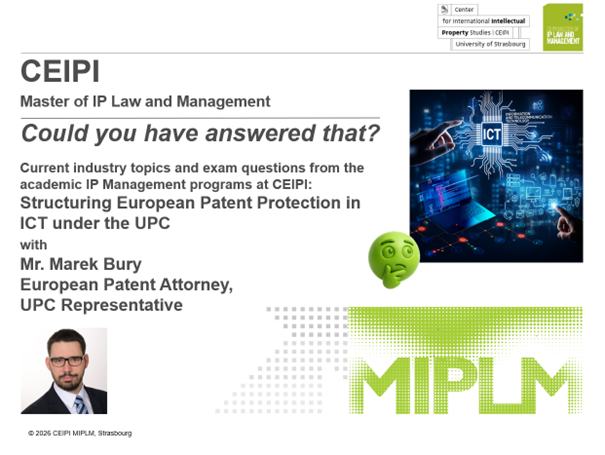
Structuring European Patent Protection in ICT under the UPC with Marek Bury

The introduction of the Unitary Patent and the Unified Patent Court (UPC) has fundamentally changed how ICT companies can structure, prosecute, and enforce their European patent portfolios. In fields such as telecommunications, software, AI, and connected systems, this is not only a legal question. It directly affects scalability, standardization, cross-licensing, market entry, and the ability to react to fast-moving competitors. To better understand these developments, the CEIPI IP Business Academy continuously exchanges with practitioners from industry, advisory services and private practice, including through its Open Foresight Board activities. These discussions confirm that there is a growing need for decision-oriented guidance at the interface of IP management, business strategy, and regulatory dynamics.
This reflects exactly the concern described in the UPC Strategy Gap study: companies face centralized injunction risks, revocation exposure, forum choices and portfolio vulnerabilities, while the market still often frames UPC advice too narrowly as procedural litigation expertise. The CEIPI IP Business Academy recently addressed the UPC Strategy Gap in Europe, showing that companies increasingly recognize the strategic relevance of the Unified Patent Court, while much of the market still frames UPC support mainly as procedural or litigation expertise.
Here you find the Findings of the study: “The UPC Strategy Gap in Europe”
This practical question with Marek Bury focuses on how ICT companies should organize European patent protection when innovation cycles are short, technologies are highly interconnected, and future enforcement scenarios remain uncertain. It shows why UPC strategy must be considered already during filing and prosecution decisions, because choices on geographical scope, budget allocation, portfolio structure, and litigation options can create long-term strategic effects for the company.
Mini Case Study
An ICT company develops a portfolio of software-enabled communication technologies, including AI-based signal processing and wireless systems. Its innovations are implemented across multiple markets simultaneously and integrated into complex, often standardized infrastructures.
As the company prepares new European filings, it faces increasing pressure to align its patent strategy with rapid innovation cycles, evolving technical standards, and competitive dynamics across jurisdictions. At the same time, the introduction of the Unitary Patent System comprising Unitary Patent and the Unified Patent Court (UPC) changes how protection and enforcement can be structured across Europe.
The company must define how to organize its European patent protection in a way that supports scalability, ensures enforceability, and remains adaptable to future developments in both technology and market structure.
Practical Question
How should ICT companies structure their patent protection in Europe under the Unitary Patent System when innovation cycles are fast, technologies are highly interconnected, and future enforcement scenarios remain uncertain? Discuss exemplary scenarios from the prosecution and litigation perspective.
Why This Question Matters in Practice
This question becomes particularly relevant for companies operating in ICT fields such as telecommunications, software, AI, and connected systems, where innovation is continuous and technologies are embedded in broader ecosystems.
In these environments, patent decisions are not isolated. They interact with standardization processes, cross-licensing structures, product development and global market entry strategies. The prosecution choices influences not only administrative efficiency and budgets, but also how companies can respond to competitors, assert rights, and negotiate in multi-party settings. Therefore, the question touches decisions regarding prosecution before the EPO, geographical scope of protection and budgeting as well as risk and opportunities in litigation.
The question is especially relevant for testing skills required for managing complex and evolving portfolios, where individual filing decisions accumulate into long-term structural effects. It also becomes relevant for companies that need to coordinate patent strategies across multiple jurisdictions while maintaining consistency with commercial objectives and technical development roadmaps.
Finally, the relevance of this question depends on an organization’s ability to handle decision complexity. Companies with more mature IP governance structures are better positioned to translate awareness of the UPC into coherent strategic positioning, while others may recognize its importance but struggle to operationalize it effectively.
Marek Bury
 European and Polish Patent Attorney and Managing Partner at Bury & Bury, Marek combines a strong technical background with extensive experience in European and international patent practice. His work focuses on patent prosecution before the European Patent Office under the EPC, as well as international filings under the PCT system.
His practice is highly specialized, particularly in ICT, electronics, telecommunications, software-related inventions—including AI-related technologies—and mechanical engineering, often combined in complex, multidisciplinary systems such as medical devices. He also brings a keen understanding of antenna systems and radio technologies, supporting innovations in wireless communication and sensing.
He collaborates closely with inventors, R&D teams, and businesses to translate technical solutions into robust and commercially valuable intellectual property rights.