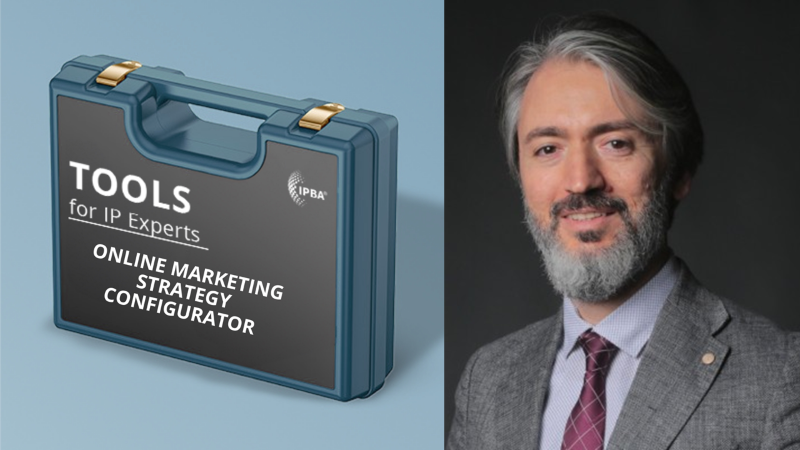
Why IP Experts Need a Tailored Marketing Framework: The Online Marketing Strategy Configurator

The intellectual property profession has traditionally relied on reputation, referrals, and long-standing professional networks. For many years, visibility within a relatively closed professional community was sufficient to attract clients and collaboration partners.
_______________________
 “The Online Marketing Strategy Configurator and my consultation with Prof. Alexander Wurzer helped me sharpen my narrative and communicate it more effectively to my ecosystem. They provided valuable insights on how to strategically use LinkedIn for professional communications, ensuring my messaging aligns with my objectives. A highly practical and insightful experience that I highly recommend!”
_______________________
However, the environment in which IP experts operate has changed significantly. Innovation ecosystems have become more global, interdisciplinary, and digitally connected. Engineers, founders, investors, and corporate decision-makers increasingly search online for expertise before initiating contact. In many cases, the first interaction with an IP professional happens through digital content, a professional profile, or a published insight.
This development has shifted how expertise becomes visible. Technical skill alone is rarely enough to create awareness among potential clients or partners. The ability to explain complex IP topics, communicate relevance for business decisions, and maintain a visible professional presence has become an additional competence for many IP experts.
At the same time, the intellectual property profession is highly specialized. Patent attorneys, IP consultants, licensing professionals, and corporate IP managers often address very specific technological fields and industry segments. Their potential clients and target groups work in organisations ranging from research institutions and startups to multinational corporations. Because of this diversity, generic marketing approaches rarely work well for IP experts.
A strategy that may be effective for a consumer brand or a general consulting service often fails to capture the characteristics of the IP profession. Intellectual property services are knowledge-intensive, trust-based, and closely connected to innovation processes. Clients usually seek experts not only for legal protection, but also for strategic guidance on technology, markets, and competitive positioning. This creates a particular communication challenge: IP experts need to demonstrate technical competence, business understanding, and credibility at the same time.
In practice, many IP professionals therefore face a common difficulty. They may be active on platforms such as LinkedIn, publish occasional articles, or participate in events, but these activities often remain fragmented. Without a coherent framework that connects topics, channels, and audiences, marketing efforts can become inconsistent and difficult to evaluate.
As a result, the challenge is not necessarily producing more content. Instead, it is about developing a structured approach that connects professional expertise with the right audience and communication channels.
A tailored marketing framework can help IP experts address several fundamental questions:
- Which industries and client groups should be addressed first?
- What type of content demonstrates expertise in a credible way?
- Which digital channels are most relevant for the intended audience?
- How can visibility activities support long-term business development?
Answering these questions does more than occasional marketing initiatives. It requires a structured reflection on positioning, communication goals, and the relationship between content, channels, and client journeys.
A Structured Approach: The Online Marketing Strategy Configurator
To support this reflection process, the Online Marketing Strategy Configurator offers a structured method for developing an individual online marketing concept for IP professionals. The configurator is designed as a guided framework that helps IP experts translate their professional profile into a coherent digital communication strategy. Instead of offering general marketing advice, the tool focuses on the specific characteristics of the intellectual property profession and the typical challenges IP experts face when communicating their expertise online.
The process begins with a structured assessment of the expert’s current situation. This includes reviewing previous online marketing activities, analysing the existing positioning, and identifying the primary audiences that may benefit from the expert’s knowledge.
From there, the configurator helps users examine several strategic dimensions of digital communication:
- One dimension concerns target groups and positioning. Experts reflect on which industries, technologies, or innovation ecosystems are most relevant to their expertise and how their work contributes to solving concrete business challenges.
- Another dimension focuses on content and communication formats. The configurator explores how technical knowledge can be translated into accessible insights, case discussions, or commentary on technological developments. The goal is not to simplify expertise, but to make it understandable and relevant for decision-makers.
- A further aspect addresses channel selection and platform priorities. Different digital channels serve different purposes in professional communication. For many IP experts, platforms such as LinkedIn play a central role in connecting with innovation ecosystems and industry networks. The configurator therefore examines how different channels can complement each other within a broader communication strategy.
- The framework also considers consistency and workflow. Many professionals struggle not with creating ideas for content, but with maintaining continuity in their communication. The configurator therefore helps map content topics and activities to a manageable publishing rhythm and available time resources.
- Finally, the strategy reflection includes measurement and evaluation. By defining goals and indicators for visibility, engagement, and interaction, IP experts can observe which activities contribute most effectively to their professional communication objectives.
The outcome of this process is a structured overview of an online marketing strategy. It includes considerations on positioning, content topics, communication channels, and the relationship between digital visibility and professional business development. Rather than prescribing a single approach, the configurator serves as a tool to help IP experts think systematically about how their expertise can be communicated within modern digital ecosystems.
In this sense, the framework reflects a broader development in the profession. As innovation networks become more connected and digital communication becomes more central to professional interaction, the ability to present and explain expertise online increasingly complements the traditional strengths of IP professionals.
A structured marketing framework can therefore help ensure that technical knowledge, strategic insight, and professional communication work together to make expertise visible where it is most relevant.