
Quality in IP Management: Why DIN and ISO Matter When IP Becomes a Management System – 5th VDI/VPP Seminar on “IP-Management”

In today’s economy, the case for quality in IP management is no longer abstract. Ocean Tomo’s 2025 study reports that intangible assets account for about 92 percent of S&P 500 market value. In parallel, current rankings of the world’s most valuable companies continue to be led by firms whose competitive position depends heavily on technology, data, software, brands, and know how. When value creation becomes this intangible, IP can no longer be handled as an isolated legal service at the edge of the business. It has to be managed with the same seriousness as quality, compliance, and innovation.
That is exactly the perspective behind DIN 77006 and the broader ISO logic discussed in your presentation. DIN 77006 defines requirements for intellectual property management systems and explicitly links IP management to the overall strategy of the organization. The standard is built on the High Level Structure used in other management system standards and is meant to support continuous improvement, legal compliance, and the achievement of IP objectives. In other words, it treats IP not as a collection of legal events, but as a structured organizational capability.
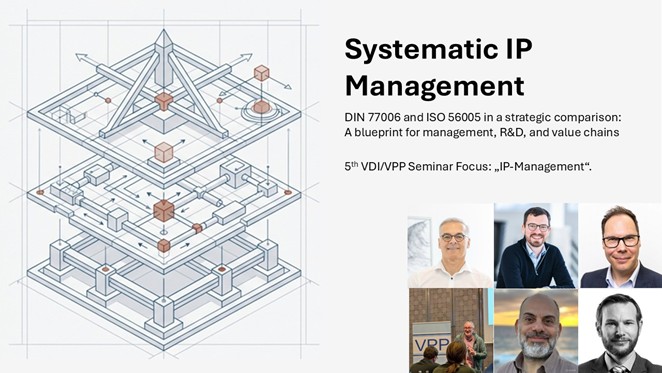
This presentation makes this shift very clear. It starts with the macroeconomic relevance of intangibles, moves into the Plan–Do–Check–Act logic, and then shows how quality in IP management only becomes real when strategy, innovation, audit, licensing, and collaboration are connected. The slides do not present DIN and ISO as bureaucratic exercises. They present them as the architecture that allows companies to make IP decisions systematically, repeatedly, and in a way that can be explained to management, auditors, and business partners.
Access the full presentation in English here.
IP Subject Matter Expert Jörn Plettig: Integrated IP Management Systems
 One of the strongest lenses in this context is the perspective of Dr. Jörn Plettig. His view is that an integrated IP management system only works when IP is linked to business strategy, embedded early in innovation processes, supported across functions, actively steered at portfolio level, and reinforced through clear tools, processes, and awareness building. That aligns closely with the background material on integrated IP management systems. There, IP is described as a cross functional management responsibility that belongs inside the company’s broader management system, alongside quality, risk, governance, and innovation. The key point is simple: IP risks and opportunities arise at interfaces, not inside one department alone.
This is also why DIN 77006 matters so much in practice. The standard is not a rigid checklist telling companies how many patents to file or which countries to choose. It is a reference framework that forces explicit decisions about responsibilities, interfaces, risk areas, reporting, and documentation. The digital IP lexicon 🧭dIPlex background material rightly emphasizes that DIN 77006 is valuable because it makes IP management controllable, transparent, benchmarkable, and auditable. It gives management a map. That matters especially in organizations where IP costs are visible, but maturity, adequacy, and decision quality often remain opaque.
IP Subject Matter Expert Max Feucker: IP Process Management
 Max Feucker’s contribution addresses the next practical question: how such a system is actually built. His emphasis on IP process management is crucial because standards only become useful when they are translated into routine behaviour. In the presentation, Max Feucker’s view is that companies need to define the major IP process areas, standardize workflows, connect IP processes with innovation and business processes, assign clear roles and governance, ensure documentation and traceability, introduce tools only after the process logic is defined, and establish continuous improvement. That is exactly the difference between formal aspiration and operating quality. A company does not become better at IP because it owns software or has external counsel. It becomes better when the right decisions happen at the right time, through reliable processes that survive organizational pressure and personnel changes. Here you can find Max Feucker digital IP lexicon 🧭dIPlex page on “IP Process Management”.
IP Subject Matter Expert Nicos Raftis: Inventing Around
 Nicos Raftis adds an equally important innovation perspective. His focus on inventing around with clarity of function and structure shows that quality in IP management is not only about administration or governance. It is also about improving the inventive process itself. The presentation highlights a disciplined approach: define the technical objective in a solution neutral way, analyze claims and drawings of relevant patents, break claim structures into elements, distinguish fixed from changeable features, develop design alternatives, and assess the broader freedom to operate landscape before selecting a technically and commercially viable route. This thinking fits perfectly with the ISO 56000 perspective described in the background material. Innovation and IP should not run in parallel worlds. Innovation creates knowledge, and IP determines what can be protected, kept confidential, monetized, or safely used. When those decisions are disconnected, IP becomes either a bottleneck or an afterthought. Here you can find the digital IP lexicon 🧭dIPlex page by Nicos Raftis “Inventing around with clarity of function and structure”.
IP Subject Matter Expert Andreas Jacob: Smart Licensing Models
 Andreas Jacob’s perspective then moves the discussion from control to value realization. His emphasis on smart licensing models is important because many organizations still understand IP quality only in terms of protection. Yet a robust system should also improve the company’s ability to commercialize and scale. In your presentation, Andreas Jacob argues that licensing models should fit the company’s position in the value chain, protect the proprietary core, regulate improvements clearly, align monetization logic with the business model, and take tax, compliance, flexibility, and ecosystem growth into account. This is a critical reminder: quality in IP management is not proven by the number of rights held, but by the quality of the options those rights create. A norm based management system should therefore strengthen not only legal defensibility, but also transaction quality and economic relevance. Here you can find the digital IP lexicon 🧭dIPlex page by Andreas Jacob “Turning IP into Value – Smart Licensing Models”.
IP Subject Matter Expert Bernd Bösherz: IP Management in Collaborations
 Finally, Bernd Bösherz brings in the collaboration problem, which is one of the hardest tests for any IP management system. Many companies no longer innovate alone. They work with OEMs, suppliers, research partners, software vendors, and joint development partners. In such settings, weak IP governance quickly destroys value. The presentation captures this well: start with a complete IP inventory, define ownership of background and foreground IP, establish clear governance and decision structures, regulate improvements and new inventions contractually, assess freedom to operate early, and align R&D, management, and the IP function internally. This is more than contract hygiene. It is collaborative IP management as system design. In a world of networked innovation, quality means that cooperation does not create ambiguity faster than the organization can control it. Here you can find the digital IP lexicon 🧭dIPlex page by Bernd Bösherz “IP Management in Collaborations”.
Taken together, the five expert perspectives form a coherent picture. Jörn Plettig explains why IP needs an integrated management architecture. Max Feucker shows how that architecture becomes process quality. Nicos Raftis proves that IP quality begins upstream in inventive work and freedom to operate thinking. Andreas Jacob demonstrates that value creation depends on smart commercialization structures. Bernd Bösherz shows that collaboration requires explicit governance if value is to remain defensible. This combination is what makes DIN and ISO quality in IP management so powerful. It is not about formalism. It is about turning IP into a managed capability that supports innovation, reduces avoidable risk, improves accountability, and makes intangible value more usable in business practice.
The most important takeaway from your presentation is therefore not that companies need another standard. It is that companies need a better operating logic for IP. DIN 77006 and the related ISO perspective offer that logic. They help organizations move from fragmented activities to a coherent system, from reactive case handling to structured management, and from symbolic protection to operational quality. In an economy built on intangibles, that is not an administrative luxury. It is a condition for competitive resilience.