
Why the 360° IP Strategy Matters More Than Ever


When The 360° IP Strategy was first developed, its central message was already a departure from the traditional way many companies thought about intellectual property. IP was not presented as a legal afterthought, a reward for inventors, or a filing activity that followed technical development. It was framed as a management instrument for securing innovation success in the market. The decisive question was not: What can we patent? The decisive question was: Where does IP contribute to business value?
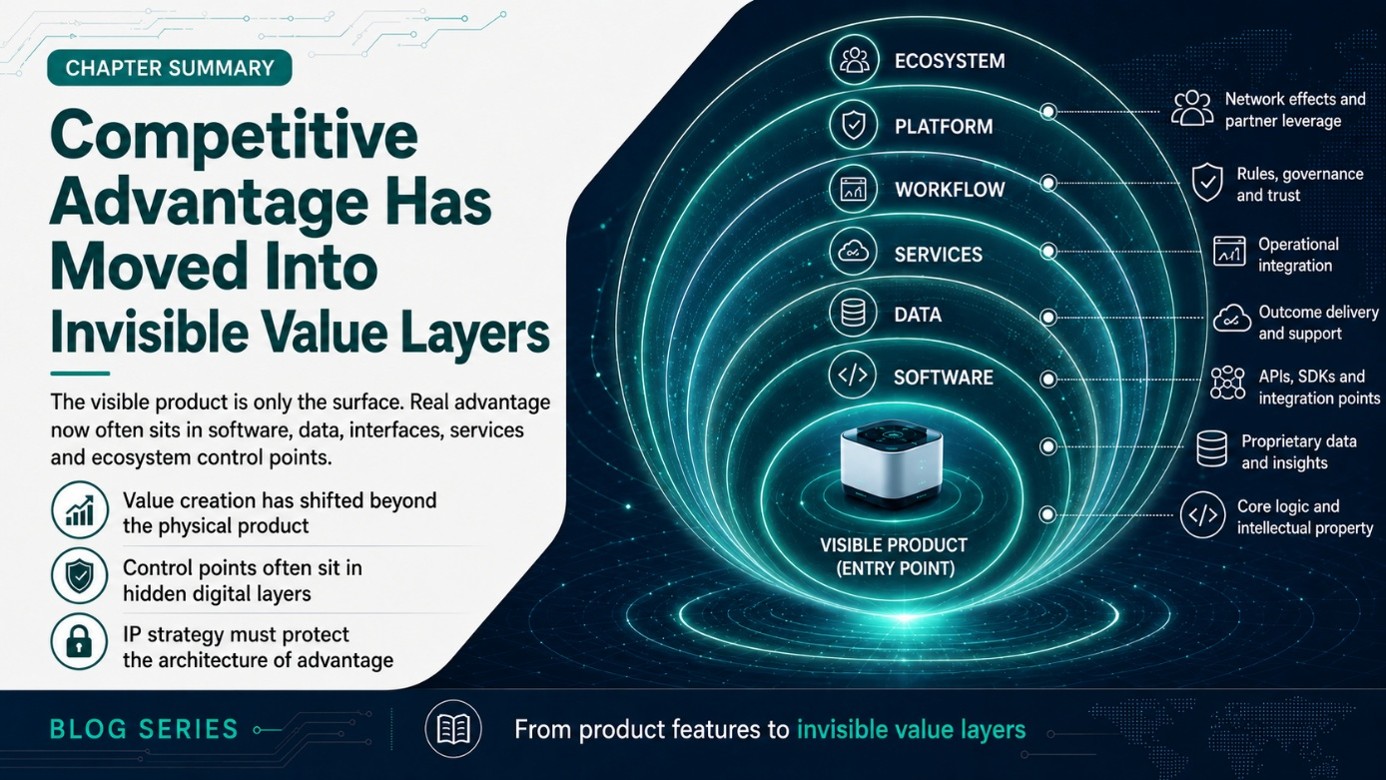
That insight has aged remarkably well. In fact, it has become more relevant. The reason is simple: the business environment has moved even further away from a world in which competitive advantage can be explained by product features alone. Today, companies compete through combinations of hardware, software, data, services, interfaces, ecosystems, user experience, regulatory positioning and operational know-how. The visible product is often only the surface. The real competitive advantage may sit in the data pipeline behind it, in the integration layer, in a workflow, in customer access, in a predictive model, in a platform relationship or in a service promise that competitors cannot easily reproduce.
This changes the task of IP management. A traditional patent-centric view starts too late and looks too narrowly. It waits for inventions to appear and then asks whether they can be protected. A 360° IP Strategy starts earlier. It asks what kind of business advantage the company wants to build, where that advantage is created, how customers perceive it, why they pay for it, and how competitors might try to copy, bypass or neutralize it. Only then does it ask which combination of IP instruments is needed.
That is why the 360° perspective matters more than ever. It was never just a patent strategy. It was a way to connect IP to customer value, market differentiation and economic effect. In the current environment, that connection is no longer optional. Companies that manage IP as a legal inventory will struggle to protect the value that actually drives their business. Companies that manage IP as part of their business model can use it to shape margins, protect control points, guide innovation, support partnerships and strengthen strategic positioning.
The first and most important update is therefore not a rejection of the original concept. It is a confirmation. The core idea remains valid: IP must be thought from the market backwards, from customer value backwards, and from business impact backwards. What has changed is the landscape in which this thinking must be applied.
The original 360° IP Strategy gave companies a way to move IP out of the patent department and into the logic of business management. Today, that movement is even more urgent because the assets that create advantage have become more distributed, more digital and more difficult to see.
Competitive advantage has moved into invisible value layers
In many industries, the visible product no longer explains the full competitive position of a company. A machine is no longer just a machine. It may be connected to a cloud service, embedded in a data ecosystem, updated through software, monitored remotely, optimized by algorithms and integrated into the customer’s own processes. A medical device may generate diagnostic data. A vehicle may be part of a mobility platform. An industrial component may become a sensor node. A manufacturing system may become a source of operational intelligence.
This shift matters because IP strategy must follow the movement of value. If value moves from the physical product into software, data and service layers, then protecting only the physical product is no longer enough. If differentiation depends on an interface, a workflow or a customer-specific configuration, then the relevant IP question is not simply whether a technical feature is patentable. The question is whether the company can create and defend a position that competitors cannot easily copy without losing time, access, credibility, data, trust or economic efficiency.
This is where the concept of control points becomes central. A control point is a place in the business model where the company can influence access, usage, substitutability or dependency. It may be a patent-protected technical function. But it may also be a proprietary data set, a trained model, a certification pathway, a customer interface, an installed base, a software architecture, an API, a trade secret process, a standard-relevant contribution, a contractual position or a brand-based trust signal.
The mistake many companies make is that they still search for IP only where engineers produce inventions. But in digital and data-driven business models, competitive advantage often emerges where functions connect: between product and service, between user and interface, between device and data, between platform and partner, between regulatory evidence and customer trust. These connections can be more valuable than isolated technical features because they shape how customers experience value and how competitors face barriers.
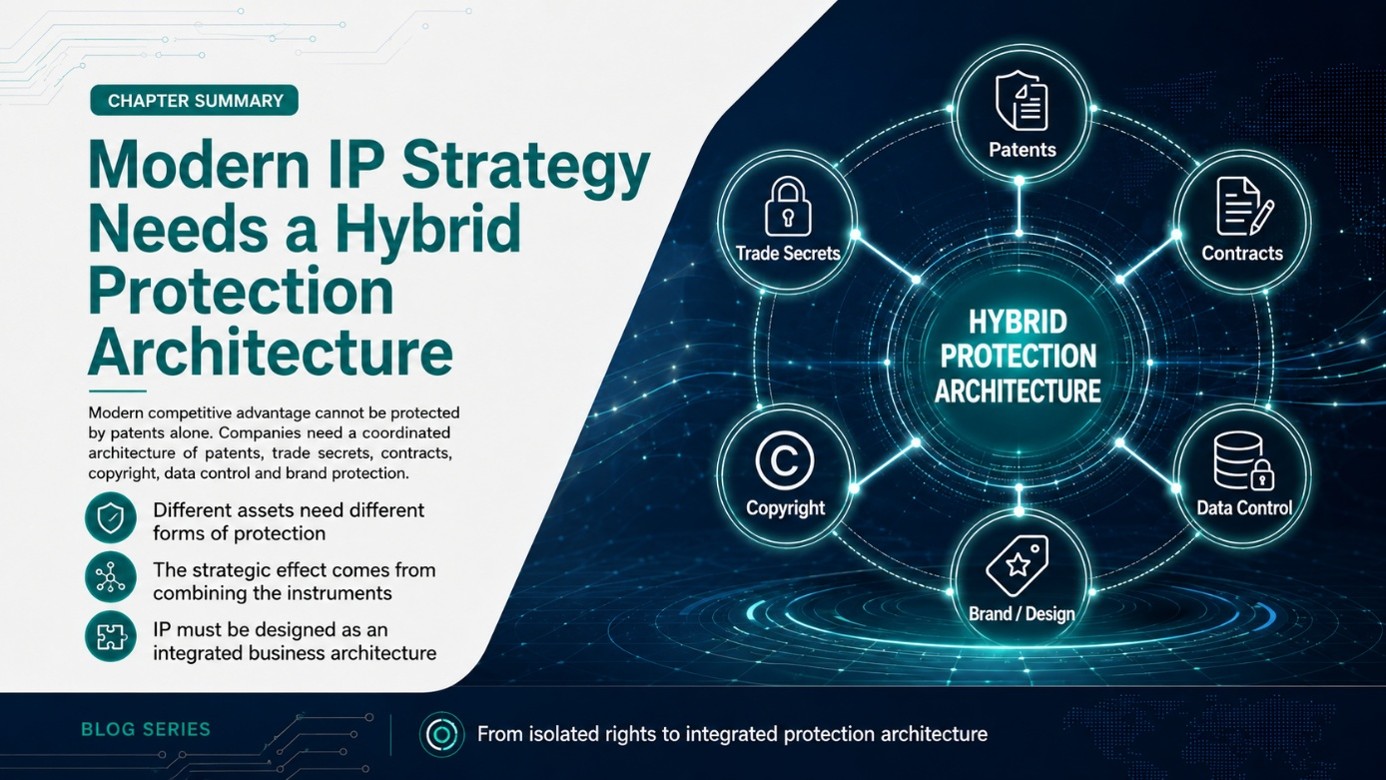
For that reason, modern IP strategy must become more diagnostic. It must identify where value is created, where it is captured, where it leaks, where competitors can imitate, and where the company can create legally, technically or commercially enforceable exclusivity. The result is not a single IP right, but a deliberate architecture of protection. Patents may be part of it. So may trade secrets, data governance, contracts, copyright, design rights, trademarks, open-source policies, documentation systems and technical access controls.
The shift toward invisible value layers does not make IP less important. It makes IP more strategic. The challenge is no longer only to protect inventions. The challenge is to protect the mechanisms through which the business creates and captures value.
The 4P logic needs to be read through digital business models
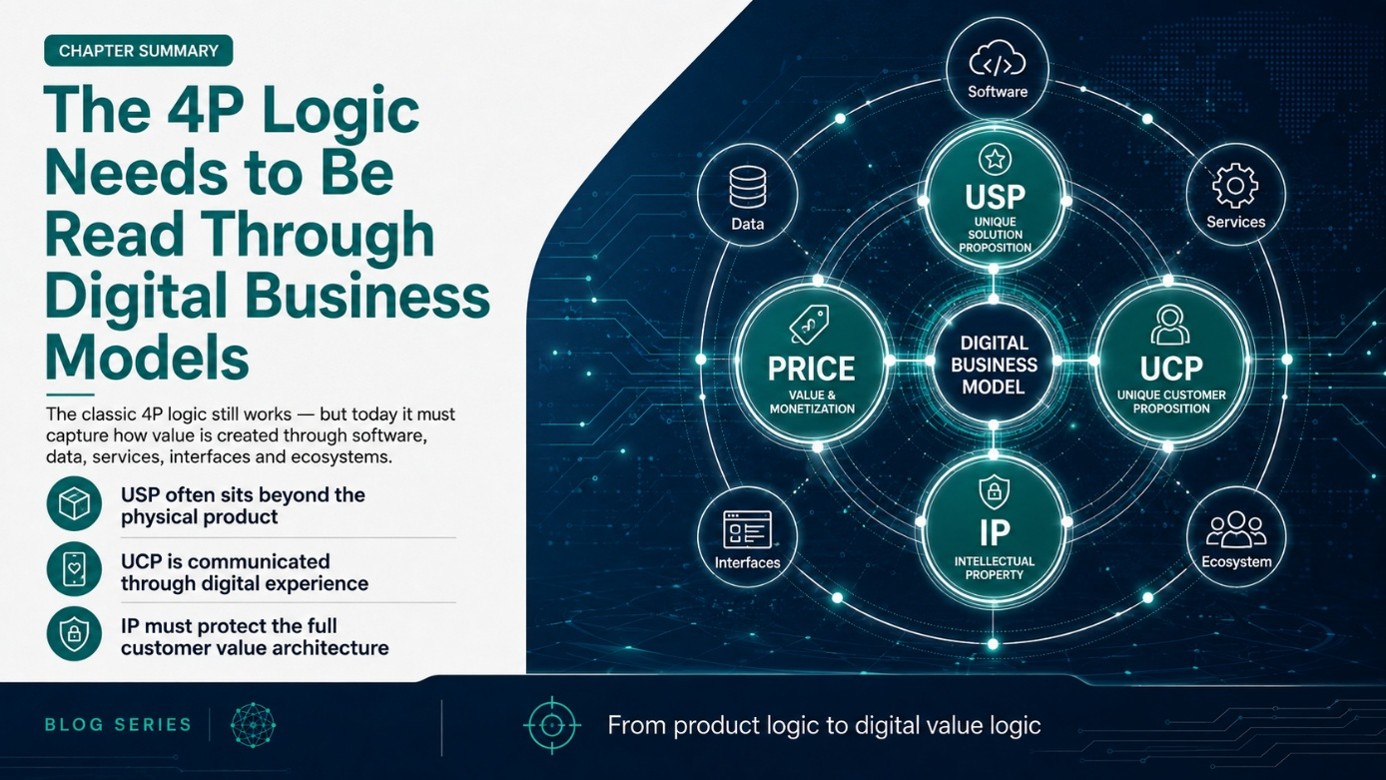
The original 360° IP Strategy placed customer value at the center. Its 4P logic connected the unique selling proposition, the unique communication proposition, IP-based exclusivity and the ability to realize price effects. This remains one of the most powerful management ideas in IP because it translates legal protection into commercial relevance. IP matters when it protects something the customer values, recognizes and is willing to pay for.
But this logic must now be read in a broader way. In classical product markets, the unique selling proposition was often tied to a visible feature: better performance, longer durability, higher precision, lower energy consumption or superior usability. Today, the USP may be less visible. It may lie in predictive maintenance, continuous optimization, data-driven personalization, integration into the customer’s workflow, interoperability with other systems or the reduction of operational risk.
The unique communication proposition also changes. In the past, the UCP might have been a product claim, a brand promise, a visible design element or a sales argument. In digital business models, the UCP may be embedded in a dashboard, a user journey, a certification label, a performance metric, a benchmark, a trust architecture or a digital interface. The customer does not only read the promise. The customer experiences it through interaction.
This creates new IP tasks. The company must ask: Which parts of this customer experience are strategically relevant? Which elements communicate the advantage? Which claims must be credible and defensible? Which data supports the promise? Which technical and legal instruments ensure that competitors cannot simply copy the same experience? Which parts should be patented, which should remain secret, which should be contractually controlled, and which should be made visible as part of market communication?
The 4P logic becomes especially important in platform and ecosystem settings. In such environments, the customer may not pay only for a product. The customer pays for access, compatibility, reliability, data continuity, reduced switching costs, compliance, community, partner availability or ecosystem confidence. The IP strategy must therefore protect not only the product’s technical function but also the structure that makes participation valuable.
This is why the customer perspective must become more precise. It is not enough to say that a product is innovative. The company must understand which specific value perception drives the customer’s decision. Is the customer paying for speed, reliability, convenience, risk reduction, compliance, integration, reputation, sustainability, transparency or future readiness? Each answer leads to a different IP logic.
The 4P concept remains valid because it forces IP to justify itself through customer value and economic effect. Its modern application must include digital experiences, platform roles, service promises and data-based differentiation.
Modern IP strategy needs a hybrid protection architecture
The more complex the value creation system becomes, the less useful it is to think in isolated IP categories. Patents, trademarks, designs, copyright, trade secrets, data rights and contracts are not separate boxes that should be managed independently. They are instruments that must work together to protect a business position. The real question is not which IP right is available. The real question is which combination of instruments produces the intended strategic effect.
This is particularly clear in software- and data-driven innovation. A technical method may be patentable in some jurisdictions and difficult in others. Source code may be protected by copyright but still vulnerable to functional reimplementation. Algorithms may be kept as trade secrets, but only if access, documentation and secrecy measures are properly managed. Training data may be commercially critical but legally complex. APIs may be technically controlled and contractually licensed. User interfaces may communicate the customer promise and support brand differentiation. Open-source components may accelerate development but introduce compliance risks.
A modern IP strategy must therefore be architectural. It must define what should be disclosed, what should be kept secret, what should be standardized, what should be licensed, what should be technically restricted, what should be monitored and what should be communicated to the market. This is not a legal checklist. It is a business design task.
The same applies to patents. Patents remain essential, but their role must be understood more carefully. A patent is valuable when it protects a relevant control point, strengthens a negotiation position, supports market differentiation, blocks an economically meaningful alternative, enables licensing, increases freedom in partnerships or contributes to valuation. A patent that does not connect to such business effects may still be legally valid, but strategically weak.
This also changes the meaning of portfolio quality. A strong portfolio is not simply a large portfolio. It is a portfolio that fits the business model. It protects the right layers. It supports the right markets. It covers the right customer benefits. It creates evidence for enforcement or negotiation. It aligns with product roadmaps, service models, data strategies and partnership structures. It is maintained because it matters, not because it exists.
Hybrid protection also requires stronger internal coordination. Product management, software teams, data teams, marketing, sales, legal, compliance, business development and IP professionals must work from the same strategic map. Otherwise, one function may publish what another function wanted to protect, integrate open-source components without understanding downstream risks, disclose trade secrets in customer projects, or file patents that do not match the commercial roadmap.
Modern IP strategy is not about choosing between patents and other forms of protection. It is about designing a protection architecture that matches how the business actually creates advantage.
The 360° approach becomes a management system for intangible advantage
The most important consequence of the digital shift is organizational. If intangible value is distributed across products, data, software, services, ecosystems, brands, contracts and know-how, then IP cannot be managed effectively through occasional legal interventions. It needs a management system. That means roles, processes, responsibilities, decision points, documentation, metrics, audits and continuous improvement.
This is where the 360° IP Strategy becomes more than a strategic method. It becomes a governance model. It helps companies decide who must be involved, when IP-relevant decisions arise, which information is needed, how risks are assessed, how protection measures are selected, how outcomes are measured and how the organization learns over time.
The starting point is still the same: define the IP need before trying to satisfy it. But in modern organizations, the IP need emerges in many places. It appears in product roadmaps, software releases, data strategies, platform partnerships, AI projects, customer pilots, supplier agreements, marketing claims, regulatory filings and M&A discussions. If these moments are not connected to IP governance, important decisions happen without the relevant perspective.
That is why IP culture must also change. It is no longer enough for inventors to report inventions. The organization must learn to recognize intangible value. Sales must understand where exclusivity supports customer arguments. Product managers must understand where roadmap decisions create control points. Software teams must understand open-source and secrecy implications. Data teams must understand how data assets become protectable and exploitable. Management must understand that IP is not a cost center but a steering system for competitive advantage.
This does not mean turning every employee into an IP expert. It means creating enough shared language and process discipline so that IP-relevant decisions are not missed. The IP function then becomes less of an administrative filing unit and more of an architect, translator and moderator. It connects business goals with legal instruments, technical realities and market effects.
The updated 360° IP Strategy therefore has a clear purpose. It helps companies manage the intangible foundations of competition. It connects customer value to control points, control points to protection architecture, protection architecture to governance, and governance to measurable business impact. This is the update needed for a world in which innovation success depends not only on what a company invents, but on how well it secures the value created around that invention.
The 360° approach matters more than ever because the strategic object has expanded. IP is no longer only about protecting inventions. It is about managing the invisible architecture of advantage that allows companies to differentiate, scale, negotiate, defend margins and remain strategically relevant in digital markets.
Supplementary content on the IPBA® platform:
IP Management Letter: Humanoid Robotics – The Race for Scalable Physical AI
This Letter explores humanoid robotics as a field where competitive advantage is not located in hardware alone. The deeper IP questions arise around learning systems, sensor fusion, deployment knowledge, safety logic, data loops and the ability to scale physical AI across real-world environments.
👉 Read more
IP Management Letter: Rolls-Royce Power-by-the-Hour – From Metal to Metrics
This piece shows how a physical product can become the entry point into a performance-based service model. The aircraft engine is only the visible layer; the strategic value sits in predictive maintenance, operational data, digital twins, contractual control and long-term customer dependency.
👉 Read more
IP Management Letter / Case Study: Rolls-Royce Digital Twins
This case looks at digital twins as a hidden innovation layer. Real-world operating data becomes simulation capability, prediction quality, engineering feedback and strategic know-how. It shows how invisible data and modelling layers can become core IP assets.
👉 Read more
IP Management Letter: Spotify – Agile Management and the IP Logic of a Global Audio Platform
Spotify provides a strong example of IP strategy inside a digital ecosystem. The user-facing service is only the surface; the deeper architecture includes copyright licensing, platform design, recommendation logic, user data, brand trust and scalable rights coordination.
👉 Read more
IP Management Letter: Wearables – From Wrist to Ecosystem
This piece explores how a wearable device becomes an ecosystem access point. The real advantage emerges through sensors, algorithms, health data, user interfaces, design, brand credibility and continuous interaction with the user.
👉 Read more
dIPlex: IP in the Digital Transformation
This dIPlex page provides the broader conceptual frame for digital IP strategy. It opens the discussion around software, data, platforms, digital content and the changing role of IP when value creation moves beyond the physical product.
👉 Read more
dIPlex: IP Protection of Digital Business Models
This page focuses directly on how digital business models can be protected. It connects IP design, hybrid protection architectures and the strategic safeguarding of business model functions rather than isolated technical features.
👉 Read more
dIPlex: Software Patents in MedTech
This page explores a field where the relevant value layer is often embedded in software, data processing and clinical workflows. It is useful for understanding how digital functions inside medical technologies can become central to differentiation and protection strategy.
👉 Read more
Glossary + Podcast: Trade Secret Management
This glossary and podcast entry goes into the protection of knowledge that should often remain invisible. It is especially relevant for data sets, models, parameters, process knowledge, internal workflows, deployment experience and other assets that may be better protected through trade secret governance than disclosure-based rights.
👉 Read more
Glossary + Podcast: IP-Driven Business Model
This entry brings the discussion to the business model level. It explores how IP can be more than a protective layer around innovation and instead become part of the value creation logic itself.
👉 Read more