
CEIPI IP Business Talk with Edd Cavanna and Daniel Speed: Protecting Quantum Innovation Across the Stack

Quantum technology is no longer only a matter of scientific promise. It is becoming a field of engineering choices, commercial roadmaps, investment decisions and international protection strategies. As quantum computing, quantum communication and quantum sensing move from fundamental research towards practical applications, the IP questions are becoming more specific, more technical and more demanding.
That is why the next CEIPI IP Business Talk will focus on a core challenge for innovators in this field: how can quantum innovation be protected when the invention itself may sit across hardware, software, protocols, control systems, mathematical methods and enabling technologies at the same time?
___________________________
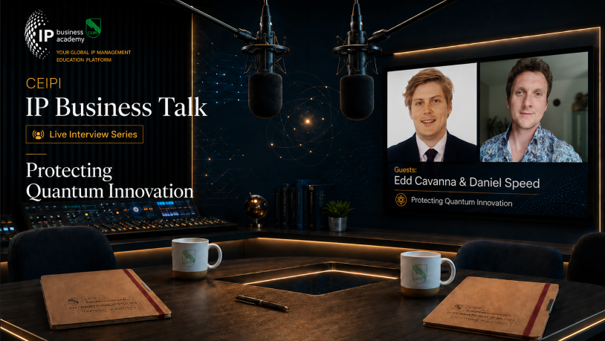
On Wednesday, 15 July 2026, at 12:00 CEST, Edd Cavanna and Daniel Speed from Mathys & Squire will join us for a 45-minute CEIPI IP Business Talk on: Protecting Quantum Innovation. Here is the registration link.
___________________________
Protecting Quantum Innovation
The conversation builds on the current dIPlex Industry Focus on Quantum Technology, which describes a structural lag between the technological momentum of quantum innovation and the maturity of IP decision-making in many organisations. Quantum is widely recognised as transformative, but many companies still struggle to translate that recognition into concrete IP structures, filing strategies and protection architectures.
This talk will therefore take the next step. It will not ask only why quantum technology matters for IP strategy. It will ask how protection can be designed when the inventive contribution is difficult to locate, when the technology is still evolving and when different patent systems may assess the same invention through different legal lenses.
From quantum promise to patentable contribution
One of the most difficult questions in quantum technology is deceptively simple: what exactly is the invention?
In traditional engineering fields, the answer may often be located in a component, a process step, a mechanical arrangement, a circuit or a manufacturing method. In quantum technologies, however, the inventive contribution may emerge from the interaction of several layers. It may lie in a processor architecture, a photonic implementation, a calibration method, a control loop, an error-correction approach, a protocol, an algorithm or the way classical and quantum systems are combined.
This makes patent drafting in quantum technology particularly demanding. The task is not merely to describe a scientific idea. The task is to identify the technical contribution that can carry the patent application and remain meaningful as the technology develops.
That distinction matters because many quantum inventions are born in research environments where scientific novelty, mathematical elegance and engineering value are closely intertwined. What is impressive in a research paper is not always the same as what can support a robust patent claim. Conversely, what appears to be a narrow implementation detail may become a crucial control point if it enables scalability, stability, reliability or integration into a future product architecture.
For patent professionals, this creates a translation challenge. They must understand the physics, but they must also understand how the invention can be expressed as a technical solution. They must help inventors move from a scientific description to a protectable structure. And they must do this early enough, before disclosures, collaborations or funding processes make the protection position more difficult.
Why breadth is difficult in a moving field
Quantum technologies are evolving quickly. Hardware platforms are still competing. Software frameworks are developing. Error correction, control electronics, photonics, cryogenics, semiconductor fabrication and quantum-enabling infrastructure are advancing in parallel. Commercial use cases may emerge in computing, sensing, communication, security, optimisation, simulation and materials on different timelines.
In such a field, applicants naturally want broad protection. They do not want to protect only the first implementation if future technical embodiments may become more commercially relevant. But breadth cannot be achieved by vague language alone. It must be supported by a clear technical teaching, sufficient disclosure and a claim structure that remains credible under examination.
This is where quantum patent drafting becomes a strategic discipline. The application must be broad enough to capture future implementations, but concrete enough to satisfy patentability requirements. It must avoid being locked into a single laboratory embodiment, but it must still explain why the invention works and what technical problem it solves.
The broader IP management implication is clear. A quantum patent portfolio cannot be built by filing isolated applications around interesting results. It needs an architecture. It must be connected to the technology roadmap, the expected evolution of the stack, the company’s collaboration model and the jurisdictions in which protection may become commercially relevant.
This is also consistent with the IP Expertise Demand Index 2026. The Index highlights that demand for IP expertise in emerging fields often arises before users can formulate a conventional IP mandate. Quantum is explicitly identified as a field where broad labels are not sufficient: quantum computing hardware, quantum software, quantum simulation, quantum communication, quantum sensing, post-quantum security migration and enabling technologies create different IP questions and different advisory needs.
The importance of jurisdictional thinking
Quantum inventions also raise difficult questions because patent systems do not always treat software-related and mathematically expressed inventions in the same way.
This is especially relevant where quantum innovation involves algorithms, protocols, mathematical models, simulation methods, benchmarking, error mitigation or control software. These elements may be technically central, but their patentability can depend heavily on how the invention is characterised and how the technical contribution is explained.
The difference between the UKIPO, the European Patent Office and the USPTO is therefore not a procedural detail. It can influence how an application is drafted from the beginning. A filing strategy that works well in one jurisdiction may not be optimal in another. A claim set that emphasises an abstract computational concept may face different risks than one that connects the method to a technical implementation, a hardware architecture, a control process or a measurable physical effect.
This is one reason why Mathys & Squire’s public quantum positioning is particularly relevant for this conversation. In our previous comparison of quantum IP communication, Mathys & Squire was described as framing quantum primarily through the lens of protection architecture. Its communication makes the complexity of protection itself visible: where the contribution is located, which technical category it belongs to, how software-related exclusions may apply and how approaches differ between jurisdictions.
That perspective fits the present discussion very well. Quantum inventions are not only scientifically complex. They are legally and strategically complex because their protectability may depend on how the same technical reality is translated into patent language.
Protecting across the quantum stack
The most valuable quantum IP positions may not arise from a single invention in isolation. They may arise from the coordination of protection across the stack.
Processors, photonics, microwave electronics, cryogenics, semiconductor processes, control systems, quantum memories, protocols, error correction, benchmarking, algorithms and application-specific adaptations may all contribute to future value creation. Some elements may be suited for patent protection. Others may be better protected as trade secrets. Some may require contractual control in collaborations. Some may become relevant for licensing, portfolio management, procurement, commercialisation or infringement analysis.
This is why quantum IP strategy must be more than a filing exercise. It must ask where control points may emerge. It must distinguish what should be disclosed and claimed from what should remain confidential. It must anticipate how today’s technical choices may shape tomorrow’s commercial leverage.
Mathys & Squire’s quantum team describes the field as covering quantum computing, quantum communication and quantum sensing, and highlights the need for far-reaching, adaptable IP protection that serves current and future business needs. The firm’s sector communication also points to patent and trade mark procurement, licensing, portfolio management, commercialisation strategies and infringement advice as part of the broader IP picture.
For founders, research organisations, investors and established technology companies, this is a crucial message. Quantum IP is not only about whether an invention can be patented. It is about whether the protection structure can support growth, collaboration, funding, market entry and long-term strategic positioning.
The upcoming CEIPI IP Business Talk with Edd Cavanna and Daniel Speed will therefore address one of the most practical questions in quantum IP today: how can innovators turn a complex, multilayered and rapidly evolving technology field into a coherent protection strategy?
Edd Cavanna
 Edd Cavanna is a Partner and Patent Attorney at Mathys & Squire LLP in Greater London. He is a European Patent Attorney and Chartered Patent Attorney with extensive experience in mechanical, electronic, software and energy-related technologies. Since entering private practice in 2013, he has worked on drafting and prosecuting patent applications across physics, engineering and software fields, and has advised clients on filing strategy, portfolio management and commercialisation of IP.
Before becoming Partner at Mathys & Squire in May 2024, Edd held several attorney roles within the firm, including Managing Associate and Associate Patent Attorney. He previously worked as a Trainee Patent Attorney at Mewburn Ellis and completed a PhD in Experimental Condensed Matter Physics at the University of Cambridge. His academic background also includes an MPhys in Physics and Maths from the University of Leeds and an exchange year at the University of California, Santa Barbara.
Daniel Speed
 Daniel Speed is a Trainee Patent Attorney at Mathys & Squire LLP. His background combines patent practice with advanced academic work in mathematics and theoretical physics. Before joining Mathys & Squire in September 2024, he worked as a Trainee Patent Attorney at Page White Farrer and gained university research and teaching experience at the University of Bristol.
Daniel holds a PhD in Theoretical and Mathematical Physics from the University of Bristol and an MMath Master of Mathematics from Cardiff University. He also completed a Postgraduate Certificate in Intellectual Property Law at Brunel University London. His profile therefore brings together mathematical depth, research experience and emerging patent expertise in a field where the boundary between abstract theory, software implementation and technical contribution is often central to the protection question.