
Quantum Technologies in Motion: Why IP Becomes a Decision System Before the Market Is Fully Defined

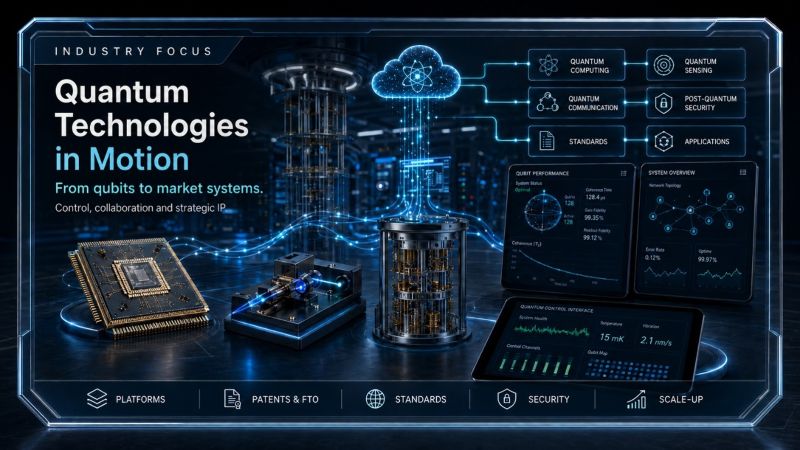
Quantum technologies are no longer only a scientific promise. They are becoming an industrial, policy and investment field in which patent strategy, collaboration architecture, market access, security, funding and standardisation begin to interact. This topic matters because it shows how IP is moving from a narrow legal protection function into a strategic decision system for control, collaboration, market access, risk management and competitive positioning.
The visible signal is not one single breakthrough. It is the accumulation of signals. The European Commission adopted the Quantum Europe Strategy in July 2025 to turn Europe into a more resilient and sovereign quantum ecosystem, support start-ups and scale-ups, and translate scientific leadership into market-ready applications. The EPO and OECD published a joint mapping of the global quantum ecosystem in December 2025, describing a field where science, firms, investment, skills, trade flows and policy are now moving together. At the same time, European IP practitioners are publishing more actively on patentability, filing timing, sufficiency, quantum algorithms and the strategic role of early portfolios.
That combination matters. It shows that quantum is not only a technology race. It is becoming a decision race.
Quantum is moving from promise to industrial reality
For many years, quantum technologies were mostly discussed as a future capability. The conversation focused on scientific milestones: more stable qubits, lower error rates, better coherence, improved sensing or more secure communication. These questions remain important. But they no longer describe the whole picture.
The field is now entering a phase where companies must decide how to act before all technical and commercial conditions are settled. Quantum computing, quantum communication, quantum sensing, enabling hardware and post-quantum cryptography are developing at different speeds. Some areas remain research-heavy. Others are already relevant for procurement, cybersecurity planning, public funding, investor assessment, technology transfer, industrial partnerships and standardisation.
This is the moment where IP management becomes more than protection. A quantum company may not yet have a fully mature product. But it may already need to speak to investors, publish research, join a consortium, negotiate with an industrial partner, protect a platform component, decide what remains confidential, assess freedom to operate, or position itself in relation to future standards.
Gemma Martynwood, Partner, UK and European Patent Attorney and UPC Representative at EIP, captures this tension in her article “Building a Resilient Quantum Patent Portfolio: Winning the Race to File First” from 29 May 2025. She writes that “speed is not the sole requirement to win the race.”
That short statement is strategically important. Quantum markets reward early positioning, but early filing is not automatically good filing. If an application is filed before the invention can be sufficiently described, it may create a weak asset. If it is filed too late, the company may lose priority, disclosure control or negotiation leverage. The IP issue is therefore not simply whether to patent. It is when, where and how to create robust strategic options under uncertainty.
The quantum stack changes the unit of IP analysis
Quantum technologies are not one product category. They are layered systems. Value may sit in hardware architectures, qubit platforms, control methods, fabrication processes, cryogenic systems, photonics, error correction, software layers, algorithms, calibration routines, measurement methods, interfaces, data interpretation, integration with classical computing or application-specific workflows.
This changes the unit of IP analysis. The relevant question is not only whether a specific technical feature can be protected. The more strategic question is where control emerges in the stack.
A company may not control the entire quantum system. It may control a critical enabling component, a fabrication method, a calibration process, a software layer, a benchmark, a use-case-specific optimisation method or a trade secret around system operation. Another company may hold strong patents but depend on third-party infrastructure, research partners, cloud access, standardised interfaces or specialist suppliers.
This is why quantum IP must be read as portfolio architecture. Patents may protect selected inventions. Trade secrets may protect tacit know-how. Contracts allocate background and foreground IP. Publications create scientific credibility but also shape disclosure risk. Standards may influence interoperability and market entry. FTO analysis may reveal future dependency points long before litigation becomes visible.
Tom Hamer of Kilburn & Strode, together with Bernadette Fernandes and Eleanor Parker, makes this point very clearly in “Majorana Qubits: Ripe for the Patenting?” from 17 March 2025. In the context of topological quantum computing and Microsoft’s Majorana 1 announcement, they write: “An effective IP strategy will be essential for smaller quantum-focused companies and quantum start-ups.”
That statement is not only about patent filings. It is about survival and leverage. In an environment where large technology companies, public research organisations and specialised start-ups operate in the same innovation space, smaller companies need IP to avoid being pushed into dependency. They need it to negotiate, raise funding, collaborate, license, defend their space and show why their contribution is commercially relevant.
Patentability becomes a strategic route-choice problem
Quantum also shows why patentability cannot be treated as a purely legal filter. For quantum algorithms, quantum AI, simulation, optimisation and software-controlled quantum systems, the way an invention is framed can shape whether it becomes protectable at all. The distinction between an abstract mathematical method and a technical implementation is not only doctrinal. It affects business strategy.
Mike Jennings, Partner and European and UK Patent Attorney at Venner Shipley, addresses this in “Navigating AI Patents: key updates from EPO and UKIPO Guidelines” from 5 March 2025. The article explains that the UKIPO added guidance for quantum computing and that the 2025 changes encourage Venner Shipley to recommend “using the EPO rather than the UKIPO when seeking UK patent protection” for many AI inventions and inventions based on quantum computing algorithms at that point in time.
This is a good example of how a legal development becomes an IP-management issue. If an applicant can obtain more predictable protection through one route than another, patent strategy becomes part of market positioning. Companies must consider not only where they want protection, but which patent office practice gives them the best chance of protecting the technical contribution that matters to the business.
For quantum companies, this is especially relevant because many inventions sit between physics, mathematics, software and engineering implementation. A claim that looks too abstract may fail to capture patentable technical contribution. A claim that is too narrow may miss the commercial value. A claim that ignores implementation detail may not support future enforcement or licensing. The patent attorney’s role is therefore not only to translate an invention into claims, but to translate technical uncertainty into defensible strategic choices.
Timing matters because quantum markets mature over patent lifetimes
A common mistake in emerging technology fields is to wait for the market to become obvious. In quantum, that can be strategically dangerous. Patent rights operate over long time horizons. A filing decision made today may still matter when the market becomes more commercially mature.
Timothy Young of Maucher Jenkins makes this point in “Is now the time to get your quantum IP in a coherent state?” from 2025. Referring to forecasts for the UK quantum computing industry, he writes that “there is a significant advantage for individuals and businesses to file quantum computing patents now.”
The relevance of this statement lies in the time mismatch. Quantum technologies may still face technical barriers, adoption uncertainty and long commercialisation cycles. But IP rights are created before markets are settled. Companies that wait until commercial value is obvious may find that foundational positions have already been taken.
This does not mean that every quantum-related idea should be patented immediately. It means that filing decisions need to be connected to roadmaps. Which inventions are likely to remain relevant as the technology matures? Which parts of the system may become bottlenecks? Which disclosures are necessary for funding or collaboration? Which elements should remain secret? Which patent filings support future licensing, investment or defensive positioning?
In this sense, quantum IP management is not a single filing event. It is a sequencing problem. The portfolio has to evolve with technical validation, product strategy, partner relationships and market signals.
IP becomes coordination infrastructure for a fragmented ecosystem
Quantum innovation is rarely created in isolation. It connects universities, public research institutes, start-ups, large technology companies, investors, national programmes, European initiatives, standardisation bodies, suppliers, customers and security-sensitive public stakeholders.
This creates a coordination problem. Who owns what? Who may use what? Which background IP enters a project? Which foreground IP leaves it? What can be published? What must remain confidential? Which data, test results, benchmarks or operating insights can be used commercially? Which rights survive if a collaboration ends? Who can license the result? Who may block future development?
These questions are too important to be left to late-stage contract drafting. They shape the business architecture of quantum projects.
The EU Quantum Strategy shows that Europe wants to build not only scientific strength but a functioning quantum ecosystem with start-up growth, scale-up capacity, infrastructure and industrial application. The EPO/OECD mapping of the global quantum ecosystem similarly treats patents, firms, investment, skills, trade and policy as interconnected indicators rather than separate categories.
This is precisely where IP becomes coordination infrastructure. It helps different actors cooperate without losing control. It enables disclosure without uncontrolled leakage. It supports investment without forcing premature acquisition. It allows companies to build partnerships while preserving future options. It also creates evidence: evidence of technological contribution, control over assets, freedom to operate, and credible value creation.
The new uncertainty is not only legal uncertainty
Classical IP advice often starts from familiar questions. Is the invention patentable? Is there prior art? Can we file? Can we enforce? Are we infringing? Those questions remain essential, but quantum adds a broader uncertainty layer.
The harder questions are strategic. Where does value actually arise in the quantum stack? Which layer will become commercially decisive? Which technical route will survive? Which standard will matter? Which supplier dependency will become critical? Which part of the system should be protected by patents, and which part should remain know-how? Which publication supports credibility, and which publication destroys optionality? Which collaboration gives access to capability, and which collaboration creates lock-in?
This uncertainty creates decision gaps. Technical teams may understand the science but not the IP consequences of disclosure. Business teams may see investor pressure but not portfolio fragility. Legal teams may assess patentability but not the commercial role of standards, benchmarks or platform control. Investors may ask for defensibility without knowing which assets actually create leverage.
Quantum therefore exposes a broader advisory problem. The market often presents IP services as fragmented offerings: drafting, prosecution, FTO, contracts, litigation, licensing or due diligence. But quantum companies need integrated orientation across these categories. They need advisers who can connect scientific maturity, patent robustness, disclosure timing, collaboration design, investor communication, standards strategy and market access.
IP experts as strategic translators
The role of IP experts in quantum cannot be limited to explaining legal rules. Their strategic value lies in translation.
They must translate technical complexity into protectable and commercially meaningful assets. They must translate patent-office practice into filing strategies that support business goals. They must translate collaboration plans into rights structures that preserve future options. They must translate investor expectations into credible evidence of control. They must translate uncertainty into decision pathways.
This is especially important for European quantum companies. Europe has strong research capabilities and public policy ambition, but the commercialisation path is not automatic. The challenge is to convert scientific contribution into scalable, investable and defensible market positions. IP experts can help only if they understand that quantum IP is not a narrow filing niche. It is a strategic management field.
In practice, this means that the best IP advice will not begin with a single patent application. It will begin with the architecture of value creation. What is the company trying to control? Which layer of the stack is its leverage point? Which rights are needed for the next financing round? Which partners are essential? Which disclosures are unavoidable? Which standards or interfaces could shape market access? Which risks must be handled before they become expensive?
That is the real movement in quantum IP. It is the movement from protection to decision infrastructure.
Strategic implications
Quantum technologies are no longer a peripheral topic for IP management. They are part of the emerging infrastructure of modern innovation and competition. Companies that understand this early can build better freedom to act, stronger collaboration positions and more credible investor narratives. Companies that treat quantum IP only reactively risk entering the market with weak control over the very assets that define their future options.
Four implications follow.
- First, quantum IP strategy must follow the stack. The relevant assets may sit in hardware, software, control systems, data, interfaces, calibration, standards or application know-how.
- Second, timing is a strategic variable. Early filing can create leverage, but only if the application is robust enough to survive sufficiency, enablement and later commercial scrutiny.
- Third, patentability is part of market design. The route chosen for protecting quantum algorithms or software-related inventions can affect commercial options, not only legal outcomes.
- Fourth, collaboration must be designed before value becomes obvious. Background IP, foreground IP, publication rights, data access, licensing options and exit rules are central to preserving control.
The conclusion is simple: quantum technologies turn IP into a decision system before the market is fully defined. In that environment, IP strategy must not wait for certainty. It must help companies act intelligently while uncertainty is still the defining condition.