Two Ways to Make Quantum IP Legible: Ecosystem Positioning at D Young & Co LLP and Protection Architecture at Mathys & Squire

Quantum technology presents an unusual communication challenge for intellectual property firms. It is scientifically complex, commercially promising and still characterised by considerable uncertainty about which technical architectures, applications and business models will ultimately prevail. A conventional practice description built around patent drafting, prosecution and portfolio management is therefore unlikely to communicate the full relevance of an adviser’s expertise. Firms must also explain how they understand the emerging market, which strategic questions they consider important and where intellectual property fits into the transition from laboratory research to commercially viable technology.
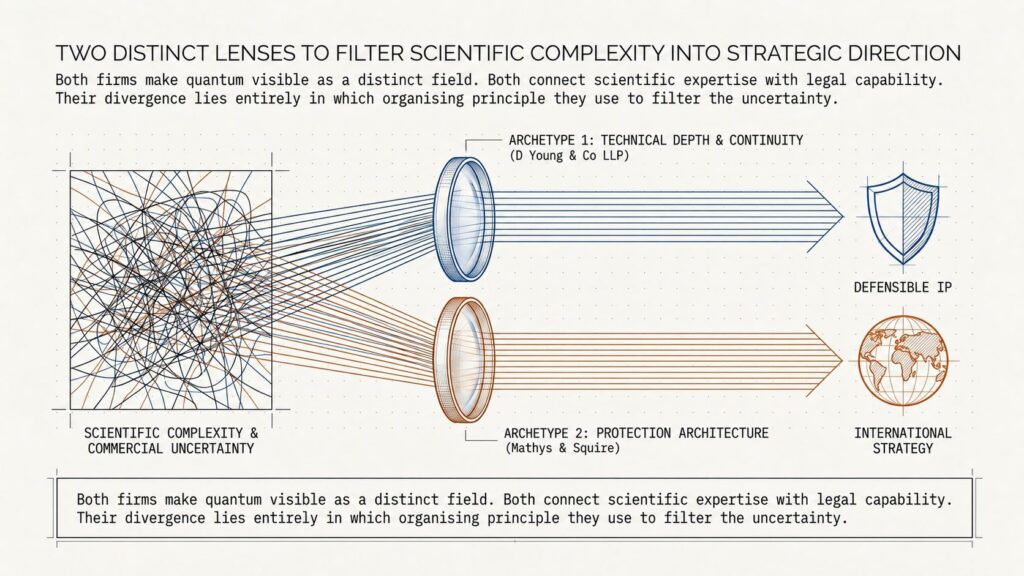
The public communications of D Young & Co LLP and Mathys & Squire illustrate two credible but distinct responses to this challenge. Both firms present visible quantum capabilities, identify technically specialised practitioners and address quantum computing, communication, sensing, hardware and software. Both also connect protection with longer-term commercial objectives. Yet the organising principles of their communications differ.
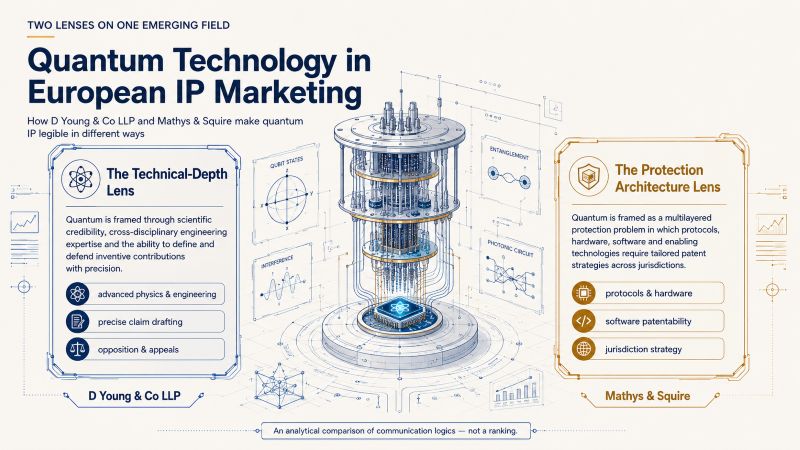
D Young & Co LLP generally presents quantum technology through the lens of deep technical expertise embedded within a broader advanced engineering and physics practice. Its positioning emphasises scientific credibility, cross-disciplinary capability and long-standing experience in complex technologies such as electronics, photonics, semiconductors and software. Intellectual property is framed as a technically rigorous exercise in identifying and protecting innovation at the level of detailed engineering and scientific contribution.
Mathys & Squire places greater emphasis on the architecture of protection. Its public materials classify the technical subject matter in considerable detail and discuss how hardware, protocols, algorithms and enabling technologies may require different approaches. Its thought leadership also highlights differences between patent systems and the difficulty of applying established software-patent frameworks to quantum inventions.
This is not a comparison of which firm has the stronger quantum practice. Public communications cannot establish that. It is instead an examination of how two IP practice groups make the same complex technology understandable to the market, and what other IP Subject Matter Experts can learn from their choices.
D Young & Co LLP: Positioning Quantum Through Deep Technical Expertise
D Young & Co LLP does not isolate quantum technology as a standalone ecosystem in the same way as some competitors. Instead, it integrates quantum-related work into its broader positioning as a technically rigorous firm with strong capabilities in physics, electronics, computing and engineering. Its practitioners frequently have advanced scientific qualifications, and the firm emphasises its ability to engage directly with complex inventions at a detailed technical level.
This positioning reflects the firm’s long-standing focus on high-technology sectors such as semiconductors, telecommunications, photonics, software and advanced materials. Quantum technologies are implicitly situated within this continuum of innovation rather than presented as a separate market narrative. The result is a communication style that prioritises continuity of expertise: quantum is treated as an extension of existing scientific and engineering domains rather than as a fundamentally distinct commercial ecosystem.
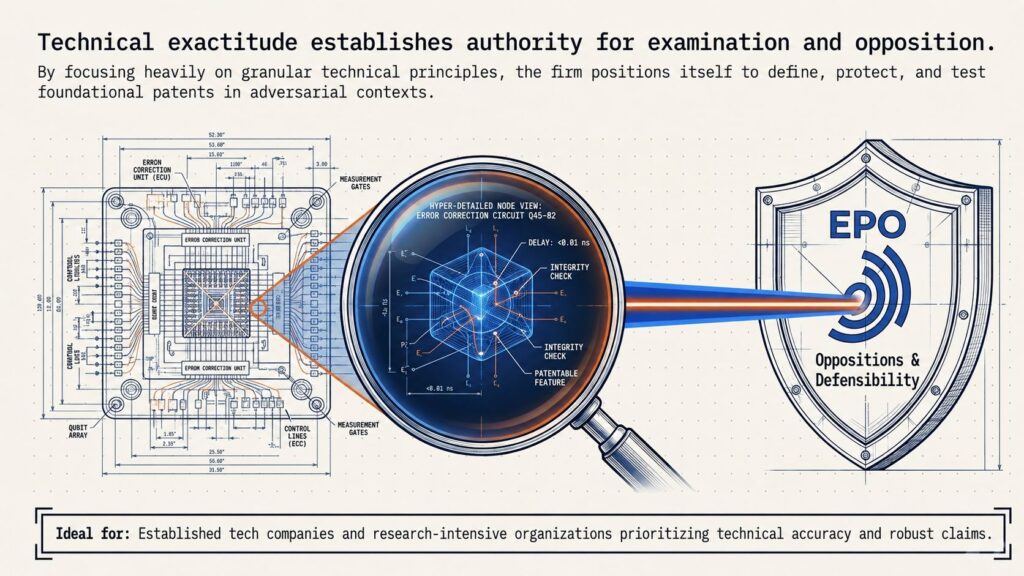
The firm’s messaging therefore centres on technical depth and precision. Patent drafting, prosecution and opposition work are framed as activities that require a detailed understanding of underlying physical principles, device architectures and computational methods. This is particularly relevant in quantum technologies, where inventions may depend on subtle distinctions in hardware design, control systems, error correction or algorithmic implementation.
D Young & Co LLP also places visible emphasis on contentious work, including opposition and appeal proceedings before the European Patent Office. This reinforces a positioning in which intellectual property is not only created but also tested, defended and refined in adversarial contexts. For quantum technologies, where foundational patents may become strategically important, this capability signals that the firm can support clients beyond initial filings.
The resulting message can be read as: “we understand complex technologies at a level that allows us to define, protect and defend their inventive contribution.” This framing is particularly relevant for established technology companies, research-intensive organisations and sophisticated in-house patent teams that prioritise technical accuracy, robustness of claims and the ability to withstand scrutiny in examination and opposition.
Mathys & Squire: Positioning Quantum as a Protection Architecture
Mathys & Squire also operates a dedicated quantum sector page, but its structure leads the reader in a different direction. The page begins with the movement of quantum computing, communication and sensing from fundamental research towards more mature applications, before foregrounding the combination of recent academic experience and senior expertise in prosecution, litigation and portfolio management. It then organises the firm’s capabilities into detailed categories: quantum protocols, quantum hardware and systems, and quantum-enabling technologies.
This taxonomy has an important positioning function. References to phase estimation, decoherence modelling, noise reduction, circuit benchmarking, resource-state generation, photonic integrated circuits, quantum memories, optical clocks, semiconductor fabrication, cryogenics and microwave electronics signal that “quantum” is not being treated as a single general technology. It is presented as a multilayered technical system in which the protectable contribution may arise at different levels and require different kinds of scientific understanding.
The communication therefore reduces uncertainty by creating order. A potential client can locate an invention within a recognisable protection landscape: protocol, hardware, component, manufacturing process, control system or enabling infrastructure. The firm also lists procurement, licensing, portfolio management, commercialisation and infringement advice, but these services are introduced after the technical map has established credibility. The route to commercial value is framed primarily through the creation of adaptable and sufficiently broad protection.
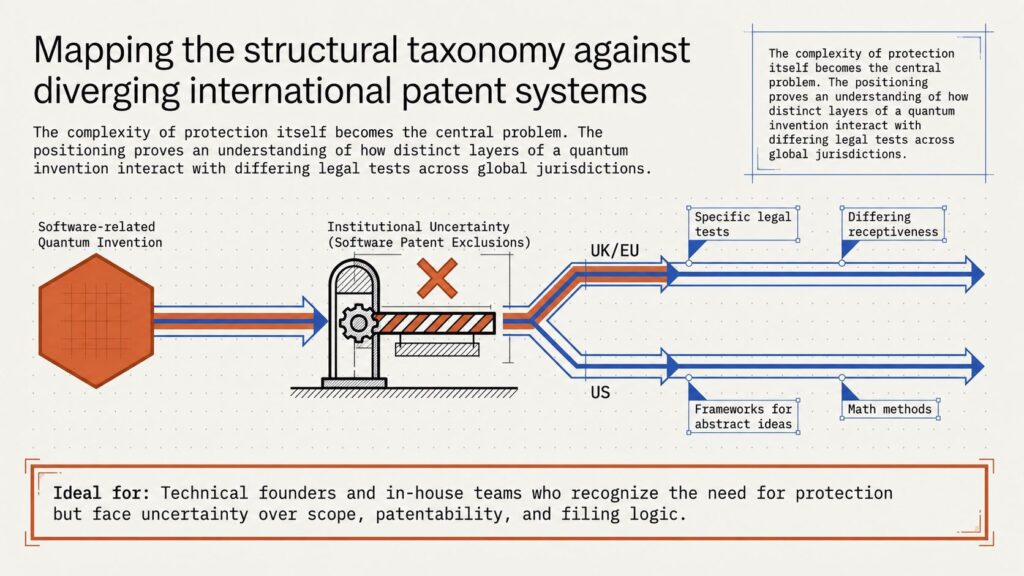
Mathys & Squire’s thought leadership on the patentability of artificial intelligence and quantum computing extends this logic from technical classification to institutional uncertainty. A 2025 article argues that the UK and European approaches to software-related inventions have diverged and examines the consequences for quantum computing. It considers whether treating quantum computers in the same way as classical computers adequately reflects features such as superposition and parallelism, and contrasts the apparent receptiveness of different jurisdictions.
The article is partly a policy argument about the attractiveness of the United Kingdom as a location for advanced technology. From a positioning perspective, however, it also communicates a practical proposition: quantum inventions cannot necessarily be protected through a uniform filing logic. Patentability may depend on how the invention is characterised, how its technical contribution is expressed and where protection is sought. Practitioner profiles strengthen this message by referring to drafting and prosecution adapted for the United Kingdom, Europe and the United States, as well as the treatment of mathematical methods, abstract ideas and computer programs.
Mathys & Squire therefore makes the complexity of protection itself the central problem. Its implied message can be read as: “we understand how the layers of a quantum invention interact with the legal tests applied in different patent systems.” This framing is likely to resonate with technical founders, in-house patent teams and research organisations that already recognise the need for protection but are uncertain about scope, patentability and international filing strategy.
The Connecting Element
The two firms are connected by more than their use of the word “quantum.” Both have made the subject visible as a distinct field, rather than leaving it within general physics, electronics or software practices. Both connect scientific expertise with legal capability, refer to several branches of quantum technology and acknowledge that commercial success depends on strategic intellectual property rather than isolated filings.
More importantly, both respond to the same underlying market problem. Quantum companies must make decisions before technical and commercial certainty has arrived. Hardware architectures are still competing. Software and algorithms may encounter difficult patentability questions. Research frequently involves universities, public funding and industrial collaboration. Commercial applications may emerge in computing, communication, sensing, security, navigation, materials or life sciences on different timelines.
In this environment, an IP practice group must demonstrate two forms of understanding. It must understand the scientific subject matter sufficiently well to identify protectable contributions, and it must understand the strategic context sufficiently well to advise on investments whose value may unfold over many years. D Young & Co LLP and Mathys & Squire both communicate these capabilities. Their difference lies in which form of understanding becomes the principal narrative.
The Difference
D Young & Co LLP begins primarily with the technical substance of the invention and the scientific expertise required to engage with it. Its content implicitly asks where the inventive contribution lies within complex engineering systems and how it can be defined with precision. Intellectual property is framed as a technically exact discipline grounded in deep subject-matter knowledge and reinforced by experience in examination and opposition.
Mathys & Squire begins primarily with the internal structure of the innovation and the legal framework through which it may be protected. Its content asks where the inventive contribution is located, which technical category it belongs to, how software-related exclusions may apply and how approaches differ between jurisdictions. Commercial growth is connected to the adaptability, breadth and international coherence of the resulting rights.
The distinction can be described as one between technical-depth orientation and protection architecture. A technical-depth orientation establishes authority through demonstrable scientific expertise and the ability to engage with complex inventions at a granular level. It shows that the adviser can translate advanced research into precise and defensible patent claims. A protection-architecture orientation establishes authority by imposing technical and legal structure on a difficult subject. It demonstrates that the adviser can distinguish layers of innovation and translate them into enforceable claims across different systems.
Neither orientation excludes the other. D Young & Co LLP also advises on portfolio strategy and commercialisation, and Mathys & Squire also demonstrates deep technical understanding. The meaningful difference is one of emphasis, sequencing and editorial centre of gravity. D Young & Co LLP tends to lead the reader from scientific expertise towards IP. Mathys & Squire tends to lead the reader from technical differentiation and patentability towards commercial value.
What IP Practice Groups Can Learn from This
The first lesson is that a technology label is not yet a positioning strategy. Publishing a page stating that a firm advises on quantum computing does little to explain why the practice is relevant. Each firm needs an organising question that can support a sustained body of communication. D Young & Co LLP appears to organise its positioning around technical excellence and the ability to handle complex inventions across advanced engineering domains. Mathys & Squire appears to organise its content around how complex quantum inventions can be classified, protected and adapted to different legal environments.
The second lesson concerns evidence. Claims of sector knowledge become more credible when the content itself performs that knowledge. D Young & Co LLP demonstrates technical authority through practitioner profiles, sector breadth and emphasis on detailed scientific engagement and contentious proceedings. Mathys & Squire demonstrates technical and legal granularity by naming specific quantum mechanisms, components and patentability problems. In both cases, the form of the content supports the positioning claim.
The third lesson is that an effective IP Subject Matter Expert does not need to comment on every aspect of a technology. Greater differentiation may result from selecting a recognisable lens. One practice might own deep technical engagement across advanced physics and engineering. Another might focus on portfolio design across the quantum stack. Others could credibly concentrate on standards, research collaborations, export controls, freedom to operate or licensing. The important requirement is consistency between expertise, target audience, service proposition and public communication.
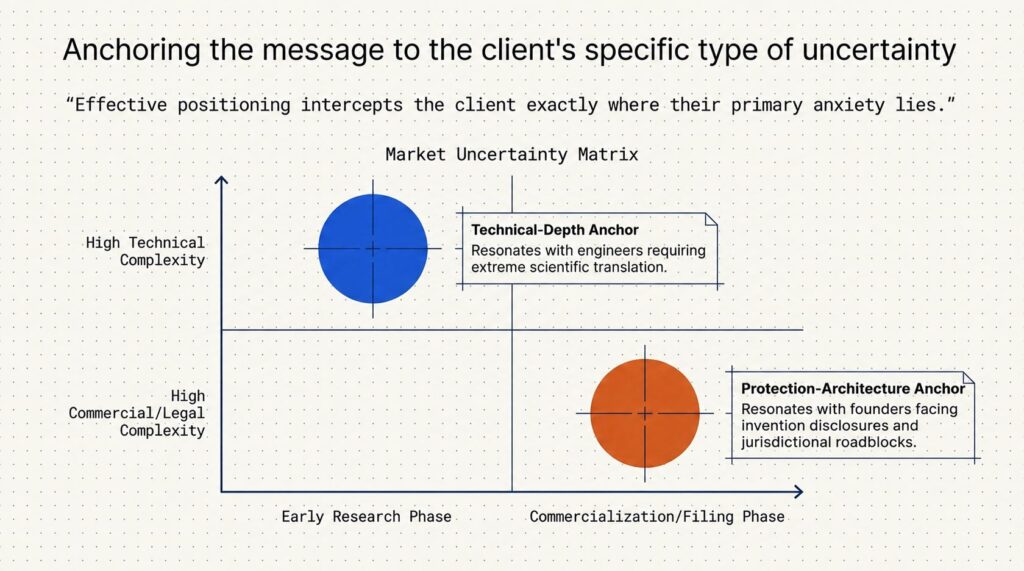
Finally, firms should consider the sequence through which potential clients encounter their expertise. Technical-depth content often resonates with organisations that already recognise the complexity of their inventions and require precise protection. Protection-architecture content may become more influential when an invention disclosure, filing decision or jurisdictional problem already exists. A mature business-development system can connect these stages without expecting one article or one practice page to perform every function.
Why This Matters for IP Business Development
Emerging technologies create a temporary opportunity for practice groups to shape the language through which clients understand their problems. In established sectors, buyers may already know which legal service they require and compare providers through reputation, relationships and execution. In quantum technology, many organisations are still defining the relationship between research strategy, financing, collaboration, product development and intellectual property. The firm that helps articulate that relationship can become relevant before a conventional legal procurement process begins.
D Young & Co LLP’s technical-depth framing creates relevance among scientifically sophisticated audiences. Engineers, researchers and in-house patent professionals may recognise their own challenges in the firm’s emphasis on precision, complexity and defensibility. This positioning aligns with situations in which the primary concern is how to define and protect a technically intricate invention in a robust manner.
Mathys & Squire’s protection-architecture framing creates a different form of relevance. It gives technically sophisticated readers a vocabulary for identifying where protection difficulties may arise and why standard software-patent assumptions may be inadequate. This can convert scientific complexity into concrete advisory questions concerning claim strategy, portfolio scope and jurisdictional choice.
For IP business development, the broader implication is that visible expertise requires more than publishing legal updates. A practice group must decide what uncertainty it is helping the market manage. D Young & Co LLP primarily helps make complex technical subject matter intelligible and defensible. Mathys & Squire primarily helps make an emerging protection environment intelligible. Both approaches connect legal capability with a larger strategic problem, but they create different expectations about the role of the adviser.
That distinction is valuable because credible positioning rarely comes from claiming universal capability. It comes from establishing a coherent perspective that prospective clients can recognise across practice pages, reports, events, articles and individual expert profiles. Quantum technology is the subject in this case, but the principle applies across emerging fields: the strongest practice-group communication does not merely state that expertise exists. It shows how that expertise interprets uncertainty and turns it into a structured basis for business and IP decisions.