
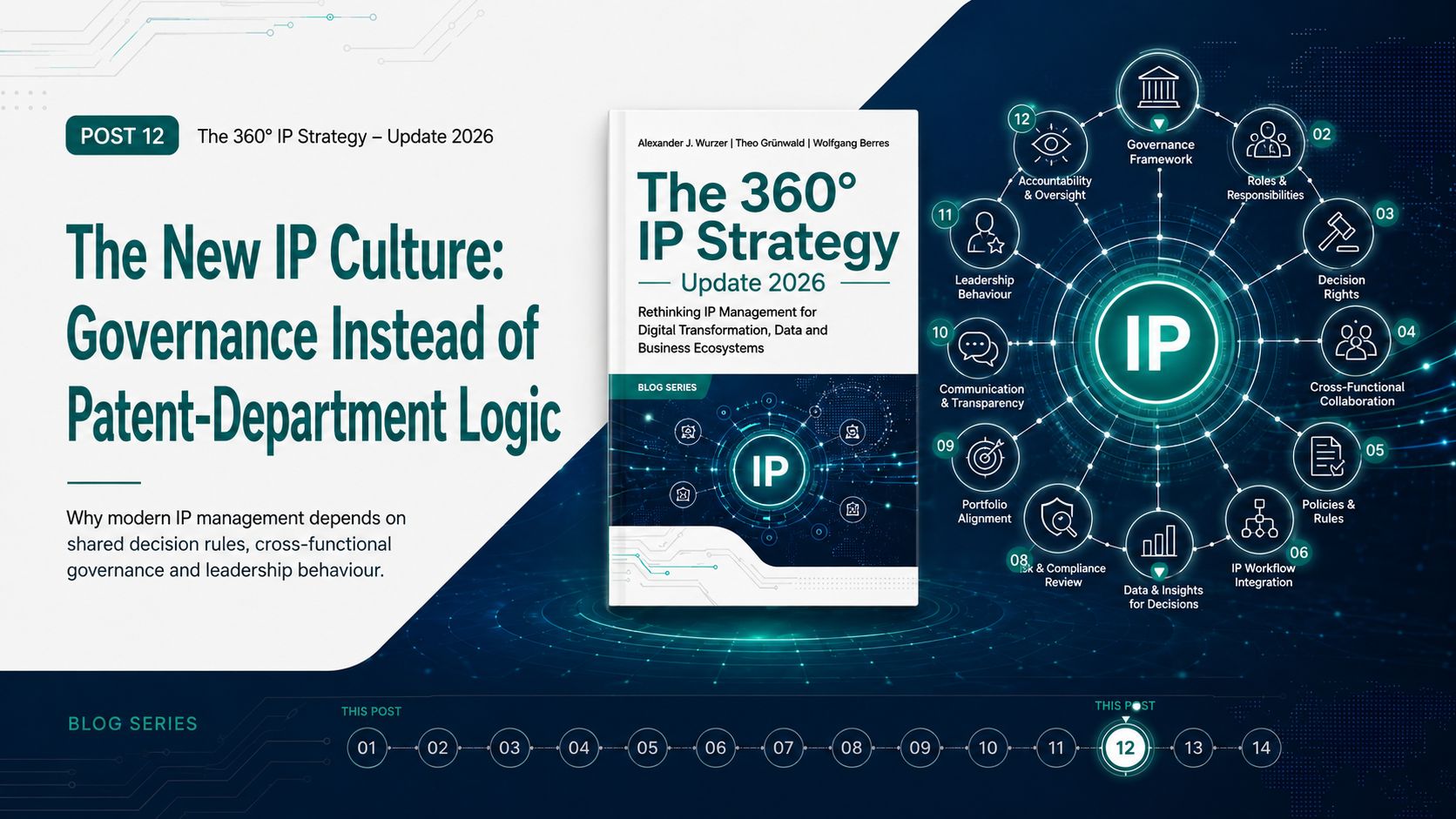
The New IP Culture: Governance Instead of Patent-Department Logic

The original 360° IP Strategy argued that IP culture is revealed by the way an organisation thinks and acts, not by the number of patents displayed in a reception area. A company whose IP process begins only when an engineer submits an invention disclosure has created a particular culture: IP is associated with technical creativity, patents and the specialist work of the patent department. That model can produce excellent rights, but it cannot govern the broader intangible architecture of a modern business.
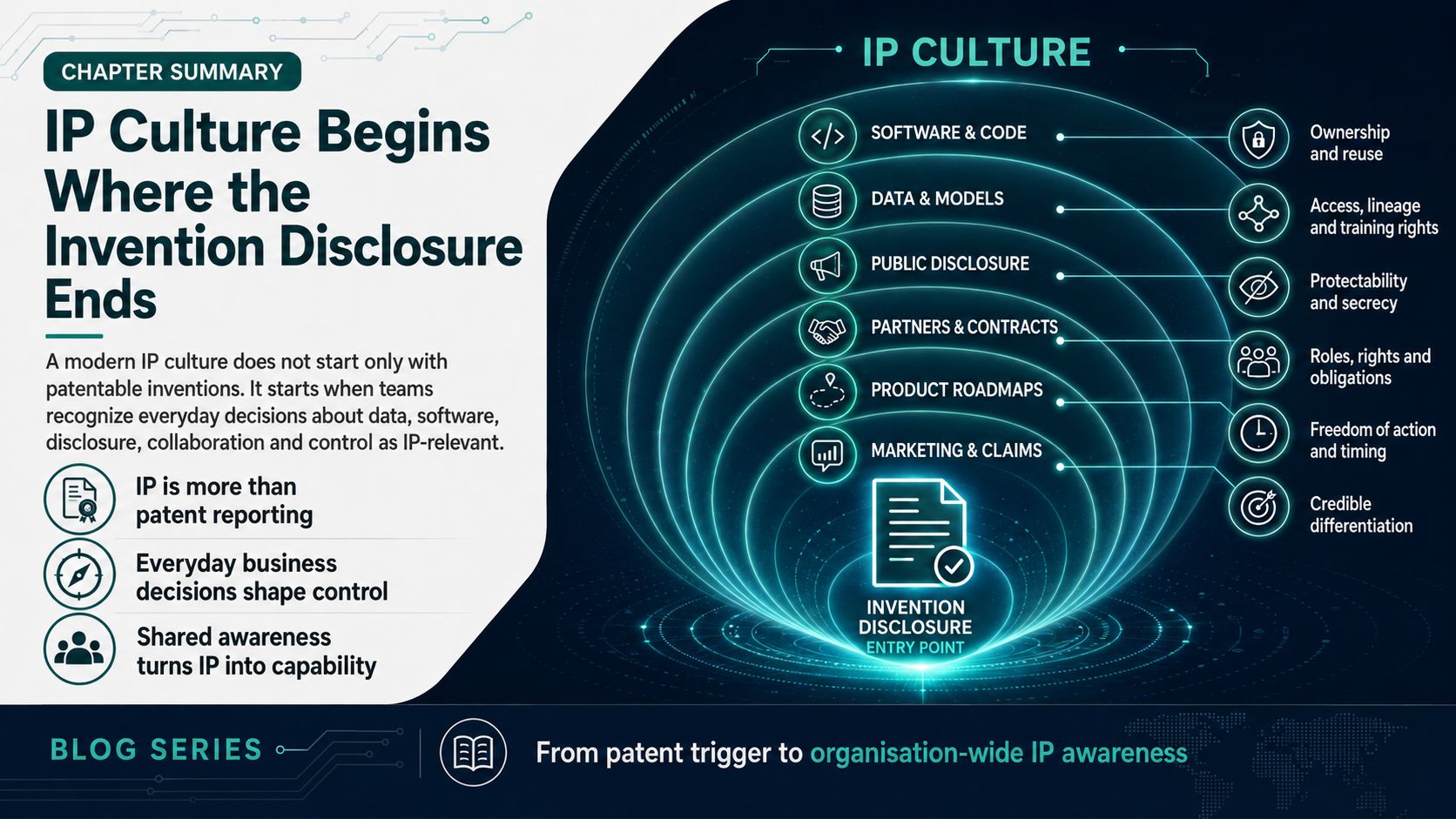
Today, commercially important IP decisions arise in product roadmaps, software repositories, data pipelines, marketing campaigns, procurement, partnerships, standards work and customer projects. A developer selects an open-source component. Marketing prepares a public demonstration. Procurement accepts ownership clauses from a software supplier. Business development shares information with an ecosystem partner. Each choice can affect protectability, confidentiality, ownership, freedom of action and future bargaining power.
The challenge is no longer simply to persuade more inventors to report inventions. It is to create a shared ability to recognise intangible value and make deliberate decisions about control, access, disclosure and use. Governance turns this ability into dependable organisational behaviour.
IP culture begins where the invention disclosure ends
The classical patent process has a clear trigger. A technical employee recognises a solution as inventive, documents it and sends it to the patent department. Patent professionals then assess patentability, draft claims and manage prosecution. This process remains indispensable, but it sees only what has already been identified as an invention and only after someone has decided that the result deserves attention.
Digital value creation produces many assets that do not naturally appear as invention disclosures. A unique dataset may result from years of customer interaction. A decisive workflow may emerge through repeated operational improvement. A model may become valuable because of its training process, evaluation logic and deployment configuration. An interface may create customer dependence without containing one obvious inventive feature. None of these assets will necessarily knock on the patent department’s door.
A broader IP culture teaches the organisation to ask different questions. Which customer-relevant capability would be difficult to replace? Which information must remain controlled? Which dependency could weaken our negotiating position? Which partner contribution must be documented? Which public statement could destroy a protection option? Which third-party rights could restrict a release? These questions do not require every employee to become an IP lawyer. They require people to recognise when a business decision has an IP dimension and to know where that decision belongs.
This changes the cultural symbol of IP. The invention disclosure is no longer the sole gateway into the system. It becomes one trigger among many, alongside release decisions, data access requests, collaboration proposals, publication plans, naming choices, licensing questions and changes in technical architecture.
A modern IP culture begins when the organisation stops equating IP with reported inventions and starts recognising the everyday choices through which intangible advantage is created, exposed, shared or lost.
Governance makes intangible-value decisions visible
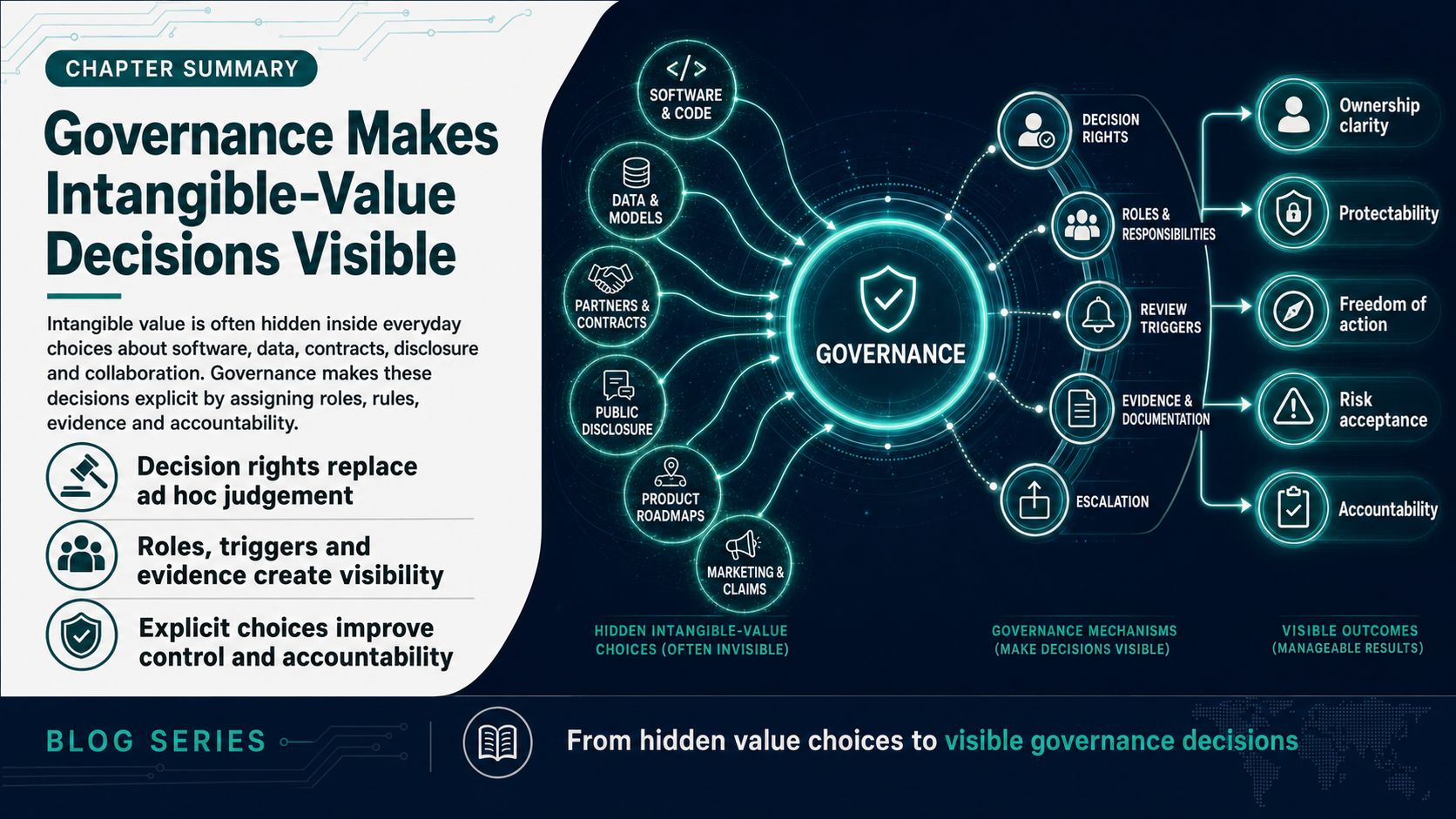
Culture without governance depends on individual awareness. An experienced product manager may involve IP early, while another team may not. A careful engineer may document third-party code, while another assumes that someone else has checked the licence. Good intentions do not create consistency.
IP governance defines the recurring decisions that matter, the criteria to be applied and the people who have authority. It distinguishes who prepares a recommendation, who owns the commercial objective, who assesses legal sufficiency, who must be consulted and who accepts the remaining risk. The purpose is not to centralise everything. It is to prevent significant decisions from becoming nobody’s explicit responsibility.
The decision catalogue is now much wider than patent filing and renewal. It includes whether to patent, keep confidential, publish defensively or release openly; whether software may be incorporated under particular licence terms; who may access a dataset; whether a model may use externally sourced material; which rights must be secured from contractors; what may be disclosed in a standardisation group; and when a launch may proceed despite unresolved third-party positions.
Governance must distinguish decision levels. Routine matters should be handled quickly within defined rules. Decisions affecting a product roadmap, strategic data source, major market launch or ecosystem position require cross-functional assessment and accountable business ownership. Exceptional risks need an escalation route to management. Otherwise, the IP function either becomes a bottleneck or loses visibility over the choices with the greatest consequences.
Useful governance makes the formal path easier than avoidance. Teams should know which information is required, how quickly a response can be expected and where unresolved trade-offs will be decided. A theoretically complete but unusable process creates workarounds and conceals risk.
Governance converts IP culture from personal attitudes into an explicit decision architecture that makes responsibility, timing, evidence and risk acceptance visible across the organisation.
Cross-functional teams need a shared decision language
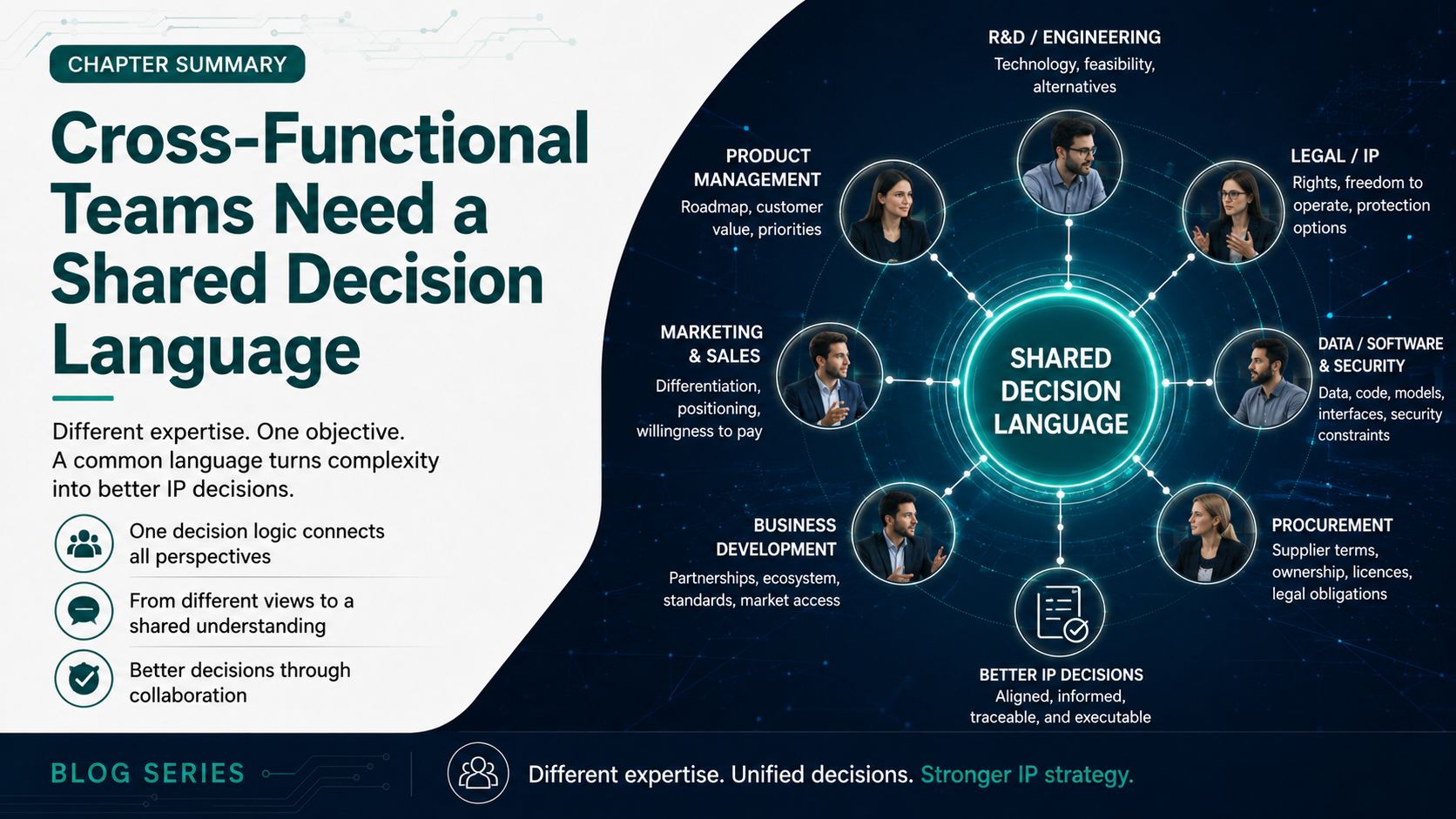
The original 360° logic emphasised multidisciplinary teams because market intelligence and technical intelligence see different parts of the same problem. R&D understands feasibility and alternatives. Product management understands the roadmap and customer priorities. Marketing and sales understand differentiation and substitution. Legal and IP professionals understand rights and enforceability. Digital business models add software, data, cybersecurity, procurement, compliance, regulatory affairs and business development.
Bringing these functions into one meeting does not create integration automatically. Each uses different concepts, time horizons and success criteria. A patent attorney may discuss claim scope. A product manager may think in release value. A software architect may focus on maintainability. Procurement may focus on delivery and liability. Marketing may focus on launch timing. The team needs a shared language that connects these views to the business effect.
That language should begin with the customer-relevant capability and the strategic control required around it. The discussion can follow a common sequence: What business outcome are we trying to secure? Which asset, behaviour or relationship creates it? What could another actor copy, access, bypass or appropriate? Which control mechanisms are available? What evidence is needed? What trade-off does the choice create for speed, openness, cost or scalability?
This prevents legal vocabulary from dominating the conversation while preserving legal precision where it matters. It also prevents business teams from reducing IP to a late yes-or-no approval. The group is not asked to agree on patent doctrine. It is asked to build a coherent decision from complementary expertise.
Shared language improves conflict quality. Openness and protection are not always opposites. Publishing may strengthen freedom of action. Open source may accelerate adoption. Interface access may grow an ecosystem. Confidentiality may preserve a process advantage. The right answer depends on the business model and should be chosen consciously rather than inherited from one department’s default preference.
Cross-functional IP work succeeds when specialists connect their expertise through one decision logic: business effect, control point, options, evidence, trade-off and accountable choice.
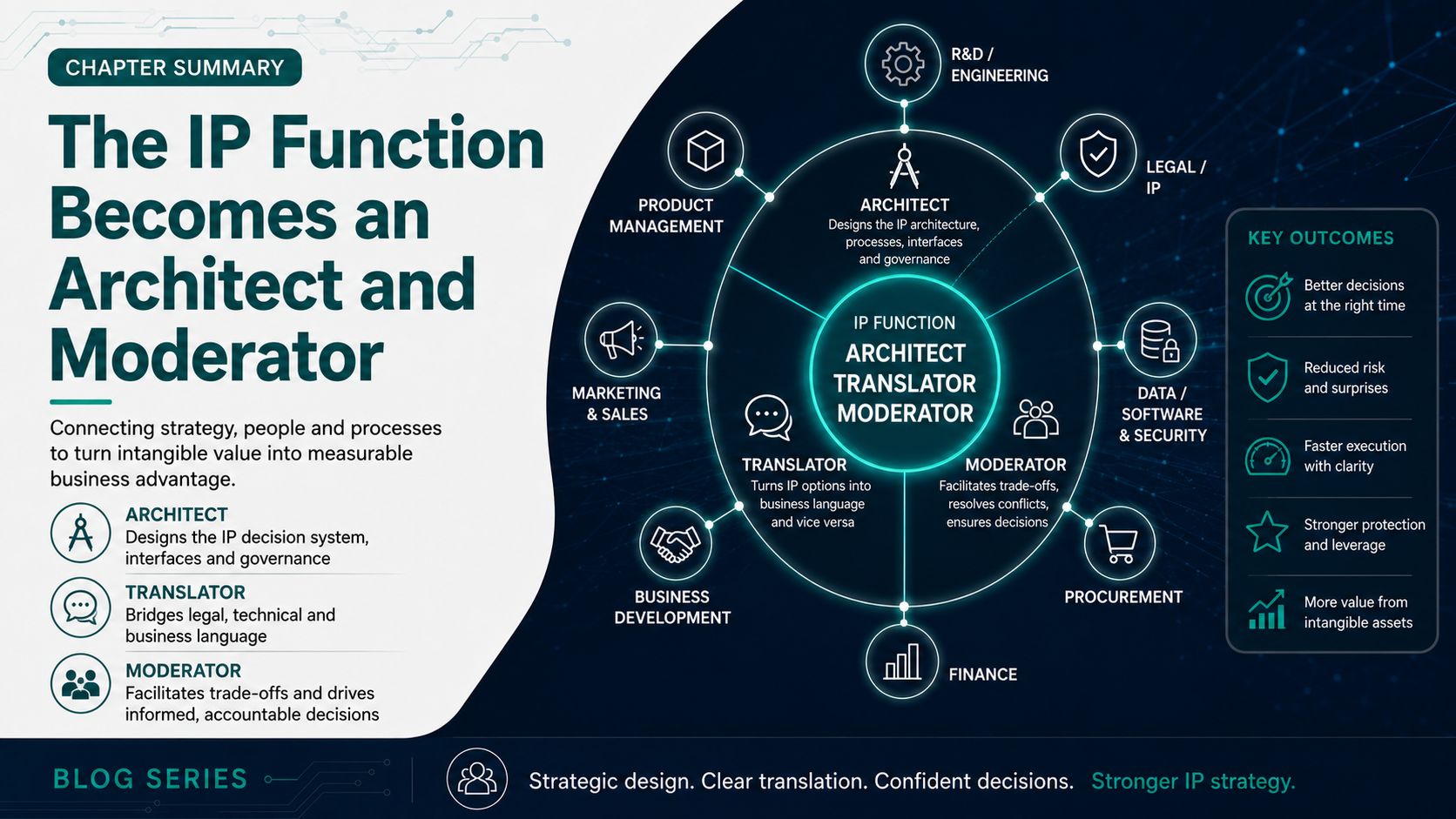
The IP function becomes an architect and moderator
The patent department was traditionally expected to receive inventions, obtain rights, maintain portfolios, conduct searches and support disputes. Those tasks remain essential and require deep legal and technical expertise. The new IP culture does not diminish that expertise. It changes where and how it creates organisational value.
The IP function becomes an architect by designing the decision system around intangible assets. It identifies recurring IP-relevant situations, defines interfaces with existing processes, develops criteria, establishes escalation paths and ensures that decisions create usable evidence. It connects patent work with trade secrets, contracts, data rights, copyright, designs, trademarks, open-source governance and technical protection rather than allowing each topic to develop as an isolated specialist track.
It becomes a translator by expressing IP options in stakeholder language. Product management needs consequences for roadmap freedom and differentiation. Finance needs resource requirements and exposure. Sales needs to understand which claims can be made credibly and exclusively. Software teams need clear rules for components, provenance and disclosure. Management needs options, assumptions and residual risks rather than unexplained legal conclusions.
It becomes a moderator because IP decisions contain legitimate conflicts. A business unit wants speed; legal wants evidence. Developers want reuse; security wants restrictions. Marketing wants visibility; patent counsel wants confidentiality. Partners want openness; the company wants differentiation. The IP function should not automatically win every conflict. It should ensure that the trade-off is framed correctly, informed by relevant expertise and decided by the person who owns the business consequence.
This role requires restraint. Not every decision needs central approval, a committee or a long memorandum. The architecture should apply proportionality: simple rules for recurring low-risk matters, expert review for material questions and management escalation for strategic exceptions.
The modern IP function remains the centre of IP expertise, but its broader contribution is to design and facilitate the choices through which intangible advantage becomes controllable, defensible and economically useful.
Culture is proven by behaviour at moments of choice
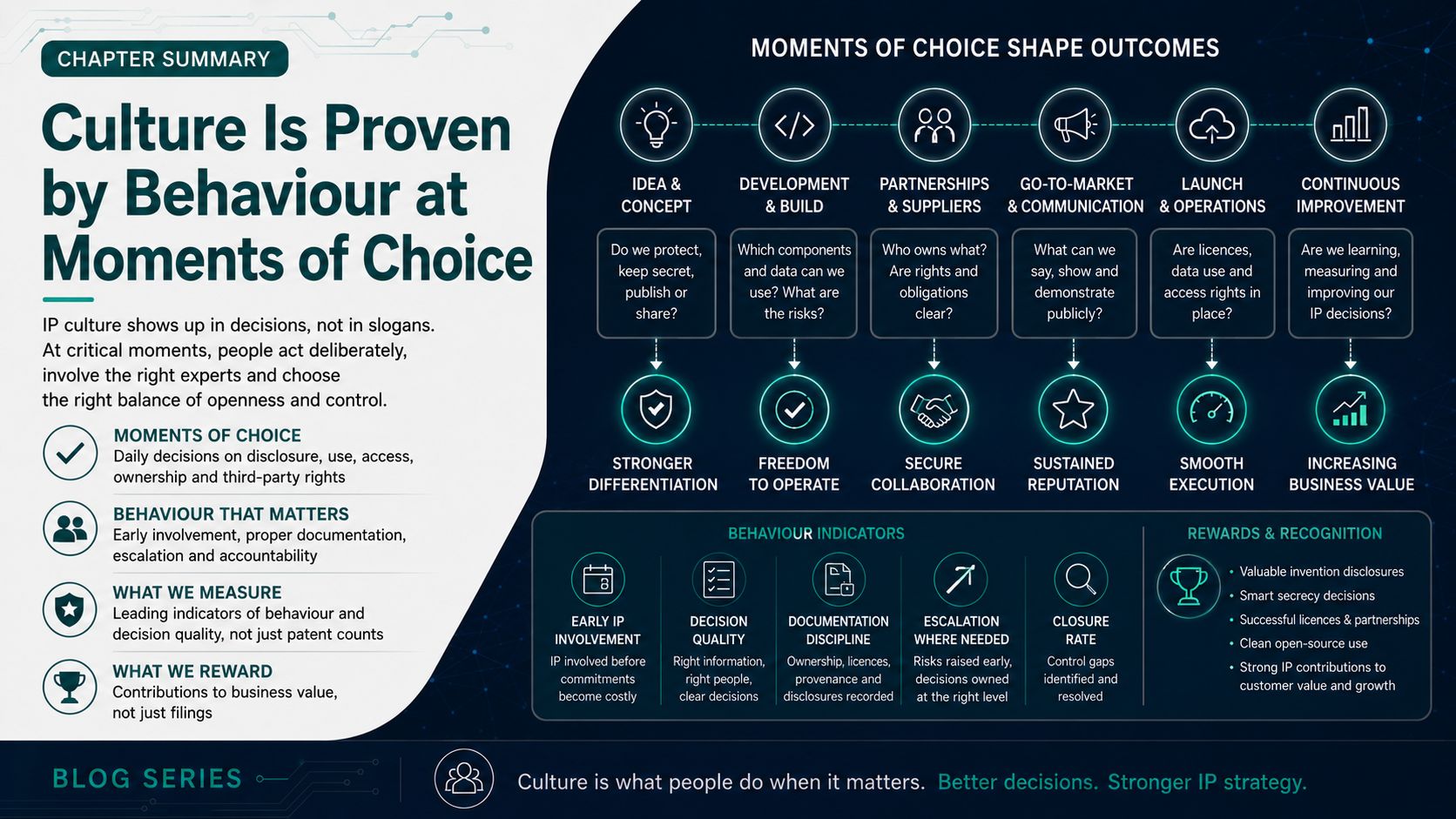
Posters, awareness days and training courses can support IP culture, but they do not prove that it exists. Culture becomes visible when a team faces pressure and still makes a deliberate choice. Does a project pause before publishing? Does procurement clarify ownership before supplier development begins? Does a software team record component provenance during the build rather than before release? Does product management involve IP while the architecture can still be changed? Does management accept or reject a risk explicitly rather than allowing delay to decide?
Useful cultural indicators therefore measure behaviour and decision quality. Examples include the share of priority projects with early IP involvement, the time required to resolve recurring questions, the completeness of ownership and provenance records, the number of strategic disclosures reviewed before publication, the closure rate of identified control gaps and the proportion of portfolio decisions linked to business objectives. These indicators should reveal whether the organisation can act with confidence, not reward bureaucracy.
Incentives shape behaviour. Rewarding only patent counts teaches employees that filing volume is the desired outcome. A broader culture recognises commercially relevant invention disclosures, intelligent secrecy decisions, successful licensing, clean collaboration structures, well-designed workarounds, responsible open-source use and evidence that preserves enforcement options. Recognition should follow contribution to business value, not attachment to one legal instrument.
Leadership signals are decisive. Employees observe which questions executives ask, which risks receive attention and which behaviours are rewarded under time pressure. When management asks how a roadmap decision affects control, freedom and differentiation, IP becomes part of business judgement. When executives discuss IP only during disputes or budget cuts, the organisation learns that it is an episodic legal cost.
The strongest culture is neither protective by default nor open by default. It is decision-capable. It distinguishes what must be owned, what may be shared, what should be licensed, what should remain secret and what can be published to create freedom or adoption. It preserves speed because responsibilities are clear, not because IP questions are ignored.
The new IP culture is governance lived in daily work: shared attention to intangible value, explicit decision rights, cross-functional judgement and leadership behaviour that turns IP from a patent-department concern into an organisational capability.
Supplementary content on the IPBA® platform:
IP Governance
Defines IP governance through decision rights, accountability, escalation paths and the distinction between the governance framework and operational execution. It provides the conceptual foundation for moving beyond ad hoc patent-department decisions.
👉 Read more
IP Culture
Explains the shared behaviours, incentives and routines through which employees recognise intangible value, involve experts early and handle protection, disclosure and third-party rights without slowing innovation.
👉 Read more
IP as a Leadership Tool
Connects IP with leadership responsibility, innovation culture and proactive risk management, showing why executive signals and internal processes determine how IP is treated throughout the organisation.
👉 Read more
Mastering the Machinery of IP in Module 4 CEIPI MIPLM: Organizational Theory Meets IP Management
Shows how functional, divisional, matrix, team-based and network structures influence IP decisions, delegation and collaboration. The discussion of subsidiarity and agile decision-making is particularly relevant for governance design.
👉 Read more
Integration of IP in the Innovation Process – Interview with Frederik Golks
Demonstrates why early integration and collaboration between R&D, IP and marketing are necessary to combine technical robustness, commercial relevance and protection strategy.
👉 Read more
IP in the Innovation Process at STIHL
Provides a practical example of a patent department evolving towards interdisciplinary collaboration, patent intelligence and proactive steering of strategically important IP creation.
👉 Read more
Unlocking Success: How Oxylabs Leverages IP Strategy to Drive Innovation
Illustrates how company-wide IP awareness, internal processes and clearly structured contractual responsibilities can embed IP thinking beyond specialist and inventor communities.
👉 Read more
Dolby Labs: The Blueprint for Multigenerational Innovation and IP Mastery
Shows how regular interaction between engineering, marketing, finance and legal teams, combined with appropriate incentives, can make IP part of a sustained innovation culture.
👉 Read more
From Chaos to Clarity: How Bas Albers Is Revolutionizing IP Management for SMEs
Distinguishes strategic IP management from portfolio administration and presents the IP manager as an organisational ambassador who connects departments, information and business objectives.
👉 Read more
IP Outsourcing
Clarifies that strategic control does not depend on performing every task internally. It depends on retaining decision rights, information quality, review discipline and the logic behind external assignments.
👉 Read more