Is Your Digital Footprint Conference-Ready?

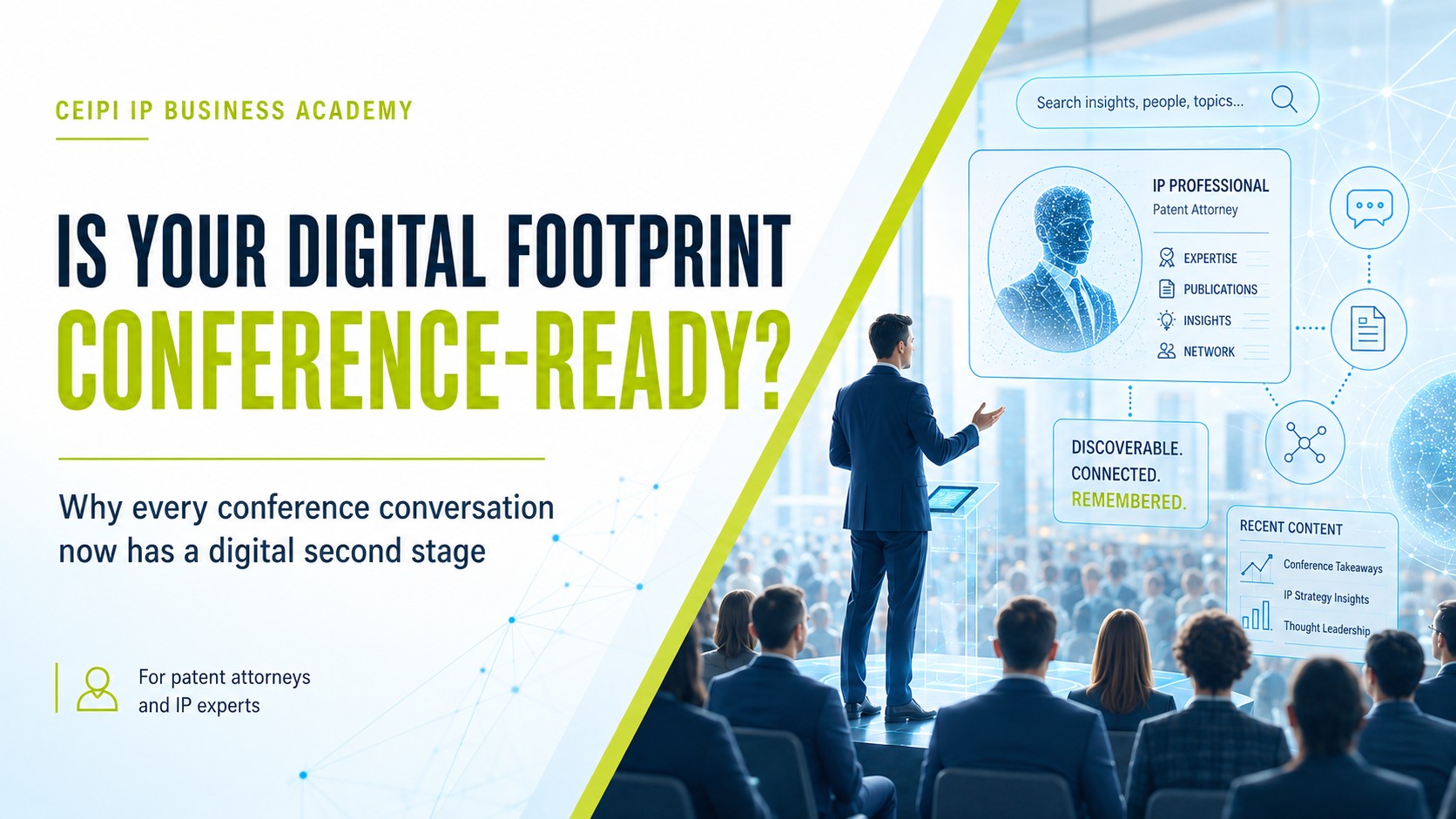
An important conference is more than a day of presentations, meetings and conversations over coffee. It is also a moment in which other participants begin to assess you digitally. After hearing you speak or meeting you in person, they may open your LinkedIn profile, visit your firm website, search your name on Google or ask an AI chatbot about your expertise. This digital judgement happens whether you prepare for it or not. The question is therefore not only whether you are ready for the event, but whether your digital footprint is ready for the people you want to meet. Our Conference-Ready Checklist helps patent attorneys and IP experts assess how well their online presence supports their role as attendee, speaker, panellist or moderator, and where preparation can increase the value of the conference.
Every conference conversation continues online
A conference takes place across a connected sequence of personal and digital interactions. Participants research speakers and attendees before arriving, check profiles during the event and revisit new contacts afterwards. These activities influence whom they approach, which conversations they remember and which relationships they continue.
A speaker may attract attention through a strong presentation and then receive profile visits while the next session is already beginning. A patent attorney may discuss a specialist issue at the coffee table and find that the other participant searches for publications on the subject immediately afterwards. A potential client may remember the conversation several days later and use Google or an AI assistant to understand the expert’s background in greater detail.
Each of these moments involves a rapid professional assessment. The person wants to understand the expert’s field, experience, relevance and credibility. LinkedIn, the law firm website, publications, podcasts, conference pages and search results collectively shape that assessment. A strong digital presence helps the new contact connect the person with a clear area of expertise. It also makes the conversation easier to remember and gives the contact useful material for an internal recommendation, a follow-up discussion or a future mandate.
Visible expertise supports professional credibility
Many patent attorneys and IP experts possess considerable specialist experience that remains difficult to recognise online. Their profiles often communicate professional titles, qualifications, offices and career histories, while the relationship between their work and the commercial challenges of clients receives less attention.
A new contact may therefore see that someone is a European Patent Attorney or a partner in an established firm while remaining uncertain about the technologies, industries and strategic situations in which that person creates particular value. Clear positioning helps resolve this uncertainty. A conference-ready profile enables visitors to understand the expert’s relevance within a few seconds. It connects technical and legal expertise with recognisable client situations, such as protecting quantum software, developing an automotive patent strategy, managing freedom-to-operate risks in medical technology or handling standard-essential patent issues.
Credibility becomes stronger when the profile is supported by visible evidence. Relevant articles, interviews, presentations, podcasts, case perspectives and conference contributions show how the expert approaches the subject. They allow potential clients and professional contacts to experience the expert’s thinking beyond the short personal conversation.
Consistency also plays an important role. LinkedIn, the law firm profile, conference biography and published content should communicate a coherent professional position. When these sources reinforce each other, search engines, AI systems and human readers can understand the expertise more easily.
Preparation should cover the full event journey
Digital event preparation begins several weeks before the conference. At this stage, the expert can define the purpose of the participation, the people they would like to meet and the subjects for which they want to be recognised. This strategic clarity provides the basis for profile adjustments, content selection and targeted communication.
Before the event, relevant participants may already be researching the agenda and deciding which conversations deserve priority. An expert who publishes a thoughtful perspective on a conference topic can become familiar to these participants before the first meeting. A speaker or moderator can also make the upcoming contribution visible and provide context that helps attendees understand its relevance.
During the conference, the digital presence should support the personal experience. Participants who visit the profile should find a clear professional position, useful evidence and accessible routes for further engagement. Selected event-related posts can extend discussions from the room into a wider professional community, particularly when they focus on substantive observations and practical questions.
After the event, the digital footprint helps turn brief encounters into continuing relationships. A personalised follow-up can refer to the conversation and include a relevant article, interview or perspective. The recipient can then revisit the profile and immediately recognise the expertise that created the connection.
This preparation is particularly valuable for speakers, panellists and moderators because their stage presence creates concentrated attention. It is equally relevant for participants whose most valuable conversations emerge spontaneously and may last only a few minutes.
Use the Conference-Ready Checklist for IP Experts
The CEIPI IP Business Academy has developed the Conference-Ready Checklist for IP Experts based on our experience with professional positioning, digital visibility and business development in the IP community.
The free Self-Assessment Edition provides a structured assessment across ten areas. It examines the strategic purpose of the conference, the digital first impression, the visibility of relevant specialist topics and the available evidence supporting the expert position. It also addresses preparation as an attendee, speaker, panellist or moderator.
Further sections cover communication before, during and after the event, the quality of the follow-up process and the consistency of the complete digital footprint. The resulting Conference-Ready score shows which aspects already support the conference appearance and where relevant gaps remain.
The assessment is connected to the specific event. It encourages experts to consider which participants matter most, which conversations they want to create and which professional position should remain memorable afterwards. This turns profile development from a general branding exercise into a practical part of conference preparation.
The checklist can be used independently and provides a clear picture of current Conference-Readiness. The score shows where gaps exist, but not automatically which gaps are most important for the particular event. In a personal Conference-Ready Review, we identify the three priorities that matter most and translate them into an individual action plan.
Where professional support is useful, we also help with the implementation – including profile preparation, specialist positioning, credibility-building content, event communication and structured follow-up.
👉 Get the free Conference-Ready Checklist – Send us an email with the subject line “Checklist”: heike.veitengruber@ipbusinessacademy.org
Compare your self-assessment with what others actually find
The Conference-Ready Self-Assessment is the starting point for the personal review. Before arranging the appointment, complete the checklist, calculate your overall score and identify the two or three dimensions that appear most important for your upcoming conference.
The self-assessment captures your perspective: the position you want to establish, the expertise you want to make visible and the contacts you hope to reach. The CEIPI IP Business Academy then prepares a preliminary review of your publicly visible digital footprint. This provides the external perspective: what a participant, potential client or professional contact can actually find and understand without already knowing your background.
The preliminary review may include your LinkedIn profile, law-firm biography, selected publications, initial search-engine results and a limited number of topic-based and AI discoverability checks.
Together, the two perspectives help answer three practical questions:
- Does the digital impression match the position you want to establish?
- How clearly does the available information communicate your expertise?
- Which gaps could most strongly affect your conference objective?
During the complimentary appointment, we compare your self-assessment with our initial observations and identify the two or three priorities that matter most for the event. This creates a focused basis for deciding what can be improved internally and where professional support would add value.
The preliminary review is intended as a starting point, not as a comprehensive audit or completed implementation plan. A detailed analysis, profile refinement, content preparation, outreach planning and implementation support are offered separately as paid Conference-Ready services.
To arrange your personal review, contact me directly on LinkedIn or by email and include:
- the conference and your role;
- the topic for which you want to be recognised;
- your overall checklist score;
- the two or three dimensions that stood out most.
We will then prepare the preliminary Digital Footprint and Discoverability Review for our conversation.
👉 Complete the checklist and contact me to arrange your complimentary Conference-Ready Review. Heike Veitengruber: heike.veitengruber@ipbusinessacademy.org