The Trust Compound: Why Continuous Online Marketing Wins


Many experts still treat online marketing as an occasional activity. They post after a conference, update their profile after a ranking, publish a short announcement when a new article goes live, and then disappear again for weeks or months. This is especially common in professional services, where client work is urgent, technical work is demanding, and communication often feels like something that can wait.
The problem is that the market does not build trust in occasional bursts. It builds trust through repeated signals. A potential client may not react to the first post, the second article, or the third comment. But over time, a pattern emerges. The expert becomes associated with a specific topic, a type of problem, a client situation, or a strategic perspective. That is why continuous online marketing is so powerful. It does not merely create visibility. It creates memory. And in expert markets, memory is often the first step toward trust.
Sporadic Visibility Is Not Enough
Sporadic marketing can create short moments of attention. A post may receive likes, a conference announcement may generate polite comments, and a profile update may briefly remind the network that the expert exists. These moments are not useless. They can support reputation and show activity. But they rarely create a stable market position.
The reason is simple: isolated signals fade quickly. Professional services are not bought like simple consumer products. A client does not usually see one post and immediately instruct a patent attorney, IP strategist, or litigation expert. The buying process is slower, more uncertain, and more trust based. Decision makers need to understand what the expert stands for. They need to see whether the expert understands their world. They need to believe that the expert can help with a problem that matters to the business.
That belief is rarely created in one encounter. It is created through continuity. A single post may answer one question. A continuous presence teaches the market how to think about the expert. It gives the audience repeated opportunities to connect the expert with a problem. It makes the expert easier to remember, easier to recommend, and easier to approach when the right need appears. Sporadic activity starts from zero again and again. Continuous activity compounds.
Online Marketing as Trust Infrastructure
For IP experts, online marketing should not be understood as decoration. It is not simply a way to look active on LinkedIn or to announce achievements. It is a trust infrastructure. This matters because IP advice is often a credential good. Clients cannot fully assess the quality of the advice before they buy it. They may not know whether they need a patent strategy, a trade secret framework, a freedom to operate analysis, a licensing model, litigation support, portfolio structuring, anti counterfeiting measures, or investor readiness work. They often feel the risk before they can name the need. Continuous online marketing helps them name that need.
When experts communicate consistently, they educate the market before the first formal conversation. They show recurring patterns. They explain common mistakes. They translate legal and technical complexity into business relevance. They help the audience recognize situations in which IP is not an administrative task, but a strategic factor. This is where the economic value begins. Better informed clients are more likely to ask better questions. Better questions lead to better conversations. Better conversations are more likely to become qualified mandates.
The Power of a Recognizable Field
The strongest expert brands are not built by saying everything once. They are built by saying the important things repeatedly, from different angles, in different formats, and for different audience situations. This does not mean repeating the same sentence every week. It means returning to a recognizable field of relevance.
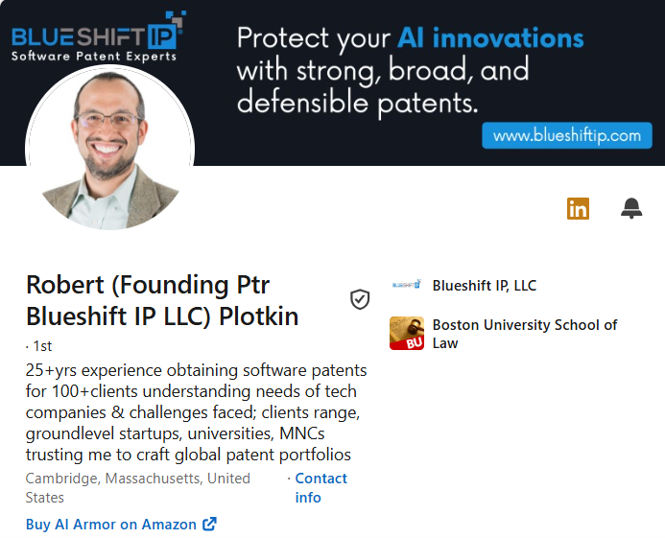
Robert Plotkin is a good example. His positioning is not framed around patent law in general. It is framed around software patents and the value of patent portfolios for growing technology companies. His public profile connects software patents with exits, financing, licensing, valuation, protection against competitors, and AI related invention. That creates a clear market signal. A technology founder or investor does not have to guess what he wants to be known for. The positioning is business oriented, specific, and easy to remember. That is exactly what continuous marketing should achieve. It should make relevance obvious before the first call.
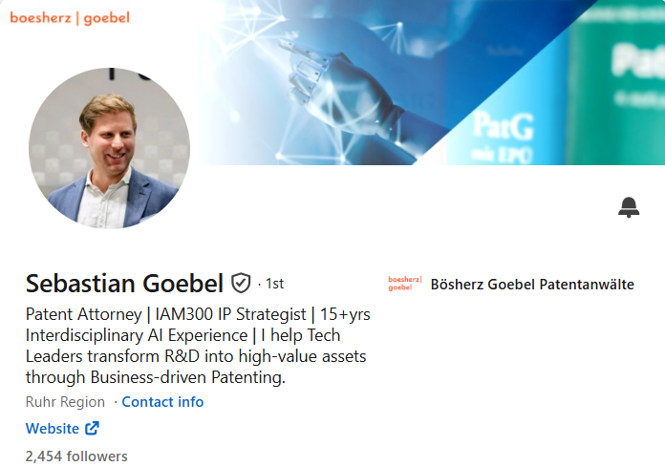
Sebastian Goebel shows another version of this pattern. His public profile connects AI, software development, digital technologies, electrical and computer engineering, and business oriented patenting. The language is not only legal. It bridges R&D and high value assets. That is important because many technology leaders do not think first in patent categories. They think in products, technical roadmaps, investment, differentiation, and competitive advantage. A single post about AI patents may create interest. A continuous presence around AI, software, digital technology, and business oriented patenting creates authority.
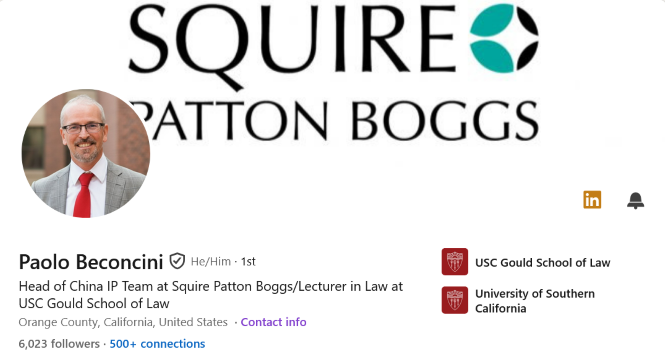
Paolo Beconcini shows a different kind of focus. His field is China IP, APAC, anti counterfeiting, enforcement, cross cultural understanding, and the protection of multinational corporations in complex markets. This is a highly specific trust field. It says to the market: when the problem involves China, enforcement, counterfeit risk, and cross border complexity, this expert voice is relevant.
Again, continuity matters because the need may not exist today. A company may not currently face a counterfeiting crisis in China. But when the issue becomes urgent, decision makers are unlikely to start from a neutral list of names. They will remember those experts who have repeatedly helped them understand the risk environment.
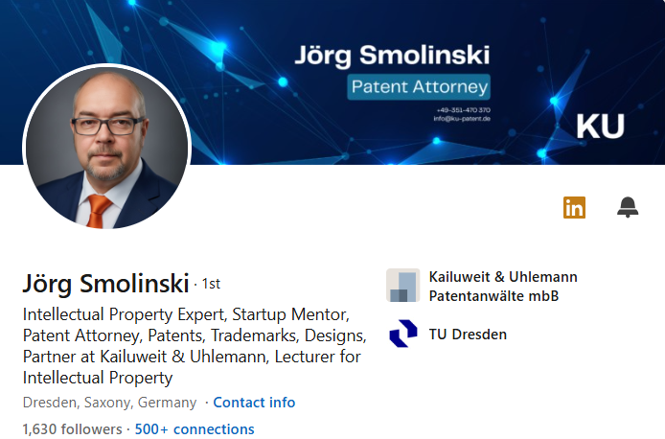
Jörg Smolinski offers another strong example. His profile combines IP strategy, patent prosecution, litigation, trademarks, designs, Life Sciences, biotechnology, chemistry, medical technology, startups, research institutions, and international companies. This creates a valuable communication field around the connection between technical innovation, regulated markets, and business aligned IP protection.
For this type of expert, continuous online marketing can turn a broad professional profile into a market narrative. It can show founders why IP matters early. It can show research institutions how protection connects with transfer. It can show Life Sciences companies why regulatory complexity and IP strategy must be considered together. The common thread across these examples is not that all experts should communicate in the same way. They should not. The common thread is that each expert needs a field that the market can understand and remember.
Repetition Is Not Redundancy
Many experts hesitate to repeat themselves. They think, “I already wrote about this.” But this is usually the wrong way to look at online marketing. The expert may have said it before. The market may not have heard it yet.
Different people see different posts. Different audiences need different examples. Different buying situations make the same idea newly relevant. A founder reading about patent strategy before fundraising hears a different message than a corporate IP manager reading the same topic during portfolio review. A technology leader thinking about AI may notice different aspects than an investor assessing the defensibility of a company.
Repetition does not mean boredom. It means reliability. The expert should not reinvent the core message every week. The examples can change. The industry context can change. The format can change. The level of detail can change. But the strategic signal should remain stable. That is how markets learn. When an expert repeatedly appears in the same problem space, the audience begins to associate the expert with that space. Over time, the expert no longer has to introduce the field from scratch. The market already has a mental frame. This reduces friction in business development. The first conversation becomes warmer because part of the explanation has already happened in public.
Continuity Improves Positioning
Continuous online marketing is not only useful for the audience. It also sharpens the expert’s own positioning. At the beginning, many experts communicate too broadly. They list all services, all industries, all credentials, and all possible areas of expertise. This may be accurate, but it is often too wide to create a memorable signal. Continuity forces selection. Each post, article, podcast, comment, or case reflection requires a decision: what is worth saying again? Which audience matters most? Which problem keeps returning? Which examples create resonance? Which topics lead to meaningful conversations? Over time, the expert learns from the market.
Some topics receive attention but no serious follow up. Others lead to direct messages, speaking invitations, referrals, or client conversations. Some formulations are too abstract. Others make the business relevance clear. Some angles remain generic. Others reveal a real market gap. In that sense, continuous online marketing is also market research. It shows where the expert’s knowledge meets demand. This is one reason sporadic activity is weak. It produces too little feedback. A burst of communication may create noise, but it does not generate enough learning. Continuous activity produces a stream of signals that can be observed, adjusted, and improved.
The Timing Problem in Expert Services
One of the biggest reasons continuity matters is timing. Expert services are often needed at unpredictable moments. A founder prepares a funding round. A competitor enters the market. A product launch moves closer. A dispute appears. A counterfeiting issue becomes visible. A board asks whether intangible assets are really protected. A company prepares an acquisition and suddenly realizes that years of IP decisions will be examined under pressure.
The expert cannot know exactly when the need will become urgent. Sporadic marketing assumes that visibility and client need will coincide. Continuous marketing accepts that they usually do not. That is the economic logic behind consistent communication. It keeps the expert present before the buying moment. It increases the likelihood that, when the problem becomes concrete, the expert is already part of the client’s mental shortlist.
This is especially important in IP because the need is often hidden until pressure reveals it. Many companies do not think about IP strategy when everything is going smoothly. They think about it when fundraising, enforcement, product expansion, litigation, licensing, or due diligence forces the issue into view. By then, trust cannot be built instantly. It must already exist.
Announcements Are Not Enough
Another common mistake is to treat online marketing mainly as announcement work. Rankings, conferences, awards, new hires, article publications, and event participation all have their place. But if communication consists only of announcements, the audience learns very little about how the expert thinks. Effective continuous marketing is different. It starts from the client’s problem.
Instead of saying, “We attended a conference,” the expert can explain which market shift became visible there. Instead of saying, “We wrote an article,” the expert can explain why the topic matters now. Instead of saying, “We are proud of a ranking,” the expert can connect the recognized expertise with a real problem that clients face.
The best online marketing does not shout, “Look at me.” It helps the audience understand something that matters to them. This is also why good expert communication is not self promotion in disguise. It is client education. It gives language to risks. It explains strategic choices. It shows patterns. It helps decision makers see that a legal or technical issue is actually a business issue.
From Visibility to Business Results
The path from online marketing to economic results is rarely linear. A person may read several posts without reacting. Later, they may mention the expert internally. Someone else may see an article. A colleague may forward a profile. A conference contact may recognize the same expert from LinkedIn. A potential client may follow silently for months before making contact. This is why measuring only immediate reactions can be misleading.
Likes are visible. Trust is not. Comments are visible. Mental availability is not. Impressions are visible. Referral readiness is not. Continuous online marketing builds assets that are partly invisible until they convert into real conversations. These assets include clearer positioning, stronger recognition, better referral language, more educated prospects, and a warmer first contact.
For IP experts, this is particularly valuable. Many potential clients do not know exactly what they need. They may only sense that something is strategically important. Continuous communication helps them connect that vague concern with a concrete expert field. That is how marketing becomes business development before the first meeting.
A Sustainable Rhythm Beats Short Bursts
Continuity does not mean publishing every day. It also does not mean producing content without a strategy. The goal is not volume. The goal is a sustainable rhythm that makes the expert’s relevance visible over time. For many experts, this could mean one strong post per week, one deeper article per month, regular profile refinement, meaningful comments in relevant conversations, and a recurring theme that connects expertise with market needs. The rhythm must be realistic. If it depends on extraordinary effort, it will collapse as soon as client work becomes intense. A good system should be repeatable. It should make it easier for the expert to show up consistently without turning marketing into a second full time job.
This is where structure matters. A clear topic architecture, recurring formats, audience definitions, editorial planning, and support in writing and distribution can turn online marketing from a burden into a professional system. The expert remains the source of substance. The communication system makes that substance visible, understandable, and commercially relevant.
The Real Question
The real question is not whether experts should post more often. More activity alone is not the answer. The better question is this: what should the market repeatedly learn about this expert until the connection becomes impossible to miss?
For Robert Plotkin, the lesson may be software patents as value creation for technology companies. For Sebastian Goebel, it may be the transformation of digital R&D into high value IP assets. For Paolo Beconcini, it may be China IP enforcement and anti counterfeiting in complex cross border markets. For Jörg Smolinski, it may be business aligned IP strategy for startups, Life Sciences, and technically complex innovation fields. Every expert needs such a field of recognition. Once that field is clear, continuity turns communication into compounding trust. The expert becomes more visible, more understandable, more memorable, and more referable. The market does not just see activity. It sees relevance. That is why continuous online marketing is not an accessory to business development. It is the beginning of business development, long before the first formal conversation starts.
Listen to the podcast episode ‘Taking the Trust Compound Further’.
 The question is therefore not simply how often an expert communicates, but which association should grow stronger with every interaction. Episode #97 of IP Management Voice continues this thought. It explores how repeated signals create memory and trust, why silent readers may matter more than visible engagement suggests, and how a sustainable communication rhythm can turn a recognizable field of relevance into long-term business development.
🎧 https://ip-management-voice.podigee.io/97-the-trust-compound-why-continuous-online-marketing-wins