Two Ways to Make UPC Strategy Legible: Pan-European Coordination at Bird & Bird and Case-Led Litigation Intelligence at BARDEHLE PAGENBERG

The Unified Patent Court has moved rapidly from institutional experiment to an important venue for European patent litigation. Since opening in June 2023, it has created new possibilities for cross-border enforcement, central revocation, provisional measures and coordinated litigation across participating EU Member States. At the same time, it has added a new layer of strategic complexity.
International companies no longer face a simple choice between litigating in one national jurisdiction or another. They may need to coordinate proceedings before the UPC with national infringement and revocation actions, European Patent Office opposition proceedings and litigation in countries outside the UPC system. They must consider the choice of division, procedural speed, evidentiary preparation, validity risk, territorial scope and the commercial consequences of decisions that may take effect across several markets. This creates a communication challenge for patent litigation practices.
A statement such as “we represent clients before the UPC” may establish basic capability, but it does not yet explain which strategic uncertainty the firm helps clients resolve. Strong UPC communication must make the new litigation environment understandable. It must show companies how the different courts, procedures and territorial options interact and how those interactions affect business decisions.
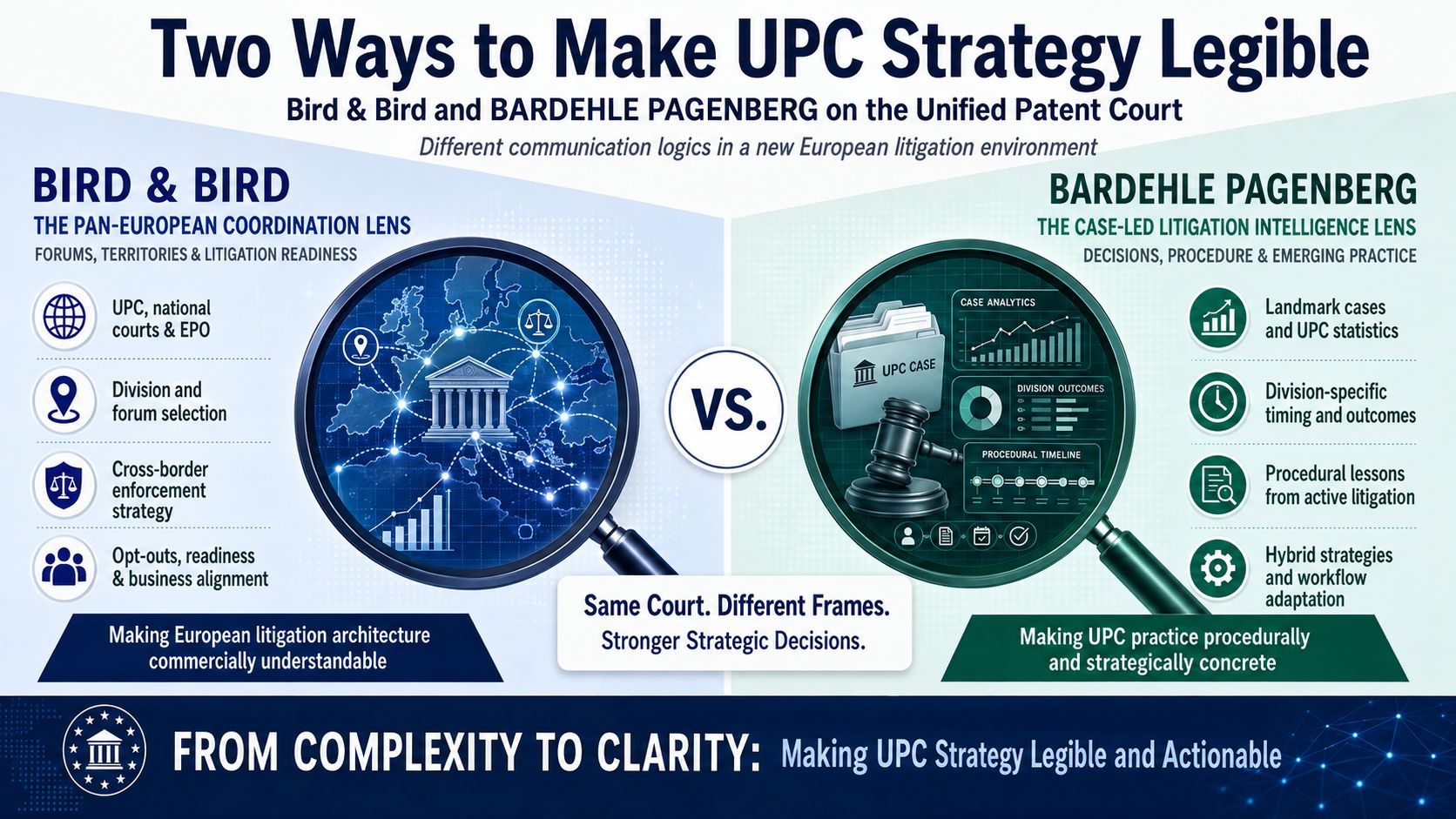
The public communications of Bird & Bird and BARDEHLE PAGENBERG illustrate two credible but distinct approaches to this task. This is not a ranking of the two firms’ legal capabilities. Public communication cannot establish which practice is stronger. It is an examination of how two highly active patent litigation teams make the UPC relevant and legible to potential clients.
The Common Field
Both Bird & Bird and BARDEHLE PAGENBERG present the UPC as more than an additional court. Their communication recognises that the UPC changes the architecture of European patent litigation. Both firms discuss infringement and revocation proceedings, provisional measures, the choice between different courts, the interaction with national proceedings and the strategic implications of emerging UPC case law. Both also foreground practical experience. Bird & Bird states that it has been involved in a significant proportion of UPC proceedings, including infringement proceedings, revocation cases, provisional-measures applications and appeals. The firm links this experience to landmark proceedings involving issues such as claim construction, validity, preliminary injunctions, standard-essential patents and the competence of the UPC.
BARDEHLE similarly places its extensive case involvement at the centre of its communication. Its public materials refer to participation in hundreds of UPC actions and highlight proceedings such as Philips v Belkin, 10x Genomics v NanoString, Amgen v Sanofi and other cases that have clarified procedural and substantive questions before the new court. These figures and descriptions are claims made by the respective firms in their own public communications and should be read as positioning signals rather than as an independently verified ranking. The common element is therefore not merely UPC visibility. Both firms use their communication to show that they are participating in the formation of a new European litigation system. The difference lies in how they organise that experience for the market.
Bird & Bird: Positioning the UPC Through Pan-European Litigation Coordination
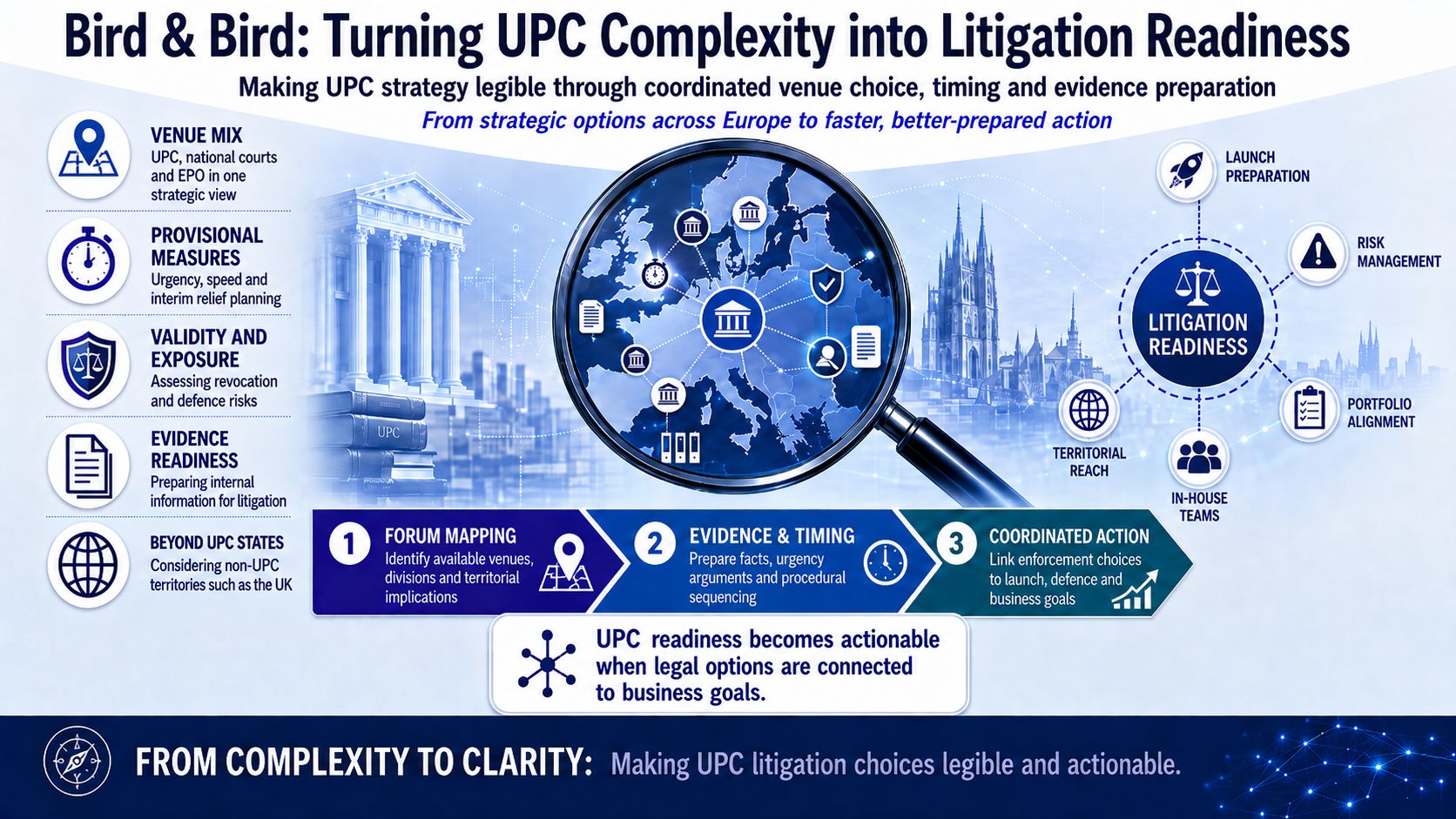
Bird & Bird’s public communication appears to be organised around the idea of pan-European litigation coordination. The firm does not present the UPC in isolation. Its communication repeatedly places the court alongside national litigation, EPO proceedings and enforcement options in countries outside the UPC system. The central question is not simply how to conduct a UPC action. It is how an international company should construct the most appropriate European litigation strategy from several available venues.
This positioning is particularly visible in Bird & Bird’s description of its UPC practice. The firm emphasises that it has specialist patent litigators across Europe, can deploy teams before different UPC divisions and understands the respective advantages and disadvantages of the UPC, national courts and the EPO. It states that these venues should be combined according to the client’s strategic needs and describes its EU and UK lawyers as one European team capable of making objective recommendations on venue and team composition.
The reader is not only shown evidence that the firm has handled UPC cases. The reader is invited to think about the wider configuration of a dispute:
- Which forum provides the most commercially useful remedy?
- Which UPC division is appropriate?
- Should proceedings be brought before the UPC, a national court or both?
- How should an EPO opposition affect the timing and structure of litigation?
- How should companies prepare for proceedings extending beyond the participating UPC states?
This logic also appears in Bird & Bird’s statistical communication. Its analyses compare the activity, speed and outcomes of different UPC divisions and translate those observations into strategic consequences for in-house teams. Division selection is presented as a genuine litigation lever. Provisional measures are connected to urgency management, internal evidence-gathering and pre-litigation freedom-to-operate analysis. Portfolio strategy, opt-out decisions and litigation readiness are treated as continuing operational responsibilities rather than isolated legal exercises.
The territorial question is particularly illustrative. Bird & Bird has publicly analysed decisions concerning the UPC’s jurisdiction over national parts of European patents in countries outside the UPC system, including the United Kingdom. Its communication translates these jurisdictional developments into potential consequences for enforcement scope, validity defences, parallel national proceedings and exposure for internationally operating businesses.
From a business-development perspective, this framing is likely to resonate with international in-house counsel, multinational litigation teams and companies preparing coordinated European market entry or enforcement campaigns.
The implicit message can be read as:
“We help you decide how the UPC fits into the complete European and international litigation architecture.”
Bird & Bird makes the UPC legible by showing how different courts, divisions, territories and proceedings can be coordinated around a company’s commercial objectives.
BARDEHLE PAGENBERG: Positioning the UPC Through Case-Led Litigation Intelligence
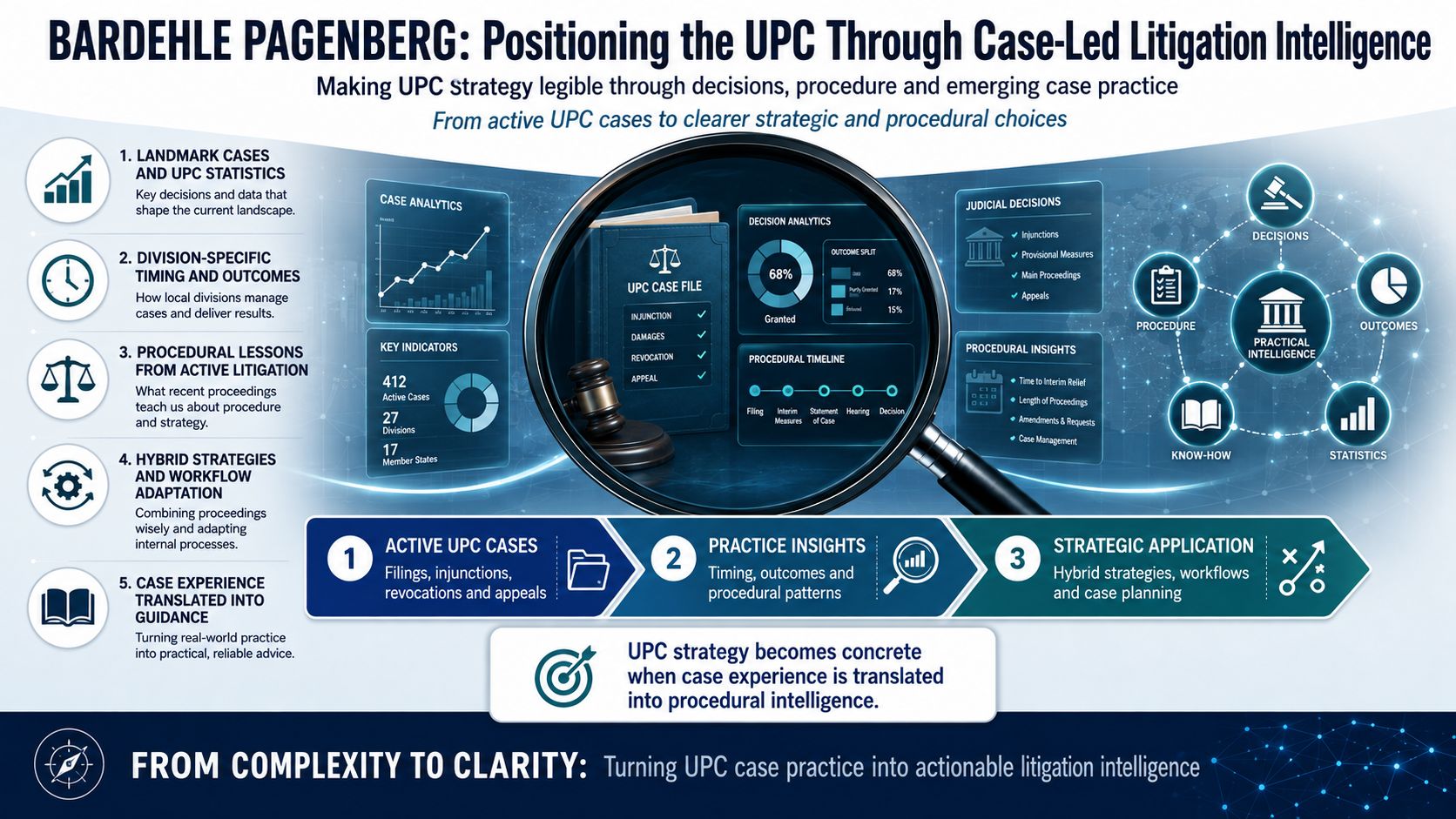
BARDEHLE PAGENBERG uses a different communication logic. Its public communication appears to lead more directly with active litigation experience, procedural developments, emerging case law and the practical lessons that can be extracted from specific UPC proceedings.
The firm’s dedicated UPC platform presents a broad body of continuously updated material, including articles, webinars, videos, brochures, statistics and analyses of recent decisions. The UPC is connected not only to patent litigation, but also to opposition and nullity proceedings, prosecution, licensing, antitrust, valuation, due diligence and trade secrets.
However, the editorial centre of gravity is frequently the court itself:
- What has a particular division decided?
- Which procedural standards are emerging?
- How quickly are different divisions acting?
- How are infringement and validity being assessed?
- Which arguments have succeeded?
- Which workflows must litigation teams adapt?
- What can parties learn from cases that have already moved through one or both UPC instances?
This approach is especially visible in the firm’s event communication. A BARDEHLE event centred on Philips v Belkin, for example, was explicitly presented as a case study delivered by active UPC litigators. The stated takeaways included an understanding of UPC schedules and case management, the optimisation of internal workflows, the combination of UPC and German national proceedings and the cross-border risks arising from the expanding reach of European jurisdiction.
Other materials examine how individual divisions handle provisional injunctions, infringement, revocation and procedural timing. BARDEHLE’s three-year UPC analysis compares outcomes across divisions, considers the interaction between UPC validity proceedings and EPO oppositions and identifies cases in which the UPC and the EPO reached different conclusions on the same patent. This performs an important positioning function. The reader is not merely told that the firm understands the UPC. The reader is shown a body of decisions, statistics, procedural firsts and litigation outcomes from which practical conclusions can be drawn.
The firm’s communication also makes extensive use of its involvement in prominent cases. It refers to first-day filings, early appellate proceedings, preliminary-injunction decisions and judgments that clarified questions of liability, remedies, validity, jurisdiction and procedural coordination. This makes experience visible through the development of the court’s own case law. BARDEHLE does not ignore the broader European litigation architecture. Its representatives expressly argue that complex cross-border disputes may require hybrid strategies combining UPC and national proceedings. The distinction is therefore not that Bird & Bird communicates strategy while BARDEHLE communicates only procedure. Both firms address both dimensions.
The difference is one of entry point and emphasis. BARDEHLE tends to lead the reader from concrete proceedings, decisions and litigation experience towards strategic conclusions. Its communication creates confidence by demonstrating proximity to the court’s developing practice.
This is likely to resonate particularly strongly with experienced patent litigators, in-house patent teams and companies already facing a defined enforcement or defence scenario. Such readers may not first need an explanation of why the UPC matters. They need to know how the court is operating, which approaches are succeeding and what must be done differently in the next case.
The implicit message can be read as:
“We know how the UPC is developing because we are actively involved in the cases shaping its practice.”
BARDEHLE makes the UPC legible by translating emerging case law and direct litigation experience into procedural and tactical intelligence.
The Connecting Element
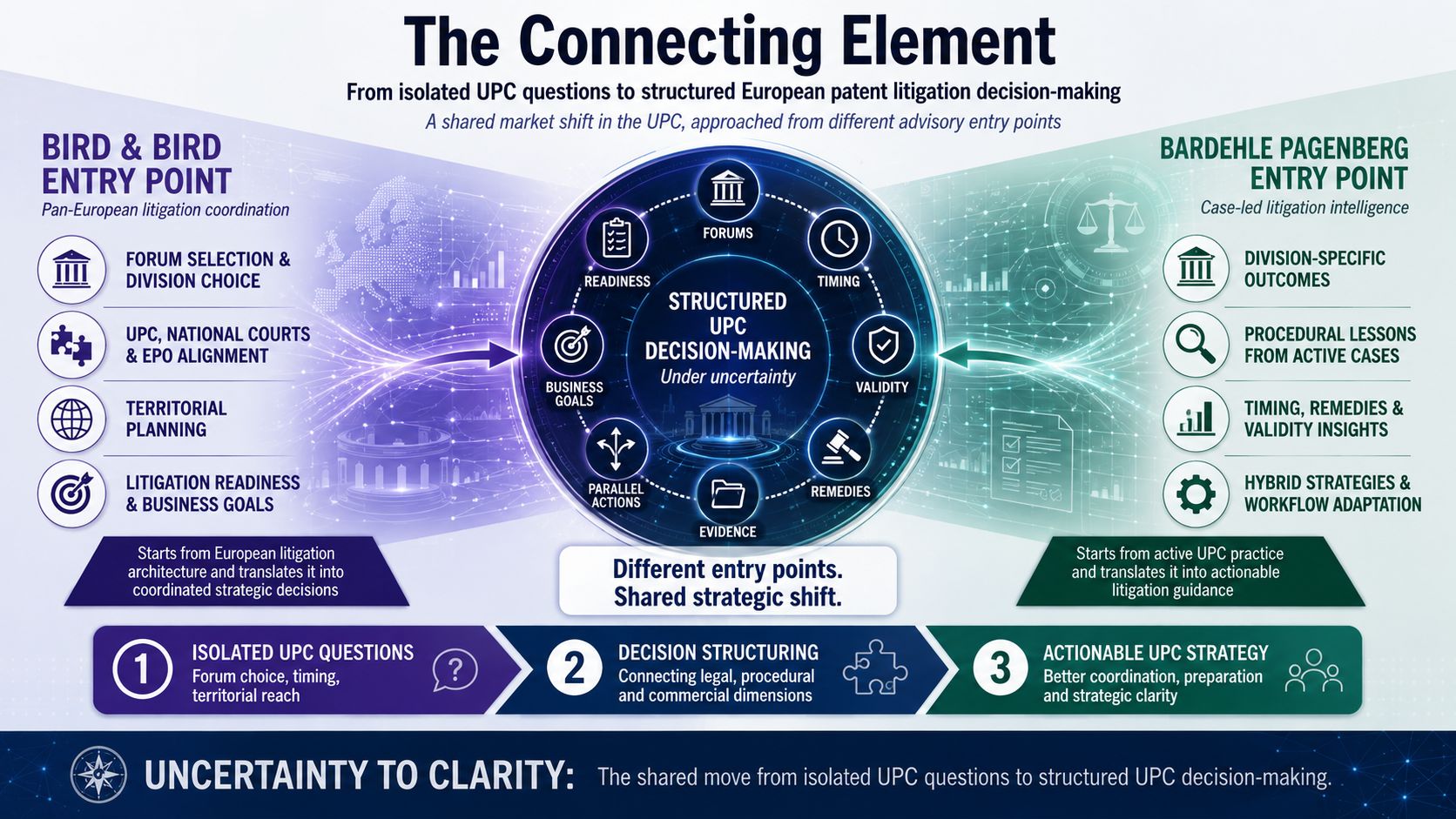
The connecting element between both approaches is the transition from UPC awareness to UPC decision-making. During the preparatory phase of the new court, much of the market communication focused on institutional fundamentals:
- What is a Unitary Patent?
- Which countries participate?
- How does the opt-out work?
- Which court will have jurisdiction?
- What are the transitional rules?
Those questions remain relevant, but they no longer define the most pressing communication need.
The UPC is now an operating litigation venue with developing case law, meaningful procedural variation, appellate guidance and commercial consequences. Companies must therefore move from understanding the system to making choices within it. They must decide where to litigate, how to prepare, when to seek provisional relief, how to respond to a rapidly filed action, how to manage parallel EPO proceedings and whether national litigation should supplement or counterbalance UPC proceedings.
Both firms address this shift. Bird & Bird structures it primarily as a problem of European and international litigation coordination. BARDEHLE structures it primarily as a problem of understanding and applying the UPC’s developing procedural and substantive practice. Both approaches reflect the same underlying market development: companies no longer need only information about the UPC. They need decision frameworks for using it.
The Difference
The central difference can be described as:
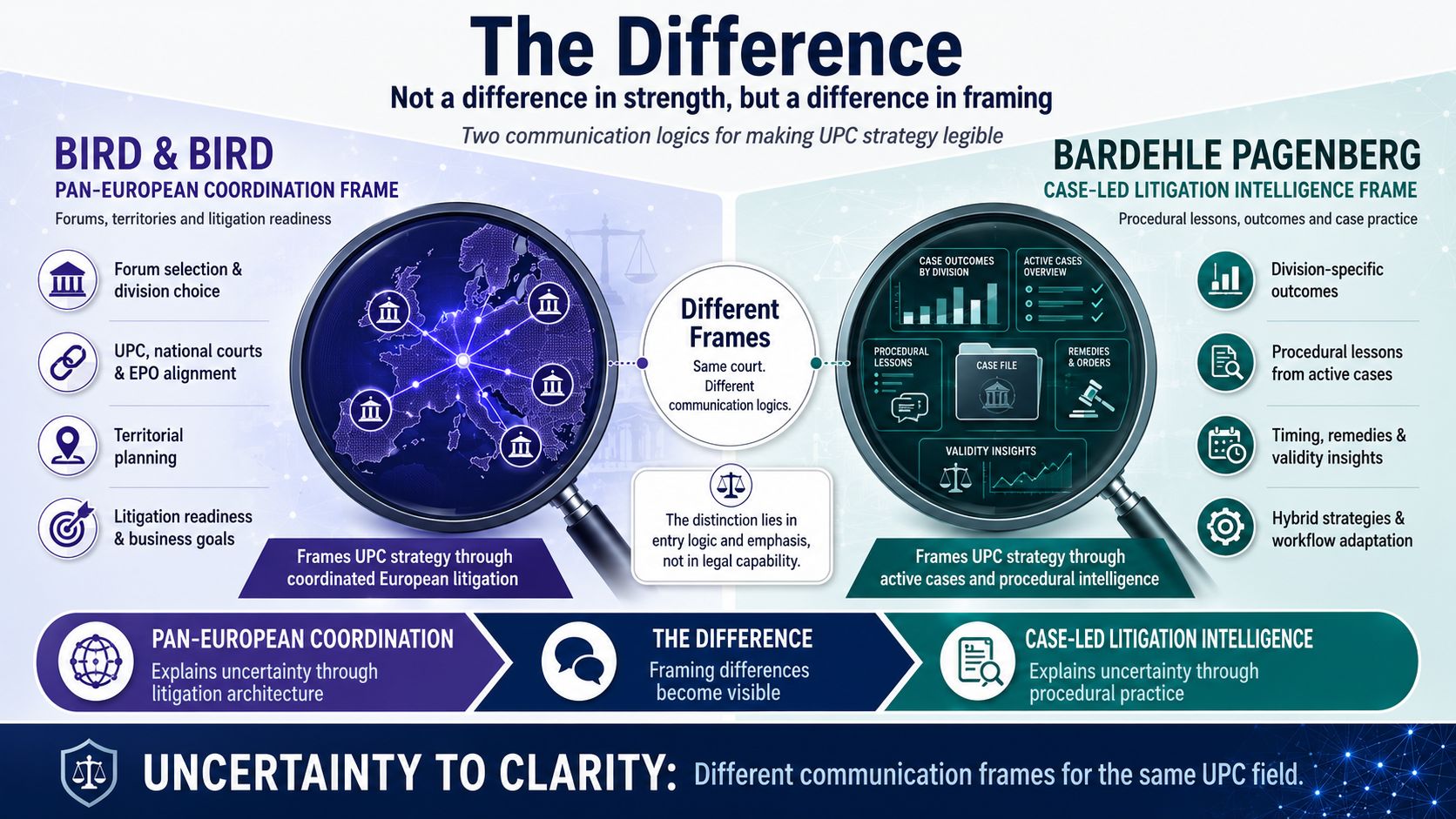
Pan-European litigation coordination versus case-led litigation intelligence.
Bird & Bird appears to lead the reader from the company’s international commercial position towards the appropriate combination of courts, divisions, territories and procedures. Its communication creates relevance by mapping the litigation architecture.
BARDEHLE appears to lead the reader from concrete UPC proceedings, decisions and statistical patterns towards practical conclusions for future cases. Its communication creates relevance by evidencing litigation experience and extracting lessons from the court’s developing practice.
Neither approach excludes the other. Bird & Bird also communicates detailed case law, statistics and direct UPC experience. BARDEHLE also discusses international strategies, hybrid litigation and the interaction between different venues. The distinction lies in emphasis, sequence and editorial centre of gravity. Bird & Bird foregrounds the orchestration of European litigation options. BARDEHLE foregrounds the practical intelligence generated by active UPC proceedings.
What IP Practice Groups Can Learn from This
The first lesson is that “UPC expertise” is not yet a distinctive positioning. Many patent litigation practices can legitimately state that they represent clients before the new court. Differentiation begins only when the communication explains which UPC-related uncertainty the practice helps clients resolve.
That organising lens could be:
- international forum coordination;
- provisional-measures readiness;
- UPC and EPO validity strategy;
- division-specific litigation intelligence;
- standard-essential patent litigation;
- life-sciences enforcement;
- evidence preservation;
- portfolio preparation;
- national and UPC hybrid proceedings;
- territorial expansion beyond UPC Member States.
The second lesson is that experience must be made interpretable. Numbers of cases and references to landmark proceedings are strong trust signals, but they become more useful when connected to decisions. Potential clients need to understand what that experience enables the firm to see or do differently.
The third lesson is that litigation communication should begin before litigation. Bird & Bird’s focus on launch preparation, forum selection, freedom-to-operate work and internal readiness shows how litigation practice can become relevant before a complaint is filed. BARDEHLE’s analyses of schedules, evidentiary expectations and procedural outcomes similarly help companies prepare workflows before they become parties to proceedings.
The fourth lesson is that different target groups require different entry points. International general counsels may respond strongly to a coordinated pan-European strategy. An experienced patent litigation team may respond more directly to division-specific results, procedural precedents and practical case lessons. A company facing a major product launch may need both perspectives. Visible UPC expertise emerges when communication shows not merely that the firm appears before the court, but how it helps clients make better decisions because of that experience.
Why This Matters for IP Business Development
The UPC has created a new market for strategic orientation. A company may not begin by searching for “UPC counsel”. It may begin with a more specific concern:
- A product launch could trigger an application for provisional measures.
- A competitor may be preparing a central revocation action.
- An EPO opposition is pending while enforcement is being considered.
- Several UPC divisions are available.
- Parallel national proceedings could create additional leverage.
- A European patent also covers the United Kingdom or another country outside the UPC system.
- A first-instance UPC decision could create immediate commercial pressure before an appeal is decided.
The practice group that structures these problems becomes relevant before a formal mandate. That is the business-development value of strong subject-matter communication. It reduces the client’s cognitive burden. It turns a complex procedural landscape into recognisable decisions and demonstrates how the adviser thinks before the client has instructed the adviser to act. Bird & Bird and BARDEHLE PAGENBERG provide two credible examples. One makes the UPC understandable as part of a coordinated European litigation architecture. The other makes it understandable through the cases, decisions and procedural patterns that are actively shaping the new court.
The central marketing question is therefore no longer:
“Can we litigate before the UPC?”
The more demanding question is:
“Which part of the new UPC decision environment do we help the market understand better than others?”
Sources Used
Bird & Bird
- Bird & Bird, “The UPC turns two!”, 16 Jun 2025. Overview of Bird & Bird’s involvement in UPC proceedings, its pan-European team structure and its approach to coordinating UPC, national and EPO proceedings.
- Bird & Bird, “Three Years of the UPC: Lessons learnt and what this means for corporate counsel and your IP strategy”, 29 June 2026. Analysis of UPC outcomes, division selection, provisional measures, litigation readiness and the implications for corporate patent strategy.
- Bird & Bird, “The UPC in Numbers: 32 Months of Action”, 17 February 2026. Statistical analysis of UPC filings, divisions, provisional measures, appeals and Bird & Bird’s involvement in proceedings.
- Bird & Bird, “UPC establishes jurisdiction over UK patent rights in landmark decision”, 29 July 2025. Discussion of the UPC’s jurisdiction concerning the UK parts of European patents and the consequences for cross-border enforcement and defence strategies.
BARDEHLE PAGENBERG
- BARDEHLE PAGENBERG, “The Unified Patent Court and the Unitary Patent”. The firm’s central UPC platform, bringing together articles, decisions, statistics, webinars, videos and guidance on enforcement, defence and portfolio strategy.
- BARDEHLE PAGENBERG, “UPC turns three: statistics, milestones, and trends”, 1 June 2026. Review of significant UPC decisions, procedural developments, filing patterns and emerging differences between divisions.
- BARDEHLE PAGENBERG, “How to win at the UPC – Lessons learned from the Court of Appeal decision Philips vs Belkin (and other cases)”, 19 February 2026. Case-led discussion of UPC schedules, case management, internal litigation workflows, national parallel proceedings and cross-border risks.
- BARDEHLE PAGENBERG, “The UPC’s role in global patent litigation”, 6 June 2025. Examination of the strategic use of the UPC by claimants and defendants within cross-jurisdictional patent litigation campaigns.
- BARDEHLE PAGENBERG, “Managing IP Awards interview: Prof. Dr. Tilman Müller-Stoy and Dr. Tilman Müller”, June 2026. Discussion of the firm’s UPC track record, prominent proceedings and its approach to hybrid strategies combining UPC and national patent litigation.
dIPlex Sources
- dIPlex, “Unitary Patent and Unified Patent Court as a Strategic IP Management Challenge”, 2026. Deep Dive on how the UPC connects central enforcement and revocation with portfolio exposure, litigation readiness, product launches, market entry and broader business decision-making.
- dIPlex, “IP Market Report: Unified Patent Court (UPC)”, 2026. Market analysis of the topics, experts, client needs and advisory opportunities emerging around the UPC, including cross-border litigation coordination, portfolio strategy, opt-out decisions and enforcement readiness.
- dIPlex, “The Emerging Strategy Gap in the UPC Market”, 2026. Analysis of the gap between the predominantly procedural presentation of UPC expertise and companies’ growing need for integrated strategic, organisational and business-oriented guidance.
- dIPlex, “The UPC as a Structural Shift in European IP Management”, 2026. Discussion of the UPC as a long-term structural development affecting territorial coverage, enforcement options, costs, portfolio architecture and corporate risk exposure.
- dIPlex, “What This Means for IP Experts”, 2026. Examination of how UPC advisers can move beyond procedural execution by providing decision frameworks, translating legal developments into business implications and supporting cross-functional coordination.
- dIPlex, “Recent Contributions to the Evolution of the UPC Discourse”, 2026. Curated overview of practitioners shaping the current UPC discussion, including Chris de Mauny on cross-border jurisdiction and Tilman Müller-Stoy on the distribution of cases among UPC divisions.